SpaceX Is Giving Me Flashbacks to Tesla in 2018
Listen to the audio version of this article (generated by AI).
Michael’s note: Back in 2018, Wall Street had plenty of reasons to doubt Tesla.
The company was burning cash and missing production targets. A lot of smart people were convinced Elon Musk was in over his head.
Andy Swan and his brother Landon, who run TradeSmith’s MegaTrends advisory, saw something different. Their consumer data showed demand for Tesla’s cars taking off… long before the financial statements caught up. So they turned bullish. Tesla shares have climbed more than 17-fold since.
That’s the edge the Swan brothers bring to TradeSmith. Their Social Heat Score software tracks millions of social media posts, search trends, and web traffic patterns to measure what real people are buying, using, and talking about – before Wall Street notices.
A few days ago, Andy recorded a video bulletin for his MegaTrends subscribers on a company he believes could follow a similar path – SpaceX.
The stock is expensive. It’s volatile. And Wall Street can’t stop worrying about how much it’s spending. But Andy’s data, and his own living room, tell a very different story.
I’ve asked Andy to share his take with you today. You’ll find it below, along with a link to the full video.
I’ve been following technology trends since the early days of the internet.
And I can tell you, I haven’t been this excited about a new frontier in a long time.
On Sept. 28, SpaceX (SPCX) sent its massive Starship rocket into orbit for the first time. It hit 17,500 miles per hour and deployed 26 next-generation satellites for Starlink, its space-based internet service.
It’s an incredible feat of engineering. And it brings Elon Musk one step closer to an ambitious goal…
Providing internet access to billions of people around the world – and eventually putting AI data centers into orbit.
It was a long time coming. On Sept. 28, 2008, SpaceX put its first rocket into orbit. That rocket, Falcon 1, was tiny by today’s standards, and it took four tries to get there.
Starship reached orbit 18 years later.
It wasn’t perfect. One engine shut down on the way up, and mission control briefly called off the push to orbit. Minutes later, engineers confirmed Starship could still make the burn… and it did.
Once in orbit, Starship released 26 of Starlink’s new V3 satellites – its first real payload after 13 suborbital test flights.
Each V3 satellite is built to handle more than 10 times the internet traffic of the generation before it. And a fully loaded Starship is designed to carry 60 of them, adding about 20 times the network capacity of a typical Falcon 9 launch.
As a Starlink customer, that’s what excites me most. Every time one of these rockets goes up, my internet gets better – the same way a Tesla improves through over-the-air software updates.
Of course, building rockets and launching satellites costs a fortune. And Wall Street has serious doubts about how long it will take those investments to pay off.
But our consumer data gives us a different view of the opportunity.
Where Main Street and Wall Street Diverge
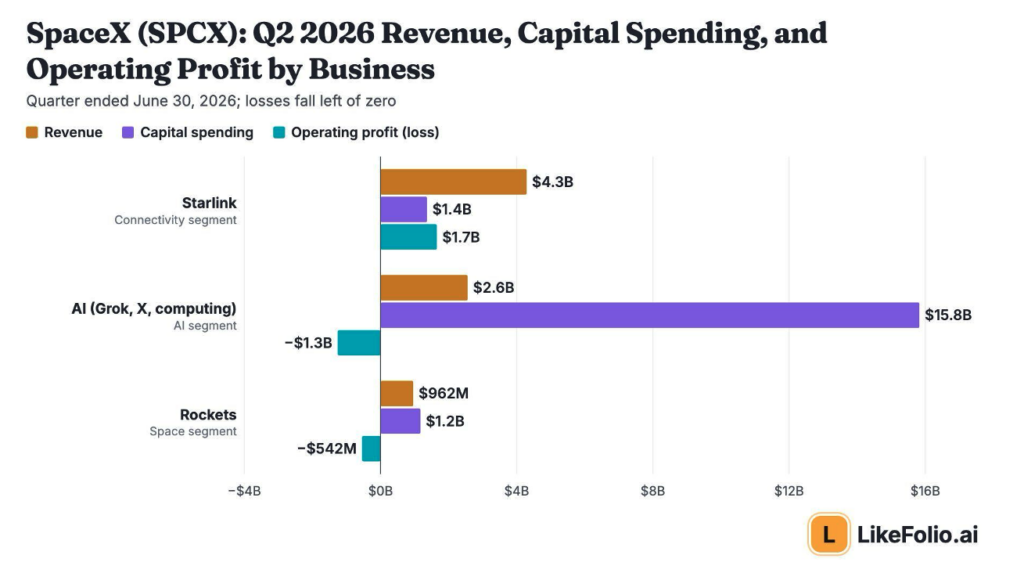
In its first earnings report as a public company, SpaceX said capital spending hit $18.4 billion in the second quarter – more than six times what it spent a year earlier, and more than double the quarter’s $7.8 billion in revenue. AI alone accounted for $15.8 billion of that capex.
Earlier this month, reports surfaced that SpaceX is looking to raise $40 billion, mostly through debt, to buy more chips from Nvidia (NVDA).
Investors are rightly concerned about all that spending and how it will pay off. SpaceX stock is expensive and volatile, and it could stay that way for years. If you’re buying because you think it’s mispriced for the next six months, you’re in it for the wrong reasons.
But our consumer data gives us reason to believe those investments will pay off.
We can measure what real people on Main Street are doing in real time, through social posts, through web traffic patterns, app usage, downloads, and more.
All that intel reveals that right now, people love Starlink.
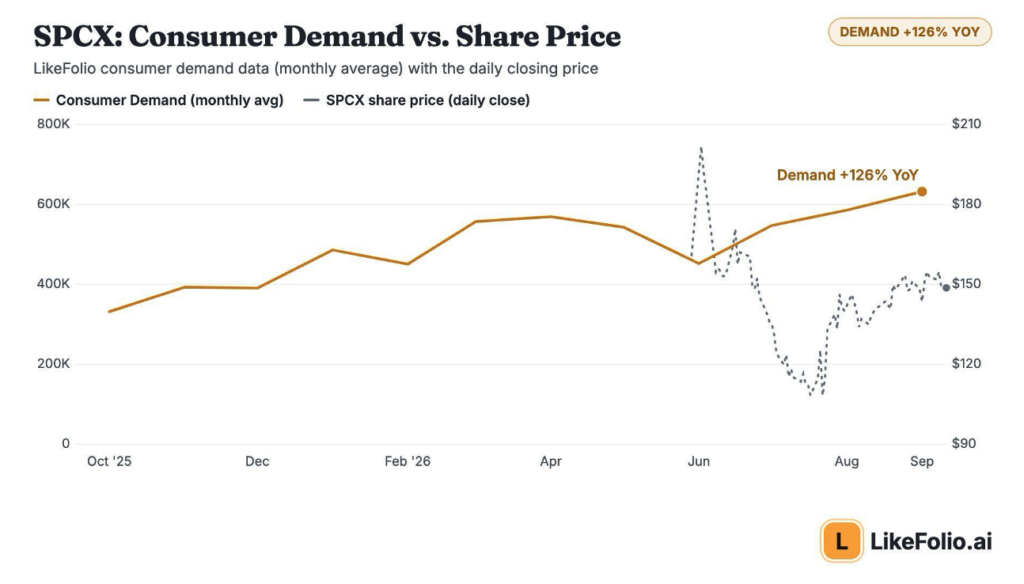
Consumer demand for SpaceX products, including Starlink, is currently running 126% higher than last year’s levels.
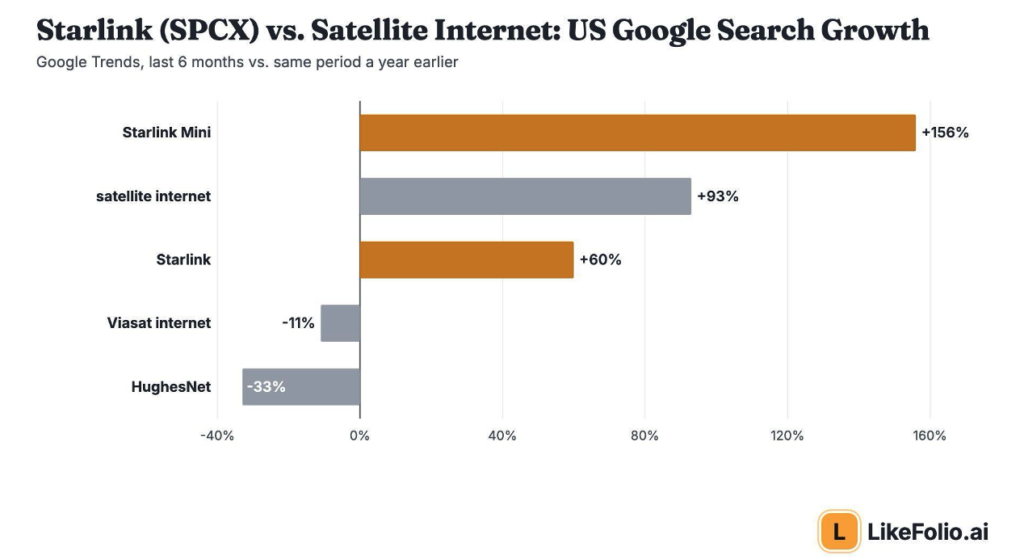
Searches for the Starlink Mini, a laptop-size dish people take on the road, are up 156% from a year ago. Searches for satellite internet are up 93%, and Starlink searches overall are up 60%. Meanwhile, searches for the older satellite providers are shrinking.
I can tell you why. I’ve been running Starlink at home alongside my traditional internet service, with some TVs and devices on each network.
It’s been flawless – even in bad weather. Multiple TVs, streaming video, AI applications… no problems at all.
Online, people who say they’ve switched to Starlink outnumber people who say they’ve canceled it 8 to 1. The most common reason switchers give? Outages and slow speeds from their cable or phone company.
One customer in rural British Columbia said the technician who came to collect his old equipment told him it was his third stop that day… and all three households were moving to Starlink.
That word of mouth is showing up in the numbers. Starlink ended the second quarter with 12 million customers, double the year before. Its revenue rose 66% to $4.3 billion, and its operating profit jumped 79% to $1.7 billion.
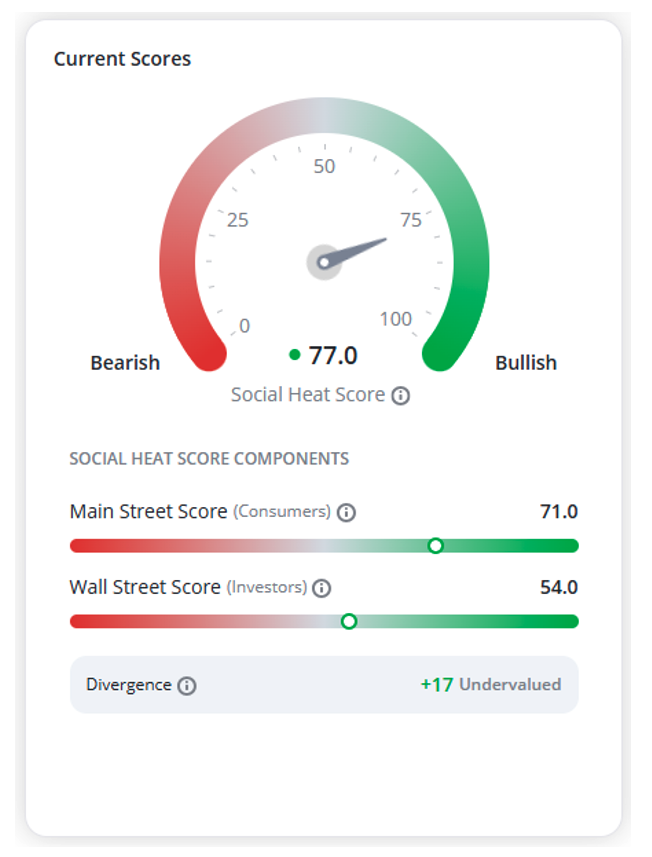
Our Social Heat Score, which combines real-time consumer demand data with Wall Street sentiment, currently gives SpaceX a bullish 77 out of 100.
Its Main Street Score sits at 71, compared with a Wall Street Score of 54.
That gap tells us consumers are more enthusiastic about SpaceX than investors are – exactly the kind of disconnect we like to find.
Starlink is SpaceX’s only profitable business right now. And its growing profits give Musk a valuable source of cash as he pours billions into AI.
The Bigger Bet: AI in Orbit
SpaceX’s AI business started as xAI, Musk’s AI lab. xAI built massive data centers in Memphis to train its own models. Now SpaceX rents that computing power to other AI firms.
Anthropic agreed to pay SpaceX $1.25 billion a month through May 2029. And Google parent Alphabet (GOOGL) agreed to pay $920 million from now through June 2029.
SpaceX’s AI revenue grew 247% in the second quarter, to $2.6 billion – faster than any other part of the business.
And the real master plan is even bigger. In January, SpaceX asked federal regulators for permission to launch up to 1 million satellites that work as data centers in orbit as part of the project dubbed Starmind. SpaceX is working with Nvidia on the hardware, plans to start testing prototypes in early 2027, and is building a factory called Gigasat in Bastrop, Texas, to mass-produce them.
Musk told investors in August he thinks SpaceX can bring in $1 trillion a year by 2030. Over the past 12 months, it brought in about $23 billion.
That sounds crazy. But that’s exactly how people talked about Tesla.
Why I Don’t Bet Against Musk
Musk gets knocked for missing his targets. But he usually misses on timing, not substance.
When we first got bullish on Tesla in 2018, tons of people on my Twitter feed, even some of our own subscribers, told me it was crazy. The company had too much debt. It was spending too much money building out its cars.
A few years later, Tesla’s Model Y was the best-selling car in the world. Not the best-selling electric car – the best-selling car, period.
I’m not saying SpaceX is a sure thing. It’s an expensive, volatile stock, and there will be massive drawdowns along the way. But right now, the data tells us Wall Street may be underestimating the opportunity. And that’s when we get bullish.
In fact, I have a bold prediction about what could happen with SpaceX and Tesla over the next 15 months. I share it in this Video Bulletin, along with exactly how I’d approach buying a stock this volatile.
Watch the video here.
I think we’re still in the very early days of this story. And from everything we’re seeing, I believe SpaceX could become one of the most important companies of the next decade.
Until next time,

Andy Swan
Cofounder, MegaTrends