Tesla’s New Robotics Rival Is Good News for This Commodity Stock
Listen to the audio version of this article (generated by AI).
In This Digest:
- OpenAI reignited the robot race – why we’re watching this key supplier
- Why the next four weeks are the best time all year to own tech stocks
- 166 quality stocks breaking out all have one thing in common
AI is going physical…
On Sunday, May 31 – with the market fresh off record highs and most investors looking ahead to the SpaceX IPO – OpenAI boss Sam Altman announced that OpenAI Robotics is hiring.
OpenAI shut down its original robotics team back in 2021, presumably to focus on building the landmark AI chatbot, ChatGPT.
But now it’s rebuilding the division from the ground up, with Altman writing that “AI should be able to help people in the physical world.”
OpenAI’s near-term focus, Altman says, is specifically on robots to support skilled workers building AI infrastructure – data centers, power grids, and factories.
The long-term vision, Altman added, is “everyone having a personal robot doing anything they need.”
So, the company behind ChatGPT just entered the robot race…
The same race Elon Musk has staked the future of Tesla on.
The headlines will spend the next year arguing over who builds the better robot. For us as investors, that’s the wrong question.
The right question is who supplies the parts every robot needs, no matter whose logo ends up on it.
Every robot is packed with electric motors – one for each joint and moving part. And nearly every one of those motors runs on the same thing: powerful magnets made from rare-earth metals.
These aren’t ordinary magnets. Rare-earth magnets are the strongest in the world, and compact enough to fit inside the tightest mechanical assembly. Without them, the robot can’t move… and the physical AI revolution Altman and Musk want is dead on arrival.
That points straight to the leading American rare-earth stock…
MP Materials (MP) owns the Mountain Pass mine in California. It’s the only large-scale rare-earth mining operation in the U.S. And the company is building out magnet manufacturing to go with it.
Robotics is a huge part of the story… But MP Materials’ magnets power not just the kind of robots Altman and Musk are building, but also electric vehicles, defense systems, and MRI machines.
Andy and Landon Swan – editors of our MegaTrends advisory – flagged MP last week in an update to their subscribers.
Andy and Landon’s major focus in MegaTrends is social sentiment. Their Social Heat Score combs social media to spot the products, brands, and companies gaining momentum on Main Street before it becomes news on Wall Street. The higher the score, the hotter the trend.
They also monitor other key indicators – like web traffic and search volume – to get a read on stocks outside the consumer sphere.
Today, some of America’s top hedge funds pay as much as $750,000 a year for access to this research.
And right now, MP Materials is lighting up their screens.
Traffic to the company’s website is up 45% over the past year, a sign of interest building again after the company made headlines last year.
The Swans don’t rate MP with a formal Social Heat Score – though it is in the works – so for now they’re treating it as a watchlist stock, not a buy for their subscribers.
But it’s interesting to note that we’re also getting bullish signals on this stock from our Short-Term Health Indicator.
Short-Term Health compares a stock’s recent price moves against its own typical trading range to see whether it’s in a healthy uptrend (Green Zone), an unhealthy downtrend (Red Zone), or a potential transition between the two (Yellow Zone).
And unlike our classic Long-Term Health Indicator, it’s built for moves that play out over months, not years.
MP entered a Short-Term Health Green Zone on June 16, 2025 ahead of the run that carried the stock from the low $30s to a high near $95 last year. You might remember that run being propelled in part by the federal government buying a 15% stake in the company.
It then entered a Red Zone on Nov. 24, 2025, at a price of $61.95. Since then, it’s been trading sideways.
But on April 30, it entered a new Green Zone…
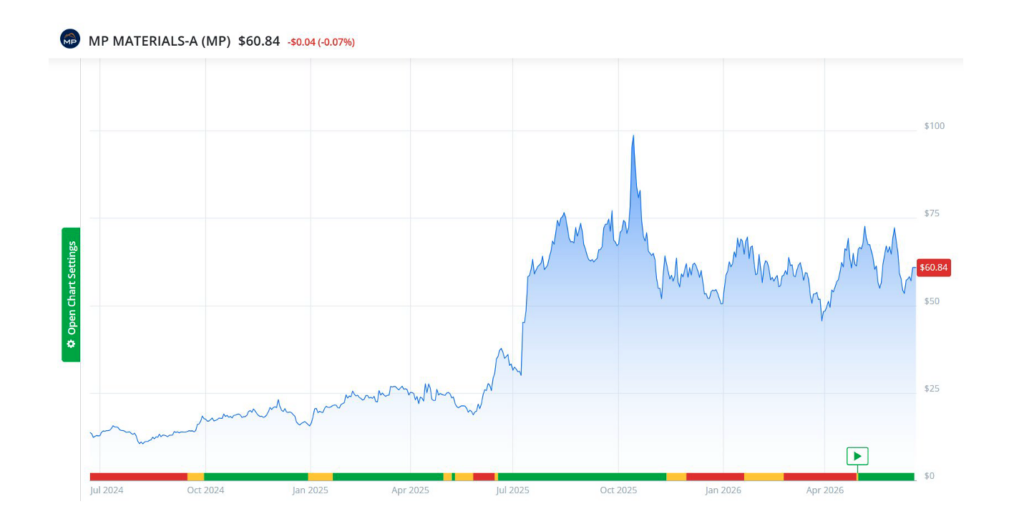
The stock hasn’t entered a new bull run – yet. But with Andy and Landon’s website analytics moving in the right direction and the stock entering a new Short-Term Health Green Zone, we have two pieces of evidence that MP could soon break out of its range.
The Nasdaq 100 hasn’t fallen during this four-week window in 15 years…
You’ve probably heard the Wall Street saying: “Sell in May and go away.” The thinking is that stocks drift through the summer as traders head to the Hamptons, so you’re better off on the sidelines until fall.
The problem with that line is it dates back to the 1800s. A lot has changed in the world and the market since then, and the idea that you should always sell stocks in the summer doesn’t necessarily hold true anymore.
In fact, there’s a four-week stretch each summer – from June 24 to July 24 – when the tech-packed Nasdaq 100 has been positive in every one of the last 15 years.
I found it with TradeSmith’s Seasonality tool, which scans years of history to find calendar windows when a stock or index has tended to rise or fall.
When one of those windows lines up with a confirming technical signal, we call it Seasonal Synergy – a higher-conviction version of the same idea.
Here’s what our Seasonality tool sees ahead for the Nasdaq 100, which you can track using Invesco QQQ ETF (QQQ).
Over the past 15 years, the June 24-July 24 window has finished higher every single year – a 100% hit rate. The average gain across those four weeks is 4.2%.
And our system shows this window has historically worked best when QQQ goes into it with its Relative Strength Index below 58.
RSI is a standard momentum gauge that runs from 0 to 100 – a lower reading means the index isn’t overheated and has more room to climb.
As of the latest reading, QQQ’s RSI sits right above 58 – confirming the Seasonal Synergy flag.
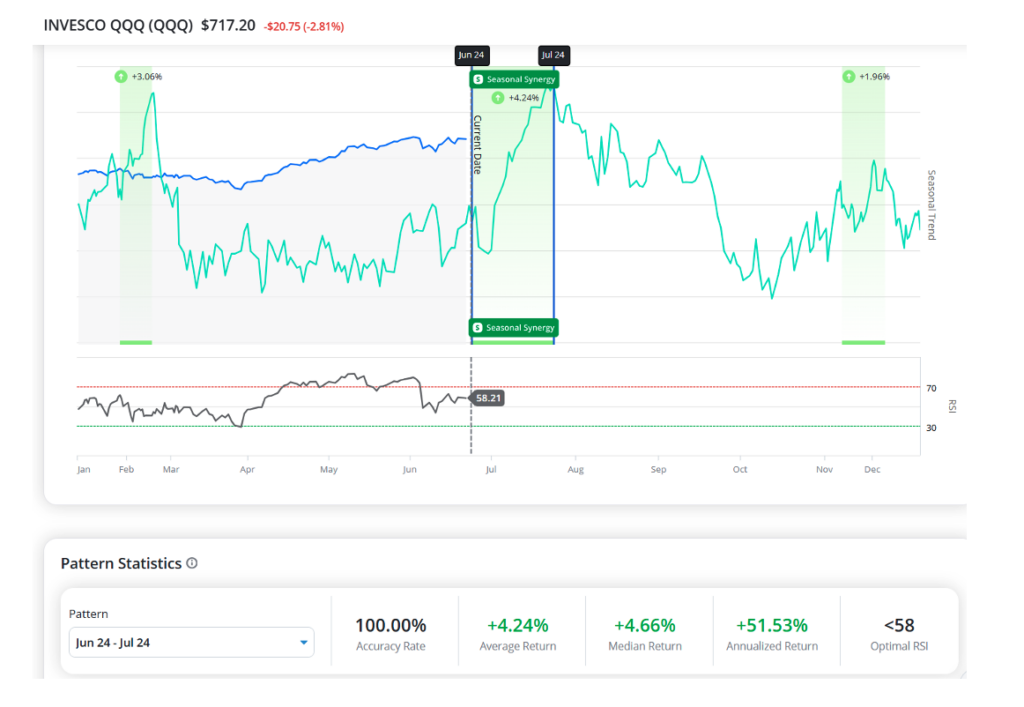
QQQ is still off 1% from its all-time high, and a seasonal surge like we’ve seen in the past would put it well above new highs by about this time next month.
That could indicate today’s selloff is a good opportunity to buy the dip.
These 166 stocks have one key thing in common…
Every morning, I run a screen for stocks with two key factors:
- Strong balance sheet numbers judged according to our Quantum Score system, which, in addition to detecting money flows, ranks companies on their earnings, revenues, profit margins, and other fundamental factors.
- Trading at a 1-month high – a simple measure of bullish momentum.
This morning, 182 stocks cleared the screen.
And more than 90% of them – 166 in total – are in the physical, industrial economy: chips and chipmaking machines, power equipment, building materials, and machinery.
By contrast, only 16 were software or digital-first businesses.
This confirms the fact that the money being made right now – even in the broader tech volatility – is still in real-world industrials and hardware.
And one hardware stock scored higher than every other…
It’s a company called Credo Technology (CRDO).
Credo builds a technology called Active Electrical Cables that are essential in modern AI datacenters. They’re essentially a more durable and cheaper data transfer cable than traditional fiber optics, using a combination of copper wiring with signal-boosting chips on either end.
Last quarter, its revenue more than tripled from the year before, and its customers include Amazon and Microsoft.
This is the physical-AI trade in a single stock – not the software running on top, but the hardware that lets the software exist at all.
Our system sees the same thing. Pull up Credo’s Quantum Score and it reads 96.9 out of 100 – nearly as high as this system goes.
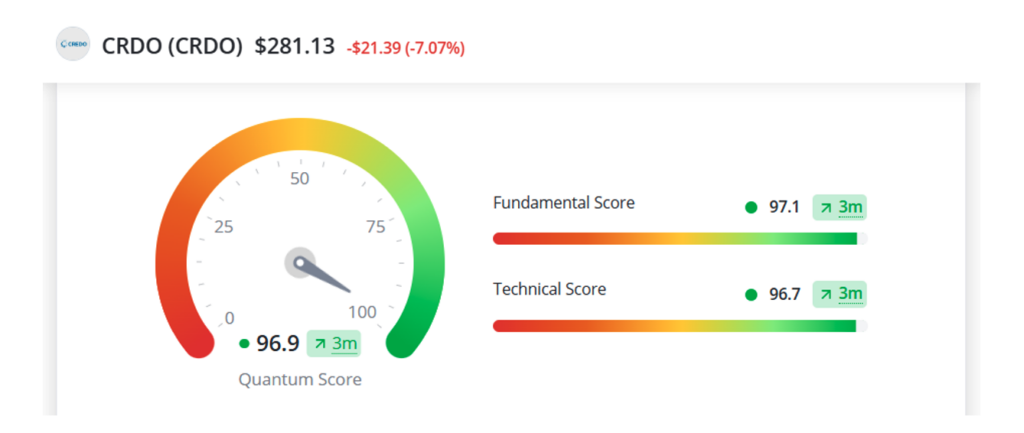
Remember, the Quantum Score blends two halves: a Fundamental Score for the strength of the business – earnings, revenue, and margins – and a Technical Score for price action and the flow of big institutional money.
Credo scores 97.1 on the fundamental side and 96.7 on the technical side. Anything above 75 is a buy signal. Credo is pinned near the ceiling on both.
And credit where it’s due: Andy and Landon Swan added Credo to their MegaTrends portfolio on Oct. 28 – and it’s up more than 91% since.
So this isn’t one to file away and check on later. The breakout screen, the Quantum Score, and the Swans’ own portfolio are all pointing at the same place: the unglamorous hardware powering the entire AI build.
If you’re a paid-up subscriber, pull Credo up on TradeSmith Finance and see its full Quantum Score profile for yourself.
To building wealth beyond measure,

Michael Salvatore
Editor, TradeSmith Daily