The 6 Risk Rules That Keep You in the Game
Listen to the audio version of this article (generated by AI).
Picture the worst version of next quarter.
Not a crash – just a grind. Down a little Monday, down more Wednesday, a brief bounce that sucks you back in, then lower again. Weeks of it. The financial media has a name for it by now. One headline says buy the dip. The next says the worst is still ahead. Everyone you follow has an opinion about how much further it goes.
What do you do?
If you’re answering that question for the first time in the moment, you’ve already lost the advantage. Fear has a way of taking over. It talks you out of good positions at the exact wrong time and talks you into selling right before the rebound.
I’d rather have the answer written down before the moment arrives.
The setup for all of this is a market that’s climbed a long way. The S&P 500 has run hard, and I’m not calling it over – there are good reasons it’s here. But runs end. Sometimes with a cliff, more often with a series of drops on the way up that look terrifying in real time and forgettable a year later. This one could keep climbing 30%, 40%, even 50% and still cough up 20% somewhere along the line.
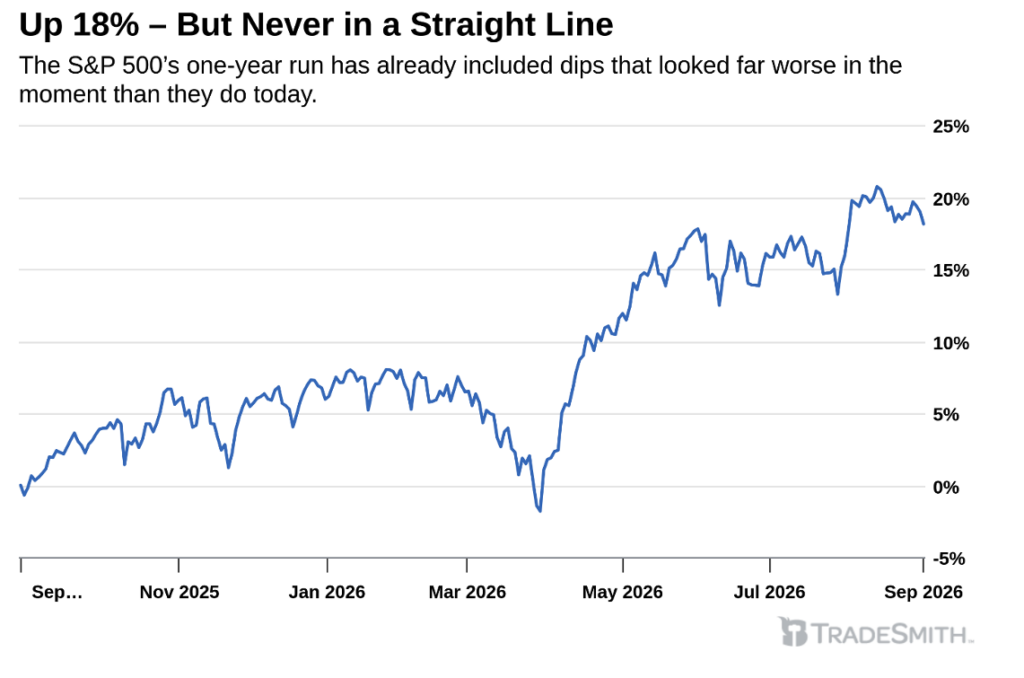
Your job isn’t to predict which drop is which. It’s to make sure the next one is a footnote for your account, not a turning point.
Here are the six rules I keep handy to make sure it stays one.
1. Check your real exposure.
Owning a lot of stocks doesn’t make you diversified. If you hold five positions and they’re all riding the same megatrend, then you basically have one position.
AI is a good example. You could own a chipmaker, a data-center stock, and a memory company and feel like you’ve spread your money around. But all three are still tied to AI.
They’re going to move together – not perfectly, but if a broad sell-off hits that trend, it hits all of them.
The easy way to check your real exposure: watch how your holdings move day to day. If they always move as one, you’re not as spread out as you think. Add another trend or two and position accordingly.
2. Do the 30% test.
Pick a position – or an entire trend – and ask a simple question: What happens if this drops 30%?
Do the actual math. What would that do to your account? Would you be able to handle the loss without smashing the sell button? And would you be smashing it right before it runs back higher – flushing out the nervous sellers so the committed holders can ride?
Run that math now, while everything’s green. It’s a much better time to find out you’re taking more risk than you can handle.
3. Set your guardrails while you’re calm.
This is where TradeSmith’s Volatility Quotient (VQ) and trailing stops earn their keep.
The VQ measures how much a stock normally moves based on its own price history. A 10% drop could be a major warning sign for one stock and perfectly normal for another.
Fit a stop to each of your stocks and decide ahead of time how much room you’re willing to give a position. Then make sure that level of risk fits you, too.
Everyone’s at a different stage. Someone younger with a longer runway can carry more risk than someone closer to retirement. There’s no single right answer – but there is a right time to decide, and it’s before the emotions show up.
4. Keep cash available.
Cash flips a scary sell-off into a shopping list – and lets you take the other side from the folks who are panic-selling.
Instead of wondering what you need to sell, you can start looking for bargains. Where has the selling gone too far? Which stocks would you love to own at a lower price?
Set aside some cash while things are good so you have something to work with when they aren’t.
5. Be very careful with margin.
Margin is money you borrow from your broker to buy more stock. It gives you more buying power – and it also magnifies your losses when stocks fall.
If your account drops far enough, your broker can require you to add cash or sell investments.
That’s where margin gets dangerous. A stock you planned to hold through a rough stretch can suddenly become a stock you’re forced to sell – potentially near the bottom.
The best rule here is to stay away from margin altogether. But if you do use it, run the 30% test and know exactly what a big drop would do to your account before it happens.6. Don’t chase the market higher.
Don’t get sucked into what I call “greedy math.”
You start calculating how much more you could have made if you’d put every dollar into the market.
Soon, the cash you deliberately kept on the sidelines starts looking like a mistake. You put some of it to work. Stocks keep climbing, so you put in a little more.
That trap only ends one way – with you overexposed and stressed right before the drop. (Worth remembering, too, that the market has a history of softening after August in midterm years. It doesn’t guarantee anything this time, but it’s one more reason not to chase.)
Stick with the plan you made before the market started messing with your head. Keep the cash you decided to keep, and don’t take on more risk just because stocks keep going up.
Bottom Line: Build a Portfolio That Can Take the Hit
The strongest setup I know looks like this: Own truly different trends. Keep plenty of cash on the sidelines. Stay away from margin. And have your stops set – or be prepared to sit tight when things get ugly.
Do that, and your goal is to look back on the next sell-off the same way we look at so many past drops today – as a blip on the chart.
One of the best things you can do in the market is nothing. I heard it put this way once: Your portfolio is like a bar of soap. The more you handle it, the smaller it gets.
So assume the sell-off is coming. Be optimistic that the market runs even higher afterward. And position yourself so you survive either way.
Stay safe and be smart,

Landon Swan
Founder, LikeFolio