The Bull Run in Healthcare Is About to Start Its Second Wave
Listen to the audio version of this article (generated by AI).
In This Digest:
- This seasonal election pattern points to more gains in healthcare stocks
- Our Predictive Alpha top bullish list is full of longevity and biotech names
- TradeSmith CEO Keith Kaplan asks: Is the bull market in space stocks over?
The strength in healthcare stocks has been hard to ignore, and more could be coming…
Over the past two months, the Invesco QQQ Trust (QQQ) – a proxy for the tech-focused Nasdaq-100 index and one of the most-traded ETFs in the market – has taken a long and strange trip to nowhere.
Take a look…
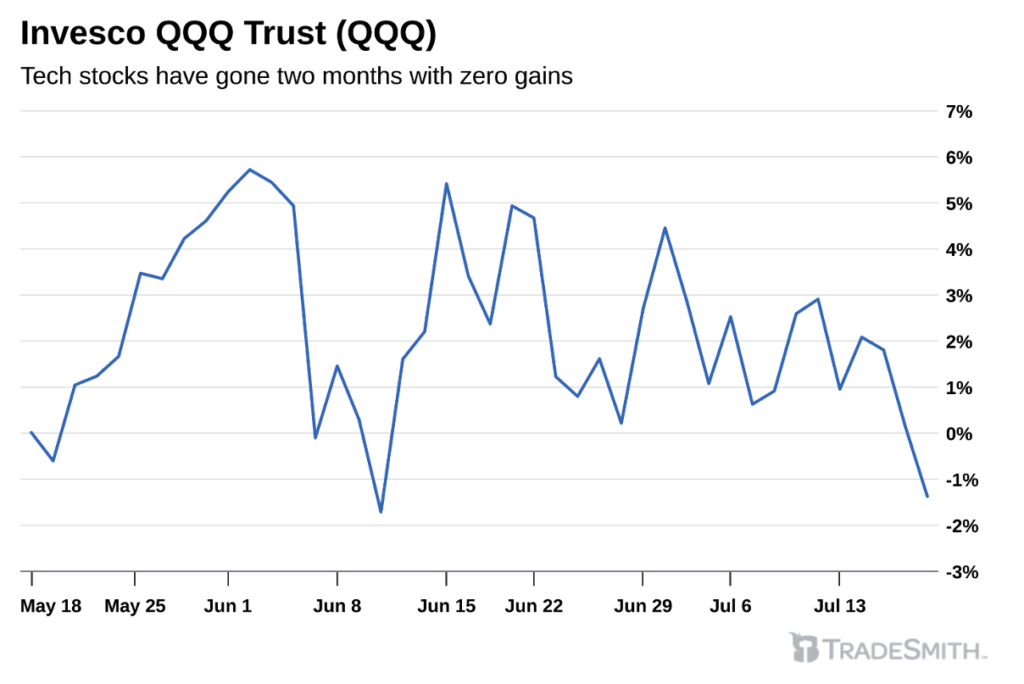
The Nasdaq-100 is still up 14.4% this year – nothing to sneeze at. But the last two months have been frustrating if you’re a buy-and-hold investor.
If you’re a more active investor who follows the major themes we cover – including the intersection of healthcare and AI – it’s a different story.
On Feb. 19, we put the AI Biotech theme on your radar, writing first about the problem of traditional drug discovery:
Before AI, drug development pipelines routinely took as long as 10 to 15 years from start to finish… and cost upward of $2 billion.
That’s because drug discovery involves testing compounds over and over again in countless slightly different combinations and dosages until you get the result you need.
AI promised to make that process much more efficient, and companies were already starting to make strides:
This isn’t just theoretical. Boston-based Insilico Medicine used AI to develop the drug Rentosertib, which targets idiopathic pulmonary fibrosis – a serious lung disease.
And Insilico took it from the discovery phase to human trials in about 30 months – a process that typically takes more than a decade.
Then on May 27, we shared an opportunity in cancer screening diagnostics company Lantheus Holdings (LNTH), which uses AI to assist in analyzing PET scan images. Since then, the stock is up more than 5% – beating the S&P 500, which has fallen 1%.
And it’s not just one stock. Over the last two months, the SPDR Health Care ETF (XLV) has risen more than 13%:
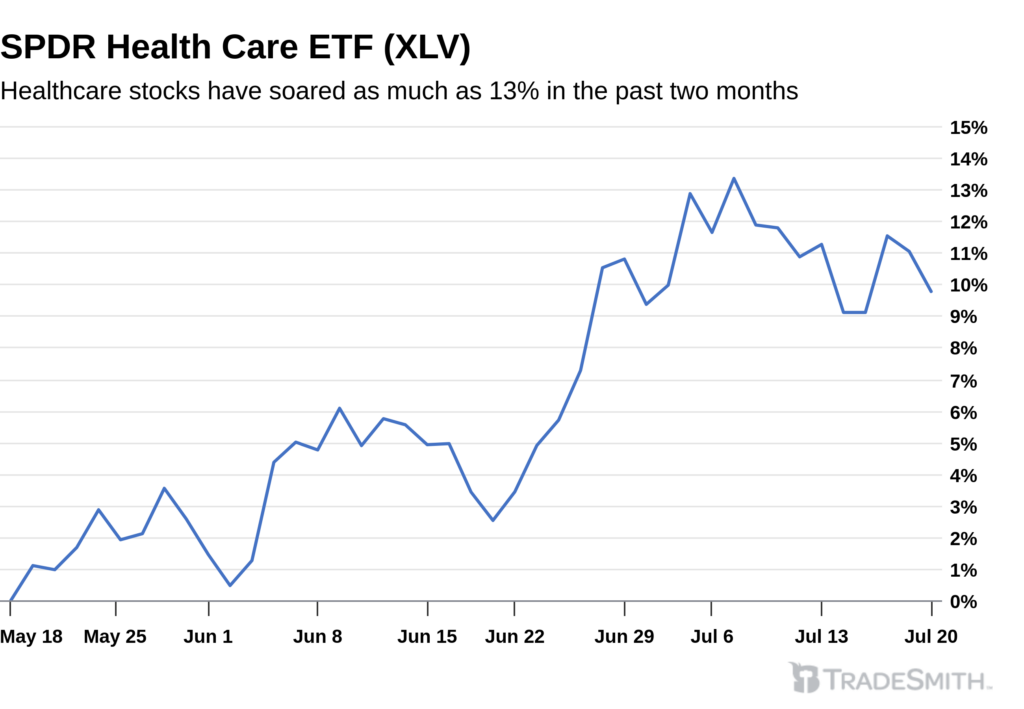
That’s the advantage of being a trader who follows where the money is going. You don’t settle for whatever the market throws at you. You outperform by following where the money is moving – and using TradeSmith’s tools to confirm those moves.
Seasonality called healthcare’s recent move, and another wave could be coming…
Check out this 15-year seasonality chart of XLV:
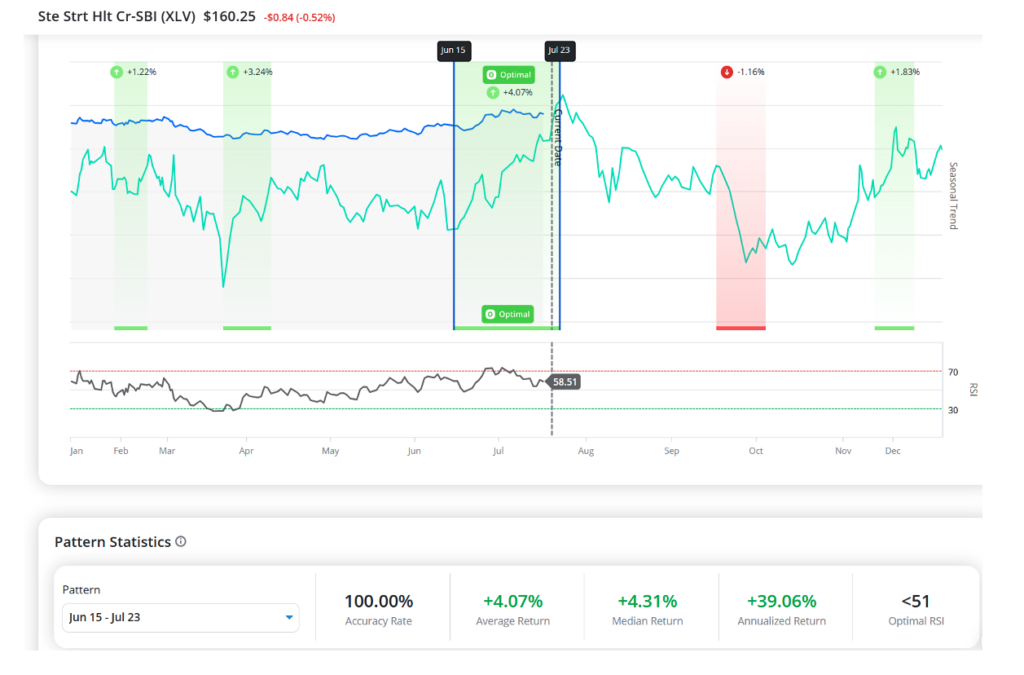
Seasonality looks across decades of market data for calendar periods when stocks have typically risen or fallen – with accuracy rates of 80% and higher.
If a stock has gone up 80% of the time over the past 15 years during a certain window, it doesn’t mean it’s guaranteed to go up during that window again this year. But it stacks the odds of success in your favor.
The chart above shows that, from June 15 to July 23, XLV has gone up every year going back to 2011. On average, it’s returned more than 4% during that window. And so far, XLV is on track to do it again this year. Since June 15, XLV is up 4.8%.
On your average year, healthcare stocks tend to top out around late July and spend the rest of the summer cooling off. From July 23 to the seasonal trough on Oct. 5, XLV has historically been about flat and been positive only a little better than half the time.
But look at this other view of seasonality. It focuses only on midterm election years, like the one we’re in now.
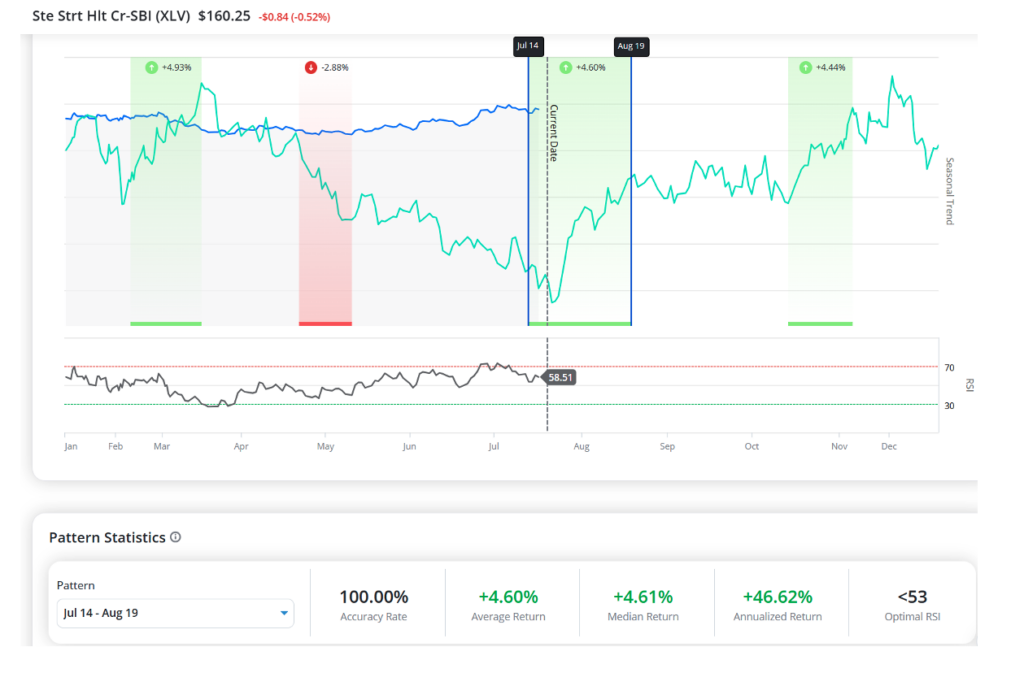
This chart shows XLV’s seasonal pattern going back over seven election cycles, all the way back to the Clinton administration.
In this view, a seasonal pattern in XLV has just begun. It’s been up every one of the past seven midterm election cycle years for an average gain of 4.6% – an even stronger pattern than the 15-year seasonal trend.
So if you feel like you missed the boat on healthcare stocks, this seasonal pattern offers another chance at getting exposure in the hot sector.
TradeSmith CEO Keith Kaplan walked through the seasonal patterns behind our Seasonality software, why they’ve held up across market cycles going back decades, and how to check any stock in your portfolio for its own seasonal tendencies.
It’s not about predicting the news — it’s about knowing what a stock has actually done on this stretch of the calendar, year after year. Once the replay is offline, this window closes with it.
If you haven’t watched Breakthrough 2026 yet, don’t wait.
Our Predictive Alpha dashboard is lighting up with biotech stocks…
AI and biotech has been one of the most exciting themes we’ve covered in TradeSmith Daily this year. And it’s been a big focus of ours over the last month.
- On June 29, we showed you how companies like Illumina (ILMN) are using AI to aid research, diagnostics, and drug discovery.
- On July 6, we dug deeper into how biotech stocks are using AI to accelerate drug discovery.
- And on July 8, we showed you how colleagues Andy and Landon Swan have been covering the longevity trend – including companies that make GLP-1 drugs, and focus on biological age testing, telemedicine, and longevity-focused fitness.
So when you think healthcare, remember that it’s just as much about these exciting sub-themes as it is the outperformance of the sector.
And Predictive Alpha may have found the next big winners.
Trained on more than 100 billion market data points, our AI-powered trading model projects where any stock could be up to 21 trading days out – along with how often it’s been right on that specific stock in the past.
For our Predictive Alpha Prime subscribers, we list the top 10 bullish forecasts every trading day. And today, 4 of those top 10 are healthcare stocks:
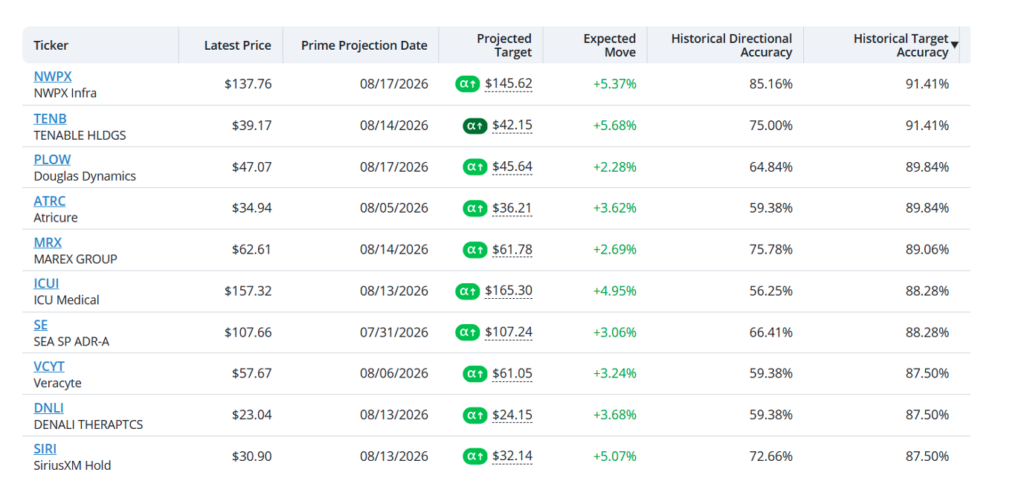
They are, in order of “target accuracy” – our term for how accurate a forecast has been in the past:
- AtriCure (ATRC) – a medical device company focused on implantable devices and surgical technology. Predictive Alpha sees its stock rising 3.6% by Aug. 5, with historical target accuracy just under 90%.
- ICU Medical (ICUI) – a medical device maker building infusion therapy, IV solutions, and critical care products. Predictive Alpha forecasts a gain of 5% by Aug. 13, and it’s been accurate 88.3% of the time in the past.
- Veracyte (VCYT) is a genomic diagnostics company focusing on cancer diagnostics and molecular testing. Predictive Alpha sees a 3.2% bullish move by Aug. 6, accurate 87.5% in the past.
- Denali Therapeutics (DNLI) is a biotech focused on neurodegenerative disease drugs for Alzheimer’s, Parkinson’s, and ALS. Predictive Alpha sees a 3.7% gain by Aug. 13, accurate 87.5% in the past.
These forecasts make for great jumping-off points for further research. They’re also further evidence of how important the AI-powered biotech and healthcare trend is to the market right now.
Watch this sector closely. And if you’re a paid-up Predictive Alpha Prime member, be sure to check the Top 10 for new opportunities each day.
Finally, our CEO asks an uncomfortable question about the most speculative theme in markets…
Space stocks have been a wreck since Elon Musk’s SpaceX (SPCX) went public on June 12.
- Planet Labs (PL), which runs a fleet of small satellites that photograph the entire Earth every day and sells the images and data, is down 29%.
- AST SpaceMobile (ASTS), which is building a network to beam cell service straight from space to ordinary phones, is down almost 31%.
- And Rocket Lab (RKLB), which builds and launches small rockets and makes satellites, is down 35%.
And SpaceX itself is now trading below the $135 price it debuted at – meaning anyone who bought at the IPO is already sitting on a loss. And it’s down roughly 45% from the peak it touched in mid-June.
Our CEO, Keith Kaplan, has been watching one ticker to see whether this group is about to bounce or crash further: the Procure Space ETF (UFO). It bundles roughly 50 space-economy stocks into a single ticker – satellite operators, rocket launchers, Earth-imaging firms, and the companies that supply them – including a slice of SpaceX. Watch UFO, and you get a read on the whole sector in one number.
And as you can see from the chart below, it’s carving out a bottom in the mid-$40s per share – the same range where it consolidated earlier this year. That repeat test of its previous support level is worth watching closely.
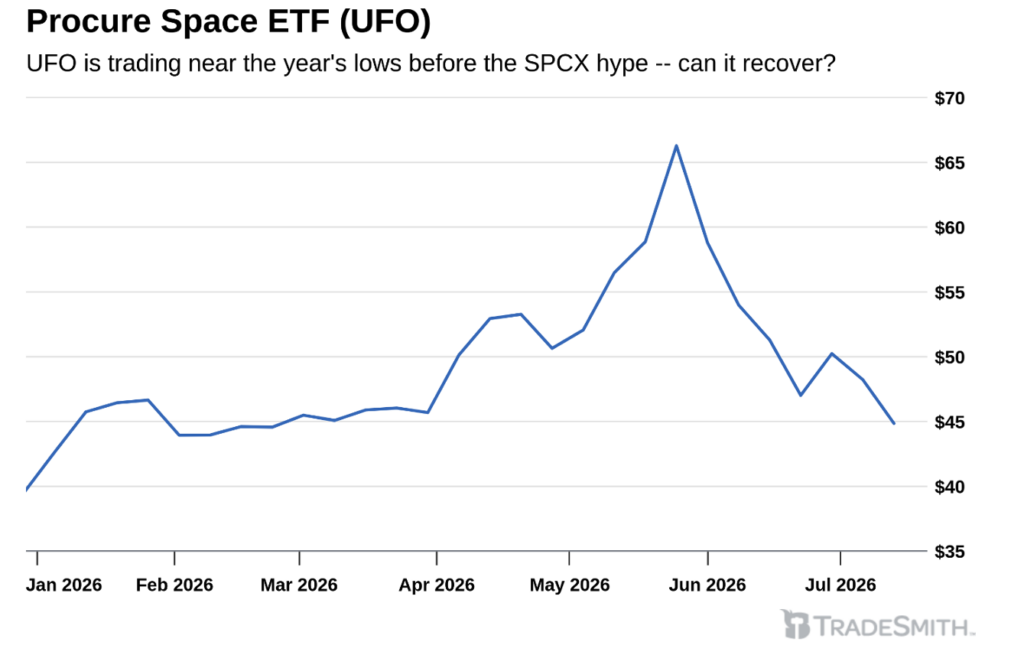
If UFO breaks below the mid-$40s, then we can expect more pain for the space sector. If it holds at this support level and pushes into the high-$40s, then the uptrend is back on.
But not every space stock is suffering right now. Three of UFO’s holdings stand out from the pack:
- Sirius XM (SIRI) is the satellite radio company – it beams music, sports, and talk shows straight to the dashboard of your car.
- Garmin (GRMN) makes the GPS gadgets that rely on satellites to work: car navigators, fitness watches, and devices for boaters and pilots.
- Viasat (VSAT) runs satellites that deliver internet to places regular cable can’t reach – including the wi-fi you use on a lot of airline flights.
There’s more backing up the SIRI setup specifically. Eagle-eyed readers will recognize it from earlier in this issue, where it graced the top 10 of our Predictive Alpha top bullish list.
Our Predictive Alpha AI model is forecasting a 5% gain for SIRI by Aug. 13.
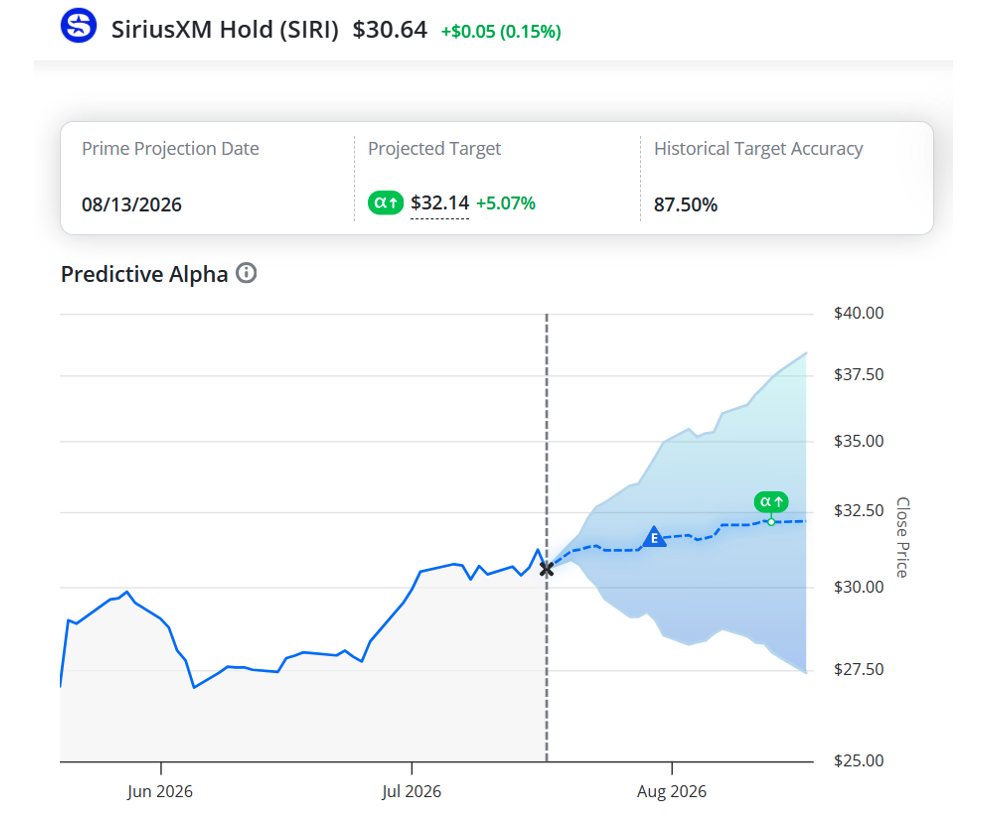
If UFO holds its line in the sand, SIRI, GRMN, and VSAT are the stocks already showing the health to lead a rebound. Add them to your watchlist, and keep an eye on the mid-$40s level in UFO – it’s the tell for the whole group.
Keith often posts calls like this on X before they make it into TradeSmith Daily. If you want his read on space stocks – or anything else he’s tracking – follow him here.
To building wealth beyond measure,
Michael Salvatore
Editor, TradeSmith Daily
Disclosures: At the time of this writing, Michael Salvatore held shares of VCYT, PL, RKLB, SPCX, and ILMN.