The Next Big Casualty of the “Age of Agents”
Listen to the audio version of this article (generated by AI).
In This Digest:
- Meta’s Muse agent is denting financials – our AI is bearish on this big loser
- Cybersecurity survived its own AI panic back in May, and our early call is up 58%
- All pressures point to higher energy prices – check out this seasonal setup
A second wave of AI disruption panic has hit the markets…
Meta’s new AI agent, Muse, topped the Apple App Store this week – a key measure of consumer demand.
If you haven’t come across it yet, Muse isn’t a chatbot like ChatGPT. It’s an AI agent that can go out onto the internet and do things on your behalf, following your instructions.
These capabilities, combined with its rocketing popularity, have kicked off the second wave of AI disruption panic to hit markets in 2026.
The first wave hit software-as-a-service (SaaS) stocks in January after the launch of Claude Code – an AI model that people without coding experience could use to build software.
Customer service platform Salesforce (CRM) plunged as much as 43% before it bottomed in June. Adobe (ADBE), which sells subscriptions for photo editing and movie-making software, lost almost 45%.
The thinking was that, if anyone can code using AI, why pay thousands of dollars for software that someone else made?
Now the panic has a new target: the financial services industry.
Investors fear that AI agents like Muse disrupt “high-friction” transactions – like money management fees or insurance premiums – by automatically researching and acting on your behalf.
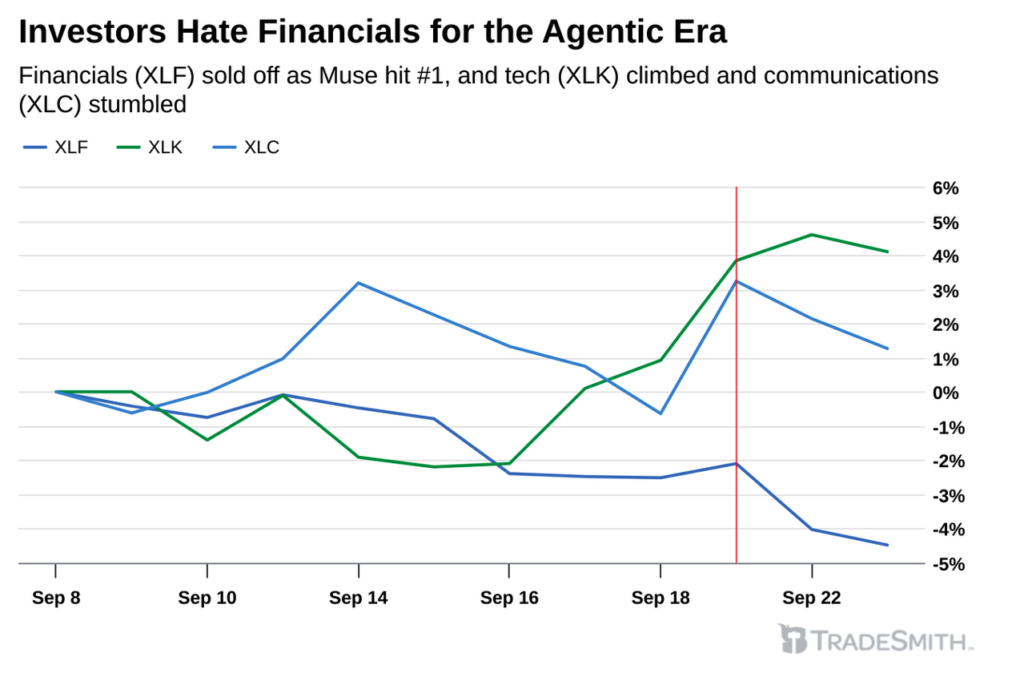
The Financial Select Sector SPDR Fund (XLF) is down more than 4% since Sept. 8, even as tech (XLK) is up more than 4% and communications (XLC) has added better than 1%.
And on Monday – the day Muse hit the top spot in the App Store (red line below) – XLF fell 2.5%.
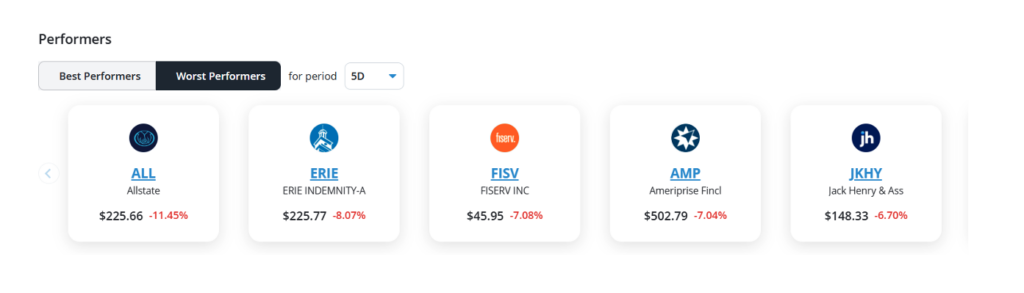
And take a look at some of the worst-performing stocks in the ETF over the past five trading days:
Property and casualty insurance is a standout. When an AI can shop and compare insurers for you – and even help do the messy business of switching carriers – that eats into insurers’ margins.
Insurers Allstate (ALL) and Erie Indemnity (ERIE) are two examples.
Allstate is one of the country’s largest home and auto insurers. It’s down 11% over the past five trading days. And Erie is down about 8% over that same stretch. Both depend on policyholders staying put instead of shopping their rates every year.
Fiserv (FISV), Ameriprise Financial (AMP), and Jack Henry & Associates (JKHY) got caught in the same wave – all three fell about 7% over the past five trading days.
Fiserv processes payments for banks and merchants, Ameriprise collects fees managing client portfolios, and Jack Henry sells the core software small banks and credit unions run on.
Big banks like JPMorgan (JPM) and Wells Fargo (WFC) are also down this week, as is brokerage Charles Schwab (SCHW), on fears that folks are going to use an agent like Muse to help them manage their finances.
Cybersecurity stocks are catching a bid, too…
Every agent that can shop, book, or move money on your behalf needs logins for your bank, your credit cards, and every account it touches.
Hand that many keys to a piece of software, and you’ve created a tempting new target for hackers. That means cybersecurity companies are crucial for the Age of Agents.
We’ve been making the case for cybersecurity stocks for months.
Cybersecurity stocks got caught up in the SaaS selloff at the start of the year. Palo Alto Networks (PANW) was among the hardest hit, plunging 30% in two months.
But on May 18, with the stock breaking out to an all-time high, we called it an easy buy. It’s up 58% since then.
And according to our Quantum Score, it’s still an easy buy today:
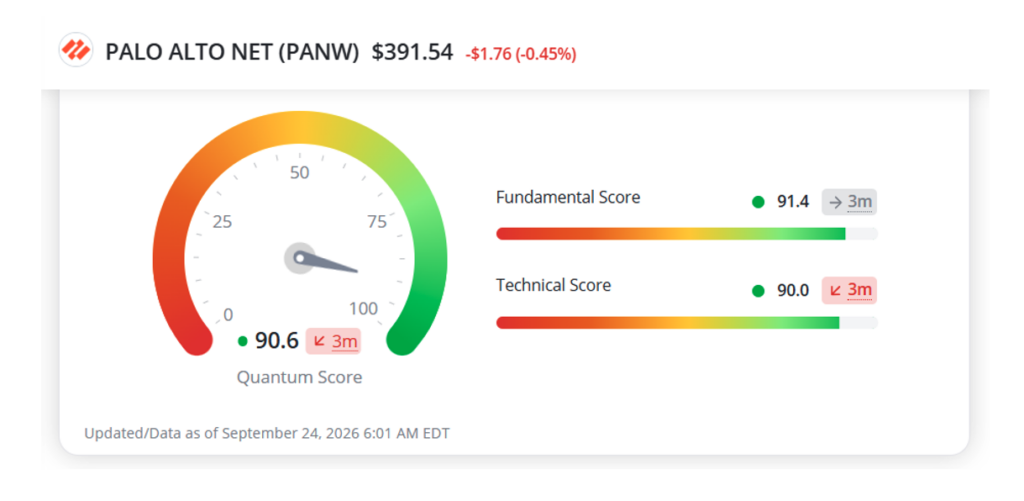
The Quantum Score rates every stock from 0 to 100 by combining fundamental strength – earnings, revenue, profit margin growth – with unusually heavy buying from institutional investors. Anything above 75 is a buy signal.
PANW scores a 90.6 today. Its Technical Score has eased slightly over the past three months, but at 90, it’s still elite by any measure. And its Fundamental Score, at 91.4, hasn’t budged.
The same panic that hit financials is working in reverse here. As AI agents take on more of people’s digital lives, the case for the companies defending that activity only gets stronger.
PANW remains a hold for anyone who bought the May breakout, and it still qualifies as a buy for new money.
If you’re subscribed to Quantum Edge Pro, keep an eye on the rest of the cybersecurity group for names scoring above 75 as this theme keeps developing.
A ban meant to lower diesel prices might do the opposite…
An adviser to Iran’s Supreme Leader warned today that another U.S. strike could push the war beyond the Persian Gulf and Red Sea into the Indian Ocean.
That comes a day after Iran’s president told the United Nations his country will not surrender – defiance that snapped a five-day losing streak in crude, sending the international benchmark Brent up 3.9% on Wednesday.
How to deal with soaring oil prices? Well, one idea gaining traction is a 90-day ban on U.S. diesel exports to bring fuel costs down at home.
It sounds like relief. But diesel and gasoline come out of the same barrel of crude – cut off exports, and refiners are more likely to trim production than simply redirect the difference to American drivers.
Even the administration’s own energy secretary has warned a ban would raise gas prices “right away.”
Here at TradeSmith, we’re not interested in politics from any perspective other than how it impacts markets.
So we just keep an eye on what’s happening and figure out if it can lead us to data-backed trade ideas.
And we’re finding one in the energy sector using our Seasonality tool.
Regular readers know Seasonality looks at years of historical trading data to find windows when a stock has reliably moved in one direction.
Refiner Valero Energy (VLO) has one of the strongest seasonal setups we track heading into winter. Going back 15 years, the stock has climbed from Oct. 27 through Nov. 19 86.7% of the time, with an average return of 6.4%.
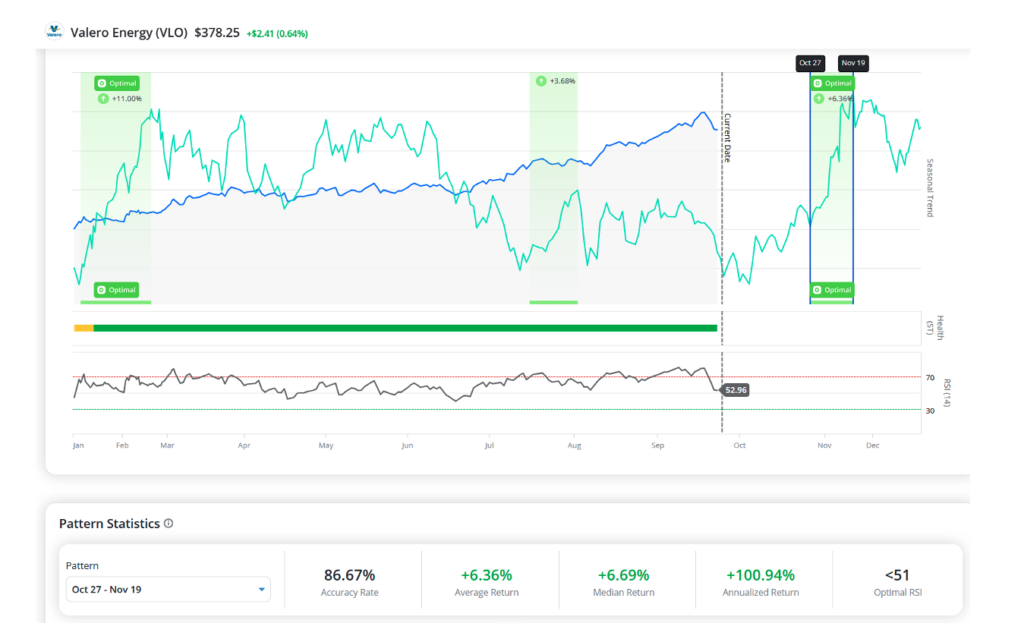
As you’ll note, though, the broader seasonal trend starts earlier. Taking the start of the window back to Oct. 4, the stock has been higher 80% of the time for an average gain of 9.9%:
Valero is the largest independent refiner in North America, turning crude into gasoline, diesel, and jet fuel across 15 refineries in the U.S., Canada, and the U.K. – exactly the products now caught between rising winter demand and Washington’s export-ban threat.
Add VLO to your watchlist now and circle Oct. 27 – that’s when the highest-conviction stretch of this seasonal window opens.
If you’re a subscriber, pull up the Seasonality tool yourself and see which other major oil refiners are set to surge.
To building wealth beyond measure,
Michael Salvatore
Editor, TradeSmith Daily
P.S. On Tuesday, TradeSmith CEO Keith Kaplan pulled back the curtain on our Super AI trading system – a new way to put the power of AI to work in your portfolio. It’s up 38% so far this year – roughly three times the S&P 500 over the same stretch.
For the first time since the system launched last October, we’re reopening membership.
Missed Tuesday’s event? It’s not too late to see how it works – and how it could sharpen your edge as an investor. Sign up here, and as a thank-you, Keith will walk you through two of the AI’s top trades.