The Race to Mars Is Already Creating Profits on Earth
“Space, the final frontier…”
The iconic opening line from Star Trek was only part science fiction when the show aired in 1966.
The first space race to land on the moon was well underway. In the same year, the Soviets achieved the first unmanned moon landing with their Luna 9 space probe.
It led to innovations like memory foam, cordless drills, freeze-dried meals, medical imaging, and countless more.
Investors in key technologies, like computing power, more than doubled their money in IBM (IBM) in the 1960s during the space race. And as these technologies made their way into consumer products, investors made a boatload in companies like Corning (GLW), which made specialty glass and coatings and more than quadrupled in the 1980s.
Six decades later, the new space race is to Mars.
The 238,855 miles it took to get to the Moon are nothing compared with the 225-million-mile journey to the fourth planet from the Sun.
But the opportunity may be worth it.
The new space race will spark innovations and breakthroughs that change our lives here on Earth – and create new opportunities for investors.
Just think about the new technology that needs to be built. To survive life on Mars and the journey to get there, you’d need:
- Electric vehicles for mobility in an atmosphere with no oxygen for combustion engines
- Solar power and batteries for power
- Underground tunnels to shield from radiation and storms
- Rockets to get there and back
- AI-powered robots for dangerous work and exposure to the harsh Martian surface
Each solves a problem here on Earth. Collectively, they move us closer to building a city on Mars – a stated goal for the world’s richest man, Elon Musk.
That makes Tesla (TSLA) a great speculative moonshot stock for the future of space travel.
That’s not just my opinion. As I’ll show you today, it’s also the opening for Wall Street’s biggest investors.
Why Tesla’s Mars Bet Is a Moonshot Worth Taking
Musk may be polarizing, but we can’t deny his impact on transportation, energy, artificial intelligence, and space.
His ventures look like separate bets. But together they form a single system: energy, mobility, autonomy, AI, and orbit access.
Tesla, the Boring Company, SpaceX, and xAI, are key to life on Mars.
- Mobility: Tesla’s mastery of battery-powered vehicles could easily become about more than just cars.
The vehicles are mass produced and rugged, perfect for rovers, haulers, and vehicles that don’t need fuel and oxygen.
Tesla has disrupted the multitrillion-dollar auto and energy complex on Earth. Tesla’s Model Y was the world’s best-selling vehicle in 2023 and 2024.
The company has built and deployed millions of battery-powered vehicles with sensors and computing hardware that generate massive amounts of driving data, which continually improves its AI driving system.
That AI – trained on billions of Earth miles – could be used to guide vehicles across hazardous Martian terrain, from flat plains to rocky crater edges.
- Energy: A Martian colony can’t rely on oil tankers or power lines. It needs modular, repairable, low-maintenance energy.
That’s exactly what Tesla Energy builds – rooftop solar and utility-scale batteries with AI-driven distribution. Every advancement in density, thermal management, and cost improves tomorrow’s outer space grid while paying off on Earth today.
Solar power’s popularity ebbs and flows, but one thing is clear: Solar panels continue to get cheaper to produce, making solar power increasingly more accessible.
Sunlight on Mars is only about 40% as strong as on Earth – thin, but still more than enough to power panels. NASA has already proven the concept with Mars rovers that ran for years on solar.
- Underground safety: Survival on Mars means going underground for stable temperatures and protection from radiation and storms.
Underground tunnels could link living spaces together, act like giant heat batteries to keep temperatures stable, and provide safe, airtight passageways for moving people and supplies.
You might not know it by the name, but Musk’s Boring Company makes tunnels. Last year, it completed a 2.1-mile tunnel called the Vegas Loop. Musk’s ultimate goal is a 29-mile system of parallel tunnels throughout Sin City.
Projects are also in the works for Nashville and Dubai. And Tesla has its own Cybertunnel in Texas to transport Cybertrucks from production to staging.

Those tunnel boring machines (TBMs) chewing through Nevada rock today are prototypes for tunneling through Martian basalt tomorrow. On Earth, the payoff is cheaper urban transit and less congestion. On Mars, tunnels would be the infrastructure’s foundation.
- The supply chain: Musk’s space company, SpaceX, aims to become an industrial logistics network. It needs to be, as much more than humans need to be transported to Mars.
The Starship rockets are designed to be reusable and carry heavy cargo like reactors, habitats, and greenhouses – and people.
Knowledge flows across Musk’s businesses. Tesla’s manufacturing efficiency informs rocket production. SpaceX’s material breakthroughs strengthen Tesla vehicles and batteries. Starlink, Musk’s satellite internet service, adds cash flow and lowers costs for global and extraterrestrial communication.
- Robotics: Robots will be plenty busy on Mars before people arrive. Tesla’s Optimus robots could clear debris, assemble habitats, maintain tunnels, work in the thin atmosphere, and so much more.
Musk and company have already made clear their intention to use Optimus on Mars.

Robots are already an exploding growth market on Earth with increasing use in warehouses, factories, and hospitals. On Mars, they would be the workforce that makes living there possible.
How to Invest in the Future Today
It may be generations before humans live sustainably on Mars. There are no guarantees it will even happen.
But the effort itself will result in technological innovation, and the massive amounts of money involved will fuel growth in certain sectors and companies.
Now is a great time to position yourself to profit.
There’s no pure play on a mission to Mars. But Tesla is the most direct. It’s a bet on the system Musk is building – one that ties together cars, energy, tunnels, rockets, and robots into a unified vision.
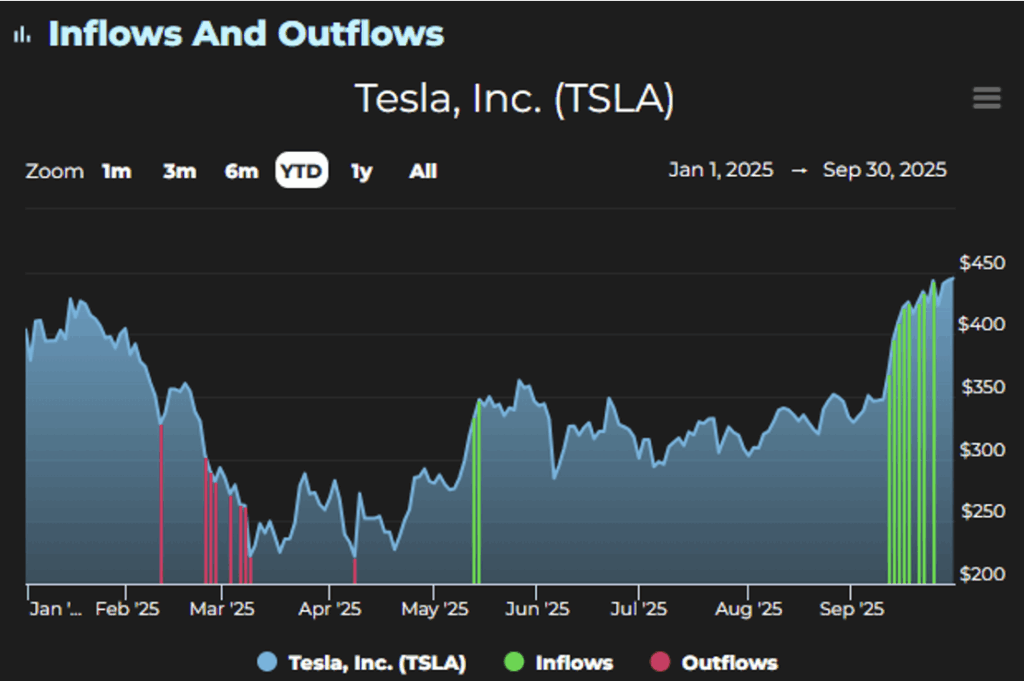
TSLA has had its ups and downs, but shares have rocketed more than 2,500% in the last five years. They are flying again this year, having doubled since the April lows.
I think that’s in part because investors see the company as more than an EV maker, and Elon Musk’s renewed focus after spending time in the government has helped.
As I mentioned above, this is not just my opinion.
I look for stocks that are on the receiving end of unusually large money flows from big institutional buyers. And as you can see below, Big Money was highly active in September. My system picked up eight buy signals (green bars on the chart). These are unusual buys that show institutions and hedge funds at work.
TSLA also rates highly on my Quantum Score.
The score ranks stocks based on their fundamentals – data like earnings and sales growth, profit margins, and valuation. It also ranks them on their technicals. This analyzes price action, moving averages and uptrends, and internal trading metrics like stochastics and relative strength.
I normally look for a combined score of 85 or higher. But Tesla’s score of 83.1 is in the neighborhood. And as you can see on in the image below, it’s in the “Green Zone” — meaning the data indicates higher prices are likely.

Watch for future IPOs as well. Musk is as much an entrepreneur as he is a visionary, and Starlink or SpaceX offerings could provide exposure to space travel and communications.
Beyond TSLA, there are great opportunities in the building blocks needed for successful missions to Mars – the time-tested “picks-and-shovels” strategy. Think semiconductors, advanced materials, automation software, and grid infrastructure companies… all positioned to benefit.
Take ACM Research (ACMR), the top-ranked semiconductor stock in my system.
It makes machines that help clean and prepare the silicon wafers used to build computer chips – a perfect picks-and-shovels investment. I recommended ACMR to my Quantum Edge Pro readers five weeks ago, and shares have jumped 44% already.
I wasn’t around for the first space race, but I’m sure it was fascinating to watch. Its success was not just a source of national pride. It accelerated technology and product development that improved our lives.
With 50 years of progress since then, this second space race should be even more fascinating and impactful. It should also make investors a lot of money.
It’s not too soon to start investing in stocks like TSLA, ACMR, and others set to make the long and profitable journey to Mars.
Talk soon,

Jason Bodner
Editor, Quantum Edge Pro
P.S. Betting on our Martian future isn’t the only way to make money right now.
As TradeSmith CEO Keith Kaplan showed folks on Tuesday, a new breakthrough helped him and other TradeSmith users generate thousands of dollars of trading income while controlling risk.
The new tool is called the T-Line, and it works alongside the Probability of Profit (PoP) indicator to boost already-stellar results.
Keith explained it all Tuesday’s T-Day Summit. He even showed some real-world trades you could make right away.
You can take a closer look at the tools right here. They just might change the way you trade, as they did for Keith and thousands of other investors.
(Jason Bodner held TSLA at the time of this writing.)