The S&P 500’s New High Has a Big Problem
Listen to the audio version of this article (generated by AI).
In This Digest:
- Stocks are at new highs, but there’s a problem
- The best-performing sector of 2026 isn’t what you’d expect, and it’s full of great buys today
- Jeff Clark is getting bullish on a sector few are watching – plus, submit your questions for our interview
The S&P 500 has hit an all-time high…
With a 0.8% gain on Tuesday, it was the index’s first record since Aug. 13.
That’s great if you have money in a retirement account. It’s also a huge relief after the volatility we saw this summer.
But when we look at the data, all is not well under the hood. So we’re not popping the champagne corks just yet.
Take a look at this breakdown of the S&P 500 stocks as measured by their Short- and Long-Term Health measures:
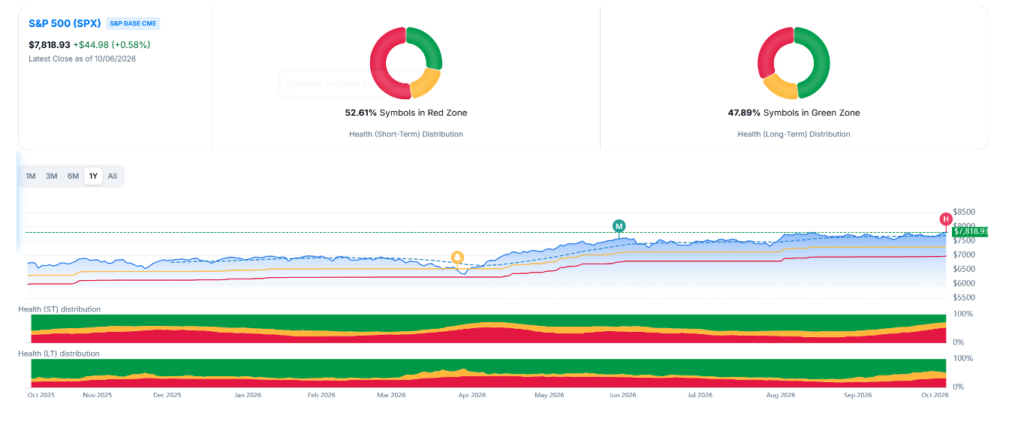
Short-Term Health is TradeSmith’s most sensitive trend indicator. It looks at how a stock or index has been trading over its recent history, then flags abnormal moves that signal a shift in short-term momentum. Green means buy. Yellow means caution. Red means sell.
As you can see from the chart above, 52.6% of the S&P 500 stocks are in the Red Zone – meaning the short-term trend is bearish. Only 28.3% are Green Zones, a sign that the bears are in charge.
How can the S&P 500 be hitting new highs when most of the stocks it tracks are in downtrends?
It comes down to how the index is built. Bigger companies count for more. So giants like Nvidia, Google, Amazon, and Microsoft account for an outsized share of the index’s moves. When they rise, they can drag the whole index higher… even if most of the other stocks are sliding.
But even among the giant tech stocks leading the index, there are stocks in unhealthy Red Zones.
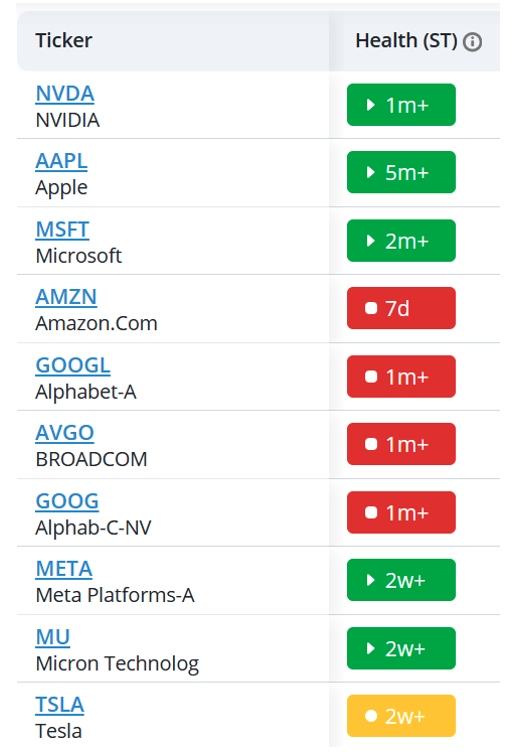
Nvidia (NVDA), Apple (AAPL), Microsoft (MSFT), Meta (META), and Micron (MU) are all in the Green. Meanwhile, Amazon (AMZN) recently shifted Red, both share classes of Google parent Alphabet (GOOG, GOOGL) have been Red for over a month, Broadcom (AVGO) as well, and Tesla (TSLA) is meandering in the Yellow.
I read this as a warning sign. Just a handful of stocks are holding up market performance, and even the generals at the top aren’t delivering the way you’d like to see in a healthy rally.
Keep an eye on your risk exposure and consider taking profits on any stocks you own that seem overstretched at these new highs.
Energy is the best-performing S&P 500 sector of 2026…
Since the Strait of Hormuz was effectively closed, access to more than 14 million barrels a day of Gulf oil has been restricted. That’s roughly one out of every eight barrels the world was producing before the war. The International Energy Agency calls it the largest oil supply crisis in history.
Meanwhile, Ukraine’s drones have knocked out more than half of Russia’s capacity to turn crude into gasoline and diesel, according to Ukraine’s military.
And this destruction of supply is happening as demand is ramping up due to the AI buildout. Data centers now use about 4.5% of all U.S. electricity. One major industry study says that share could double by 2030.
And when energy capacity comes offline as demand rises – prices go up. That’s great news for energy producers.
As you can see, the majority of stocks in XLE are in Short-Term Health Green Zones – 52.4%.
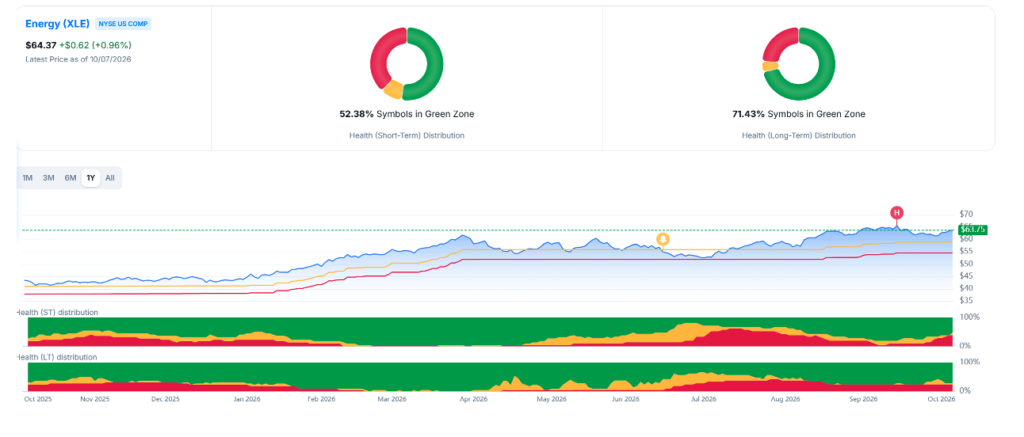
And while that number has been falling over the past few weeks, the issues surrounding the energy markets driving prices higher are not going to be resolved overnight. And we’re not seeing any end to the data center buildout.
One energy stock that’s stands out for us is ONEOK (OKE), in particular because of its Quantum Score:
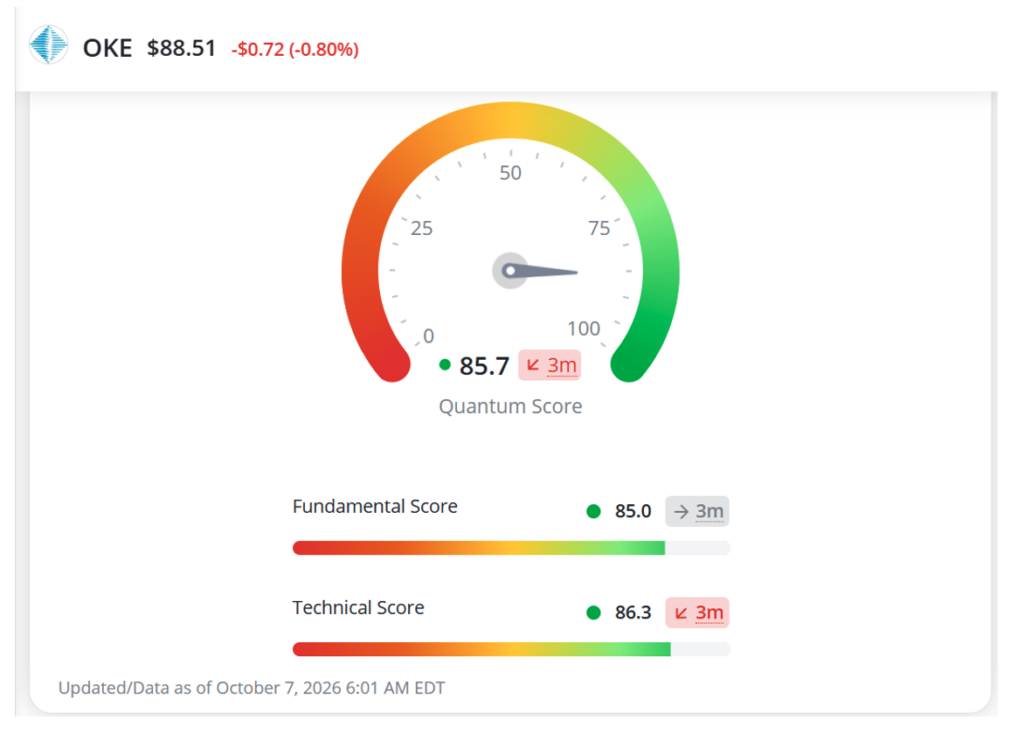
TradeSmith’s Quantum Score rates every stock on a 0–100 scale by combining fundamental strength (earnings, revenue, profit margin growth) with technical momentum (price action and unusually large institutional buying volume). Anything above 75 is a buy.
OKE is the top-rated energy stock in the State Street Energy Select Sector SPDR ETF (XLE) ETF right now at an 85.7. Its Technical score has pulled back recently as energy prices have declined, and the stock itself is down about 9.5% from its recent high. But with the overall health of the energy sector, that looks like a dip worth buying.
Jeff Clark’s newest trading challenge idea…
Jeff Clark just recommended a new trade to participants in his 12 Trades to $1 Million Challenge.
And in true Jeff Clark fashion, it’s on a corner of the market that almost no one is talking about right now.
Jeff pointed out to his readers that Chinese tech stocks (KWEB) are trading at an extreme discount to U.S. tech, the State Street Technology Select Sector SPDR ETF (XLK), both in price and in valuation.
KWEB is the ticker for the KraneShares CSI China Internet ETF, a basket of the largest Chinese internet and e-commerce companies.
KWEB spent most of 2026 grinding lower, but the momentum underneath it has quietly been building since March, which is usually a sign the selling is running out of road before the price confirms it.
This wouldn’t be the first time we’ve seen a reversal in KWEB this year.
Back in June, U.S. megacaps and semiconductors were doing all the work holding the market near its highs while almost everything else drifted lower.
Then in July, semiconductors dropped 23% in four weeks, and money poured into the laggards.
KWEB popped 20% that month. And Jeff thinks the setup heading into October looks a lot like the setup heading into that July rotation.
It’s the latest trade in the real-money options series he’s running step by step with readers.
So far, the Challenge has been a hit. Four out of five trades have been winners, with an average winning gain of 100%.
We won’t detail the newest trade here – that’s exclusive to Jeff’s subscribers.
But you should keep KWEB and other individual Chinese tech stocks on your radar for a potential reversal, especially if U.S. tech stocks start to weaken.
One more thing: I’m sitting down with Jeff tomorrow afternoon.
If there’s a stock, a chart, or a question about his trading challenge you want me to put in front of him, send it my way at [email protected] and I’ll consider sharing with Jeff during our conversation.
To building wealth beyond measure,
Michael Salvatore
Editor, TradeSmith Daily