The White House’s AI “Red Card” Is a Hidden Buy Signal
In This Digest:
- The feds are trying to kick AI models out of the game
- Cyber stocks are more important than ever, and they’re lighting up these two key signals
- It’s too early to trade SpaceX, but not these other space stocks
The White House just threw a “Red Card” into the AI field…
Along with 12 million other people last week, I tuned in to the inaugural World Cup match between Mexico and South Africa.
This game was unusual for the number of red cards issued – three of them total. Soccer fans know (and fear) red cards as the referee’s power to eject an unruly player from the game, forcing the team to play without them.
The entirety of the last World Cup, in 2022, had just four red cards. We saw three of them in this Cup’s opening match.
Then, the next day, the government issued two red cards of its own against leading AI lab Anthropic.
Late on Friday, Anthropic received an order from the Trump administration to disallow any “foreign national” users to access its Fable 5 and Mythos 5 models out of concern for national security.
Regular readers know that these models proved so powerful, they were able to find and exploit security vulnerabilities that were missed by human engineers for decades.
That spurred a closed-door meeting with Treasury secretary Scott Bessent, former Fed chair Jerome Powell, and a litany of top banking executives to figure out how to defend the financial system from this new threat.
Eventually, Anthropic formed Project Glasswing – an exclusive group of high-profile tech organizations like Amazon Web Services, Google, Nvidia, along with major cybersecurity companies like CrowdStrike and Palo Alto Networks – to test the models and use them to patch vulnerabilities.
Now, though, without the ability to quickly discriminate who can access these models, Anthropic simply shut down access for everyone – presumably even those in Project Glasswing.
We’ll leave the opinions on AI regulation to the pundits on social media.
Our job at TradeSmith is to look at the biggest trends and themes in the market and help you turn them into winning trade ideas using our software.
Today, AI cybersecurity is a can’t-miss investment theme.
And we’ve found a cyber stock that’s lighting up on two powerful signals.
This decision from the White House throws a big spotlight on cyber…
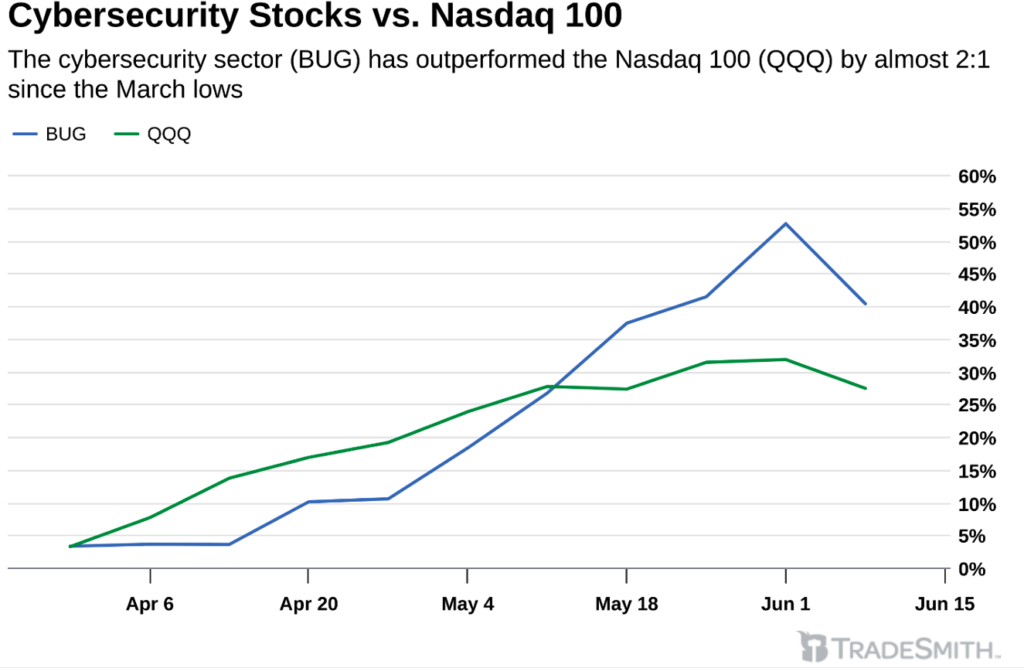
Cybersecurity stocks have been on fire for the past couple months. Check out this chart of the Global X Cybersecurity ETF (BUG) vs. the Nasdaq 100 ETF (QQQ), since the broad market found a bottom in late March:
We’ve mentioned before that cybersecurity stocks were the baby thrown out with the software bathwater.
As AI models rapidly advanced earlier this year, investors started doubting software-as-a-service (SaaS) companies would survive in a world where AI makes it easier than ever to create software.
Whether or not that turns out to be true, cybersecurity got wrapped up in that same thinking.
But in a world where AI models are getting better and better at cyberattacks, cybersecurity becomes more important – not less.
Just think about firewalls. They’re designed to filter out the worst computer viruses from infecting networks across the world.
In the age of AI, it isn’t just easier to detect vulnerabilities. In the hands of a bad actor, an AI model could quickly develop a virus designed to exploit them – stealing sensitive data, shutting down systems, or even taking control of critical infrastructure.
That’s part of the reason why investors have crowded into cyber stocks these past couple months.
But does the trade have legs beyond its 40% run in two months?
Our tools – along with this 50-year quant’s Stock Grader – can tell us…
Recently, TradeSmith partnered with quant investing legend Louis Navellier to bring his flagship stock rating system to our subscribers.
Louis has spent nearly five decades building quantitative models that grade stocks on their underlying business strength.
His Stock Grader assigns every stock a letter grade from A to F based on its fundamentals – earnings growth, sales growth, profit margins, and the like. An “A” means the business behind the stock is firing on all cylinders.
It helped Louis spot Microsoft when it traded for a split-adjusted 38 cents, Nike when it traded for 33 cents, and Nvidia in 2005, 17 years before ChatGPT kicked off the AI boom in 2022.
Following that recommendation alone would have turned $1,000 into more than $1 million.
All told, Louis’ system has flagged 676 stocks that doubled or more – including 22 that went up 100x.
So you can be confident that Stock Grader tells you what to own.
And when you pair it with our Short-Term Health Indicator – which reads whether a stock is in a healthy uptrend (Green Zone), a caution zone (Yellow Zone), or a downtrend (Red Zone) – you also know when the trend is on your side.
This approach helps you whittle down the market to only the highest-quality stocks in the strongest uptrends. And when you overlay it on the cybersecurity sector, one stock stands out: A10 Networks (ATEN).
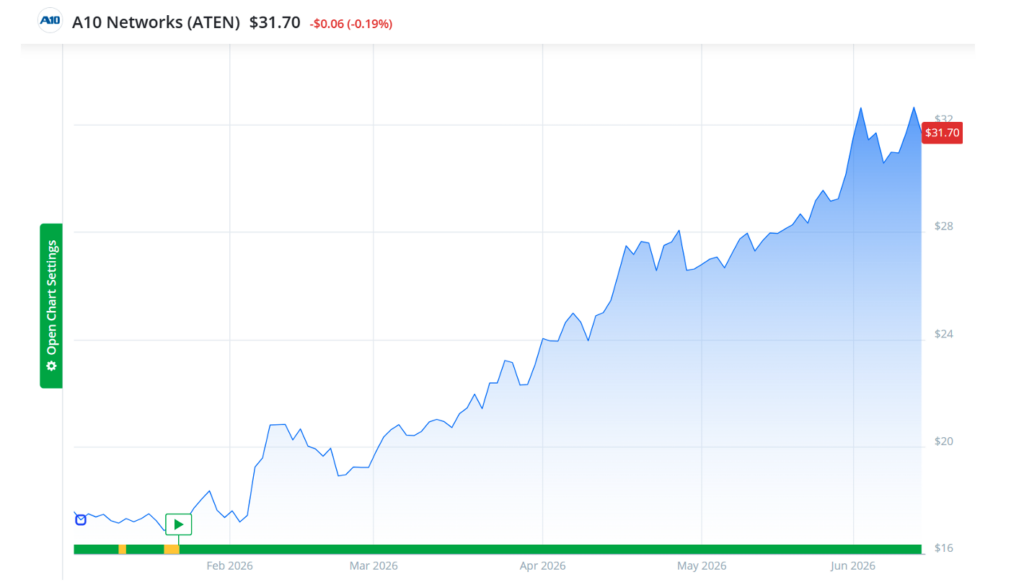
Among dozens of cybersecurity stocks in the Global X Cybersecurity ETF (BUG), ATEN is the only one that earns an A on Louis’s Stock Grader.
And this really caught my eye: While investors were busy dumping cyber stocks earlier this year, they never dumped this one. ATEN has gone in essentially one direction in 2026 – up.
Look at the chart above. The last time Short-Term Health flashed its most recent Green signal on ATEN, the stock was trading at $17.22. Today it sits at $31.70 – an all-time high. That’s a gain of 84.1% for anyone who acted on that signal, in a sector most of Wall Street were busy writing off around the same time.
That’s the power of pairing the two tools. Stock Grader finds the businesses with the strongest fundamentals. Short-Term Health tells you when the market agrees. When a stock lights up on both – strong grade, healthy trend – you’ve found something worth a serious look.
And finding those stocks just got easier.
At last week’s event with Keith and Louis, we revealed a new five-stock strategy called the Tactical Profits Portfolio.
Every week, it scans the market with our AI Fusion score – powered by TradeSmith’s master machine-learning algorithm – to surface the five stocks that look strongest on both Louis’s Stock Grader and our Short-Term Health Indicator.
The first five positions went live today.
If you want to get in on the ground floor – the very first set of positions – now’s the time. The replay from last week’s event is still up, but not for long: catch it here while it’s still live.
Why it’s too early to trade SpaceX, but not these other space stocks…
SpaceX went public on Friday, trading up more than 19% in its first session.
It’s one of the most anticipated IPOs in years, and I’d bet plenty of readers are itching to buy.
Here’s the problem: SpaceX is so new, our TradeSmith toolkit doesn’t have nearly enough data to give a meaningful signal on the stock.
As just one example, our Predictive Alpha forecasting model needs history to do its job. In the same way ChatGPT predicts the next word in a sentence by studying billions of examples, Predictive Alpha predicts a stock’s next price move by studying more than 100 billion market data points.
The model constantly adjusts based on how its past forecasts played out. So when it doesn’t have the data to make a smart call, it stays quiet.
A company that started trading three days ago simply doesn’t have enough history yet. That discipline is exactly what makes its other reads worth trusting.
But while Predictive Alpha doesn’t have a take on SPCX right now, it has plenty to say about the rest of the space sector.
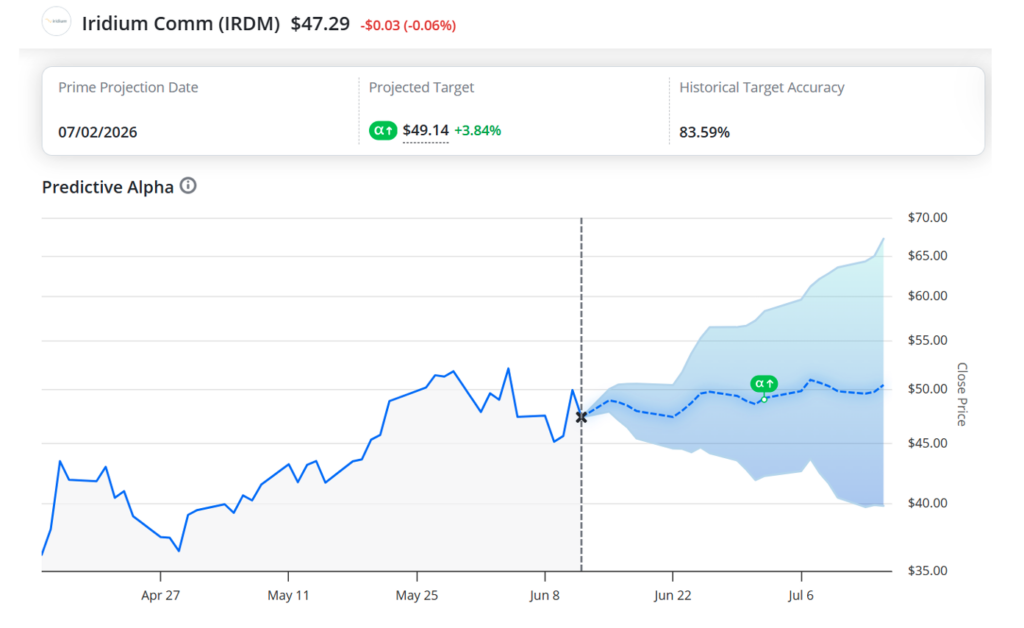
Take Iridium Communications (IRDM), the satellite communications company. Predictive Alpha is forecasting IRDM to rise to $49.14 by July 2 – a move higher of 3.84% from its most recent close of $47.29. The historical accuracy on this specific stock sits at 83.6%.
But not every space stock gets the green light. Look at Rocket Lab (RKLB), one of the most popular stocks in the sector.
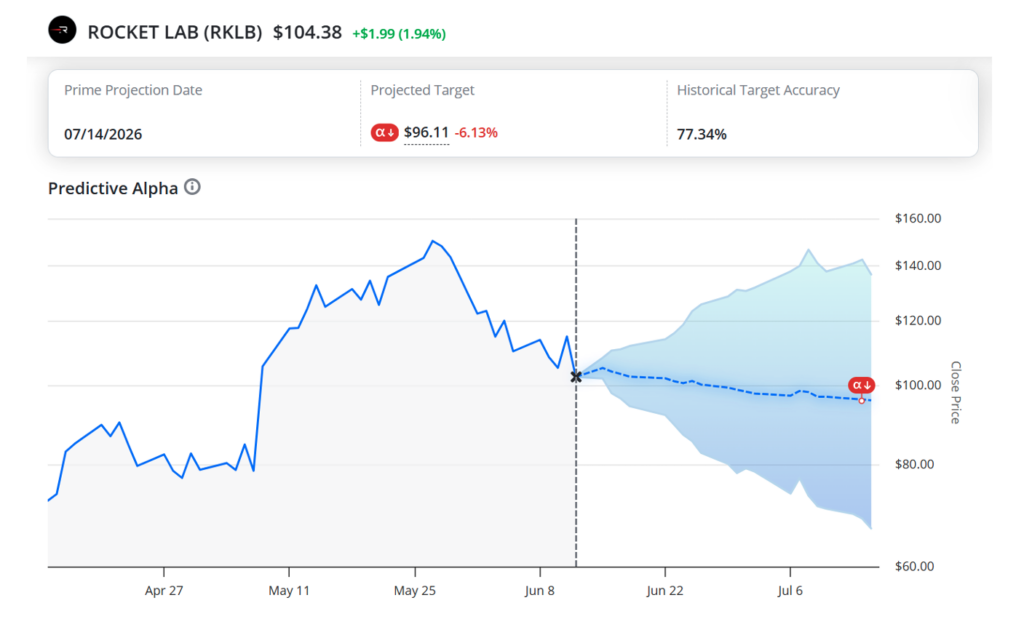
Predictive Alpha is forecasting RKLB to fall to $96.11 by July 14 – a drop of 6.13% from today’s $104.38 – with a historical accuracy on this ticker of 77.34%. That’s a stock the model says to be cautious on right now.
The space trade isn’t a single wave that lifts every stock at once.
There will be winners and losers – and the financial media, chasing the SpaceX headlines, won’t tell you which is which.
Our software will. It doesn’t care which company has the splashiest launch or the biggest founder. It reads the data, stock by stock, and tells you where the math says the next move is most likely headed.
SpaceX may turn out to be a fine investment. We’re not telling you to avoid it.
We’re telling you that you can’t yet trade it backed by the kind of battle-tested system that’s proven to give you an edge – and for the rest of the sector, that edge is available right now for our subscribers.
To building wealth beyond measure,
Michael Salvatore
Editor, TradeSmith Daily