This AI Chokepoint Stock’s Green Window Hasn’t Failed in 14 Years
Listen to the audio version of this article (generated by AI).
In This Digest:
- This AI cooling stock is set to rip for the next five weeks
- Tesla is tightly converged, and our signals point to an imminent breakdown
- AI just disrupted for-profit education, and our system went Red before this stock’s 6% one-day drop
The hottest market theme is rapidly cooling off…
For all of 2026, one investing theme has reigned supreme: AI chokepoints.
Big tech spent $410 billion on the AI infrastructure buildout last year. It’s set to spend up to $725 billion this year – a 77% boost. Next year, forecasts run as high as $1.2 trillion – another 65% rise.
And here at the Daily, we’ve been urging you to get exposure to where this money is flowing.
Not only the chipmakers, but also the companies making high-bandwidth memory, optical interconnectors, and cooling systems for AI data centers.
Just as important are the companies providing the extra electricity and grid capacity they rely on.
But as important as the AI chokepoints theme is, we can’t ignore that it’s taken some heat lately.
Just look at key AI infrastructure plays over the last month:
- The iShares Semiconductor ETF (SOXX) – a benchmark for chip stocks – is down more than 13% from its all-time high set on June 22.
- Memory chip company Micron (MU) – previously up nearly 285% this year alone – is now down 19% from those highs.
- Even Nvidia (NVDA), the poster child of the AI boom, is down more than 10% from its all-time highs.
- And on the software side, IBM (IBM) just dropped more than 25% in a single session – erasing tens of billions in market cap – for reporting that its Q2 revenue would miss expectations due to companies committing all of their spending to AI hardware.
If all you own is AI stocks, you’ve gone on a wild ride over the past month.
And if you want clarity on where the AI chokepoints are heading next, seasonality can provide it…
Regular readers know our seasonality software looks back over decades of market data to find consistent times throughout each year when a stock has tended to rise or fall.
That’s not a guarantee that the same pattern will happen again. But it stacks the odds of success in our favor.
With AI infrastructure stocks under pressure, we can look to seasonality to help find the best buy opportunities in this key market theme.
For example, take Watts Water Technologies (WTS):
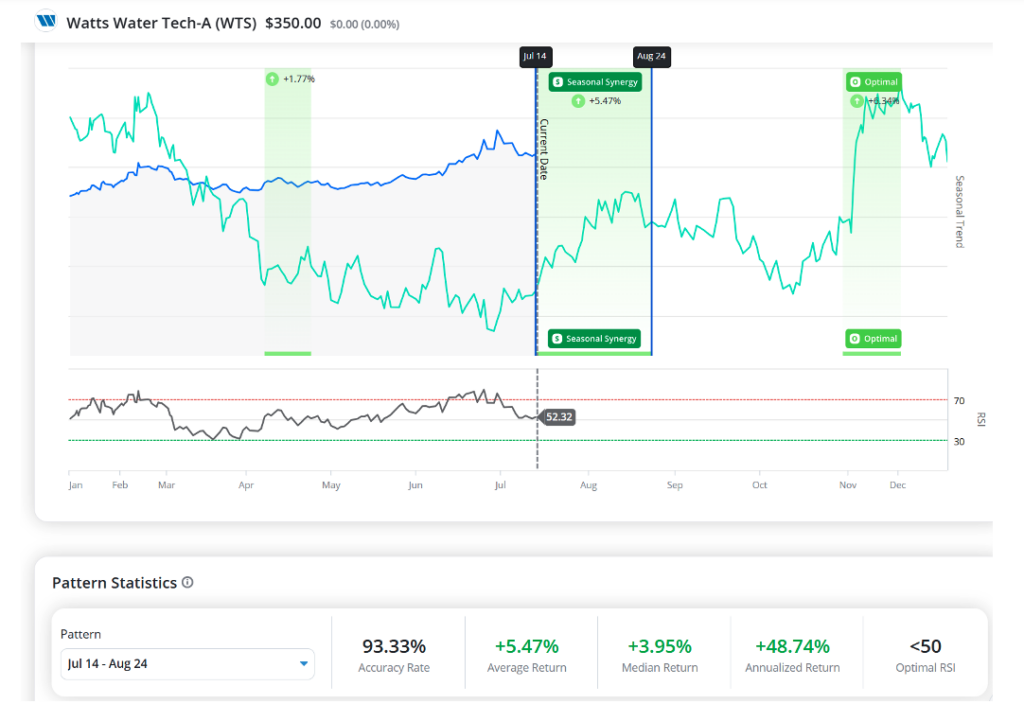
Watts is a $12 billion heating and plumbing company that’s been publicly traded since 1986. The stock has traded higher in 14 of the past 15 years from July 14 to Aug. 24 – and it hasn’t fallen during this window since 2011.
On average, the stock has returned 5.5% in this five-week window. And last year, it returned 13.5% – more than double the average.
The company is a critical player in the AI infrastructure theme. Its cooling systems keep data centers operating efficiently while saving on water costs. And its AI-enhanced Nexa platform actively gathers data from water softeners, valves, and heaters to detect leaks and prevent plumbing waste.
If the AI data center trade has seen the worst of its cooling-off period, this stock is worth a close look from now through Aug. 24.
Like the rest of the sector, it’s down about 10% from its 1-month high – so it’s coming into this seasonal window after sellers have already knocked the stock down.
And right now, we’re inviting you to find seasonal windows on any stock you want…
From now until tomorrow at 10 a.m. ET, you can try out our seasonality software on any stocks you own – or want to buy – with this free, limited-time trial version.
We’re making it available ahead of our Breakthrough 2026 event, where our CEO Keith Kaplan will break down the key seasonal patterns you need to be aware of in this critical year.
It kicks off tomorrow at 10 a.m. ET. And it’s urgent that you attend.
Keith will walk you through how we uncovered these patterns, why they persist even in chaotic markets, and how you can use them to guide real-world trading decisions.
Knowing when the windows are opening and closing likely matters more to your wealth than any single decision you’ve made in 2026 thus far.
The first date you’ll want to circle on your calendar is July 16. If seasonality patterns hold this year, it could open up a lucrative trading opportunity in one of the market’s hottest AI stocks.
Sign up right here, and you’ll learn how to access a limited-time free trial of our seasonality software.
Tesla is the “tightest coil” in our system, and our signals lean bearish…
One of my favorite TradeSmith indicators is the Convergence/Divergence tracker, developed in partnership with master options trader Jeff Clark.
Jeff has spent more than 40 years trading options. He managed personal fortunes for roughly 100 of California’s wealthiest individuals before “retiring” and sharing his trading insights with newsletter readers.
These days, he heads up TradeSmith’s Delta Report advisory. It’s where he identifies high-probability options trades – often in volatile markets like today’s, which is exactly when options traders can profit most.
One of Jeff’s main strategies is following stocks that are tightly coiled or “converged,” with narrow price action that tends to precede an explosive move. We measure that state with our Convergence tracker, which looks for stocks where three key trendlines are closely pinched together.
Right now, the single most converged stock in our system is electric vehicle, solar, and robotics maker Tesla (TSLA):
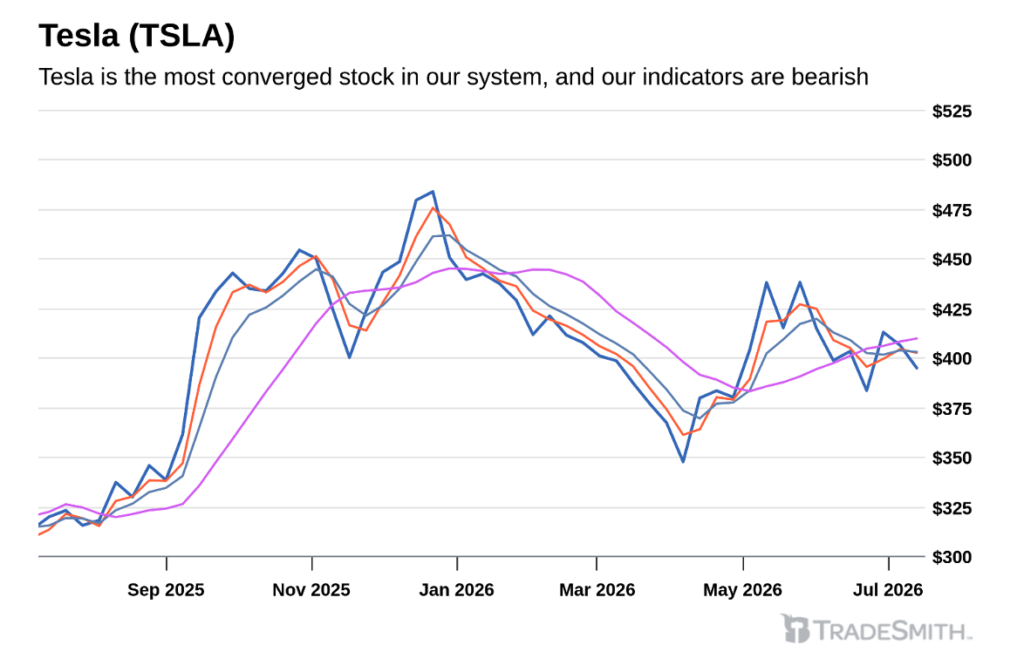
Now, a converged stock is like a coiled spring. It’s building up energy for a big move in one direction or another. It could be up, or it could be down.
In the case of TSLA, though, we have to give the edge to the bears.
TSLA just fired a Short-Term Health Red signal.
Veteran TradeSmith readers know Short-Term Health is our most sensitive trend indicator. It compares a stock’s recent price moves to its typical trading range to flag whether it’s in a healthy uptrend (Green Zone), a caution zone (Yellow Zone), or a downtrend (Red Zone).
The last time TSLA fired this signal in mid-February, it fell as much as 16% two months before rebounding.
Now it’s firing again after setting a lower high in May.
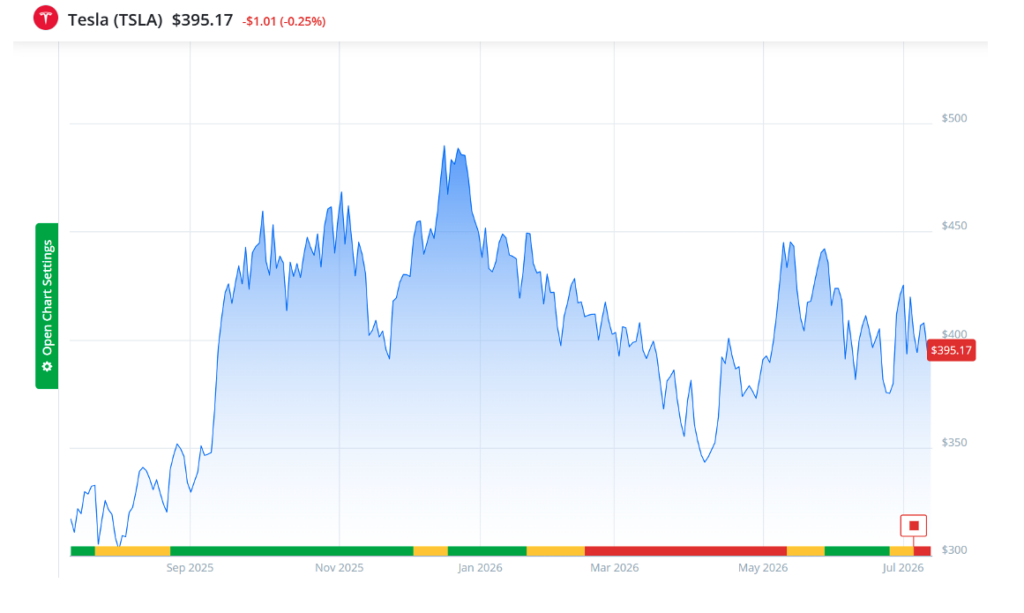
With this combination of signals, TSLA seems like a stock to stay away from right now.
AI just disrupted the hot for-profit education sector, and our system was ahead of this big drop…
Yesterday, leading AI lab Anthropic announced Claude for Teachers. It’s an initiative aimed at giving verified K-12 educators in the U.S. free access to Claude’s premium features for a full year.
The tool connects to academic standard learning resources to help build lesson plans and generate testing questions while keeping student data private.
It’s a good example of how AI is being applied to the most fundamental aspects of society. Starting now, any grade school-aged kid could be taught with the help of one of the most powerful AI tools available.
Moves like these level the playing field between public and private education, especially for-profit education.
For years, tech-savvy education firms had an edge. They built proprietary software and tools that public schools couldn’t easily match on tight budgets.
Just as we’ve seen all this year with software-as-a-service companies, AI is shrinking that edge. A free AI tool that plans lessons and grades work is now open to any public school teacher. It doesn’t cost districts a cent.
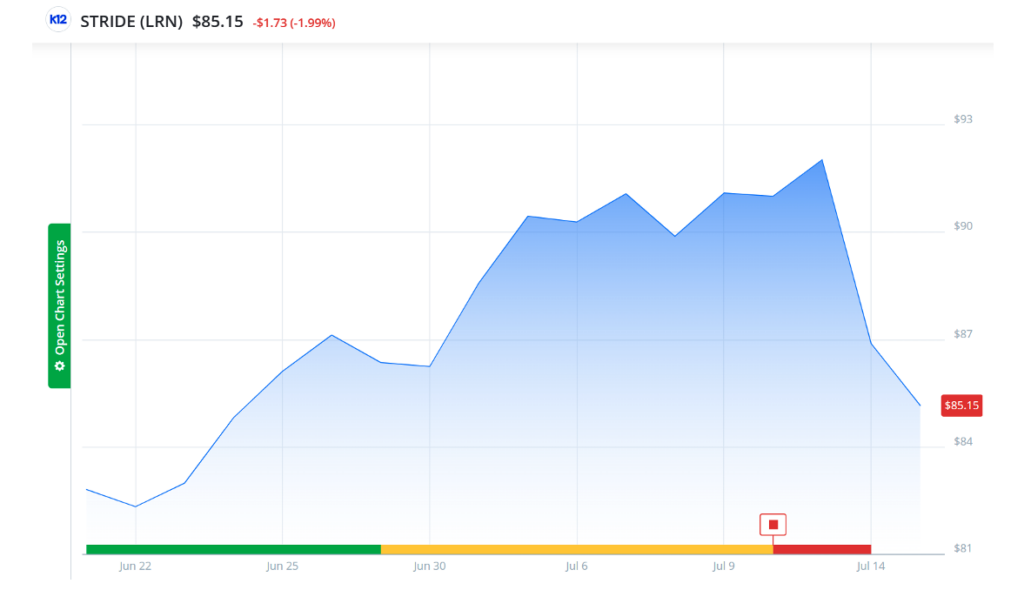
Immediately after the announcement at 11 a.m. ET on Tuesday, shares of for-profit education company Stride (LRN) dropped as much as 7% from peak to trough.
Stride builds and sells software that does what Claude for Teachers promises to do for free. It makes perfect sense that investors would immediately re-price the stock accounting for a potential drop in revenue over the next year.
Here with Stride, we should note that our Short-Term Health signal got bearish on the stock right ahead of Tuesday’s big slide. Since it fired Red on Friday’s close, the stock is down 4.5% and is considered a sell in our system:
Software may have made a comeback, but the AI disruption story is far from over.
Keep an ear out for new AI applications just like these. And if you have access to TradeSmith’s Short-Term Health Indicator, be sure to monitor it for new Red signals on stocks in this sector.
To building wealth beyond measure,
Michael Salvatore
Editor, TradeSmith Daily