This Seasonal Pattern Says Tech Is a Buy in July
Listen to the audio version of this article (generated by AI).
In This Digest:
- Tech is entering its most bullish seasonality window this year
- Why our most accurate AI-powered forecasts are all pointing overseas
- Make sure you’re signed up for Thursday’s U.S. AI Power Summit
Tech sold off, then ripped higher, right on schedule…
June was a rough month for tech stocks.
Since June 1, the Nasdaq 100 ETF (QQQ) – a basket of the 100 biggest U.S.-listed tech stocks – has swung as much as 7% in both directions.
That kind of back-and-forth is brutal for bulls and bears alike. Just when you think the market’s picked a direction, it flips.
After all that chop, nothing much changed. QQQ ended the month down about 1%.
So what happens now?
We can’t predict the future. But there’s a seasonally bullish window opening today for QQQ that’s worth watching. Take a look…
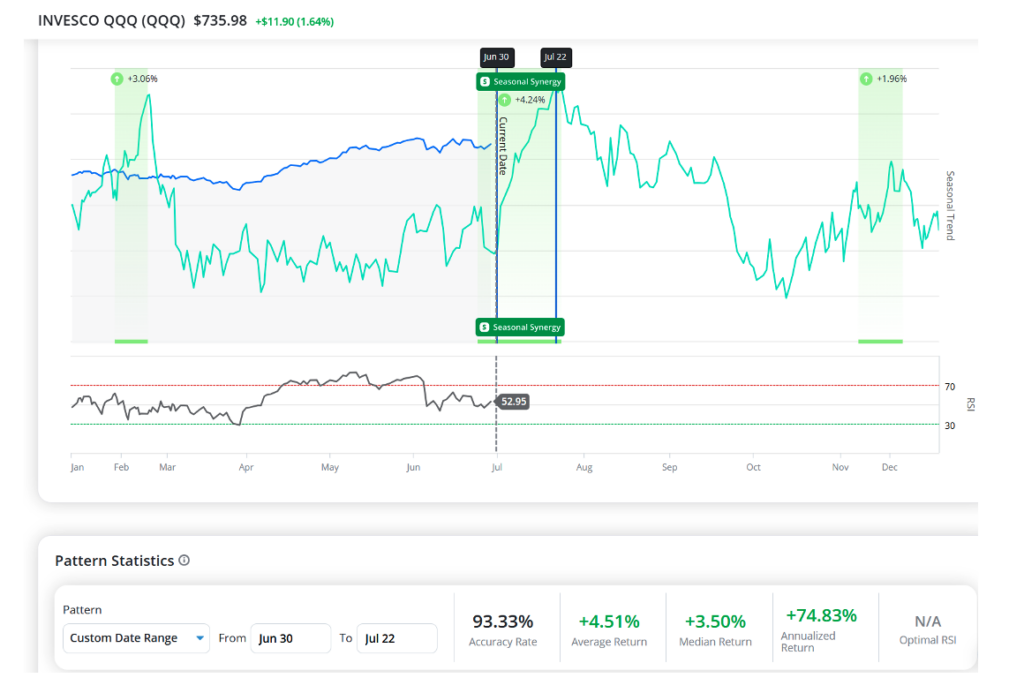
Our Seasonality tool tracks how stocks and indexes have tended to perform during specific stretches of the calendar year, going back over years of trading data.
And as you can see, from June 30 (yesterday’s close) to July 22, QQQ has historically been higher in all but one of the last 15 years. And it’s risen for an average gain of 4.5%.
That’s not a guarantee that QQQ will rally this June – it’s a pattern. But patterns like this are the kind of edge that can tilt the odds in your favor.
And this signal is stronger than your typical seasonal pattern. We call it a Seasonal Synergy signal, because two things have to line up at once.
First, the calendar has to be in QQQ’s favor. Second, we check that QQQ isn’t already “overbought” – meaning it hasn’t shot up so far, so fast, that it’s due for a breather.
After June’s choppy action, it’s tempting to sit out July on the sidelines. But this strong seasonal bullish pattern suggests more gains to come this month.
Our Predictive Alpha AI model says it’s time to buy the wider world…
If you’ve been with us for some time, you’ll know that Predictive Alpha uses AI to forecast stock prices up to 21 trading days out.
It’s based on something called time-series forecasting. It’s a way of using past data to make an educated guess about the future – the same basic idea a weather forecaster uses to predict tomorrow’s temperature from years of past weather data.
Every time it makes a forecast, it also tells you how often that kind of forecast has been right before – so you’re never just taking its word for it.
Right now, four of the five most historically accurate bullish forecasts the model is making aren’t U.S. stocks at all. They’re U.S.-based ETFs that track the stock markets of countries in Asia and emerging markets.
Here are the country funds the model likes best, sorted by their historical accuracy rates.
- iShares MSCI Taiwan ETF (EWT) – Owns Taiwan’s largest companies. Expected gain 4.3%. Historical accuracy 92.2%.
- iShares MSCI Emerging Markets ex China ETF (EMXC) – Holds emerging-market stocks, with China left out. Expected gain 2.8%. Historical accuracy 91.4%.
- Avantis Emerging Markets Equity ETF (AVEM) – A broad group of emerging-market companies. Expected gain 2.4%. Historical accuracy 91.4%.
- iShares MSCI All Country Asia ex Japan ETF (AAXJ) – Asia’s major markets in one fund, minus Japan. Expected gain 2.6%. Historical accuracy 90.6%.
- iShares MSCI South Korea ETF (EWY) – Owns Korea’s biggest companies. Expected gain 3.1%. Historical accuracy 89.8%.
Of these, Taiwan (EWT) and South Korea (EWY) stand out. About 45% of the value of South Korea’s stock market is concentrated in memory hardware companies Samsung and SK Hynix. And about 44% of the value of Taiwan’s stock market is concentrated in Taiwan Semiconductor Manufacturing Company (TSM) – the world’s largest chipmaker.
If you want exposure to the AI hardware trade without picking a single chipmaker, these two ETFs are an interesting way to do that.
If you’re a paid-up subscriber, pull these tickers up on the TradeSmith Finance platform and check each one’s Short-Term Health before you buy.
An even bigger opportunity is the AI power trade…
That’s according to Andy and Landon Swan at our MegaTrends advisory.
As they’ve been showing their readers, the AI boom is pushing America’s power infrastructure to its limit.
Now, power forecasts are being revised higher at a rapid pace:
- AI data centers consumed 460 terawatt-hours (TWh) in 2022, more than Sweden’s total electricity usage. By 2028, that figure is projected to surge to 1,300 TWh, surpassing Japan’s entire grid consumption.
- U.S. data centers will quadruple their share of the national grid from 4.4% in 2022 to 12% by 2028. That’s more than the combined annual electricity demand of California and Texas.
- Goldman Sachs has doubled its 2030 energy demand projection for AI-related infrastructure. Analysts warn this may still be conservative.
This isn’t a problem to address years down the line. It’s something President Trump and his team are acutely aware of.
On his first day in office, he declared a national energy emergency.
Then last April, he invoked wartime powers under the Defense Production Act, directing billions of dollars toward grid infrastructure: transformers, high-voltage transmission components, substations, advanced conductors. As he put it in the order itself: “America’s aging and constrained electric grid infrastructure poses an increasing threat to national defense.”
And last November, he went even further.
He signed the executive order launching the Genesis Mission – mobilizing all 17 Department of Energy National Laboratories, 40,000 government scientists, and the most powerful supercomputers in the country toward a single objective: winning the AI race through energy dominance.
The order described the initiative as “comparable in urgency and ambition to the Manhattan Project.” It was the government’s crash program that built the atomic bomb that ended World War II.
The Swans have already shown their readers how to profit. Last April, they recommended small nuclear reactor designer Oklo (OKLO). And they closed out half of that trade in the MegaTrends model portfolio last September for a 461% gain.
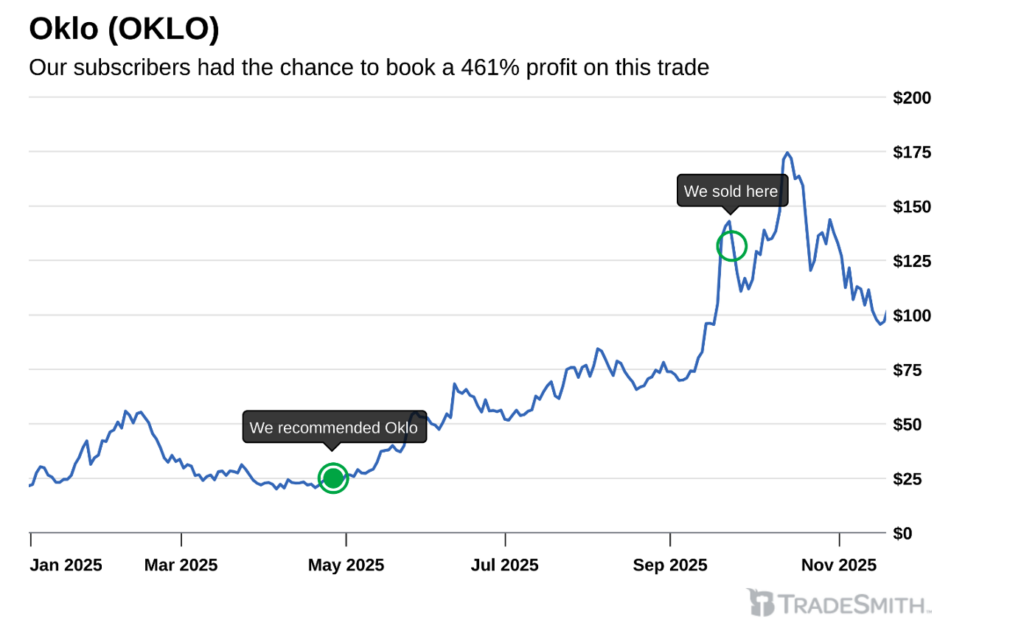
And Oklo was just one of the first signals that there was an emerging theme connecting energy to AI.
As you may already know by now, the Swans base their recommendations on the online consumer behavior patterns their Social Heat Score system captures.
They recommended Oklo when it hit a bullish score of 79. Now, that same data is showing the interest in the AI power trade is spreading across an entire sector of small, largely unknown infrastructure companies that are being pulled into the center of America’s power buildout.
The companies designing transmission systems. Building substations. Operating natural gas pipelines. Filing the permits that have to happen before a single AI data center goes online.
Landon will be revealing all this Thursday at 10 a.m. ET in his U.S. AI Power Summit. If you’re not already scheduled to attend, you can secure your spot here.
Landon will be joined by forensic account Joel Litman at our corporate affiliate Altimetry, who’ll be going into detail on the still-tiny energy infrastructure companies his research shows are most likely to benefit from as the AI power trade gains steam.
To building wealth beyond measure,
Michael Salvatore
Editor, TradeSmith Daily