Three AI Power Forces Are Converging – Here’s How to Prepare
Listen to the audio version of this article (generated by AI).
In This Digest:
- Microsoft’s 20-year power deal reveals the biggest opportunity in AI
- Three monumental AI power forces converge on July 10 – and these two systems agree on what to buy
- Seven of our top Pivot signals point to one major theme – led by this beaten-up chip stock
Everyone’s still chasing AI chips – but the better trade is in AI power…
On Monday, Microsoft signed a 20-year deal with Chevron to build a dedicated power plant in the gas-rich Permian Basin in West Texas.
It’s planned as a 2.67-gigawatt facility – enough to power a city the size of Houston. And it exists to exclusively feed a single Microsoft AI data center. It won’t even connect to the public grid.
Microsoft plans to spend about $190 billion on AI infrastructure this year, 61% more than last year. And to power its AI ambitions, it needs to have its own gas-fired power plant locked down for the next two decades.
That’s a sign that the AI boom is running into its most critical chokepoint – power.
AI data centers draw enormous amounts of power, and the U.S. grid wasn’t built for them.
That’s why Washington has been pushing initiatives like the Genesis Mission. It’s an effort sponsored by the White House to harness the power of AI for breakthroughs in energy production, along with other scientific research and national security measures.
It’s why the most interesting opportunities on our radar here at TradeSmith aren’t in the trillion-dollar software giants – they’re in the smaller, overlooked companies that build, power, and feed this buildout.
Two very different analysts are coming together to unveil their top picks…
The first is Joel Litman, chief investment officer at our sister research firm, Altimetry.
Joel is trained as a forensic accountant. That means he rebuilds corporate financial statements from the ground up to find what a company actually earns versus what it reports to the world. And he’s one of the best.
He counts the 10 largest money managers in the world among his clients. He’s consulted for the FBI and the Pentagon, lectured at Harvard and Wharton, and he’s known for warning clients ahead of the 2008 and 2020 downturns.
When his system catches one of those mispriced companies before the market wakes up, the price moves to follow can be extreme.
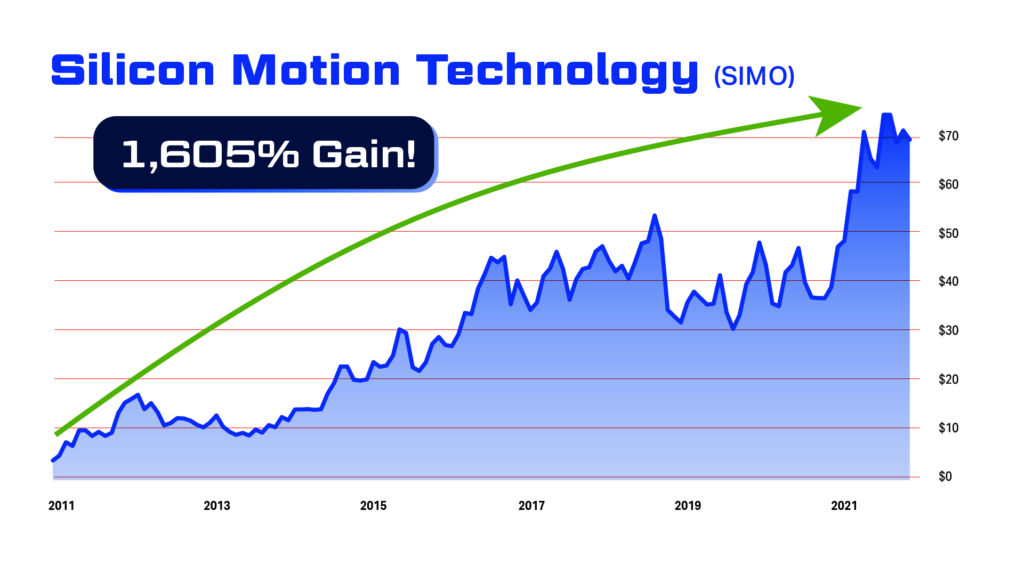
In our testing, we found that his True Blue system flagged chipmaker Silicon Motion (SIMO) before a run of more than 1,600%.
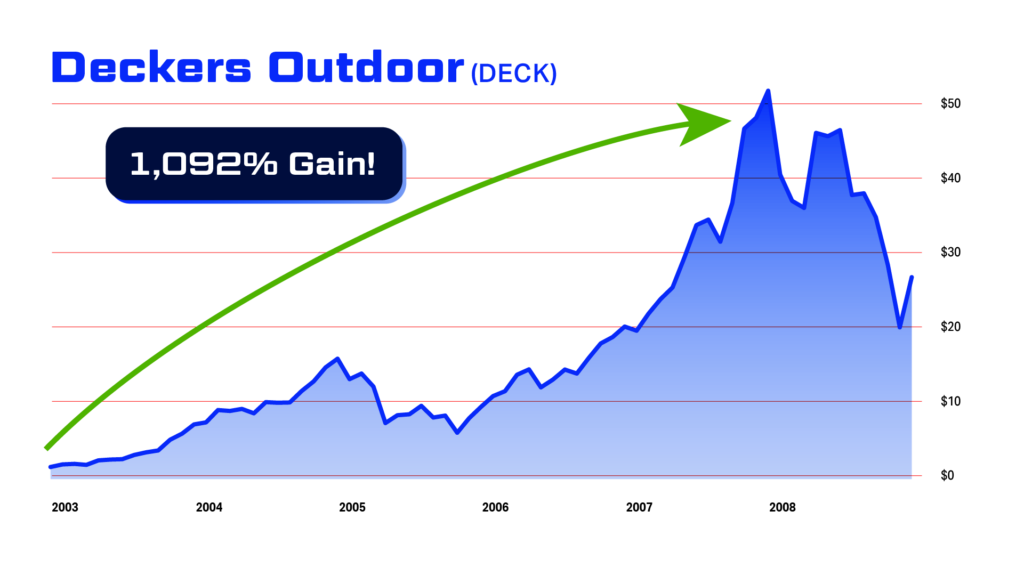
It also found Deckers Outdoor (DECK) – the company behind Ugg and Hoka – before a climb past 3,700%.
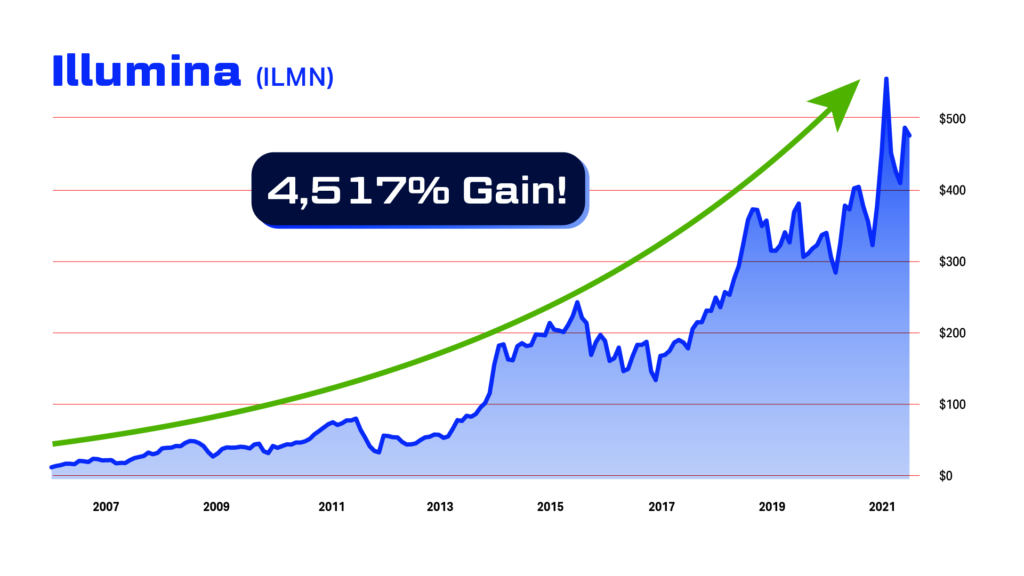
It flagged gene-sequencing firm Illumina (ILMN) ahead of a move over 4,500%.
Joining Joel will be Landon Swan, cofounder of our MegaTrends advisory, along with his brother Andy.
If you’ve been with us for some time, you’ll know that Landon and Andy built our Social Heat Score from the ground up – pulling data from every major platform, from X to Facebook to Google, to track what hundreds of millions of people are searching for, talking about, and buying before any of it shows up in a company’s earnings.
The system distills all of that data into a single number, from 0 to 100. When a stock crosses 70, it’s a signal that consumer momentum has become strong enough to move the price. When it hits 100, the results can be extraordinary.
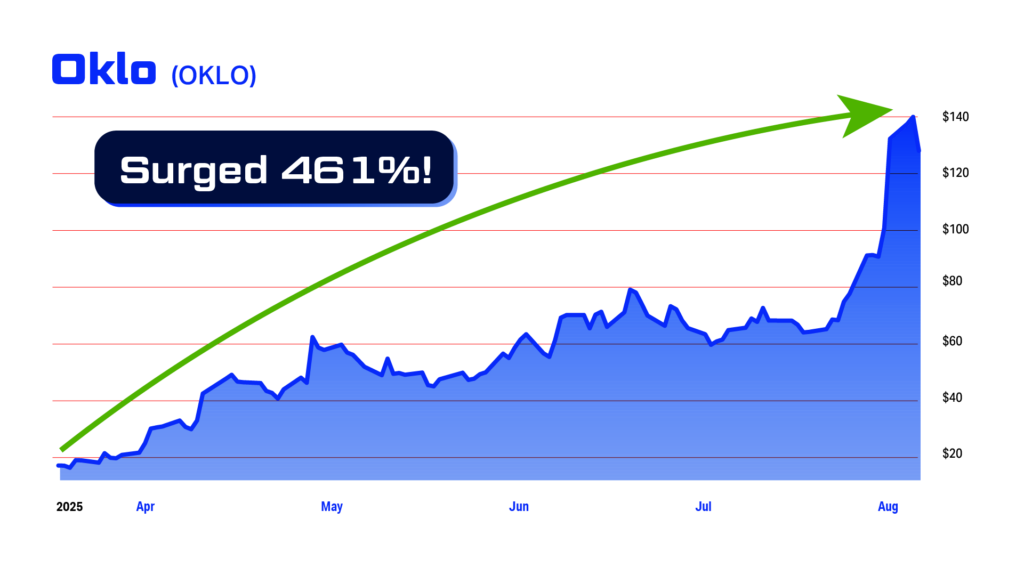
Small nuclear reactor designer Oklo (OKLO) hit 79 – and went on to surge 461%.
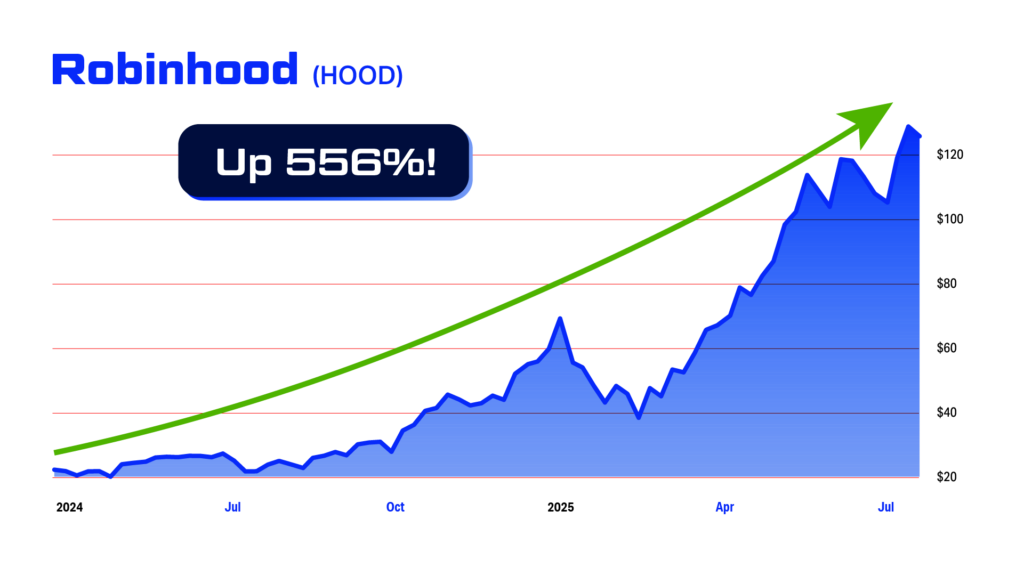
Robinhood (HOOD) hit 80 – and jumped 556%.
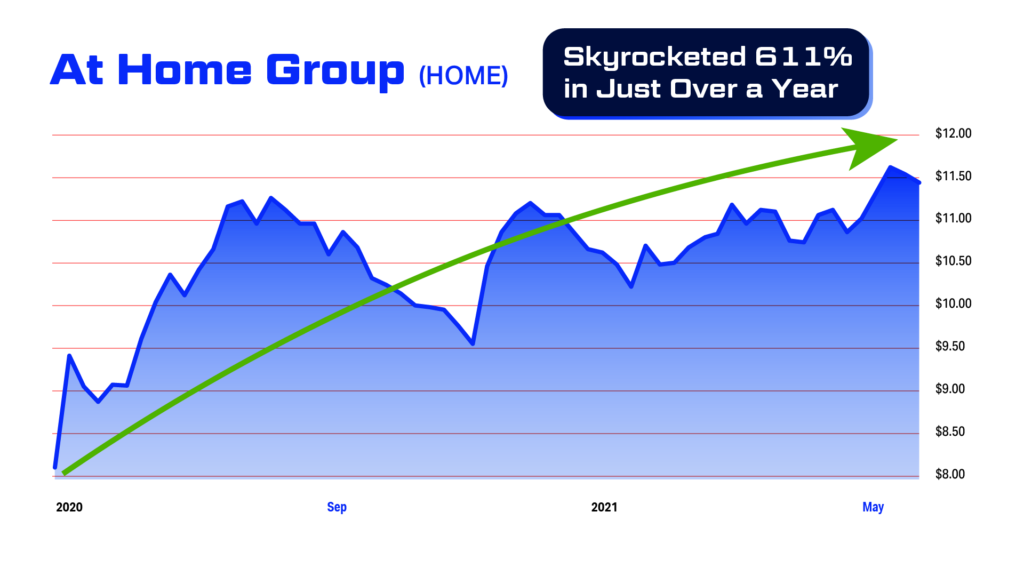
At Home Group (HOME) hit 100 – and skyrocketed 611%.
And those are just some of the highlights. Over the past five years, 28 of their closed recommendations have at least doubled – and some have done a lot better.
This is the first time Joel and the Swans have combined their systems – forensic earnings on one side, real-time sentiment on the other.
And for reasons that Joel and Landon will share with you over the next week, they say the single-best opportunity for individual investors is in a small group of microcap stocks – smaller, more speculative names – that are still flying under most investors’ radars.
They’ll also discuss three monumental forces converging within the next two weeks – involving a rare momentum signal, a hidden move by the Fed, and a big leap in American innovation – that are set to push the AI energy theme into overdrive.
In their U.S. AI Super Summit, which kicks off next Thursday, July 2, Joel and Landon will discuss out the five AI-energy stocks they’ve found at the center of this bullish trend – including one free recommendation as a thank-you for attending.
Registration opens today. Add your name to lock in your spot and get the details as they’re released: click here to sign up.
Our Signals system is flagging a related AI trend…
Lucas Downey, who heads up our new Signals trading service, sent out a note earlier this week about a pattern he can’t stop seeing.
As we’ve been covering in the Daily, every stock has its own behavioral “thumbprint” – a set of patterns in the data that repeats. A signal study looks back through a stock’s history, finds the moments that looked most like today, and asks: What usually happened next?
Not once or twice. Dozens of times, sometimes hundreds. The average outcome – and how often it played out – becomes your edge.
That’s what our Signals software does automatically, running those same calculations across more than 2,400 stocks every day.
And according to Lucas, the same trade keeps showing up: AI infrastructure.
These trades are all about the memory that stores the data, the silicon photonics that move it at the speed of light, and the power systems that keep the data centers running around the clock.
As Lucas puts it, these are the raw materials AI runs on. And they’ve been among the market’s biggest winners this year.
Right now, one category of signal is dominating: what we call a Pivot. It fires when a strong stock sees an extreme short-term dip. And it’s built to catch the snap-back when investors step in to buy the dip.
Seven of the 10 highest-quality Pivot signals in our system right now are on AI-infrastructure stocks:
- ON Semiconductor (ON) – Makes the power chips that manage electricity inside data centers, cars, and factories
- Teradyne (TER) – Builds the machines that test semiconductors before they ship – a checkpoint nearly every AI chip passes through
- Coherent (COHR) – A photonics company whose lasers and optics move data through AI data centers on beams of light
- Vertiv Holdings (VRT) – Supplies the power and cooling that keep dense AI server racks from overheating
- Vicor (VICR) – Designs the power modules that feed electricity to high-performance AI processors
- Sandisk (SNDK) – A memory and storage maker whose flash drives hold the enormous datasets AI feeds on
- Qualcomm (QCOM) – A chipmaker pushing its processors deeper into AI, from phones to the data center
One stock on that list stands out…
ON Semiconductor sits at the top, with a Quality Score of 99.82 – the highest of any setup in the system today.
To put that in plain English: The machine-learning layer of our system is saying this is about as strong a setup as it ever sees.
This signal fires when the stock drops 6.5% or more in a single session. The last 50 times that’s happened over the last 10 years, the stock has been higher 88% of the time over the following month.
Of those times, the median trade has gained about 6%. And the best trade netted a profit of 30% over an average hold of about eight days.
Here’s the part that caught my eye. Look at every time this signal has fired since 2019:
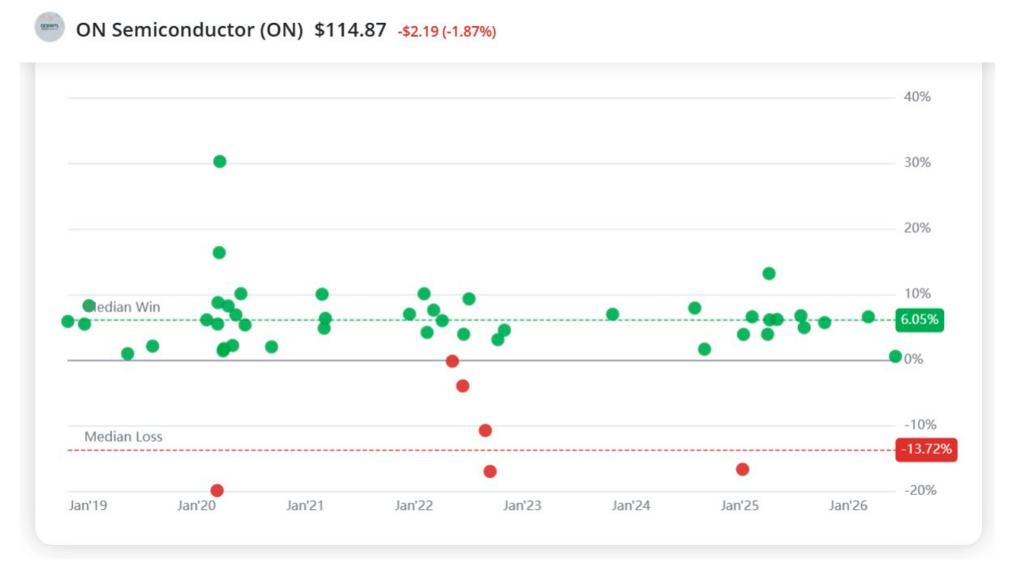
The red dots are the losing trades. What you’ll notice is that most of the losers were during either the 2020 pandemic crash or the 2022 bear market.
There was also one losing trade in January 2025, when semiconductors across the board were in a rut after the low-cost Chinese AI model DeepSeek spooked the market.
Right now, the odds are in favor of ON pivoting and moving higher.
If you subscribe to Signals, add it to your alert list and let the signal’s exit rule tell you when to take profits.
To building wealth beyond measure,
Michael Salvatore
Editor, TradeSmith Daily