To Make Real Money in AI, Own the Chokepoints
Listen to the audio version of this article (generated by AI).
Will June’s SpaceX IPO be a “supernova” event that sparks a frenzy in space-themed stocks?
Will AI agents — digital employees that work around the clock — help build the first trillion-dollar one-man company?
What happens when one in eight Americans are on GLP-1 shots — and entire categories of consumer spending start to shrink or disappear?
These were some of the topics on the table last week at our annual Big Ideas meeting in Washington, D.C.
Once a year, we meet with the analysts from our sister firms Stansberry Research, Altimetry, Chaikin Analytics to talk through our biggest money-making ideas for the year ahead.
These aren’t the typical talking heads you see on TV.
InvestorPlace’s Eric Fry has been picking stocks for nearly four decades. And Louis Navellier has been doing it even longer — he started his first newsletter, MPT Review, in 1980.
Marc Chaikin built indicators that are carried on every Bloomberg terminal around the world. And Joel Litman over at Altimetry advises some of the biggest pension funds in the country.
We discussed dozens of trends and themes over our two days together in D.C. But one idea dominated the room — the monumental spending flowing into AI infrastructure and how that’s creating a rolling set of chokepoints in the supply chain.
The companies that control those chokepoints wield rare advantages — pricing power, multi-year demand visibility, and competition that can’t catch up fast enough to matter.
That’s what I want to walk you through today — two of the chokepoints at the chip level and the three companies our system is flagging as the best ways to play them.
$700 Billion, and It Still Isn’t Enough
By the end of this year, four U.S. tech giants — Microsoft, Google, Amazon, and Meta — will have spent more than $700 billion on AI infrastructure.
That’s more than twice what it cost in today’s dollars to land 12 men on the Moon and build the atomic bomb — combined.
And that’s not the total bill for the AI buildout. That’s just one year. Wall Street expects the figure to top $1 trillion in 2027.
It’s the largest sustained surge in spending in the U.S. since the end of World War II. If you’re not thinking about it as an investor, you’re ignoring the most powerful force in the market today.
But here’s the part the headlines miss: The money is moving faster than the physical world can absorb it.
You can see the strain across the entire AI supply chain:
- High-bandwidth memory chips — the specialized memory that feeds AI processors — sold out through 2026 by the end of last year.
- Power transformers needed to hook data centers up to the grid are on lead times stretching to five years for specialized units.
- Liquid-cooling parts needed to stop AI chips from overheating have waitlists that run into 2027.
And in Loudoun County, Virginia — the world’s largest data center hub — the local utility, Dominion Energy, has warned that some new projects could wait up to seven years for a full power hookup.
These aren’t supply hiccups. They’re critical chokepoints this trillion-dollar spending wave is running headlong into.
For the tech giants, that’s a headache. For us as investors, it’s a chance to own the chokepoint — and that’s where fortunes get made in industrial booms.
When supply can’t expand to meet demand, the companies that already own the supply are in a rare position. They don’t chase customers. The customers chase them. And the barriers to new competition — capital, expertise, regulatory approval — are too high for anyone else to clear quickly enough to matter.
We’ve identified five chokepoints in the AI infrastructure buildout. Today I’ll walk you through two — both inside the chips themselves. Then we’ll look at the other three in my regular slot next Friday.
Chokepoint No. 1: The Memory Wall
The first chokepoint is something many investors have never heard of — high-bandwidth memory (HBM).
A frontier AI model has hundreds of billions of internal settings. Every time it generates a sentence or writes a line of computer code, it has to pull those settings out of memory and feed them to the processor. Regular memory chips can’t move all that data fast enough to keep up.
Only three companies make HBM: South Korea’s SK Hynix, Samsung, and Micron Technology (MU) here in the U.S. The manufacturing process is so demanding it’s taken these three more than a decade of R&D to get there.
Last October, SK Hynix told the Financial Times its entire 2026 production was already sold out. Customers are now negotiating for 2027 slots. Goldman Sachs called it the worst memory shortage in 15 years.
Micron is the cleanest U.S.-listed way to play it. And our system agrees. The platform’s Quantum Score — a single 0-to-100 read that combines fundamental and technical signals — has Micron at 91.2.
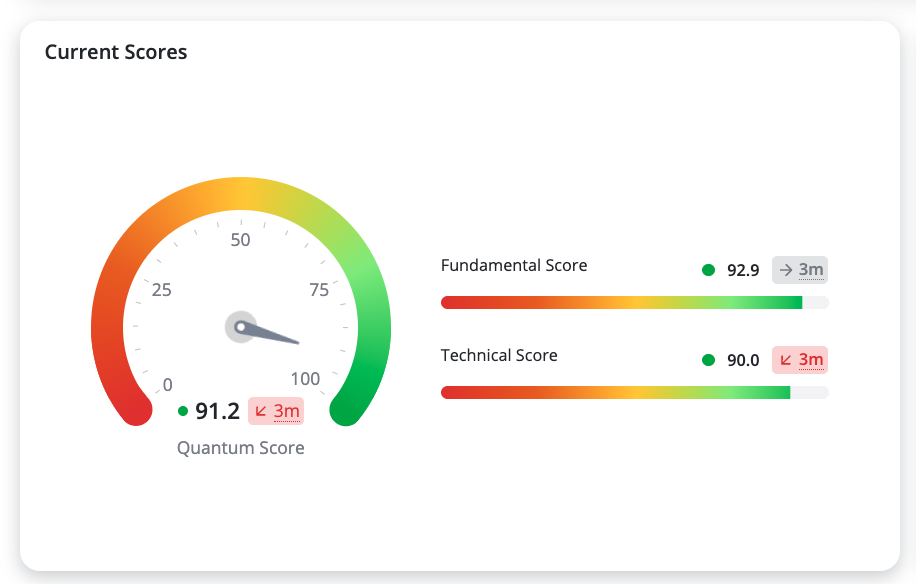
That puts it in the top tier of every stock we track.
Chokepoint No. 2: The Photonics Crunch
Solving the memory problem is only half the battle. Once data leaves a chip, it has to travel — usually to another chip, in a building where tens of thousands of processors are working together on a single AI model.
For decades, those connections have been copper wires. But at AI speeds, copper wastes too much electricity as heat. And the signals start to degrade.
The solution is called silicon photonics — sending pulses of light through tiny glass fibers instead of electrons through wire. Light is faster. It doesn’t waste energy as heat. And it can carry far more data through a far smaller cable.
But building the components that turn electricity into light and back — called optical transceivers — is genuinely hard. The lasers fire pulses of infrared light at wavelengths so precise they’re measured in billionths of a meter. And the machines have to run 24 hours a day, for years, without failing.
Two companies dominate this overlooked piece of the AI infrastructure buildout.
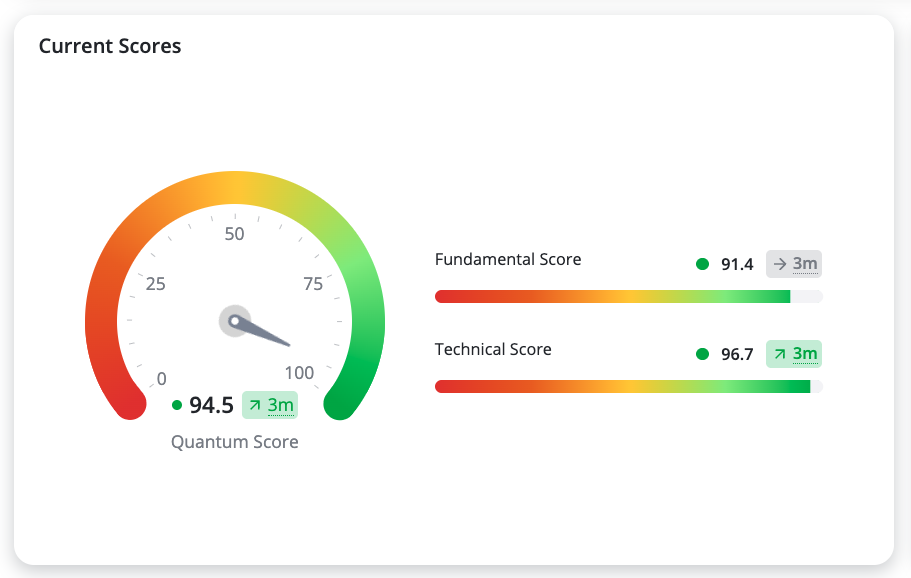
Broadcom (AVGO) designs the networking silicon that routes traffic between the GPUs inside an AI cluster. Nvidia sells the GPUs. Broadcom sells the connective tissue that links them together.
It has a Quantum Score of 94.5.
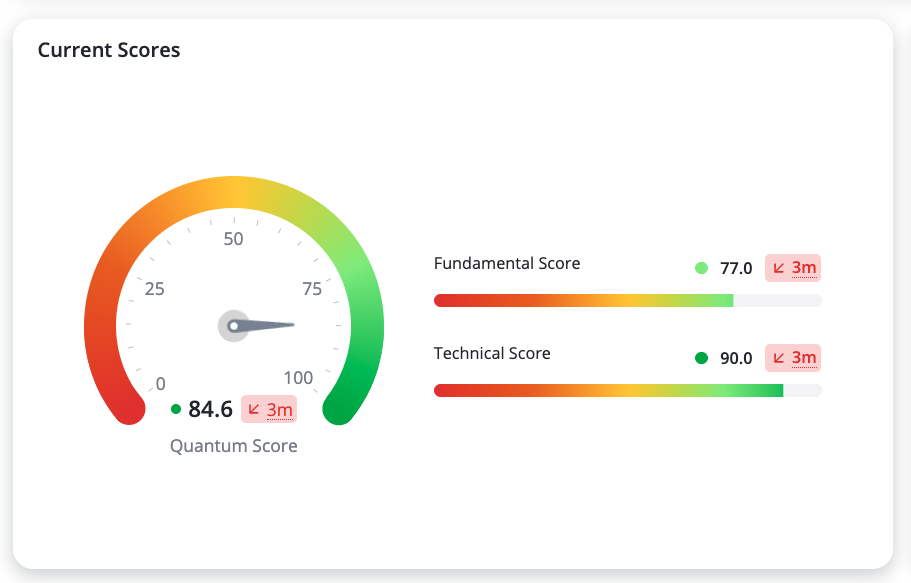
Coherent (COHR) makes the optical transceivers. In March 2026, Nvidia made a $2 billion strategic investment in the company — a signal of how central Coherent has become to the AI networking layer.
It has a Quantum Score of 84.6.
How to Play This Trend
Owning key stocks that control these chokepoints is a great way to play the AI boom.
But it doesn’t come without risk.
These three stocks have already had big run-ups. Micron is up nearly 60% in the past month alone. Broadcom and Coherent have more than doubled over the past year.
So I’m not recommending you back up the truck here. Instead, put these stocks on your watchlist, scale in on pullbacks, and use a tight stop from the start.
The most effective way to do that is with our Short-Term Health indicator. Short-Term Health is tuned for faster shifts in trend than our traditional Long-Term Health indicator. It will get you out earlier if the AI trade — or the broader market — starts to roll over.
You may get stopped out and have to re-enter. That’s the trade-off. But after run-ups like these, I’d rather you pick the right entries and follow your stops than get crushed by potential pullbacks.
It’s not enough to spot big trends — you also have to know how to play them without taking big risks.
Owning the chokepoint is how you make the money. Buying on pullbacks and using a tight stop-loss is how you make sure you lock in those profits.
I’ll be posting more about this and other big themes and trends we’re watching here at TradeSmith on my X account.
If you’re a subscriber, you can track my latest posts from the TradeSmith Finance dashboard. You can follow me directly on X here.
I post there every day about the opportunities our systems are flagging. So it’s a great way to keep up with our latest ideas.
All the best,

Keith Kaplan
CEO, TradeSmith