Trend Watch: The Collapse of College
BY ANDY SWAN
A compelling advertisement popped up on college campuses this spring, printed in bold white letters on a black background:
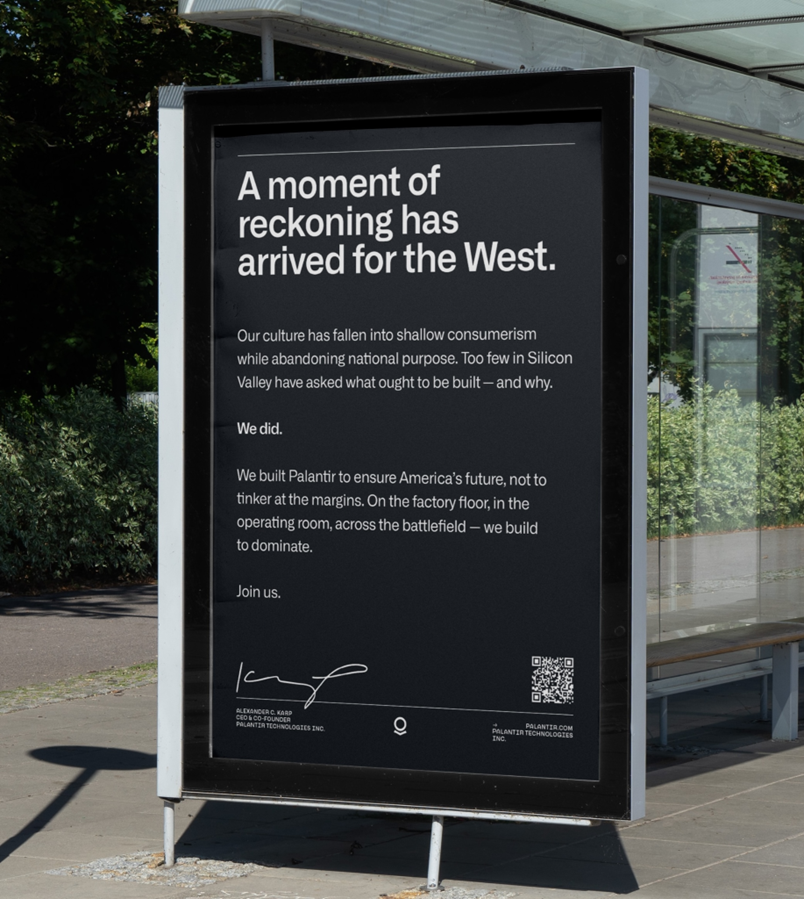
“A moment of reckoning has arrived for the West.
Our culture has fallen into shallow consumerism while abandoning national purpose. Too few in Silicon Valley have asked what ought to be built – and why.
We did.
We built Palantir to ensure America’s future, not to tinker at the margins. On the factory floor, in the operating room, across the battlefield – we build to dominate.
Join us.”
The ad from Palantir Technologies (PLTR) is designed to recruit talented individuals, no degree required.
In April 2025, Palantir launched its Meritocracy Fellowship – a four-month, full-time training program for high-achieving high school graduates. There’s no tuition, no coursework, and no formal credentials.
Participants work on real engineering problems inside the company. Those who deliver results can move into full-time roles.
It’s a direct alternative to college… and a bold challenge to the “old guard” career path of past generations.
Palantir is no outlier. Employers across all sectors – from tech to airlines to retail – are actively dropping or relaxing degree requirements:
- Google (GOOGL) now hires for many technical roles based on its Career Certificates program, rather than a college transcript.
- Delta Air Lines (DAL) has eliminated degrees as a prerequisite for pilots and corporate positions, building its own flight academy pipeline.
- Walmart (WMT) promotes hourly workers into salaried roles through its Live Better U program, which covers tuition for supply chain, health science, and IT tracks.
- Chipotle Mexican Grill (CMG) managers routinely rise from crew positions without any formal credentialing beyond internal training modules.
All these developments show us one thing.
The college degree is no longer the default signal of readiness.
Employers from Palantir to Chipotle are leaning on internal credentials, short-form training, and project-based evaluations to identify talent.
Students see it, too. The number of Americans who are confident in higher education has fallen from 57% in 2015 to just 36% in 2024. One-third now report little or no confidence at all.
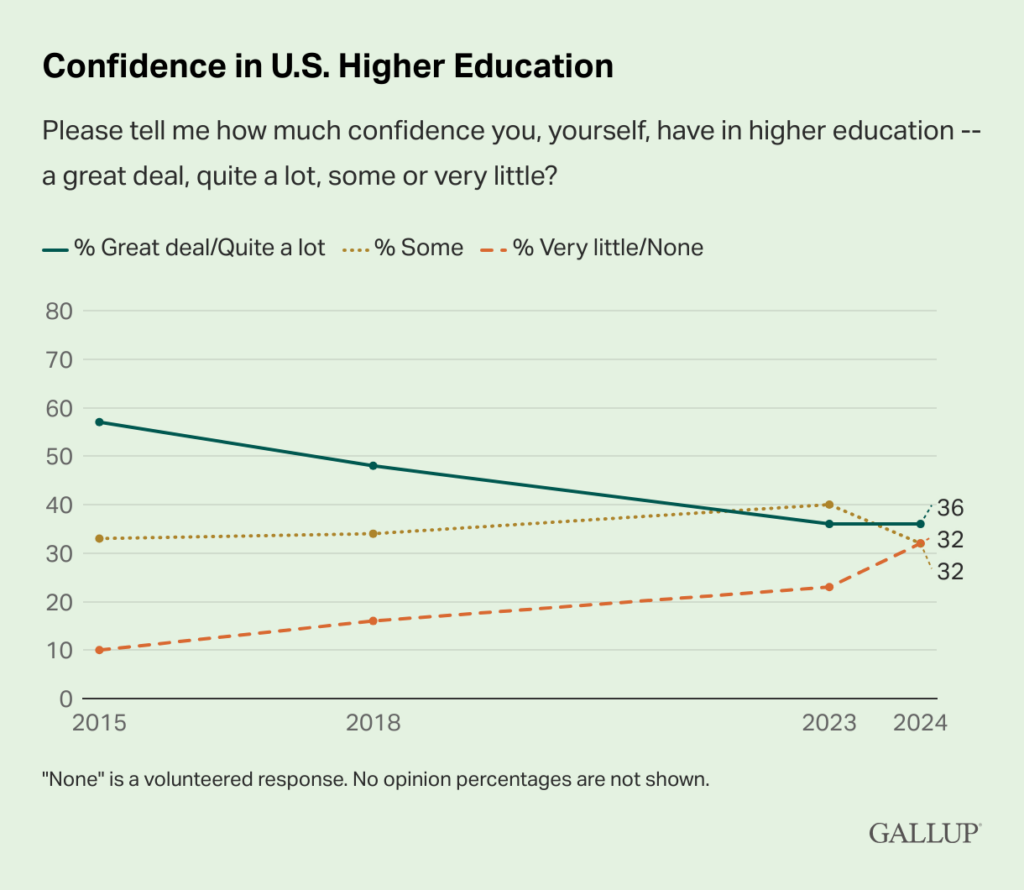
That skepticism is grounded in economics. Students are graduating later, paying higher tuition, and entering a job market that no longer meets expectations.
The return on investment and sweat equity is diminishing – fast.
According to the National Center for Education Statistics, college attendance declined as much as 15% between 2010 and 2021. While total enrollment has stabilized in recent years, it’s still down 8.4% since 2010.
The long-term trend remains negative.
The value proposition weakens with every graduating class.

And now the demographics are compounding the pressure.
According to WICHE (Western Interstate Commission for Higher Education), the number of U.S. high school graduates will peak in 2025 before entering a long, sustained decline through 2041.
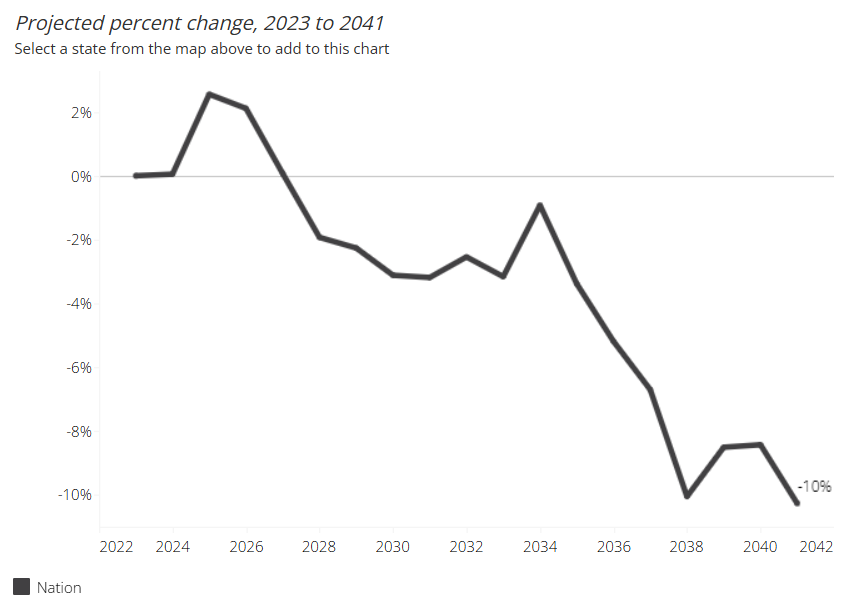
That contraction is seemingly locked in, driven by falling birth rates stemming from the 2008 financial crisis and continuing since then.
The declines won’t be evenly distributed, either. The Midwest and Northeast are expected to experience the sharpest drops, placing even greater pressure on regional liberal arts colleges already facing declining enrollment.
In just the first nine months of 2024, 28 accredited degree-granting institutions shut down – nearly double the number from the prior year. Analysts expect dozens more closures by the end of the decade as enrollment pressures deepen.
The model that powered American higher education for 70 years is collapsing.
- Public confidence in college has been decimated – only 36% of Americans still trust the system.
- Enrollment is down 8.4% since 2010.
- The student pipeline is shrinking, with high school graduate numbers set to decline through 2041.
And at the same time, the alternatives are scaling…
“New School” Opportunities for a New Era
Career-aligned high school programs, short-form technical certifications, and skills-based hiring platforms are replacing traditional four-year paths. And many of today’s students are opting for these cheaper, faster, job-linked alternatives to the traditional college experience.
These alternative models operate on compressed timelines, focus on job placement, and rely on performance rather than degrees. Most programs can be completed in under a year.
Students are drawn to them for the clear path to employment. Employers back them because they deliver talent faster and more efficiently than the old model ever could.
And what might not be obvious is that this shift in education is investable…
What you’re reading right now is a sneak peek of the brand-new issue of MegaTrends. In these monthly member reports, we dig into a major investor trend and leverage LikeFolio’s consumer data to find the potential winners.
This month’s highlights three companies positioned to benefit from these shifts – one of which is already in our portfolio and has more than doubled in the past year.
Each captures a different stage in the larger scale educational collapse underway:
- The first is building the career track before students ever consider college.
- The second is capturing demand for hands-on skills in fields traditional schools have ignored.
- And the third is scaling the workforce engine employers now rely on – without a diploma in sight.
I’ll let you in on that first stock today, our top pick for playing this trend. It’s a name our subscribers already have a huge headstart on.
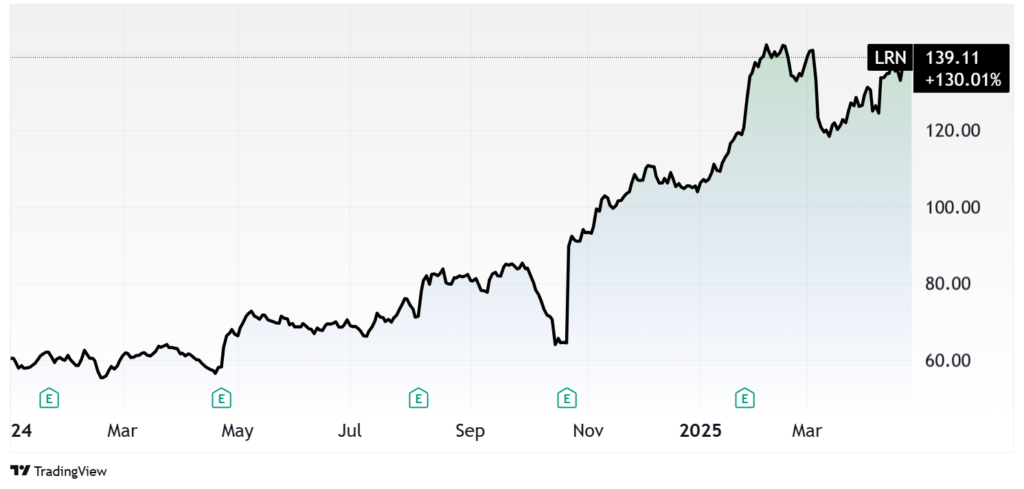
We got them into this trade early last January – and it’s delivered +139% so far.
This stock has proven to be a green outlier in the market’s sea of red, and LikeFolio data suggests there’s plenty more profits to come…
Our Top Way to Play
Online courses and tools are playing an increasingly prominent role in a global education sector ripe for disruption – and Stride’s (LRN) offerings are meeting this demand head on.
Stride offers a digital alternative to traditional high school, delivering blended learnings solutions across various grade and ability levels with an emphasis on career preparation and skills training.
The company dabbles in adult learning and professional development programs as well, but its strongest momentum is coming from younger students – especially those enrolling in career-focused programs that align directly with employer needs in health care, IT, and skilled trades.
These programs introduce practical, industry-aligned training before graduation and are already reshaping how families think about long-term education planning.
Stride is also leaning into personalized academic support to address a massive increase in tutoring demand since the COVID-19 pandemic. Its K12 Tutoring program, launched nationwide in December 2024, is growing through direct school district partnerships, offering high-impact sessions with state-certified educators.
If you need further proof that demand for alternative learning solutions is rising, look no further than Stride’s latest earnings:
- Total enrollment rose 19% year over year to 230,600.
- Students in its Career Learning segment (focused on job-aligned education for middle and high school students) jumped 31%.
- Revenue increased 16% to $587.2 million.
- And earnings climbed 32% to $2.03 per share.
Stride’s operational model is scaling cleanly. Revenue per enrollment remains stable. Overall demand for its services is strong. And the stock is a proven winner.
Anyone can find this data on the company’s website.
At LikeFolio, our edge comes from the proprietary metrics we developed to measure real-time consumer demand and sentiment. This largely untapped data source tells us how the most important factor to any company – its customer – is interacting with it.
LikeFolio predictive consumer metrics reveal that Stride’s digital traffic is outpacing segment-wide averages – visits to its K12 programs are up +23% year over year:

Stride is focused on students who begin exploring career-aligned options well before college is on the table. As early-career training becomes a primary decision driver, Stride is positioned to capture enrollment well before college even enters the picture.
Sure, investing in an online learning stock may not sound as exciting as scooping up shares in high-profile AI, robotics, or autonomy plays.
But while the rest of the market reels from uncertainty, Stride’s performance remains steadfast. And I think we can all use a little consistency right about now.
The world is evolving. Traditional degrees aren’t the shoo-in they used to be. And the market gets more volatile by the day.
But with LikeFolio and TradeSmith in your corner, you can turn even the bleakest trend into your own profit opportunity.
Remember, Stride is one of three ways to play this trend. Here’s what I can tell you about the others:
- Pick No. 2 is capturing demand for hands-on skills in fields traditional schools have ignored. Web visits are gaining by 24% year over year, indicating growing interest among prospective students.
- Pick No. 3 is scaling the workforce engine employers now rely on – without a diploma in sight. It’s a speculative play, trading under $5 a share. But as employers resume hiring and shift further away from degree-based filters, this company will benefit.
Our paid-up members have the full details on these stocks in hand in their April MegaTrends Issue.
To see how you can join today and get your hands on the report while the opportunities are hot, click here. You’ll learn all about our proprietary system for sorting the winners from the losers – and the powerful stock-picking tool behind it.
Until next time,
Andy Swan
Founder, LikeFolio