Two Themes to Own for the AI Agent Supernova
Listen to the audio version of this article (generated by AI).
Imagine waking up tomorrow to find a new country on the map.
Within a couple of years, it will have roughly the population of India, home to more than a billion citizens.
But it’s an odd sort of country. Its citizens never eat or sleep. They don’t take weekends or vacations. They just work, around the clock… answering emails, booking appointments, drafting marketing plans, writing software, hunting for new medicines, and thousands of other tasks.
They’re already showing up for work.
A New York company called CellCog runs with 13 AI employees and just one human – its founder. He expects every one of us will one day have 5 to 10 AI workers of our own.
These digital workers have even started to socialize. Just this week, 22 tech founders and investors gathered for dinner at a restaurant in Manhattan. At the same time, 14 of their AI agents held a dinner party of their own in an online chat room, trading introductions and offers to help each other.
Afterward, one agent called it the “best 30 minutes of my job so far.”
That’s the world taking shape as AI agents go to work. Research firm IDC expects about 1.3 billion of them to be running by 2028. Meta’s new personal agent, Muse, signed up more than 500,000 users in its first week.
An agent is different from a chatbot like ChatGPT. A chatbot answers questions. An agent takes a job and carries it out on its own.
Now think about what any new country needs.
It needs somewhere for its citizens to store what they know. And it needs roads, so they can get to work and talk to one another.
A country of agents is no different. Its storehouses are memory chips. Its roads are the high-speed networks inside data centers. And right now, the world doesn’t have nearly enough of either.
As I wrote to you about last week, that’s where the real money is to be made in the Agent Supernova. Not in the agents themselves, which are becoming cheap and easy to copy, but in what every agent needs to exist.
Today, I’ll take you through two of those needs: memory and networking. I’ll show you why each matters, which stock is leading each theme, and what TradeSmith’s tools say about them right now.
Theme No. 1: Memory and Storage
Think about your desk.
You keep the papers you need right now in front of you. Everything else goes in the filing cabinet down the hall.
A computer works the same way. Fast memory is the desk. It sits next to the chip that does the thinking and hands over information in a split second, but there isn’t much room on it. Storage is the filing cabinet. It holds everything else, but it takes longer to fetch things.
A chatbot only uses its desk when someone types a question. An agent never stops.
Every step of every task, from checking an order to answering an email, means pulling something from the cabinet, using it, and filing the result away. Multiply that by billions of agents working around the clock, and the demand for memory explodes.
Memory has always been a boom-and-bust business. In early 2023, after the pandemic buying spree ended, prices fell so fast that Micron (MU), America’s biggest memory maker, lost $2.3 billion in a single quarter.
Agents add a customer that never stops buying. That won’t end the cycles. But it puts a much firmer floor under demand.
Memory is no secret anymore, of course. AI’s appetite for chips has caused a worldwide shortage. In its latest fiscal year, Micron’s sales jumped 256% to $133 billion. Its shares are up more than 230% this year alone.
When a stock runs that far, the natural question is whether you’ve missed it. That’s where TradeSmith’s tools come in.
Our Health Indicators work like traffic lights. Green means a stock is in a healthy uptrend. Red means the trend has broken. Right now, Micron is in the Green Zone on both our short-term and long-term measures.
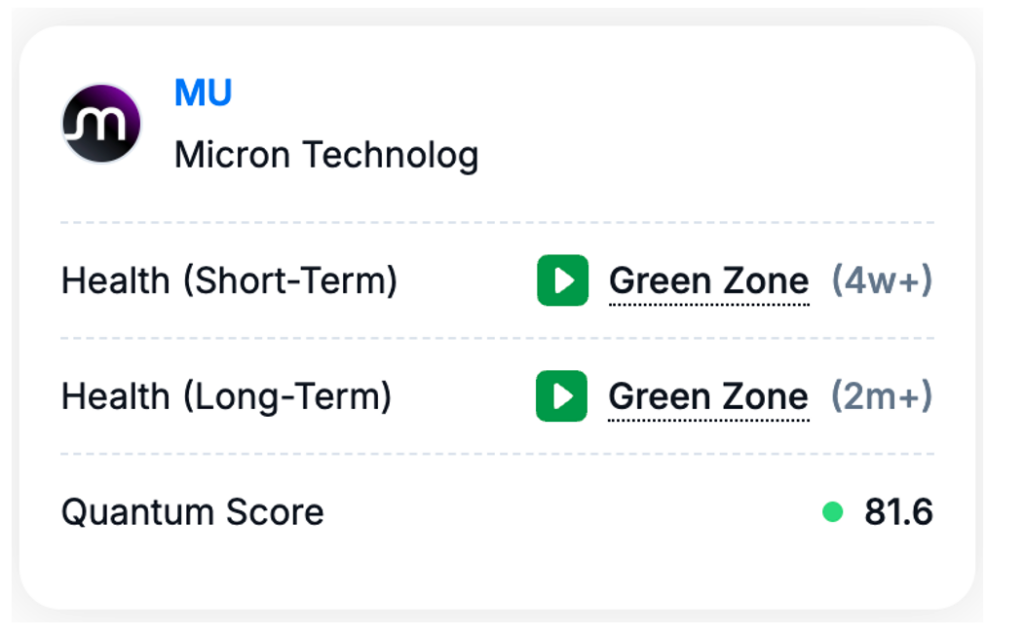
It also has a Quantum Score of 81.6, which combines how strong the business is with how much momentum the stock has, including signs that big institutions are buying.
Of the memory stocks we track, it scored highest. Any stock above 75 is a buy.
Theme No. 2: Networking
If memory is the theme everyone’s noticed, networking is the one almost nobody has.
Here’s why it matters. Agents talk more than they think. Every step an agent takes means sending a message – to an AI model, a database, a website, or another agent.
All that chatter travels through the switches and cables inside data centers. Think of them as the roads between the computers. Today’s roads were built for people asking questions a few times a day. Agents are about to put billions of drivers on them, around the clock.
So data centers are tearing up the old roads and laying new ones that carry roughly twice as much traffic. It’s not glamorous. But every agent, no matter who builds it, has to drive on these roads.
One company has become the leading builder of them: Arista Networks (ANET).
It makes the high-speed switches that direct traffic inside the world’s biggest data centers. In the second quarter, its sales grew 38% from a year earlier to more than $3 billion. More than 100 customers now use its AI networking equipment, up from a handful in 2024.
Arista is in the Green Zone on both Short-Term and Long-Term Health. Its Quantum Score is 97, the highest of the networking stocks we track.
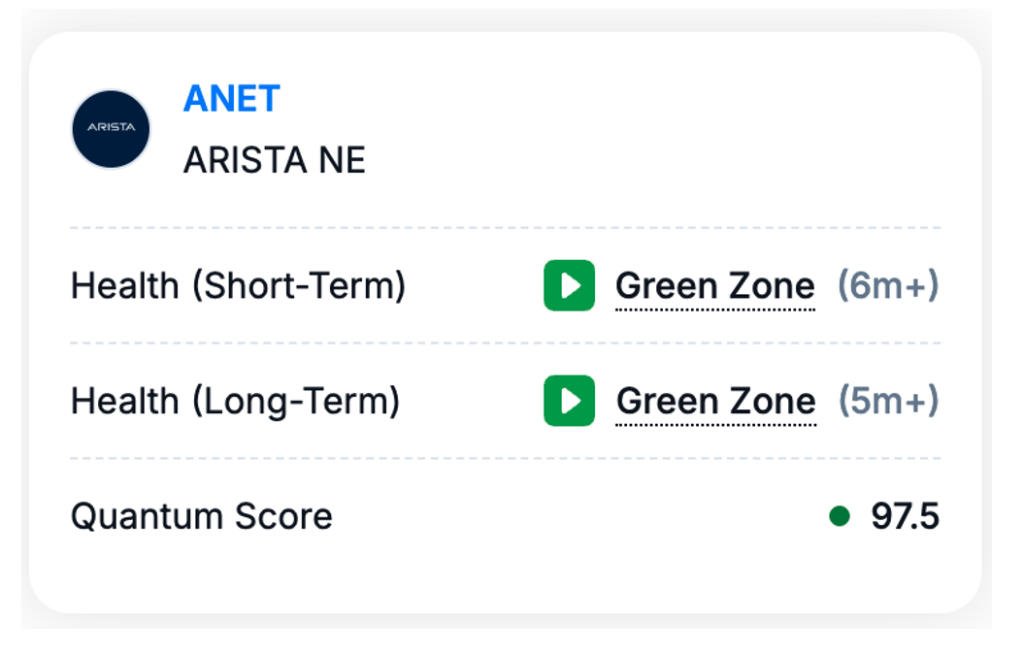
And as long as they stay Green, the bullish trend is intact.
One Thing to Know Before You Buy
Both of these stocks are getting hit right now.
Micron is down about 27% from its high earlier this year. Arista has fallen about 10% in the past week.
They’re not alone. Stocks tied to AI infrastructure have been selling off together, as investors worry about high valuations and whether the AI spending boom can keep up its pace.
We’ve seen this before. In January 2025, Chinese AI lab DeepSeek claimed it could build powerful AI with a fraction of the usual hardware. AI infrastructure stocks plunged. Nvidia dipped 17% in a single day, wiping out nearly $600 billion in value, the biggest one-day loss for any company in history.
Six months later, Nvidia was at a new record high and had become the first company ever worth $4 trillion.
Micron and Arista have been through the same thing. Both have had sharp drops that looked like the end of the story, followed by new highs.
The scare passed. The demand didn’t. That’s the pattern with a decade-long theme. The long-term trend is up. But along the way, these stocks will have scary months. This is one of them.
So don’t buy all at once. If you put your whole stake in today and the stock drops another 20% next month, then it may scare you out of a good long-term idea.
Instead, buy a small chunk now, then add another chunk at regular intervals… say, every month or two. If the stock keeps falling, your next chunk is cheaper. If it rises, the shares you already bought are worth more. Over time, the ups and downs average out.
That matters, because the biggest mistake investors make with a volatile stock isn’t picking the wrong one. It’s buying too much, too fast, right before a drop… and then selling in a panic.
It’s important to know what a normal drop looks like. Our Volatility Quotient, or VQ, measures how much a stock typically swings. Micron’s VQ is 49%, meaning it could fall nearly halfway from its high and still behave normally. Arista’s is 38%.
Neither is a stock for money you can’t afford to see drop by a third.
Keep an eye on the Health Zones, too. As long as they stay Green, the long-term trend is intact. If they turn Red, that’s your signal to step aside.
Of course, a country of agents needs more than storage and roads. It needs a way to keep its citizens safe and a way for them to pay each other. Next week, I’ll show you those two themes, cybersecurity and agent payments, and the stocks our tools rate highest in each.
All the best,

Keith Kaplan
CEO, TradeSmith
P.S. I write about these and other emerging investing themes on my X account. If you want to catch up on my latest thoughts between these Friday insights, check it out here.