Wall Street’s Whales Leave a Trail – Here’s How to Follow It
Listen to the audio version of this article (generated by AI).
Michael’s note: Most investors assume options trading is a casino – too risky, too complicated, and built for professionals with a Bloomberg terminal and deep pockets.
We built the Smart Money Edge to change that.
Smart Money Edge watches where Wall Street’s biggest players are placing their bets in the options market, before the rest of the market catches on.
You’ve heard our CEO Keith Kaplan talk about this tool over the past week – the pattern it’s built to catch, and the trades it’s flagged before the news broke.
Today, I asked Mike Burnick, our Senior Analyst for Options360 – the suite of tools that includes Smart Money Edge – to walk you through what it looks like in practice.
If you haven’t caught the replay of Keith’s 30-Day Wealth Accelerator event yet, do it today. Everyone who watches – whether you buy anything or not – gets access to three free trades Keith gave away live. That access closes Monday.
Now, here’s Mike…
Every day, hedge funds and big Wall Street trading firms use call and put options to place massive bets on which way they think stocks will move.
They do this instead of buying the stock directly, because they can control more shares with less money at stake – and much larger payoffs if they get it right.
That’s why the whales on Wall Street often place these trades in the options market before a stock’s price actually moves.
Despite the size of these trades, most everyday investors never see any of this action. It’s buried in a blizzard of daily trading data.
That’s what drove our team to build a new tool to uncover those hidden signals and turn them into ideas you can actually trade. We call it Smart Money Edge.
Following the Whales
Instead of guessing where a stock is headed next, Smart Money Edge shows you how the Wall Street pros are placing their bets behind closed doors – and gives you the chance to place yours alongside them.
There’s good reason to want in on that.
We tested Smart Money Edge against every stock in the S&P 500 from February 2022 through April 2026.
About 80% of the stocks it flagged moved higher within a month. The average gain across all of them – winners and losers both – was about 14% over the next 21 trading days.
Those are backtested results, not live trades, so treat them as a guide to how the system behaves rather than a promise of what it’ll do next.
But the pattern showed up often enough, and consistently enough, that we knew we had to bring it to TradeSmith’s Options360 and Platinum users – the latter group getting everything we publish, and both getting all updates we push.
Smart Money Edge has already caught some real moves before they broke into the headlines:
- Rocket Lab (RKLB) – flagged the day before it beat earnings and jumped 50% in a single day
- Vista Energy (VIST) – flagged nine days before a surprise acquisition sent shares up 32%, even while the stock was still falling
- Oscar Health (OSCR) – flagged about a week before strong earnings sent shares up 15%
- GameStop (GME) – flagged before a single social media post sent shares up 70%
None of those moves were visible in the stock price when our system caught them. They were visible in the options market first.
What’s Actually Driving the Signal
Smart Money Edge runs on two numbers most investors have never thought twice about: Volume, the number of options contracts traded on a given day, and Open Interest, the total number of contracts still open.
Think of Open Interest as a running tally of every bet still on the table. Volume is how much new action showed up today.
When Volume outpaces Open Interest, that means new money is flowing in fast – somebody’s making a move before the rest of the market catches on.
Each trading day, our system scores every stock on a scale that reflects how strong that signal is. The higher the score, the more likely it is that smart money is active in that stock’s options right now. Three checks build that score:
- The Big-Money Check. We compare today’s total dollar volume in a stock’s options to its normal 30-day average. If a stock that normally sees $2 million a day in options volume suddenly sees a single $500,000 trade – a quarter of its typical full day – that’s someone placing a serious bet.
- The Directional Check. We look at whether the buying is lopsided toward calls (which pay off if the stock rises) or puts (which pay off if it falls). A roughly even split doesn’t tell you much. A heavy lean one way does.
- The Urgency Check. We measure how much implied volatility – the market’s own estimate of how far a stock might move – has jumped over the past five days. A sharp spike means someone’s trading with urgency, not casually building a position over weeks. That’s the tell that somebody knows something and is acting on it now.
When all three line up, that’s a Smart Money Edge signal – real money moving fast, in one direction, on a stock most investors haven’t even glanced at yet.
Now, some stocks are heavily traded in the options market by virtue of them just being very popular stocks. A score that looks huge on a quiet stock might be completely normal for one that trades options constantly.
So every Smart Money Edge score also runs through an AI model that learns what’s normal for that specific stock – its own trading “personality” – and flags only the scores that break from that stock’s own pattern.
When a stock shows up on our daily Smart Money Edge list, it’s cleared both bars: a high score and a break from its own normal behavior. That combination is what you’re looking for.
Why This Matters Even If You’ve Never Traded an Option
You don’t need an options account to get the value out of this. The signal itself – unusual, urgent, directional money moving into a stock before the news breaks – is worth knowing about no matter how you invest.
But if you do want to act on it directly, this is exactly the kind of edge Keith built the Smart Money Edge tool to hand you. It’s live inside Options360 right now, flagging new signals every trading day.
For example, take a look at this signal that showed up on Friday:
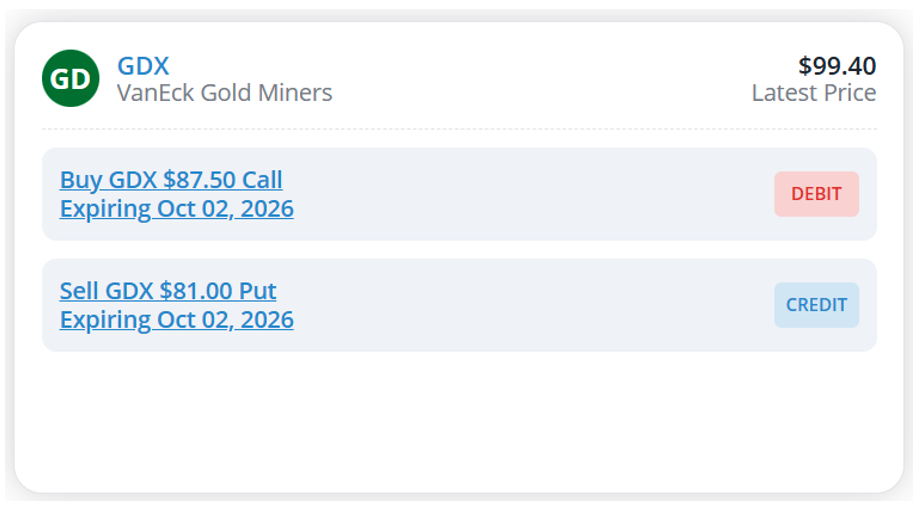
Right now, the Smart Money Edge system is detecting unusual activity in the VanEck Gold Miners ETF (GDX). It’s recommending two different trades to take advantage:
- Buying the GDX $87.50 call option that expires on October 2, 2026.
- And selling to open the GDX $81 put option expiring October 2, 2026.
Options360’s dashboard can help you decide which trade to take. Take a look at these two key dashboard metrics:
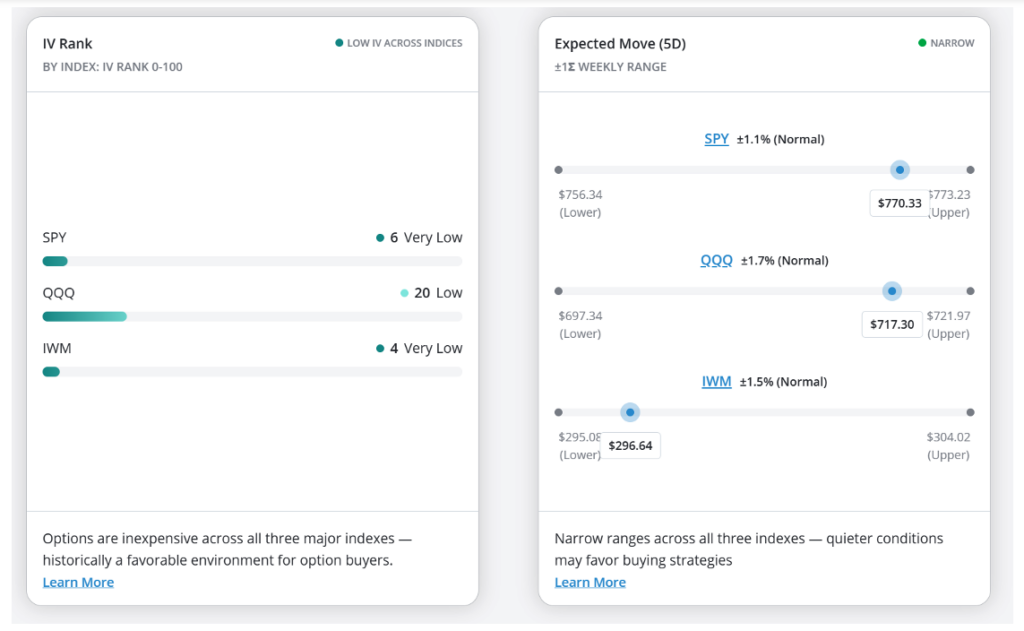
The IV Rank tool shows us that there’s very low implied volatility across options markets in the major indexed ETFs: the SPDR S&P 500 ETF (SPY), the Invesco QQQ Trust (QQQ) – a proxy for the Nasdaq-100 – and the iShares Russell 2000 ETF (IWM). That means options are cheap, because volatility is low.
And the 5-day Expected Move tool tells us that investors are expecting a narrow range for markets over the next 5 days. That reinforces the low-volatility, cheap-option environment.
Both things indicate an edge for options buying strategies. And that means the Buy Call trade idea on GDX is worth keeping on your radar.
Bottom line, Wall Street’s biggest players leave a trail in the options market days or weeks before their bets pay off. Most investors never see it – and not for lack of trying.
Smart Money Edge was built to read that trail in real time. And in our testing, about 80% of what it’s flagged has paid off within a month.
If you want to see what it’s currently flagging – and get the same three free trades Keith gave away during his 30-Day Wealth Accelerator event from last week – you’ll need to move before Monday. After that, this window closes.
Get the full details right here.
Good investing,

Mike Burnick
Senior Analyst, TradeSmith