We ❤️ Extreme Fear
Listen to the audio version of this article (generated by AI).
In This Digest:
- We ran the numbers – Extreme Fear markets are the time to buy
- The ultimate anti-AI trade is live entertainment
- Two stocks to love for very different reasons
Our new Fear & Greed gauge proves that nagging feeling you have…
You know the feeling.
You turn on CNBC and you can almost see the sweat around the collars of the pundits.
The chyrons are bathed in red for special coverage of “Markets in Turmoil.”
Every topic at hand is about how much worse things could get. Think the pandemic crash of March 2020, the bear market summer of 2022, and the April 2025 Liberation Day crash.
Moments like these are prime time for TV’s talking heads and financial “gurus” on social media.
This is when the most eyeballs are pointed their direction, seeking answers… but finding only more reasons to fear.
Next time this happens, we urge you to tune out from the noise.
Instead, check TradeSmith’s Fear & Greed indicator…
And maybe consider holding your nose and buying.
Our new Fear & Greed indicator works differently from the one you’ll find on CNBC.
We’ve built a Fear and Greed indicator that comes with a built-in trading blueprint.
We measure a proprietary group of stocks by how far they’ve fallen from their 3-month high, their 20-day volatility, and any unusual spikes in volume recently.
Then we measure the percentage of that group that’s trading in bullish or bearish conditions based on these readings. That gives you the score between 0-100, where the lower the score, the more fearful the market.
But the testing – conducted over 10 years of real market data – is what really shines.
We’ve divided up the market into five “regimes” – covering Extreme Fear, Fear, Neutral, Greed, and Extreme Greed.
Most of the time, the market shifts between Neutral and Greed. And you might expect these are the best times to be in stocks.
They’re certainly not bad. Over the following 20 days, Neutral markets are higher 68.2% of the time for an average gain of 1.2%. In Greedy markets, the 20-day win rate rises to 69%, but the average gain falls to 0.8%.
Turns out, Buffett was right that you should be greedy when the market is fearful. And we’ve proven it.
Over the following 20 days of Extreme Fear ratings, stocks were higher 84.6% of the time for an average gain of 6.4%.
That’s more than five times the average return from when stocks are in Neutral. It’s both the highest win rate and highest average 20-day return of any regime on our gauge.
Markets are in Neutral today, to be clear. But this should serve as a friendly reminder that when investor sentiment gets excessively fearful – as it did during the Liberation Day Crash, the Iran War correction, and the recent chip stock momentum unwind – that’s a time to back up the truck.
Billionaires are buying into this AI-proof asset…
And the top stocks to get exposure are winners for different reasons.
Two headlines hit this week that, seem like head-scratchers.
First, it was reported that Amazon founder Jeff Bezos was in talks to buy a minority stake in English Premier League football club Liverpool FC at about a $6 billion valuation.
Days later, word got out that two-time former Disney CEO Bob Iger, along with tech venture capitalist Joshua Kushner, were buying the Los Angeles Lakers at a $12.5 billion valuation.
Why are these big tech and entertainment leaders suddenly so interested in buying sports teams?
It’s an anti-AI trade.
Sports and other in-person entertainment appear to be a big AI-proof industry, as well. As both the U.S.-hosted World Cup and the recent excitement over the New York Knicks’ NBA championship have shown, people are still passionate about human beings getting out on the court, pitch, or stage and showing off their natural talents.
Yesterday, we covered why Financial stocks are a safe haven from the volatility and uncertainty that AI technology brings.
Today, two stocks stand out for different reasons: Madison Square Garden Sports (MSGS) and Madison Square Garden Entertainment (MSGE).
MSGS owns the New York Knicks, along with the New York Rangers ice hockey team and a few smaller league teams.
This stock has been on a tear lately, up more than 60% this year alone. And while it’s decidedly not a “sleep-well-at-night” kind of stock – its earnings are negative and it pays no dividend – it’s got all the right momentum right now for a quick trade.
And our AI-powered forecasting algorithm, Predictive Alpha, backs that up. Take a look at its price forecast going out to Sept. 10:
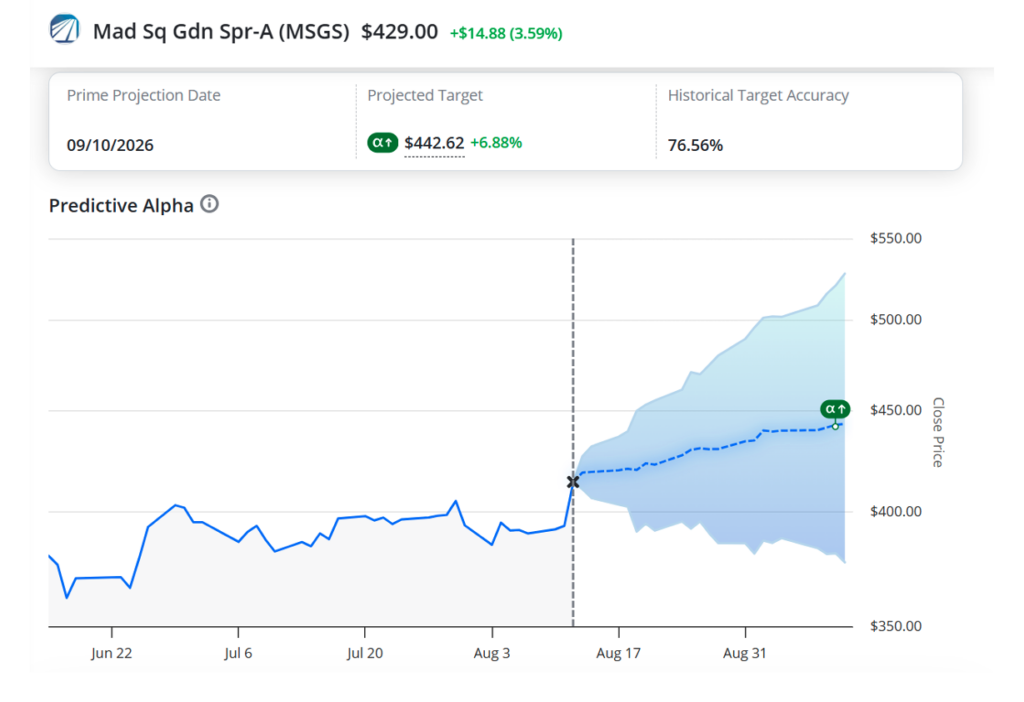
TradeSmith vets know that Predictive Alpha is like ChatGPT for stocks. Rather than predicting the next most likely word, Predictive Alpha crunches 100 billion market data points to predict the next most likely move for a stock. And each forecast – correct or not – reinforces the model.
Predictive Alpha sees MSGS at $442.62 by Sept. 10. And 76.5% of its forecasts have been right, to the penny, in the past.
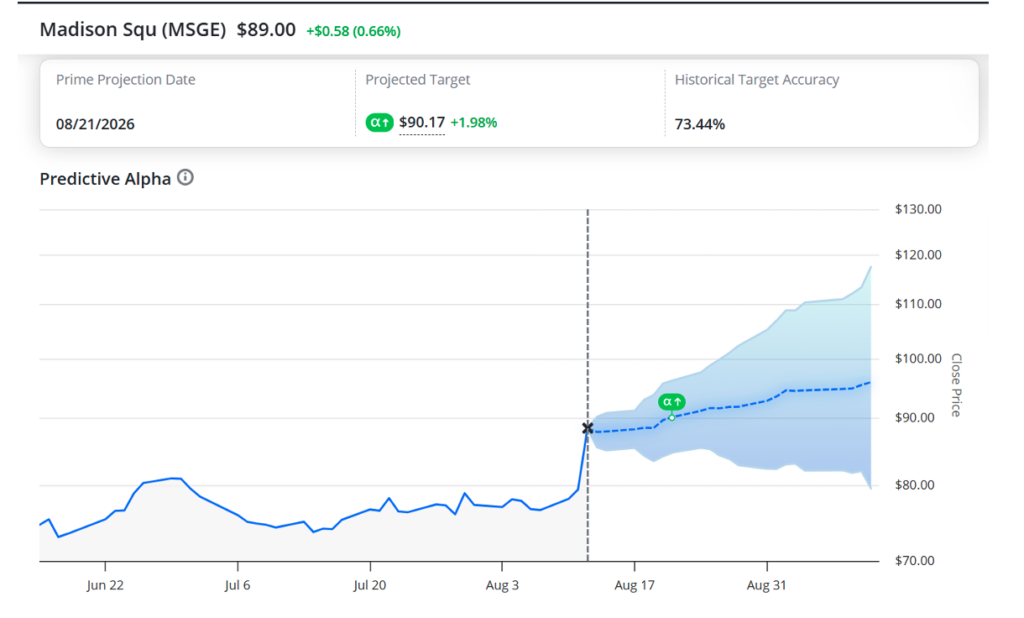
MSGS is a spinoff from MSGE, which owns the Madison Square Garden arena, along with several other iconic entertainment venues.
That stock has a less bullish forecast, with Predictive Alpha calling the stock to rise about 2% by Aug. 21 with 73.4% historical accuracy:
But where MSGE does stand out is in its Quantum Score…
Our Quantum Score rates thousands of stocks from 0-100 on two key factors:
- Fundamentals – earnings, revenue, and profit margin growth
- Technicals – price momentum and unusually large buying volume – the kind that tend to come from Wall Street institutions
Combine these two factors, and you get the overall Quantum Score, where the higher the score, the better the buy over the next 9-12 months.
While MSGE doesn’t have as bullish of a Predictive Alpha forecast as its sports-focused spinoff, it does have a superior Quantum Score that’s reflected mainly in its earnings. Take a look:
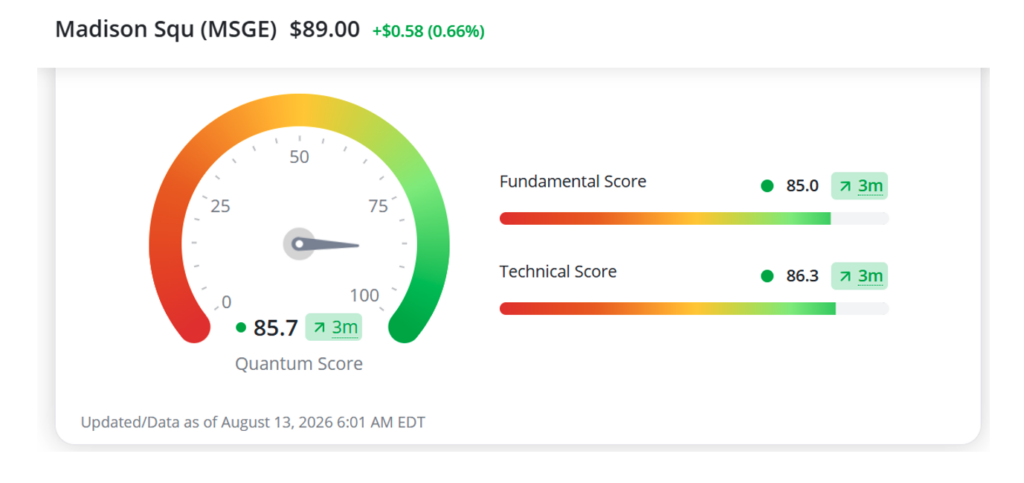
MSGE rates a bullish 85.7 on its Quantum Score, with the overall score along with its component scores all rising over the last three months.
Meanwhile MSGS, while still in the buy zone, has a far lower Fundamental Score – reflecting its shallower fundamental growth:
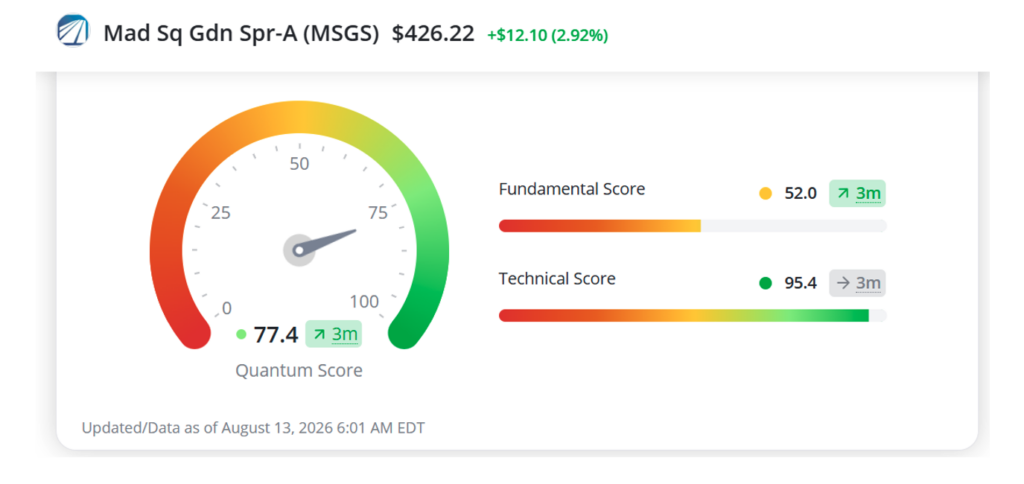
That’s why the sports wing of Madison Square Garden reads like a quick momentum trade, and the entertainment side looks like a better longer-term hold.
To building wealth beyond measure,
Michael Salvatore
Editor, TradeSmith Daily