What’s Holding Up While Tech Falls Apart
Listen to the audio version of this article (generated by AI).
In This Digest:
- Inflation, Iran, and SpaceX IPO jitters send tech down 6% — and the money’s rotating to these stocks
- The AI-powered strategy combining two elite quantitative signals
- Keep a close eye on the chip stocks staying afloat in the tech selloff
Investors suddenly have a lot to worry about…
Wednesday’s inflation report showed the Consumer Price Index advanced at a 4.2% annual rate. That’s the highest pace of inflation in three years, back when the Fed’s rate-hiking campaign was sending inflation lower.
Much of the price increase is tied to the energy lockup in the Middle East. Since the Iran War started earlier this year, the key oil chokepoint — the Strait of Hormuz — has been effectively closed, with few tankers being allowed to pass.
And in response to the Iranian military shooting down a U.S. Apache helicopter, the war is all but back on.
Amid all this, tech investors are flocking out of risky stocks ahead of the SpaceX IPO, which is proving to be a “sell-the-news” moment from the market.
The Nasdaq 100 was down more than 6% from its highs as of Wednesday’s close. But that pales in comparison to the declines in the most popular AI data center and space stocks from their all-time highs, set just weeks ago:
- Alphabet (GOOGL) is down more than 11.5%
- Nvidia (NVDA) is down 15%
- Oracle (ORCL) is down 19%
- Broadcom (AVGO) is down more than 22%
- Rocket Lab (RKLB) is down more than 30%
- And Redwire (RDW) is down more than 42% (much of that decline coming after Andy and Landon Swan recommended selling it for a 130%+ gain)
It’s like a sugar-high crash after the market’s turbocharged recovery following the first reports of a war ceasefire in April.
But as always in this market, not everything is crashing at once.
There are plenty of stocks seeing new buy signals as money rotates from the hot trades to other areas of the market that investors had left for dead.
And we can find them with our Short-Term Health Indicator…
Short-Term Health is TradeSmith’s most sensitive trend indicator. It compares a stock’s recent price moves to its typical trading range to flag whether it’s in a healthy uptrend (Green Zone), a caution zone (Yellow Zone), or a downtrend (Red Zone).
You can generally count on Short-Term Health trades to last anywhere from several weeks to several months. But with strong enough uptrends, they can extend even further.
Here are the 10 most recent Short-Term Health Green signals across the major large-, mid-, and small-cap market benchmarks.
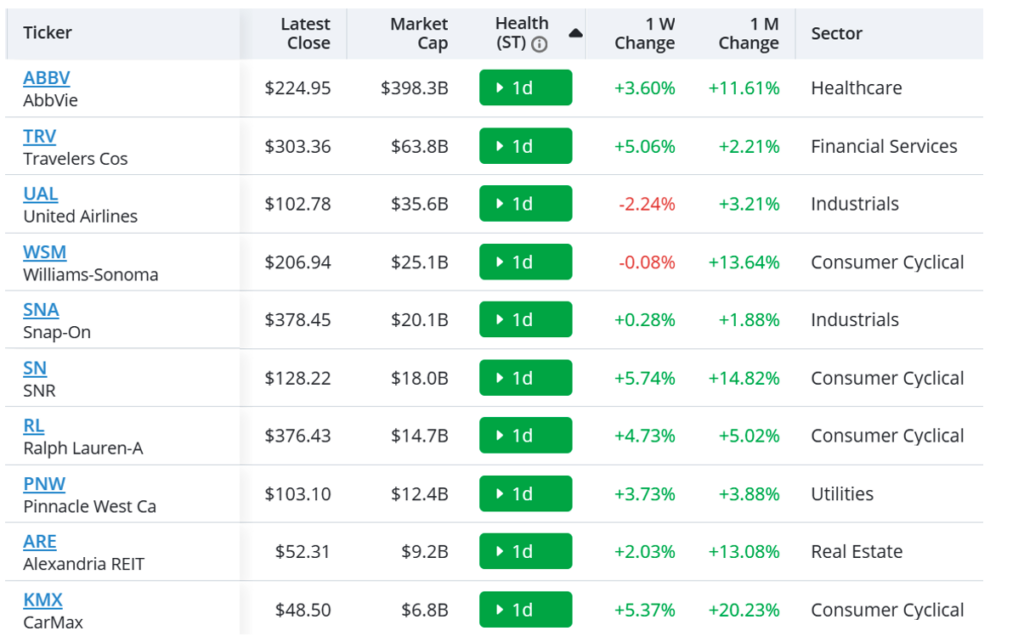
hese are among dozens of other stocks that have fired new Green signals in the last three days.
The first thing to notice is there’s hardly a tech or data center stock in sight. These are predominantly stocks that meet the consumer – insurers (TRV), airlines (UAL), clothing and furniture (RL and WSM), utilities (PNW), small appliances (WSM), tools (SNA) and more.
It’s all “real-world” stuff that, for the most part, sits outside the disruption zone of AI.
But with so many new buy signals, we need a way to filter them.
That’s where Louis Navellier’s Stock Grader comes in…
Stock Grader is Louis Navellier’s quantitative model that he’s been building for the better part of 50 years.
It rates stocks from A (Strong Buy) to F (Strong Sell), cutting through emotional bias to surface mathematically driven rankings. The system evaluates growth potential based on factors like earnings and sales growth, expanding margins, and return on equity, among dozens of other fundamental and technical markers.
Just in the past few years, Stock Grader gave buy ratings on Celestica (CLS), which returned 595%… Sezzle (SEZL) which ran up more than 600% in less than a year… and Bloom Energy (BE), which rose 1,116%.
A and B Stock Grader ratings are essential to watch. And we recently partnered with Louis to bring Stock Grader to our readers.
We found that by combining Louis’ Stock Grader with Short-Term Health, we could vastly improve the entry and exit points of what are already market-beating stocks.
Only four of the 10 stocks I showed you earlier are B grades, and none are A’s. (If you’re a Trade360 subscriber with access to Louis’ Stock Grader, you can look up the grades on all those stocks and thousands more now.)
So let’s run that same screen again, only this time we’ll only look for the top five A stocks showing recent Short-Term Health signals.
This shrinks a list of more than 712 stocks in the Green down to just 132 companies. Here are the top five by recent Short-Term Health Green signal:
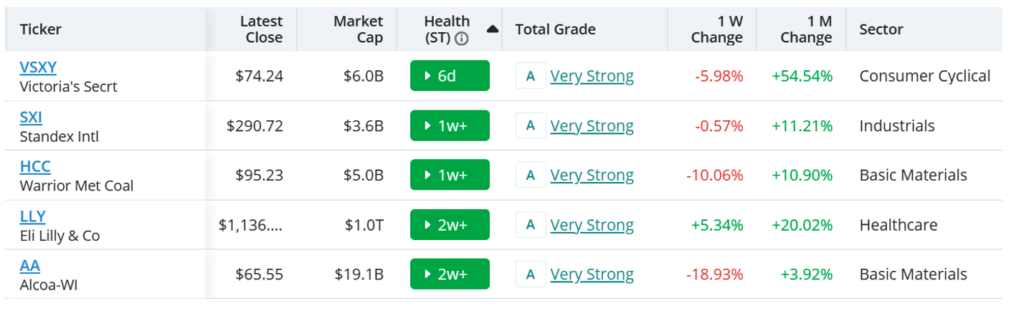
Here we’re finding a strong combination of signals in Victoria’s Secret & Co. (VSXY), global industrials company Standex (SXI), coal producer and steelmaker Warrior Met Coal (HCC), pharma giant and GLP-1 leader Eli Lilly & Co. (LLY), and aluminum producer Alcoa (AA).
Some of these stocks – particularly the materials-exposed companies HCC and AA – have pulled back over the last week with the broad market. But most are up big over the last month.
And more important, Louis’ Stock Grader shows us that these are high-quality companies in broad uptrends. The past week’s decline could prove a short-term discount.
But here’s how these two indicators really come together…
Louis’ Stock Grader answers the first question any investors should ask before buying a stock: “Is this a company worth owning?” An A-rated stock is one the numbers say is firing on every fundamental cylinder.
Short-Term Health answers the second question many investors forget to ask: “Is now the time to own it?” A great company in a downtrend can still cost you money.
Put them together, and you get quality companies caught at the moment their trend turns higher.
That’s the engine behind the newest AI-powered strategy we’ve built with Louis.
It’s called the Tactical Profits Portfolio.
Each week, it narrows the entire market down to a short list of the five stocks that look strongest – the place where Louis’ Stock Grader and our Short-Term Health momentum signals agree.
By buying those five stocks once per week, our backtest measured significant outperformance versus buying and holding the broad market.
Over the past five years, this approach would’ve returned more than five times your money since 2021 – using just five stocks at a time.
It even held up when the market couldn’t. In 2022, the year the S&P 500 fell 20% and handed most investors a miserable ride, this approach could have delivered a positive 50% return instead.
Keith and Louis went into deep detail on the Tactical Profits Portfolio in the launch event yesterday – walking through exactly how it works and how to get access before the doors close on June 16.
If you missed it live, I’d strongly recommend watching the replay while it’s still up.
And for a taste of how the system works – including this week’s top five stocks – be sure to tune in this Saturday for an interview I just recorded with Keith.
And speaking of our fearless leader…
Keith found the one corner of the market that refused to break…
There’s one more thing I want to put on your radar before you go.
You just saw how our Short-Term Health screen is surfacing the “real-world” stocks holding up while tech sells off.
Our CEO, Keith Kaplan, has been making the same observation in real time over on his X account – and one of his recent posts is worth your attention.
On the market’s ugliest recent day – when the Nasdaq 100 had its worst single session since April 2025 – Keith didn’t focus on what was falling. He focused on what wasn’t.
In his words:
[On] days like this, the real signal isn’t what fell. It’s what held firm. The Health Care Select Sector Fund ($XLV) climbed 0.6%. The Invesco Dynamic Pharmaceuticals ETF ($PJP) gained 0.4%. And Eli Lilly ($LLY), which we covered earlier this month, rose 0.55% on Friday and tacked on another 3.3% this morning.
Notice the stock in the middle of that list: Eli Lilly – the very same stock our Stock Grader and Short-Term Health screen flagged earlier.
Keith’s reasoning for health care isn’t a hunch, either. As he put it, the strength is “demographic destiny.”
More than 10,000 Americans hit retirement age every day, and the U.S. population aged 80 and older is projected to roughly double – from 14.7 million in 2025 to 29.4 million by 2045.
That’s a tailwind for every corner of medicine: cardiology, oncology, dermatology, and the rest.
Demand is already here today, and it grows for at least the next decade.
His bottom line: Count him as bullish on health care – specifically the SPDR Healthcare Sector ETF (XLV), the Invesco Pharmaceuticals ETF (PJP), and LLY.
This is exactly why Keith’s X account is worth following. It’s a goldmine of ideas for how to put the TradeSmith platform to work, and a direct look at the kinds of stocks landing on his watchlist.
Follow him @KeithTradeSmith to see what he’s watching before it shows up anywhere else.
To building wealth beyond measure,

Michael Salvatore
Editor, TradeSmith Daily
Disclaimers: Michael Salvatore held shares of AVGO and GOOGL at the time of this writing.