What’s Next for the Tech Trade After This Week’s Surge
Listen to the audio version of this article (generated by AI).
In This Digest:
- This signal study shows what’s in store for tech stocks
- Jeff Clark is bullish on bonds
- How to play the recovery in cybersecurity stocks
And just like that, the conversation about stocks has changed…
Take yourself back to the distant past of… one week ago.
The Invesco QQQ Trust (QQQ) – which tracks the biggest tech stocks in America – was down nearly 12% from its high.
But as of yesterday’s close, QQQ was up 9.4% from the low it set last Wednesday. And our Signals software shows that more gains are likely on the way.
Signals studies spot rare patterns in a stock or index. Then they scan history for every other time that pattern showed up to see what tended to happen next.
A gain of 9% or more for the Nasdaq-100 over four trading days is rare, but not without precedent. Here’s a look back over the past 10 years.
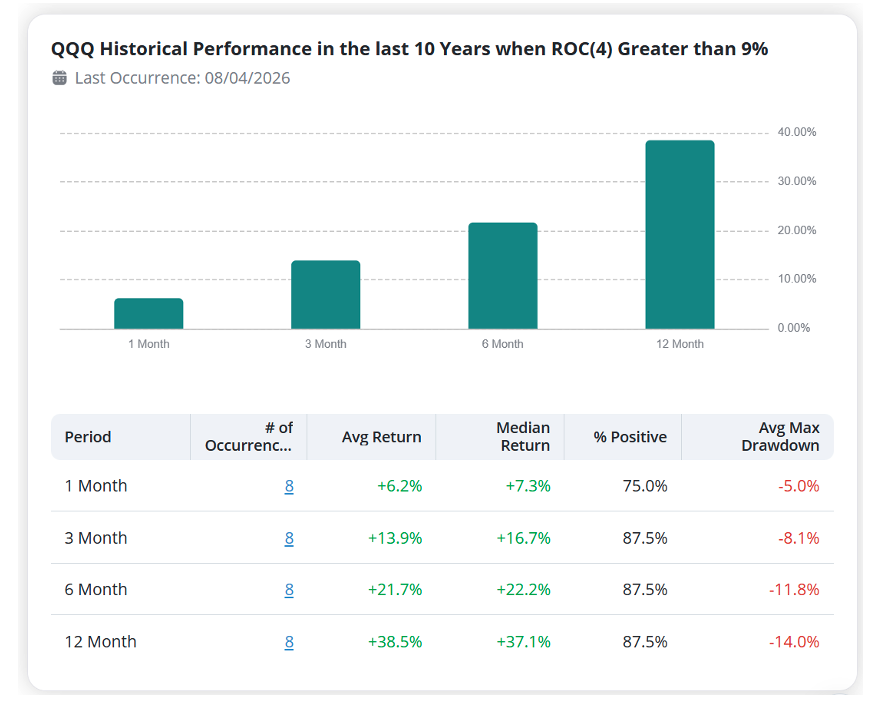
This signal has triggered eight times over the past decade. And afterward, the returns over the next 1-, 3-, 6-, and 12-month timeframe have tended to be positive more than 75% of the time – with a 12-month average return of 38.5%.
Before you back up the truck, a word of caution…
That 38.5% average covers only the past 10 years. Widen the lens all the way back to 1999, and this same signal has a darker side.
The first time it fired, in June 1999, the market kept climbing until the following March – and then the dot-com crash hit, eventually wiping out around 80% of the index’s value.
And that’s not a huge surprise. A sharp, near-vertical run is often how the stock market behaves in the final innings of a boom – right up until it breaks.
We’re not saying that’s where we are now. The recent record clearly favors the bulls. But it’s a reminder to keep your stops in place – so if this run does end in tears, you’re out before a pullback turns into a wipeout.
The market’s most-hated trade of 2026 might be about to turn…
Ask most folks what they think of Treasury bonds right now, and you’ll get an eye roll. After all, the iShares 20+ Year Treasury Bond ETF (TLT) is down 3% this year while the S&P 500 is up 10%.
But Jeff Clark is taking the unpopular side of that trade.
Jeff is the 40-year trading veteran behind our options-trading Delta Report service. And he’s made a career out of spotting turns before the crowd.
- In June 2017, shares of Target (TGT) were down 30% while the market was up 8%. While analysts and headlines turned against the stock, Jeff called a rebound anyway, telling readers to get in on June 8. Four days later the stock was up 6%, and his recommended option position returned 139%.
- In 2018, with gold in the doldrums and even gold bugs abandoning the trade for Bitcoin, Jeff took the contrarian side and bet on a rally. By mid-January gold had risen 10%, and the option trade returned 155%.
- In 2023, as the S&P 500 kept climbing on its longest winning streak since 2021 despite fresh bank failures, Jeff told readers in June the rally was overextended and wouldn’t hold. The second half of 2023 proved him right, as the S&P fell as much as 10% from its highs that year.
According to Jeff, the gloomy inflation picture is why bonds have become so unpopular.
But as he pointed out to readers of our Market Minute e-letter on Tuesday, relative to the S&P 500, Treasury bonds are as cheap as they’ve been in over a decade.
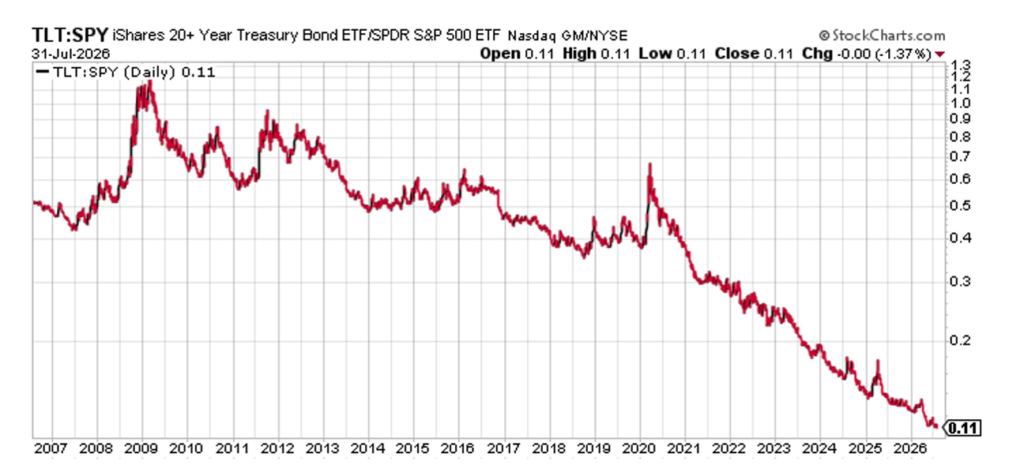
When the line on the chart rises, bonds are outperforming – usually because investors are scared, like in 2008 or 2020. When it falls, stocks are outperforming bonds, which happens most of the time.
As you can see, bonds have never done this poorly versus stocks going back 20 years.
To find out when a move like that has stretched too far, Jeff adds Bollinger Bands to the chart – bands that mark out the normal trading range for a stock or index. When something trades outside its bands, it’s usually gone further than it should and is due to snap back.

On Friday, the TLT-versus-S&P ratio closed below its lower band. The last time that happened, back in February, the S&P 500 fell 9% over the next two months while TLT rallied 5% in one.
If you’re looking for a short-term trade, Jeff’s analysis shows a bounce in TLT is coming.
Cybersecurity stocks are making new highs – and regular readers saw this coming…
At the start of the summer, when the arrival of AI coding tools sent software stocks tumbling as much as 27%, cybersecurity got dragged down with them. The sector fell as much as 21%.
Wall Street’s fear was that if AI makes it cheaper to write software, it also makes it cheaper to write viruses and ransomware.
That fear wasn’t wrong, we argued. But as we laid out in our June 2 Daily, it missed the bigger picture. As we wrote at the time:
The rise of AI agents – autonomous programs that can browse the web, execute tasks, and make decisions without a human in the loop – is creating an entirely new attack surface.
These agents can probe for security weaknesses at machine speed, across thousands of targets simultaneously. No human hacker works that fast.
That means every company running an AI agent – which will soon mean every company on Earth – needs a new layer of protection. Cybersecurity isn’t becoming less important because of AI. It’s becoming more important, faster than most investors realize.
That thesis has been proven right. The stocks we flagged back then have gone on to new highs.
Now, our Predictive Alpha AI trading model is pointing to the next one – Cloudflare (NET).

Predictive Alpha projects a 4% gain for NET by Aug. 19. And its forecasts on NET have historically been accurate 78.1% of the time.
Just be mindful of its earnings report, due out tomorrow after market close. For the past year, NET’s earnings reports have marked a significant spike followed by a quick retrace:
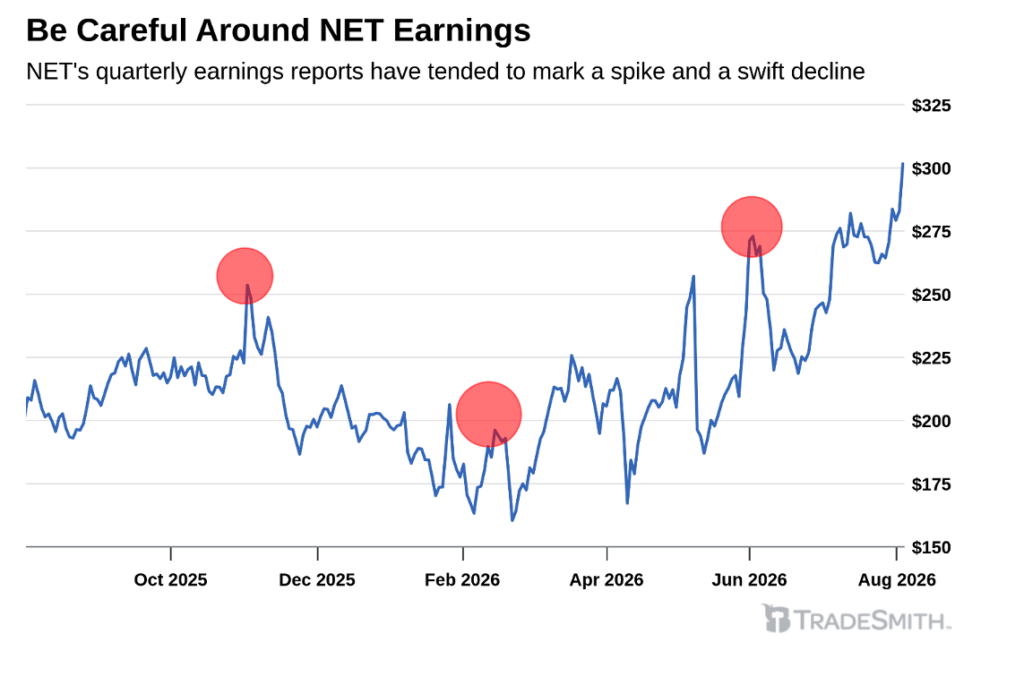
If you’re looking for exposure to cybersecurity stocks, NET is worth a close look after the dust has settled – and potentially offers a better entry point.
To building wealth beyond measure,
Michael Salvatore
Editor, TradeSmith Daily
Disclosure: Michael Salvatore held shares of NET at the time of this writing.