Why “AI Power Pipelines” Are a Key Moneymaking Theme
In This Digest:
- The AI power pipeline is a can’t-miss, dominant theme
- Cybersecurity stocks are popping after being left for dead
- Two more days to go before we end enrollment for Jeff Clark’s trading challenge. Learn more here before midnight Tuesday.
The AI power pipeline is a theme worth paying attention to…
Chipmakers like NVIDIA (NVDA), Broadcom (AVGO), and Advanced Micro Devices (AMD) have been the cornerstone of the AI trade for three years running.
Just look at how much the VanEck semiconductor ETF (SMH), as well as these individual companies, have crushed the market over that span:

Over the past three years, the semiconductors ETF has more than tripled the S&P 500’s gain. NVIDIA alone is up six-fold. The chip stocks have earned the headlines.
And there’s good reason for that…
AI data centers need hundreds of thousands of these chips – costing tens of billions of dollars – to run. A single hyperscale facility can house more than 5,000 servers across 10,000 square feet, drawing 100 megawatts of power – enough to keep the lights on in 80,000 American homes.
But the new AI era that’s dawning needs a lot more than just chips.
Every one of those chips needs electricity. And the AI hyperscalers are now planning facilities measured not in megawatts but in gigawatts – each one capable of drawing the same power as a mid-sized city. Anthropic, the company behind Claude, estimates that by 2027 training a single frontier AI model will require 5 gigawatts of power. That’s about twice the peak electricity demand of New York City.
And it turns out the power isn’t there. Of the roughly 12 gigawatts of new U.S. data center capacity announced for 2026, only about a third is actually under construction. The rest is stuck waiting for grid connections, transformers, and switchgear that won’t be available for years. Some new projects are now being told they’ll wait up to five years for utility power.
Electricity is the bottleneck.
And our data tells us that the fastest place that electricity is coming from is natural gas infrastructure stocks.
Microsoft is building a 5-gigawatt gas plant in West Texas. Google has a 933-megawatt facility going up in North Texas. Meta has seven more gas plants being bolted onto its Hyperion campus in Louisiana.
The AI race is being run on gas. And it has to flow through pipes to get to where it’s needed.
This morning, five natural gas infrastructure stocks lit up on a screen we’ve put together…
It tracks stocks with stellar fundamentals — things like earnings, revenue, and profit margin growth— that are trading at one-month highs.
It’s a great way to spot new themes and trends that are emerging in the market. We might call this one the AI Power Pipeline, and ONEOK (OKE) looks like a great way to play it.
OKE is a $58 billion operator of pipelines that move natural gas and natural gas liquids (NGLs – the propane, butane, and ethane that get separated out of the gas stream) across the country.
And OKE isn’t just lighting up our new breakout screen.
Short-Term Health is TradeSmith’s most sensitive indicator for spotting shifts in market trends. It looks at how a stock has been trading over its recent history, then flags abnormal moves that signal a shift in momentum. Green means buy. Yellow means caution. Red means sell.
OKE flashed Red in February 2025 and stayed there for almost 10 months as the stock got cut down 30% from its highs.
But then on Dec. 19, 2025, at a price just under $72, Short-Term Health turned Green, and the stock has been climbing ever since. It closed Friday at $92, up nearly 28%.
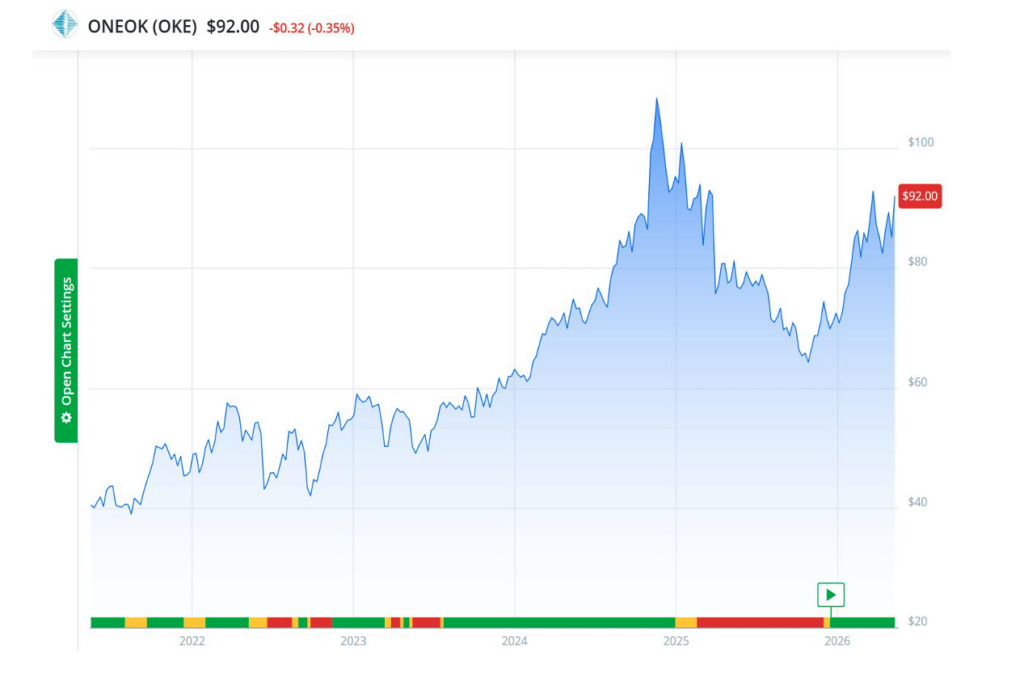
OKE is one of the best ways to play the AI Power Pipeline theme. But it’s just one of many stocks we’re seeing participate.
On our theme scanner, we saw no fewer than four other similar stocks to this one appear.
That confirms this isn’t some one-off shot. The AI Power Pipeline is real.
You can get great exposure by buying OKE. But stay tuned for these pages for more ideas on this key theme and more stocks playing a part in it.
Cybersecurity stocks are back in a big way…
No stock better captures the 2026 AI-eats-software panic than Palo Alto Networks (PANW).
PANW is the biggest cybersecurity company in the world. It’s worth $197 billion and has customers in every Fortune 500 office.
That still didn’t stop it from plunging 30% in two months.
What happened? The same thing that happened to other high-quality software stocks in this year’s “Software-Maggedon.”
In February, Anthropic launched Claude Code Security, a tool that scans codebases for vulnerabilities and proposes patches. It reportedly even found vulnerabilities that human coders had missed for decades.
Wall Street started asking if cybersecurity companies would survive an AI revolution. And Wall Street tends to ask questions by slamming the sell button.
It wasn’t just PANW. The First Trust NASDAQ Cybersecurity ETF (CIBR) – which holds a basket of cybersecurity companies – fell more than 22% from its October highs.
AI panics in 2026 have seen investors throwing the baby out with the bathwater. And cybersecurity might’ve been the least-rational selloff of them all.
The mainstream narrative around the sector has been that these companies are toast now thanks to leaps in AI. But the jury’s still out on that. And the recent sell-off has led to some great buy-the-dip opportunities.
On Friday, PANW didn’t just break out – it broke out to an all-time high. And it’s now in Short-Term and Long-Term Health Green Zones.
Each on its own is a great way to know if the short-term and long-term momentum is bullish or bearish. When both flip Green in the same week, that means the longer-term picture and the near-term momentum are confirming each other. It’s a rare-but-powerful buy signal that always catches my attention in our system.
Here’s the Short-Term Health chart for PANW:
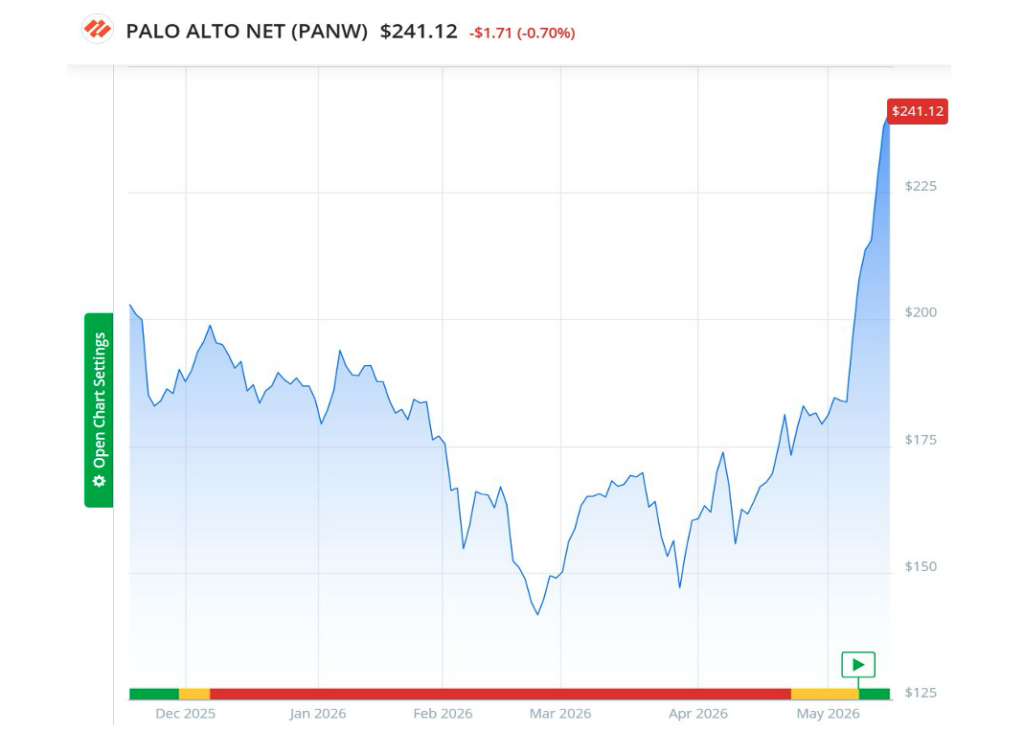
Short-Term Health also flagged the bearish move in this stock. PANW entered a Red Zone on December 5 ahead of the 28.8% drop. Now it’s flashing Green at an all-time high, with Long-Term Health right alongside it.
PANW is an easy buy. Both of our best trend indicators are flashing Green, and the stock has just confirmed the move by breaking to a new high.
But even more broadly, we’re seeing that the AI arms race isn’t just about faster chips or more capable AI models. It’s about companies that can defend against ever more sophisticated hackers.
Cyber stocks aren’t dead – they’re more alive than they’ve ever been. Keep the whole space on your radar, and stay tuned for more big ideas on it.
Two days left to join Jeff Clark’s 12 Trades to $1 Million Challenge…
Jeff has been trading options professionally for 43 years — first as an advisor to folks in Silicon Valley and later as one of the most widely followed traders in our industry.
And on Thursday, he launched his first-ever trading challenge. Along with a group of readers, he’ll attempt to turn a $5,000 stake into $1 million in 12 trades or fewer.
More than 3,000 of your fellow readers tuned in to watch him lay out the strategy. And Jeff will be releasing the first trade of his challenge very soon.
Don’t worry if you missed it. You have until Tuesday, May 19 at midnight ET to take part. After that, the offer closes and the playbook goes back behind the paywall.
Jeff didn’t pick this moment to launch the Challenge by accident.
He went back through nine years and 381 closed trade recommendations in his Jeff Clark Trader service and found two prior streaks long enough that rolling $5,000 from one trade to the next would have crossed seven figures.
The first was during the 2023 banking crisis. Nine trades, $5,000 to $1.3 million.
The second was during the AI repricing of 2025. Twelve trades, $5,000 to $2.6 million.
Both happened during major market disruptions like the ones we’re seeing today. And both windows closed within months.
Three things you need to know about the Challenge:
- The odds of hitting the full $1 million target are low. Jeff is the first to say so. Any trading carries real risk of loss, and the money you commit should be money you can afford to lose. But his track record shows it’s entirely possible.
- Even if you don’t complete the Challenge, you could turn a modest starting stake into $50,000 or $100,000 – that’s a result almost no buy-and-hold strategy can match in the same window.
- Jeff will be keeping one eye firmly on risk management all the way through. He’s a naturally conservative trader.
If that sounds like something you’d be interested in, catch Jeff’s 12 Trades to $1 Million Challenge launch event here.
To building wealth beyond measure,
Michael Salvatore
Editor, TradeSmith Daily