Why “Bio-Intelligence” Could Be AI’s Biggest Payoff
Listen to the audio version of this article (generated by AI).
“Life is good.”
That’s Connie Franciosi, who turned 80 this year. She gardens, volunteers at her library in Bridgewater, Massachusetts, and plays golf.
She also survived the deadliest form of skin cancer, in its most dangerous phase, because an AI found something in her tumor that no doctor could.
In May 2020, Connie found a spot on her skin. It was melanoma, and it had been caught late. Surgeons removed it. Then her doctor came back with more bad news. The cancer had reached her lymph nodes.
From there, melanoma spreads – to the lungs, the liver, the brain. It kills about 8,500 Americans a year.
So her oncologist offered her a place in a trial, testing something that had never worked before.
Cancer is so often fatal because it’s not like bacteria or a virus that enters the body from the outside. It’s your own cells, copying your own DNA, with a few mutations telling them to keep growing. So your immune system can’t spot the threat, and the tumor slips past your defenses unnoticed.
The trial changed that. Researchers sequenced Connie’s tumor, letter by letter. Then an AI model compared it against her healthy blood, searching hundreds of mutations for the few her immune system could be trained to attack.
It found 34.
Those 34 were written into a vaccine – instructions delivered in mRNA, the molecule our cells use to carry orders from our DNA. Then her immune system went to work on the cancer.
Five years on, her scans are clear.
What saved Connie wasn’t a new drug, exactly. It was information – her tumor’s code, read closely enough to write new instructions her body could act on.
And that points to something much bigger than one cancer vaccine.
You’ve heard no end about what AI is going to do – the chatbots, the agents, the jobs it’s supposedly coming for. You’ve heard far less about the part I think matters more.
I call it bio-intelligence. It takes the same pattern-finding power behind those chatbots and points it at the human body.
Your body runs on information – 3 billion letters of DNA in every cell, plus a constant stream of chemical messages your cells trade every second you’re alive. A lot of what we call disease – and of what we call aging – is that information going wrong.
We’ve known this information existed for decades. What’s new is that we now can read the code the body runs on, copy the messages it sends, and even write new ones for it to follow.
And that changes what medicine can do.
The same approach is now being turned on other diseases. For instance, doctors have already used gene editing to correct the DNA behind sickle cell disease – rewriting the error at its source. They’ve also given people losing their sight to an inherited disease a working copy of the gene they were missing, restoring much of their vision.
And because it applies to every human being alive, this may also be the largest investment opportunity we’ll see as a result of AI.
This new read-write medicine has already taken the market by storm in the form of a drug already in millions of bathroom cabinets across America.
Profound Implications
You’ve heard of Ozempic, Wegovy, and Mounjaro. Some 30 million Americans now take these GLP-1 drugs to lose weight and manage diabetes.
Here’s what most of them don’t know. GLP-1 isn’t a foreign chemical. It’s a message your own body already sends.
After a meal, your gut releases GLP-1 to tell your brain you’ve had enough. The signal fades within hours. These drugs are near-copies of that message, redesigned to last for days instead of minutes.
That’s it. No attack, no override. Just your body’s own instructions, copied and sent on a new schedule.
And the results went further than anyone expected. In the trials, people on GLP-1s had fewer heart attacks and strokes and were even less likely to die during the study.
One message, copied correctly, did more good than the drug was designed for. And that has profound implications beyond just GLP-1s.
Disease Is an Information Problem
For thousands of years, we’ve seen our bodies as run by organs and blood. But at a deeper level, they’re run by information.
Some of that information is fixed in the 3 billion letters of DNA coiled inside almost every cell – the master copy of the genetic code your body works from. Copy a letter wrong, and a cell can start doing the wrong thing for the rest of its life.
Your body is also run by trillions of chemical messages.
You have some 30 trillion cells, and every second you’re alive, they’re in near-constant chemical conversation, passing billions of instructions back and forth about what to do next.
Cancer is that conversation gone wrong. So is aging – it’s a message copied with an error somewhere along the line, or an instruction a cell should have followed and ignored instead.
Which means beating these diseases comes down to finding the single signal that matters inside an ocean of data. In Connie’s case, that meant spotting which of hundreds of mutations her immune system could be taught to attack.
In the case of Ozempic and Wegovy, it was recognizing which of the body’s own “I’m full” messages to copy – and sending it back on a schedule that lasts for days instead of hours.
And that’s something AI does better than we do. Point it at enough of the body’s information, and it finds patterns no doctor ever could.
Wall Street Has Taken Notice
On Wall Street, this is already moving stocks – and not by a little.
Go back to Connie’s vaccine. On Aug. 19, Moderna (MRNA), the company that made it, announced the vaccine had met the goals of a full Phase 3 trial. Over a thousand melanoma patients. The first time in history an mRNA cancer treatment had worked at that stage.
The stock jumped about $40 billion in value in a single day. It’s up 474% this year.
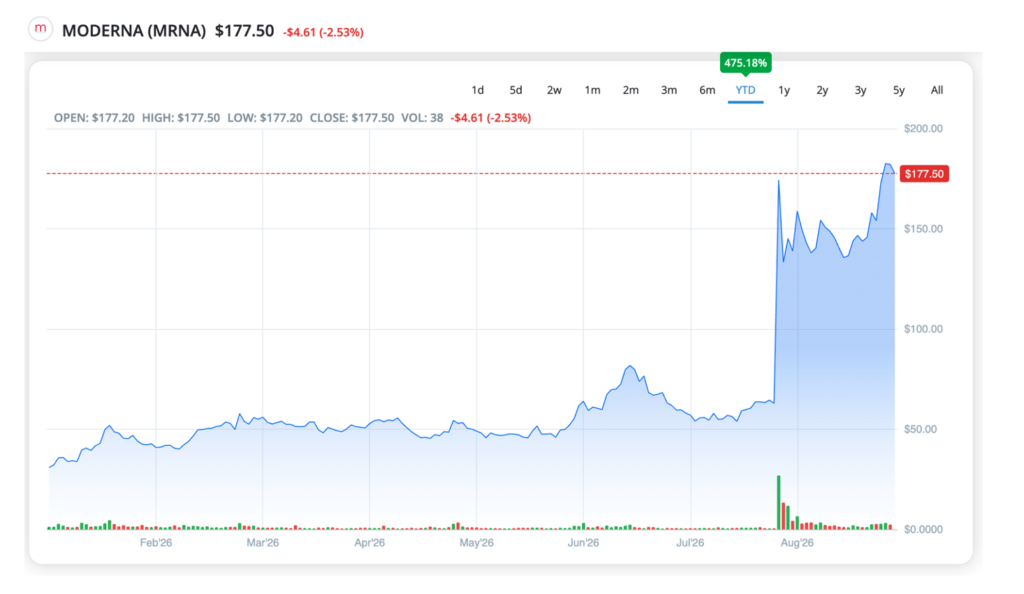
Moderna isn’t stopping at melanoma. It has nine more trials running, across lung, bladder, and kidney cancer. If the approach works, the same method could apply to almost any solid tumor.
Eli Lilly (LLY) makes the GLP-1 drugs Mounjaro and Zepbound – now two of the best-selling medicines in the world. Its stock is up roughly 300% since Mounjaro’s approval in May 2022.
Last year, LLY became the first healthcare company ever worth $1 trillion.
How to Play It
So how do you play something this big?
If you want a simple way in today, start with the sector itself. The iShares Biotechnology ETF (IBB) holds a broad basket of these companies in a single position. You don’t have to pick the one winner – you own the trend.
It’s up 21% this year. And it’s in Short-Term and Long-Term Health Green Zones – meaning the bullish trend is intact.
Like with every position, you want to keep an eye on risk. Make sure no single stock or fund dominates your portfolio. And decide when you’ll sell before you buy.
If you’re a TradeSmith subscriber, you have no shortage of tools to help you.
If you use TradeStops, you already have a custom-fit trailing stop-loss level determined by your entry point and a stock’s historical volatility. That tells you when to sell any stock you own.
If you have access to our Trade360 software suite, you can use the Risk Rebalancer and our Asset Allocation tools to spread out your risk by volatility and by sector.
And if you subscribe to our Options360 toolkit, to build smart income strategies that pull money out of your stock holdings and lower your risk.
Investment themes like bio-intelligence are exciting to be a part of. But like with any investment, you have to keep your risk in check and make sure you’re getting the most you can out of it.
All the best,

Keith Kaplan
CEO, TradeSmith