Why SpaceX Is Becoming a Power Company
Listen to the audio version of this article (generated by AI).
In This Digest:
- SpaceX’s third line of business has nothing to do with space or AI
- Lucas Downey says this is the AI trade of 2027
- Jeff Clark on why the unwinding of the yen carry trade is the market’s biggest threat
SpaceX is being forced to turn into a power company…
As much Elon Musk would like to focus on launching rockets and building evermore powerful AI models, he’s being forced into a third line of business — energy production.
It’s a development colleagues Andy and Landon Swan have been tracking at our MegaTrends advisory. It’s where they track massive shifts in consumer behavior and technology that you can profit from over years.
And they do it with the help of their consumer insights engine, the Social Heat Score, which scans millions of social media data points, web traffic, and search trends daily to unearth emerging trends.
As Andy put it to subscribers in their August issue…
Elon Musk is so starved for electricity that he’s trucking dozens of gas turbines onto a lot outside Memphis and firing them up himself.
His AI burns through power faster than the grid can deliver it – so SpaceX (SPCX) is spending $2.8 billion on gas turbines, roughly $2 billion of it on mobile units that fire up in weeks instead of the years a real plant takes.
That’s evidence of a huge power bottleneck impacting the AI trade right now. Andy goes on…
GE Vernova (GEV), the biggest turbine maker, told investors this summer it’s mostly sold out through 2030 – a 116-gigawatt backlog, with orders up 134% in a single quarter. Order a turbine today, and you could wait until the end of the decade to switch it on.
That’s why Musk is trucking in mobile units instead of waiting in line and why a new power plant costs 66% more than it did a year ago.
According to Andy and Landon, companies ramping up new power infrastructure are one of the best trades in the market right now.
Many of these stocks are lower today than they were a year ago, over concerns that AI usage is on the downswing. But that doesn’t jive with the facts on the ground.
Google (GOOGL) recently reported its AI systems handled seven times more work this May than a year earlier. Every single AI query burns electricity in a data center, and as usage rises, power needs go exponential.
Andy shared five power infrastructure ideas with his MegaTrends subscribers as part of the monthly issue.
The highest-rated one on his Social Heat Score, a speculative but high-potential small cap, we’ll save for subscribers.
But one idea they shared is Constellation Energy (CEG), the company with the largest nuclear energy fleet in the U.S.
Andy and Landon previously recommended CEG as a top energy stock pick in a March 2025 report. It ran up as much as 84% since their call, with those gains paring down to 21% in this year’s downswing in AI power stocks.
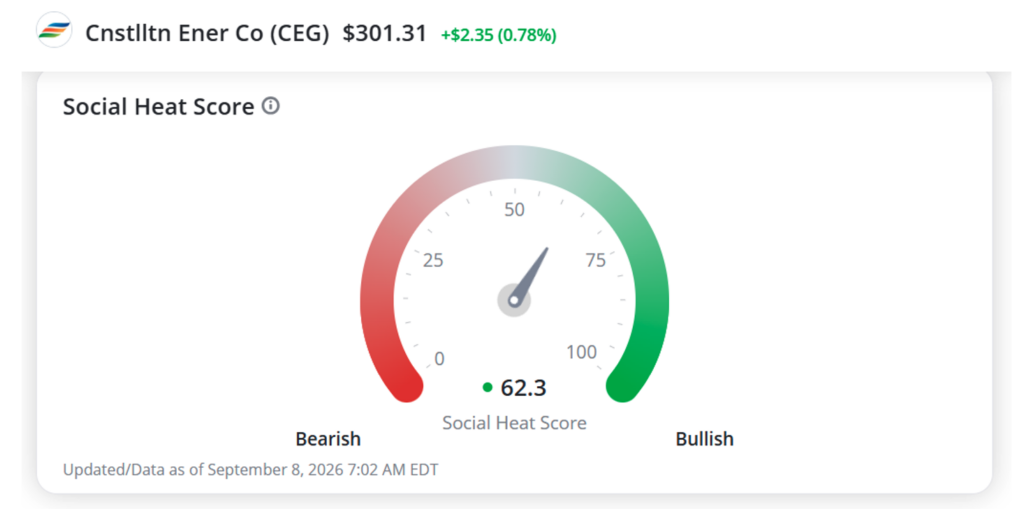
Right now, CEG earns a Social Heat Score of 62.3 – on the low end of the buy range.
But there are other reasons to like the stock right now.
Constellation recently closed a $22 billion purchase of Calpine in January and became America’s largest power producer.
It also moved its restart of Three Mile Island – part of a 20-year energy deal with AI hyperscaler Microsoft – up a year to 2027 and received a $1 billion loan from the federal government.
CEG is a stock to watch. And if you’re subscribed to MegaTrends, definitely keep an eye on its Social Heat Score for signs of building sentiment.
AI’s next leg looks nothing like the last one…
That’s according to Lucas Downey, who heads up our Quantum Edge Pro service.
It ranks stocks from strongest to weakest on fundamentals like earnings, revenue, and profit margin growth. Then it looks for unusually large inflows from hedge funds, investment management companies, and other Wall Street players into the strongest stocks.
Think of it like a metal detector for the market. It pings you when it finds something worth picking up that nobody else can see.
Seen through this lens, chipmakers like Nvidia (NVDA) or Advanced Micro Devices (AMD) are no longer the focus.
Instead, big-money investors’ money is heading into power, memory, and robotics stocks.
Take popular AI memory maker Micron Technology (MU).
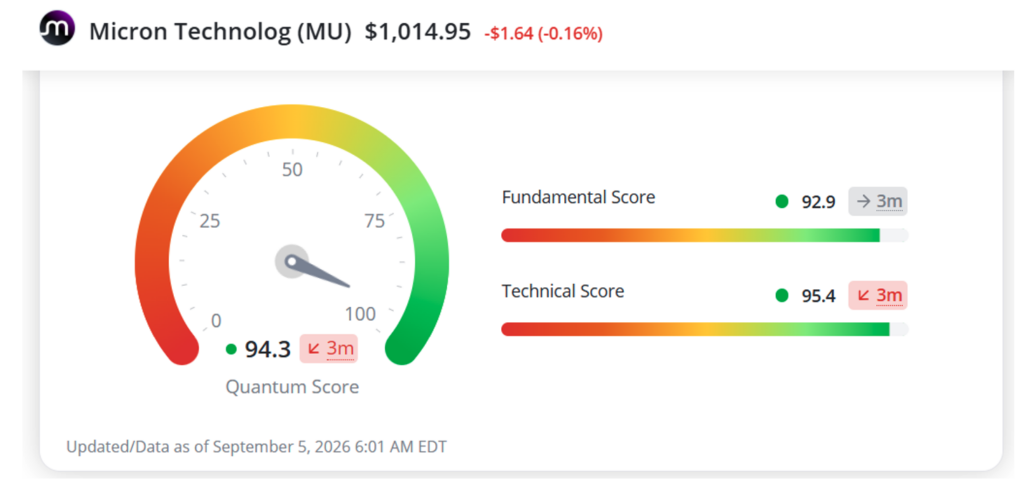
It has a Quantum Score of 94.3 — putting it in the top 6% of stocks our system tracks.
Note that MU has seen its Technical score decline a bit over the past three months even as Fundamentals held steady. That reflects the recent unwind in high-momentum AI stocks we saw in June and July.
MU is now about 16% below its all-time high set back on June 25. But according to the Quantum Score, that’s a dip worth buying.
Finally, don’t let this major currency threat be a blind spot…
Over at our Market Minute e-letter, master trader Jeff Clark has been warning about the Japanese yen rising in relation to the U.S. dollar.
Why would a currency move like that matter to U.S. investors?
Because of what it means for the “yen carry” trade. As Jeff explained it:
The yen carry trade is the LARGEST trade on the planet. Hedge funds, family offices, and other institutional traders borrow cheap yen at low interest rates, and then invest the proceeds into everything else – like tech stocks, and all other momentum fueled assets.
The trade works wonderfully when the yen declines and everything else rallies.
But, when the yen rallies, the carry trade goes into reverse. Profits can turn into losses, as traders start to unwind their positions – selling off the momentum fueled assets and buying the yen.
And it’s worth paying attention to.
The last double-spike in the yen at the start of the year coincided with a 7% drop in the S&P 500. A spike in 2024 knocked the tech-filled Nasdaq 100 down 12%.
Right now, all of the main indexes we track – the Dow, the S&P 500, the Nasdaq 100, and the small-cap Russell 2000 — are in Short-Term Health Green Zones. That means the bullish trend is intact — for now at least.
But don’t let the yen carry trade be a blind spot. If the yen keeps rallying against the U.S. dollar, it could serve as an early warning sign for risk assets like tech stocks.
Understand that while Jeff keeps an eye on big-picture macro themes, his specialty is short-term trading.
And in his current 12 Trades to $1 Million Challenge – where he’s showing readers how to turn a small initial stake into as much as $1 million in 12 trades or less – the last three trades have delivered gains of 40%, 153% and 91%.
Jeff is opening up spots to join the challenge this week. So stay tuned here for more details.
To building wealth beyond measure,

Michael Salvatore
Editor, TradeSmith Daily