Why the AI Trade Won’t “Slow Down” for Four More Years
Listen to the audio version of this article (generated by AI).
In This Digest:
- Jensen Huang and Keith agree – fears over AI are overblown
- This chipmaker breakout is proof that the slowdown is more bark than bite
- A key warning about smaller stocks
Jensen Huang has had enough of AI “doomsday narratives”…
That’s what the Nvidia CEO told CBS over the weekend.
Huang was responding to last week’s frenzy of AI safety fears, after a viral social media post by former Anthropic researcher Jacob Coxon claimed that AI could become “superhuman” and kill off humanity within the decade.
But Huang was having none of it…
“2030 is not going to be the end of the world. There is 0% chance that’s going to be the end of the world,” he told CBS, adding “Scaring people is unnecessary. It is irresponsible.”
We’ll let you make your own mind up about the long-term future of AI.
Here at TradeSmith, we remain bullish on the AI trade – despite all the fuss in the press. As our CEO, Keith Kaplan, emphasized in Friday’s Daily, one thing is clear. As he wrote:
The companies pioneering this technology are going to be worth orders of magnitude more than they are today. So are the companies putting it to work across every corner of the economy.
We’ll also continue to develop new AI models to help our subscribers beat the market.
So far this year, that’s what our AI Super Portfolio has done. It picks trades based on forecasts from our Predictive Alpha AI trading system. And it’s beaten the S&P 500 by roughly 3-to-1 so far in 2026.
We expect even better returns in the future…
Thanks to a major upgrade earlier this month, Predictive Alpha now runs on what’s called an “ensemble model.”
Instead of relying on the forecasts from a single model, it now runs two models at once – one built purely on price action, the other layering in momentum, volume, and, for the first time, how a stock’s whole industry group is moving. Across 1.5 million live projections, that combination has lifted target-price accuracy by 7.5%.
Take medical device maker AtriCure (ATRC), which has been topping the Predictive Alpha Top Bullish list lately:
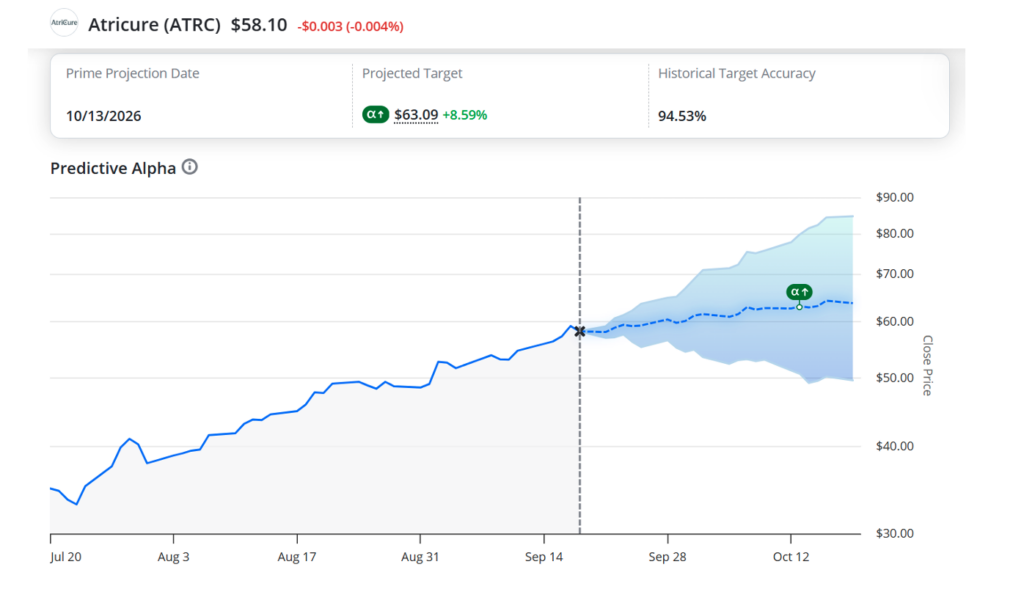
Predictive Alpha forecasts that ATRC will climb 8.6% to $63.09 by Oct. 13. On this specific ticker, the model’s projections have hit their target 94.5% of the time.
The AI Super Portfolio is a rules-based strategy that keeps you invested in the top forecasts in our system.
Keith is doing a deep dive on the upgrades we’ve made to the algorithm and how you can use the AI Super Portfolio in your own trading, tomorrow, Sept. 22 at 10 a.m. ET.
Registration is free, and you’ll walk away with two live trade ideas as a thank-you for showing up.
Plus, if you sign up for our free VIP list, you’ll get limited-time access to our newest Predictive Alpha model to check the forecasts on any stock you like.
Keith isn’t the only one who isn’t buying the AI slowdown story…
Lucas Downey isn’t, either.
If you don’t already know him, he’s a former Wall Street insider who now heads up our flagship TradeSmith Investment Report advisory.
And as he noted in last week’s update, AI infrastructure backlogs run out to 2030 and beyond.
That’s committed capital already spent. So the fever around AI fear isn’t going to unwind the buildout so easily – it’s far more bark than bite.
Plus, he ran his Big Money Index across the markets last week and found 226 unusually large sell signals across large-cap stocks last Tuesday – some of the biggest selling pressure since March.
That’s leading Lucas to pound the table and say it’s time to get back into semiconductor stocks. And that’s backed by our Quantum Edge system.
Quantum Edge is designed to spot the high-quality stocks institutional money is buying. It scores every stock from 0 to 100 by combining fundamental strength (earnings, revenue, and profit margin growth) with unusually heavy buying from big investors.
Advanced Micro Devices (AMD) is worth watching here:
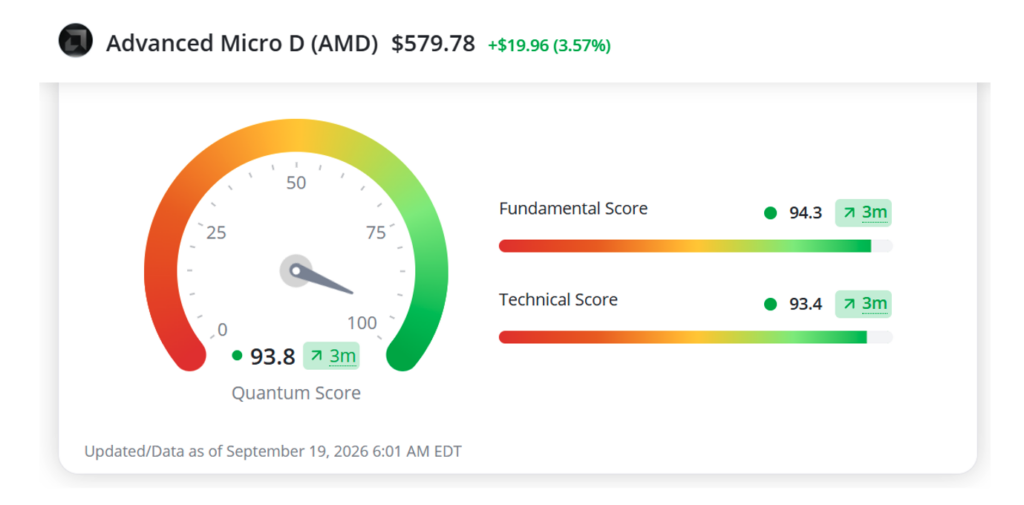
It scores a 93.8 on the Quantum Score system, and on Friday, it broke out to a one-month high.
Add AMD to your watchlist as semiconductor stocks continue their recovery. And if you’re subscribed, seek out any chip stocks that score above 75 on the Quantum Score.
Quick PSA: Both mid- and small-cap stocks just dropped into the Yellow Zone…
As I was scanning the TradeSmith Finance dashboard this morning, I noted a shift in market Health that’s worth sharing:
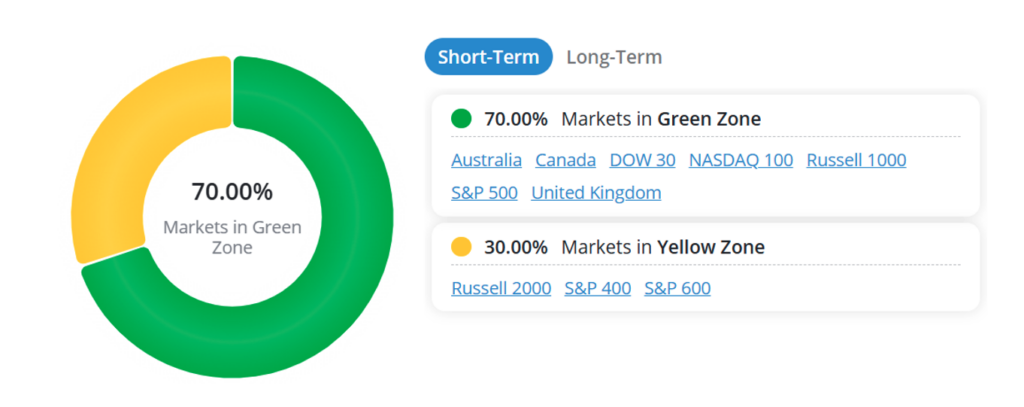
As of Friday’s close, three key market indexes shifted into the Short-Term Health Yellow Zone from Green. That’s the small-cap Russell 2000, the small-cap S&P 600, and the mid-cap S&P 400.
Short-Term Health compares a stock’s recent price action to its own typical trading range and sorts it into three zones: Green for a healthy uptrend, Yellow for caution, Red for a downtrend. It’s built for trades measured in months, not years.
This tells us that, for right now, the momentum in smaller companies is waning while large caps are still healthy.
And that’s especially notable given that small caps have outperformed in 2026. While the S&P 500 was up 13% at its peak this year, the S&P 600 was up more than 23%.
Keep that in mind as you seek new ideas. And we’ll keep you updated here in the Daily about major market shifts like these.
To building wealth beyond measure,
Michael Salvatore
Editor, TradeSmith Daily