Why Wall Street Has Forgotten About Iran
Listen to the audio version of this article (generated by AI).
In This Digest:
- The Mag 7’s recovery is real — buy these tech titans today
- A bullish signal with an 87% accuracy rate just triggered for Microsoft
- If the oil price is rising, how come oil stocks are getting hosed?
The U.S. is looking to deploy its first hypersonic missile…
The weapon, called Dark Eagle, travels at more than five times the speed of sound to strike distant targets.
It was originally designed to fight Russia or China – but now the military wants it in the Middle East.
Iran has moved its missile launchers deep enough into the country that U.S. precision-strike weapons can’t reach them.
Even though a ceasefire has been in place since April 9, both sides have spent that time rearming. The new Supreme Leader, Mojtaba Khamenei, insisted that Iran retain access to nuclear technologies and missiles.
With this backdrop, the bombs could soon start flying once more.
That explains why Brent crude — the international benchmark — spiked to a wartime high of $126 a barrel this morning before pulling back to about $116. That’s roughly double where it was a year ago.
You’d imagine this kind of news would send investors rushing toward the exits.
But it isn’t. The S&P 500 and Nasdaq 100 are both up as I write this morning.
Because what’s central to the U.S. stock market right now is not concerns about the price of energy… but the AI infrastructure buildout.
After yesterday’s close, Microsoft (MSFT), Amazon (AMZN), Meta Platforms (META), and Google parent Alphabet (GOOG) reported first-quarter earnings. Here’s a quick recap:
- Microsoft posted $82.9 billion in revenue, up 18% from a year ago, with its AI business alone surpassing a $37 billion annual revenue run rate.
- Alphabet grew 22% to $109.9 billion, with net income up 81%.
- Amazon grew 17% to $181.5 billion; AWS — its cloud unit and the engine of its AI ambitions — grew 28% and beat estimates.
- Meta grew revenue 33% to $56.3 billion, with net income up 61%. It guided second-quarter revenue slightly below the high end of analyst expectations — the closest thing to a disappointment in the bunch.
Combined, these four companies plan to spend $650 billion on AI infrastructure in 2026.
The U.S. stock market isn’t ignoring what’s happening in the Middle East.
It’s just realized that the conflict isn’t putting a dent in the big tech AI spending race… which just keeps accelerating.
And TradeSmith’s data can help you find the best opportunities to take advantage…
The Mag 7 has four strong buys and one major dud…
A month ago, peak Iran war fears knocked the world’s most valuable companies down by 20%, 25%, and more.
Today, most of the Magnificent 7 stocks have staged a recovery that’s worth paying attention to.
Take a look at this view of the Mag 7 with their Short-Term Health status and recent price performance as of yesterday’s close:
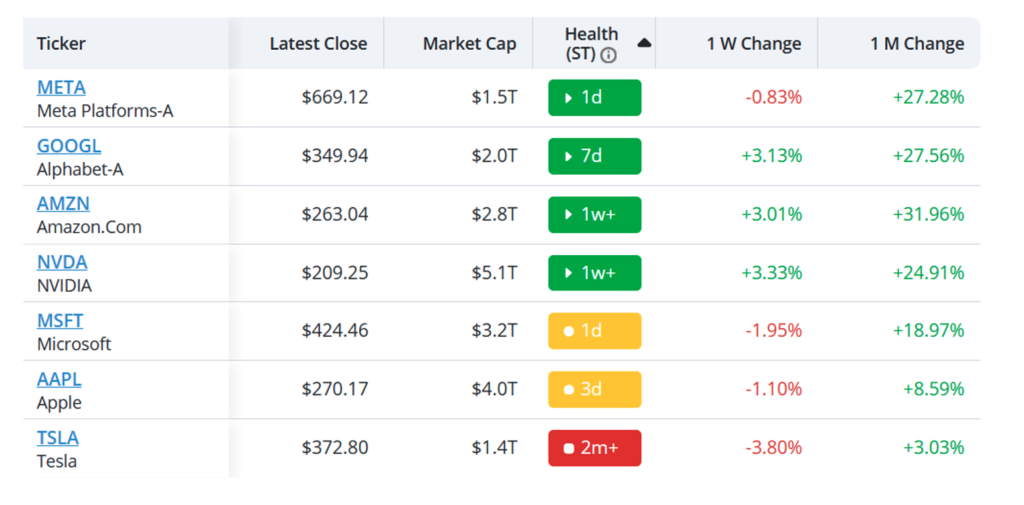
Short-Term Health compares a stock’s recent price moves to its typical trading range to see whether it’s in a healthy uptrend (Green Zone), a caution zone (Yellow), or a downtrend (Red Zone).
Right now, three of the four recent big tech earnings reports – Meta, Alphabet, and Amazon – are all Green. They’re also the biggest recoveries since the March lows.
Nvidia (NVDA) also turned green a little over a week ago, and the price has popped 3.3% over the last week.
Microsoft and Apple (AAPL) have both turned into the Yellow from the Red Zone just this week, even as the share prices declined over the last week.
The outlier is Tesla (TSLA), which remains in Red and has gained just 3.0% over the past month. The technical picture there hasn’t improved as it has with the rest.
Microsoft deserves a special mention. MSFT’s Short-Term Health flipped to Red on Nov. 26 when the stock was trading near $489. Following that signal would’ve kept you out of a meaningful drawdown.
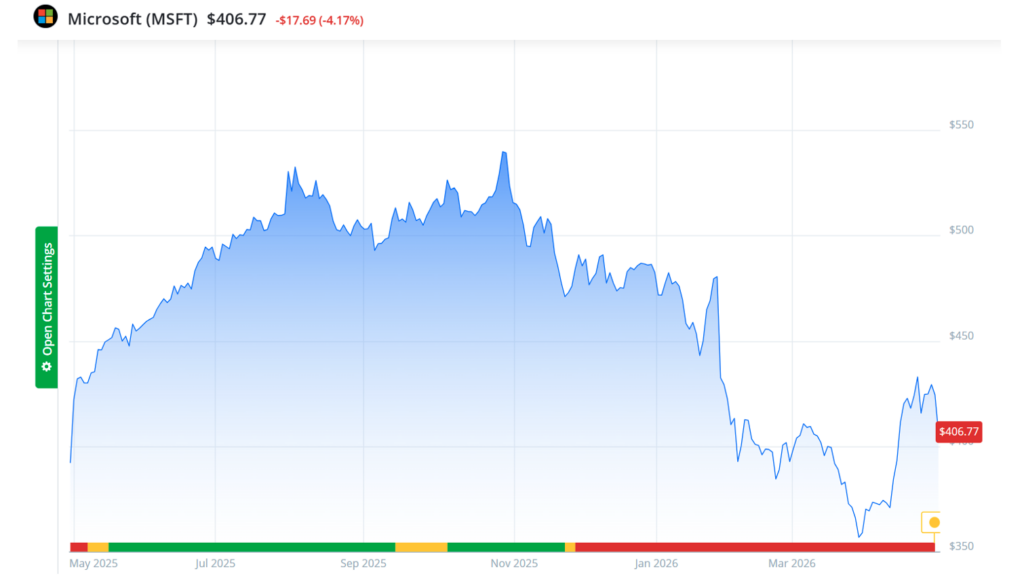
It’s now back in Yellow — the first step toward a full recovery. Not a buy signal on its own. But no longer a warning, either.
If you’re looking for where the Magnificent 7’s strength is concentrated right now, the Health statuses are pointing you directly at it: META, GOOGL, and AMZN.
MSFT just triggered a bullish trading signal with an 87% accuracy rate…
There’s more to Microsoft than its shift into the Yellow.
Our Signals software has flagged a fresh bullish setup — and the historical track record behind it is worth a closer look.
Signals is an AI-powered trading system built by our Chief Quantitative Strategist, Mike Carr.
It doesn’t look at balance sheets… read earnings reports… or follow news headlines. Instead, it detects tiny anomalies in stocks’ historical data. Then it finds statistical connections among them that a human analyst would never find.
Think of it like a “thumbprint.” Every great trade has one. A unique alignment of factors – technical indicators, price patterns, market conditions – that has lined up before.
When those factors align again, our system flags a high-probability setup. Some with historical accuracy rates of 90% or more.
The signal active on Microsoft right now is a Bullish Pivot signal. It fires when MSFT closes down during a session with the narrowest trading range of the past seven days. A move like that tends to mean selling pressure is lifting.
You close the trade when short-term momentum becomes extremely overbought — or after 21 trading days, whichever comes first.
Over the past decade, this signal has triggered on MSFT 87 times. The stock has been up 87.4% afterward for a typical gain of 2.4% over 12 days.
The reward-to-risk ratio is 4.05-to-1 — meaning the average gain has been roughly four times the size of the average loss.
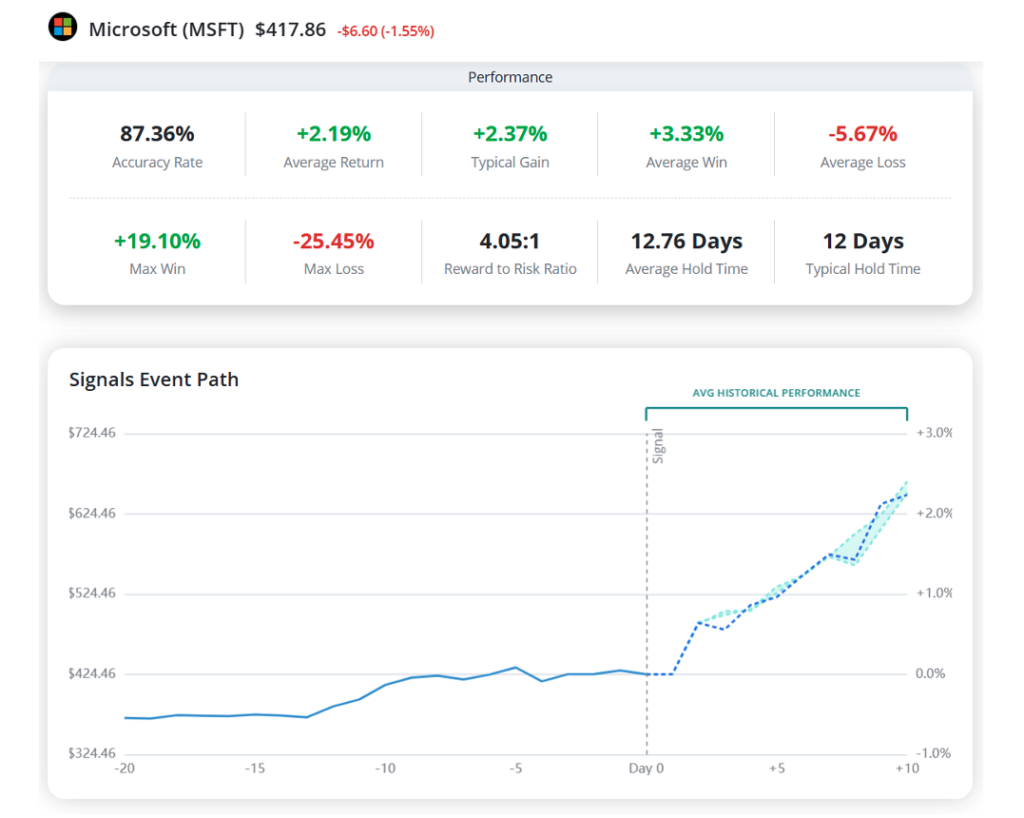
Two TradeSmith systems are pointing at MSFT right now: Short-Term Health confirming the trend recovery and Signals identifying a precise entry pattern within it. That makes MSFT a compelling trade setup right now, at least for the short term.
Oil is at wartime highs, so why are the big oil stocks down?
Crude oil is trading near its highest levels since the Iran war began. You’d expect that to be a windfall for oil companies.
Well right now, it isn’t. Check out the biggest one-month price declines among energy stocks in the S&P 500:

EQT (EQT) is down 12.5% over the past month. Expand Energy (EXE) is down 11%. Exxon Mobil (XOM) is off 9.5%. Chevron (CVX) has dropped 9%. Phillips 66 (PSX) and Occidental Petroleum (OXY) are both down 7%–8%.
These are the household names of American energy production and refinement — and they’ve lost ground while the commodity they produce has surged.
But it’s not a universal problem in energy. Flip the sort to the top performers and we see where the sector is holding up:
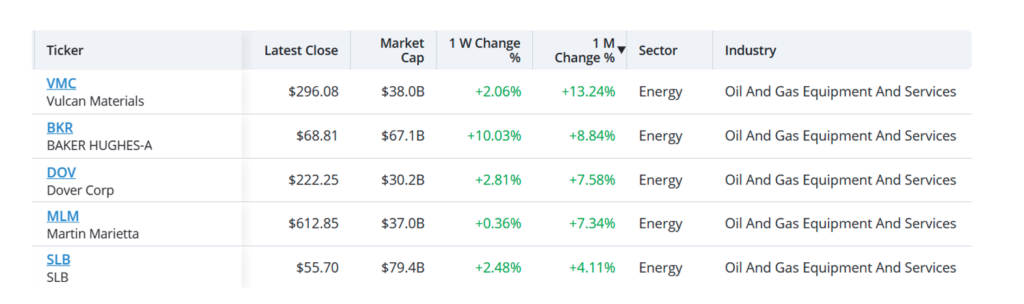
Notice the difference here: The services companies are up, while the explorers, drillers, and refiners are down.
That’s because oil services and equipment companies get paid when producers are drilling. And with prices as high as $120 a barrel this week, producers are drilling hard.
That business is contracted today. A ceasefire announcement next week doesn’t cancel the jobs already in the ground.
Meanwhile, oil producers reflect where investors expect oil to be in the future. Their revenues are less certain when the price of oil is volatile, like it is now… and especially as the ultimate goal of the U.S. pressure campaign against Iran is an end to the war.
That means at least in the short term, oil services companies are the ones to own – whether oil prices continue higher from here or settle down.
With that in mind, here are the freshest Short-Term Health Green signals across the oil services and equipment sector across the S&P 500, mid-cap S&P 400, and small-cap S&P 600:
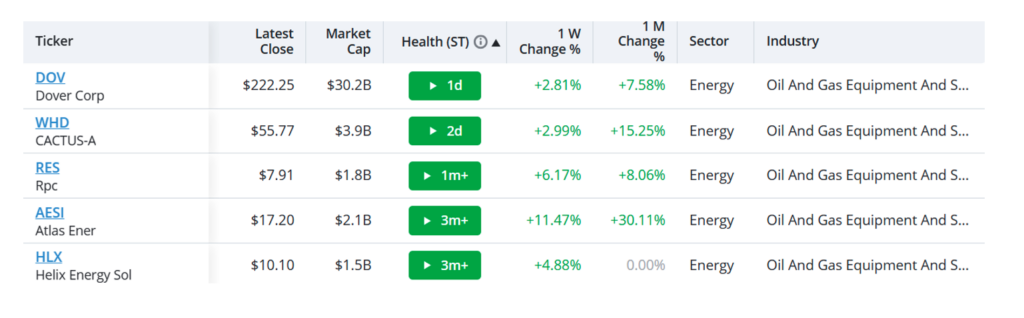
Note how with only one exception, all of these stocks are smaller – under $4 billion in market cap.
- Dover Corp (DOV) is the exception, an oil and gas equipment and services company up 7.6% on the month and with the newest ST Health Green signal.
- Cactus Wellhead (WHD), also an equipment and services supplier, up 15.3% and up more than 15% over the last month.
- And note RPC (RES), another services company, up 8.1%
Keep these stocks and others like it on your watchlist as the Iran war plays out.
To building wealth beyond measure,
Michael Salvatore
Editor, TradeSmith Daily
Disclaimer: Michael Salvatore held shares of GOOGL and EQT at the time of this writing.