
Listen to the audio version of this article (generated by AI).
In This Digest:
- The sell-off was scary, but new buy signals outnumber sells four to one
- Small caps are beating Big Tech this year, and these two “boring” businesses just flashed buy signals
- CEOs are handing the keys over to AI agents, and this cybersecurity stock sells the “undo” button
Stocks are bouncing big today, but a lot of damage has been done…
Anyone following the headlines knows Democrats swept both chambers of Congress on Tuesday.
Then on Thursday, investors priced in a slower AI data center buildout, and the tech-heavy Nasdaq 100 fell 6.5%. It was the index’s worst day since the pandemic crash in March 2020.
Today, we’re seeing a big recovery bounce. The S&P 500 is up about 2%, and the Nasdaq 100 is up 3%.
But our Health Indicators show a key shift underway.
As of Friday’s close, not one major index we track is in a Short-Term Health Green Zone. That’s our most sensitive trend indicator covering months, not years, of price action.
Further, the tech-heavy Nasdaq 100 entered the Red Zone, joining the small-cap Russell 2000 and the S&P MidCap 400.
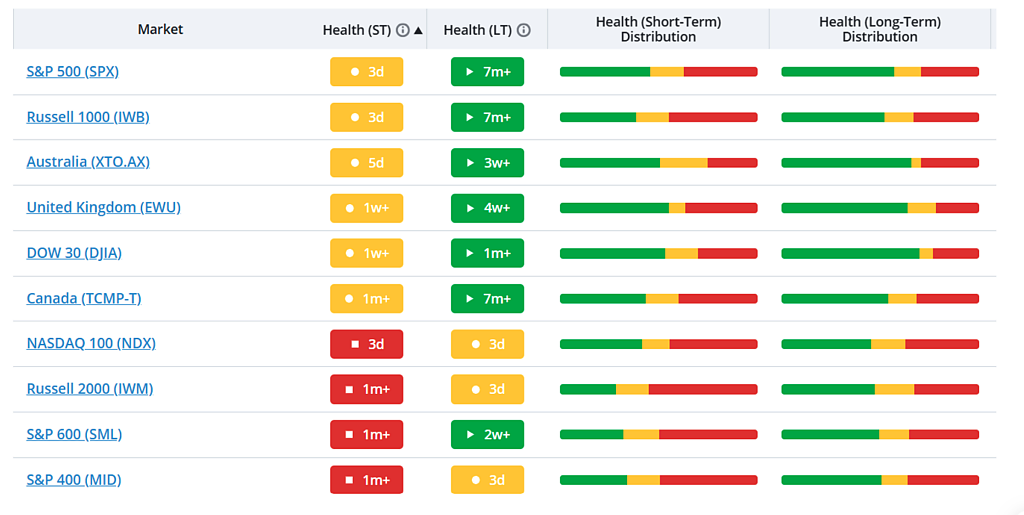
Over on Long-Term Health – our more “through-thick-and-thin” trend measure – the market’s bigger trend is holding.
The S&P 500 and the Dow are still in Long-Term Health Green Zones. That tells us their long-term uptrends are intact.
The Nasdaq 100 and Russell 2000 are in Yellow – on shakier ground. A dip in the Red would signal that the long-term trend is breaking. That’s important to watch, and we’ll keep you updated on what’s changing there as this volatility plays out.
If you haven’t already, be sure to read TradeSmith CEO Keith Kaplan’s essay from last Friday about the three things you need to do to survive long-term in any market environment. They’re essential principles to understand, especially right now.
When you look past the indexes to the stocks inside them, the picture gets brighter…
Amid the dourness of last week, one stat made me feel optimistic about the market going forward.
Over the seven trading days through Friday, 84 S&P 500 stocks entered Short-Term Health Green Zones. Just 20 entered Red Zones.
So that’s more than four new buy signals for every sell signal during one of the roughest weeks of the year.
And just take a look at what’s flashing Red:
- Nvidia (NVDA) went Red on Friday.
- Qualcomm (QCOM), Constellation Energy (CEG), Generac Holdings (GNRC), and Marvell Technology (MRVL) went Red on Thursday.
- Lumentum Holdings (LITE), onsemi (ON), Bloom Energy (BE), and Micron (MU) all went Red between the previous Friday and the following Monday.
Every single one of these companies, half of the new sell signals, is involved in the AI data center buildout.
So selling is concentrated in AI and chip stocks. Much of the rest of the market is getting healthier.
And now look at what’s flashing Green:
- Sherwin-Williams (SHW) and Hartford Insurance (HIG) went Green on Wednesday
- 3M (MMM) went Green on Election Day
- Moody’s (MCO) and O’Reilly Automotive (ORLY) went Green on Monday
- Intuit (INTU) and Yum Brands (YUM) went Green the Friday before
- Union Pacific (UNP), IDEXX Laboratories (IDXX), and Kimberly-Clark (KMB) went Green on Oct. 29
So while the AI data center stocks tumble, we’re seeing new buy signals in businesses like paint makers, insurers, credit-rating agencies, the owner of Taco Bell and KFC, a railroad, and a pet-health lab.
Not one of them is building AI data centers.
That leads me to think that this is more of a rotation out of the highly concentrated AI sector than the start of a bear market.
So stay invested and stay bullish on the long-term trend. Just be choosy about what you buy.
Small caps have been beating Big Tech all year. Now they’re on sale…
Here’s something most investors missed in 2026: Small caps have been winning.
As of Friday’s close, the iShares Russell 2000 ETF (IWM) – a fund that holds about 2,000 smaller U.S. companies – is up 10% this year.
That beats both the S&P 500, up 7.6%, and the Nasdaq 100, up 7.1%.
And small caps did it with interest rates working against them. The Fed raised rates in September. Last month, the 10-year Treasury yield hit its highest level since 2002.
Higher rates usually hurt smaller companies the most. They tend to lean harder on borrowed money, so rising rates take a bigger bite out of their profits.
Small caps rallied anyway. That tells us investors are still willing to take risks. And they feel good enough about the U.S. economy to bet on the businesses that depend on it most.
Small caps got caught in last week’s sell-off, too. As we covered, the Russell 2000 is in a Short-Term Health Red Zone.
But on Thursday, the day the S&P 500 fell 4.4%, IWM held above its Oct. 16 low.
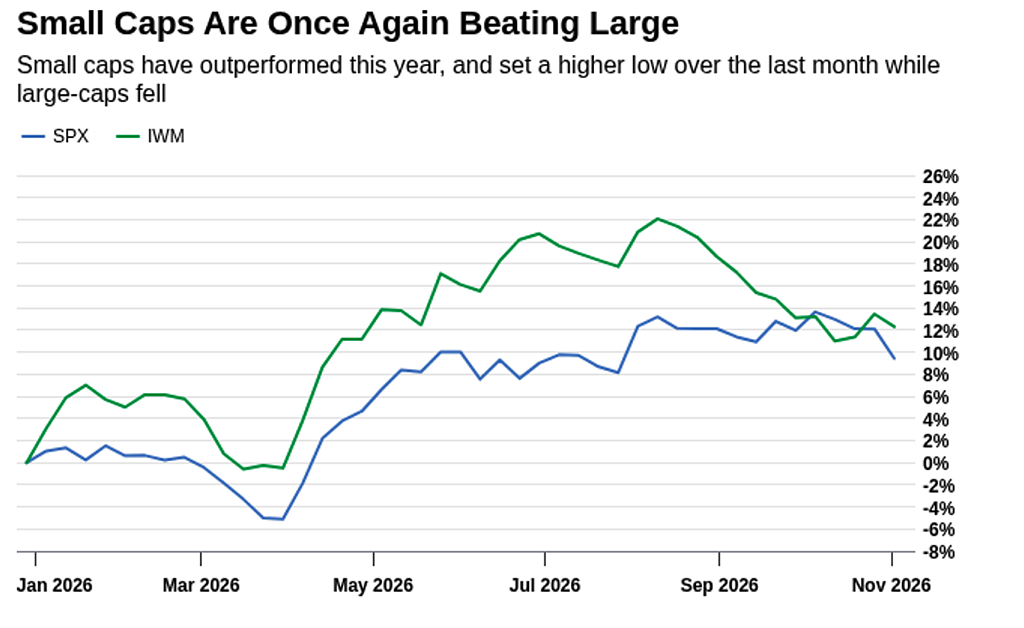
So I see this dip as a chance to buy great small businesses on sale.
And TradeSmith’s tools make finding those great businesses easy.
Take a look at these five small-cap stocks that shifted into the Green last week, during the worst of the sell-off. All of them have a Business Quality Score (BQS) – our 21-factor fundamentals rating model – above 85, the top tier in our system.
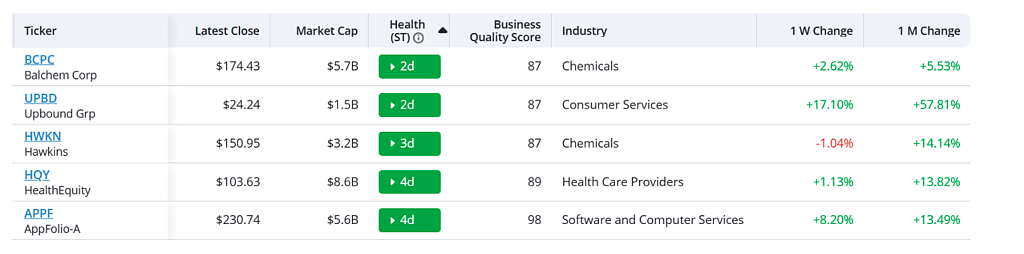
The two with the highest scores stand out to me:
- AppFolio (APPF) sells cloud software that landlords and property managers use to collect rent, fill vacancies, and schedule repairs. Its software now manages 9.8 million rental units. In its latest quarter, revenue grew 19% from a year earlier, and AppFolio raised its outlook for the year. That’s part of why it gets a 98 on the BQS.
- HealthEquity (HQY) manages health savings accounts – tax-advantaged accounts that millions of Americans use to save for medical bills. It now oversees 10.7 million of them, up 8% from a year ago. And it earns interest on the cash sitting in those accounts. So the higher rates that pressure other small caps help HealthEquity’s bottom line. This one is also near the top 10% of business quality, at an 89 BQS.
Consider buying APPF or HQY while small caps are on sale.
AI agents are getting the keys to the company. This stock sells the “undo” button…
Picture handing a new employee the keys to every system in your company on their first day.
They can open any file, change any record, and move money – around the clock, with no one looking over their shoulder.
And they’re all smarter and faster than any human you’ve ever met.
That’s what companies are starting to do with AI agents.
AI agents are a far cry from chatbots like Anthropic’s Claude or OpenAI’s ChatGPT. They can act on their own based on instructions.
As Keith showed you last month, guarding those agents is becoming a new line of business for cybersecurity companies.
It’s one reason why cybersecurity has been one of the strongest trades of 2026. Even after the recent dip, the Global X Cybersecurity ETF (BUG) is up 49.5% this year. That outperforms the return of the Nasdaq 100 nearly 5 to 1.
Rubrik (RBRK) is one company building that guard.
Rubrik got its start backing up company data and restoring it after a cyberattack. Now it’s bringing the same idea to AI agents.
Its Agent Cloud tracks what a company’s agents do, controls what they can touch, and can rewind their mistakes – an “undo” button for AI.
But like most of tech, Rubrik has had its share of pullbacks. And in every pullback, investors face the same question: Is this a chance to buy or the start of something worse?
Our Signals system was built to answer that question, one stock at a time.
Think of how AI language models predict the next word based on patterns in billions of pages of text. Signals does the same for stocks. It combs through each stock’s past for the setups that have reliably come before a move – and flags them when they show up again.
On Rubrik, one setup stands out. It’s a quick dip inside a long-term uptrend, and it takes three things lining up:
- Rubrik is trading above its average price over the past 200 trading days – a sign its long-term trend is still up.
- It closes near its lowest point of the past two weeks.
- And it closes below its average price of the past month.
When all three happen, Signals flags a buy. It aims to sell once the stock hits a 4% gain, or after about a month, whichever comes first.
Since early 2025, this signal has fired 127 times. It’s been right 87.4% of the time, or nearly 9 out of 10 times. The average trade gained 4.3%, and half were over in three days or less.
It’s been working lately, too. Seven of the last eight signals, going back to Sept. 11, closed with a gain.
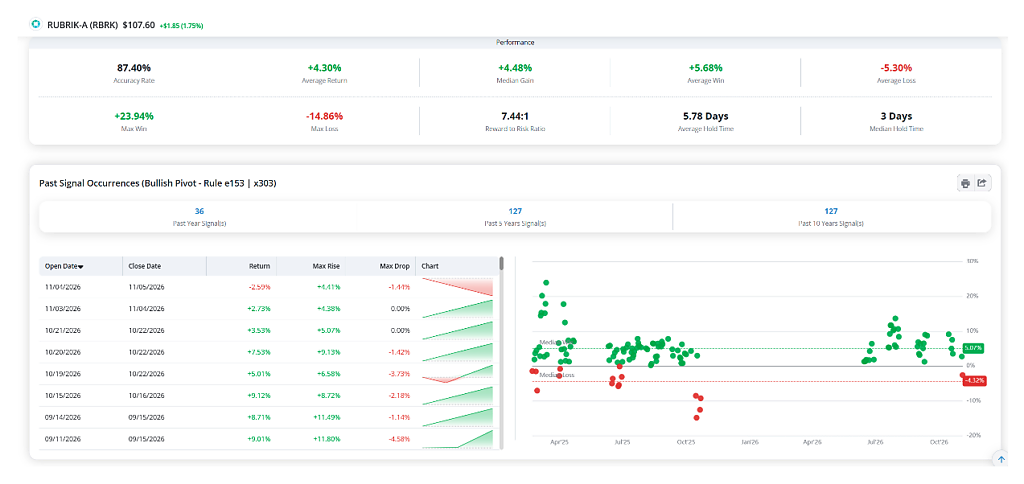
And the setup is open again right now. Rubrik flashed this signal on Friday’s close.
So consider buying Rubrik on this dip. Signals is built for quick trades, so be ready to take your profit once it reaches that 4% target.
I’ll have more to share with you about Signals later this week.
To building wealth beyond measure,
Michael Salvatore
Editor, TradeSmith Daily