

I remember it like it was yesterday.
In April 2018, we published a special report on Tesla, calling it “clearly a buy” at under $60 (split adjusted).
Last week, the stock hit more than $1,200/share… That’s a nearly 2,000% gain, or 20x your money, in under four years.
Awesome.
But not for everyone.
Because in April 2018… EVERYONE thought Tesla was overvalued. Or even worse, that the company was on the verge of bankruptcy. So they didn’t buy in, and they missed out on some incredible gains.
But because we had LikeFolio consumer data at our fingertips, we knew that consumer demand was high enough to pull the company through.
And it paid off. Huge.
So why am I bringing this up now?
Well, this last week we saw a similar phenomenon: An electric vehicle company with almost no revenue began trading on Wall Street.
Rivian (RIVN) is the newest player in the electric vehicle market, and boy, did it make an entrance.
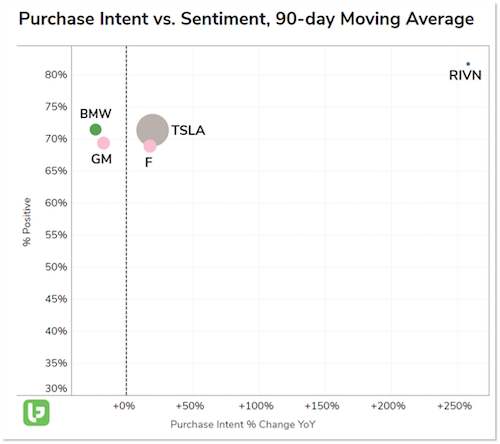
Check out demand and happiness compared to peers in the last 90 days…
The company made its public debut Nov. 10, trading under the symbol RIVN on the Nasdaq. Initial shares were priced at $78 but opened higher, just above $106.
This upward trajectory continued into Thursday, with shares trading more than 17% higher versus Wednesday’s close.
But who is this company, and does data support this extremely high (and growing) valuation? Let’s break it down.
At first glance, Rivian is positioning itself very differently from the other top player in the EV game, Tesla.
Tesla is a luxury vehicle first (with cool doors and a unique design) and the brainchild of a captivating CEO, Elon Musk, second. The electric nature of Tesla is certainly a selling point with consumers, but it’s not necessarily top of mind.
Rivian, in contrast, is positioning itself to “solve problems undermining the health of our planet and its inhabitants.”
Its vehicle lineup is adventure-worthy, featuring a truck and an SUV, and its imagery is shrouded in views of trees and mountains and families hiking.
The company’s landing page doesn’t even feature a picture of a vehicle.

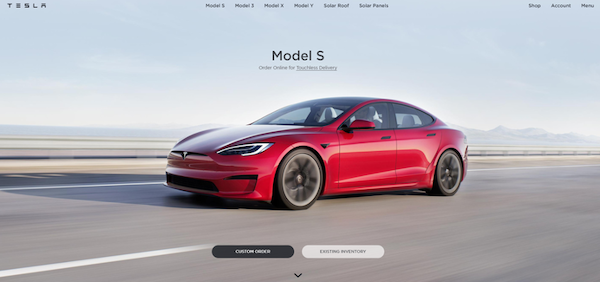
Talk about different vibes.
While Rivian has nailed down its brand image, it still has some things to work out when it comes to actual electric vehicle sales.
It doesn’t have an official business model yet, and it doesn’t expect more than $1 million in revenue in the third quarter.
But it does have a lot of things going for it.
Consumers are lining up to buy a Rivian vehicle.
Demand is rocketing alongside the company’s public trading debut. The company noted more than 55,000 R1T (truck) and R1S (SUV) preorders as of Halloween.
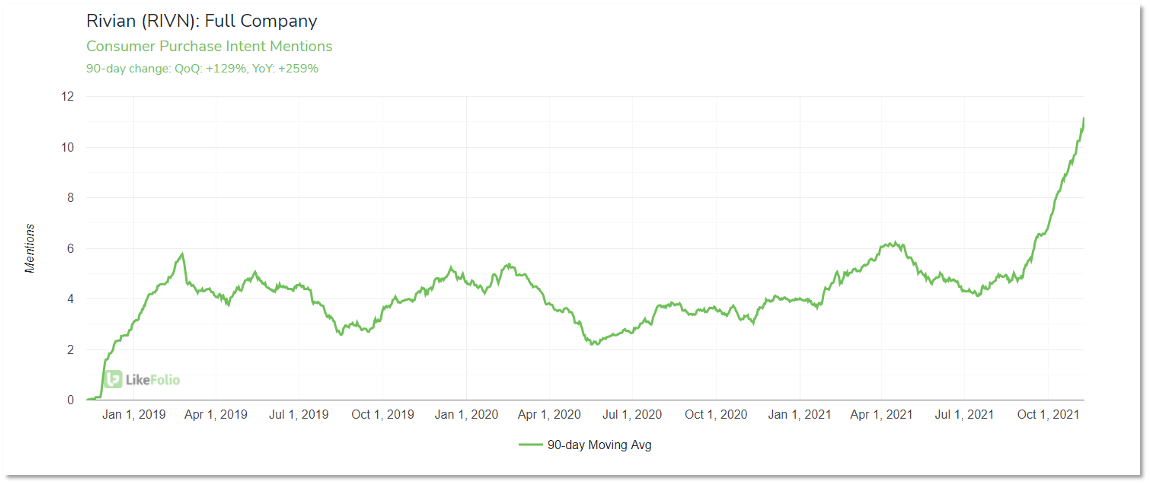
And this consumer-facing Purchase Intent doesn’t capture the estimated 100,000 electric delivery vans ordered by Amazon and expected to be on the road by 2030.
Speaking of Amazon…
Rivian has backing from two major players: Amazon and Ford
Not only is Amazon planning to release thousands of Rivian electric delivery vans on the road in the next decade, but it also holds a 20% stake in the company.
Ford, which is developing its own line of electric vehicles, holds a 12% minority stake in RIVN that it deems a strategic investment.
Consumers are buying into Rivian’s brand hype.
Consumer happiness for Rivian vehicles is 82% positive, around 10 points higher than for EV darling Tesla.
Rivian is the first company to go to market with a fully electric truck. Sales are direct-to-consumer, and many trucks have already been spotted on the road. The company has delivered about 50 vehicles, mostly to employees, and expects to make additional deliveries before the end of this year.
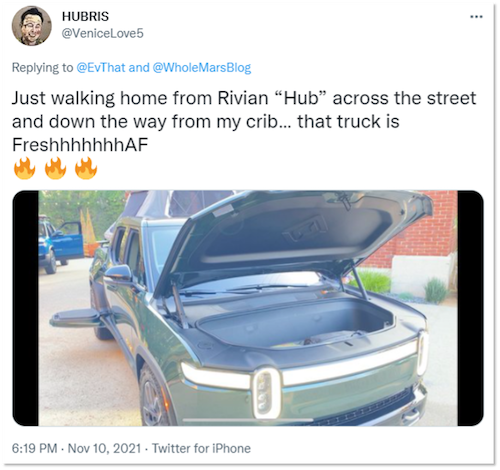
Tweets are overwhelmingly positive related to the truck’s appearance.
Rivian is being bolstered by a major consumer macro tailwind: electric vehicle demand
Consumer demand for electric vehicles continues pushing to new highs.
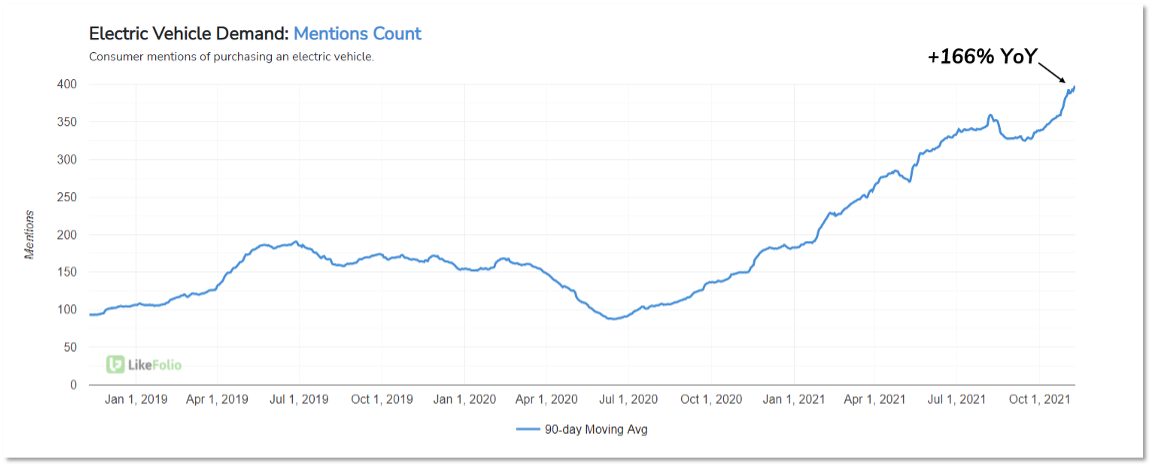
And Rivian appears to have carved itself a niche in the adventure market.
While the market speculates about valuation, expect some near-term volatility.
But also stay armed with real-time consumer insights. (It’s how LikeFolio issued a Bullish Coverage Addition Report prior to RIVN’s public debut…)
The RIVN hype is about more than the share price.
And we can’t wait to watch how demand unfolds over time.
Andy Swan,
Founder, LikeFolio