

Have you noticed the switch in stock-market leadership lately?
Small-cap stocks, as measured by the iShares Russell 2000 ETF (IWM), have been on an upside tear. Meanwhile, the tech giants leading the SPDR S&P 500 ETF (SPY) have taken it on the chin.
Why the sudden shift?
Traders are betting on the Federal Reserve pivoting to interest rate cuts. And small caps are loving it.
Naturally, folks are dumping money into the IWM because it’s a great way to invest in a diverse group of small caps with a single trade without taking much individual-stock risk… right?
Not so fast. There’s more to this story than meets the eye. Much more.
Many investors don’t realize the problems lurking beneath the surface of major indexes and the ETFs that track them.
Today, I’m going to pull back the curtain and show you what’s really going on inside the indexes.
Russell 2000 = Well-Diversified Trash
Let’s start with the Russell 2000. Sounds impressive, right? Two thousand companies! That’s diversification on steroids.
Or is it?
Here’s how the Russell 2000 Index works: It includes the 2,000 smallest companies in the Russell 3000 Index. Whenever a company grows too large, it gets kicked out and replaced by a smaller company.
Sounds good in theory. But in practice? The best-performing stocks consistently get taken away from IWM, while worse stocks get added.
But wait, it gets worse.
Did you know that 44% of companies in the Russell 2000 aren’t profitable? In fact, more than a quarter of them have negative operating cash flow!
That’s right. When you own the IWM, you’re investing in a sea of red ink.
And it’s not just about profitability. Many of these companies have terrible Business Quality Scores (BQS), our proprietary measure for evaluating stocks.v So when you buy IWM, you’re not just buying small caps. You’re buying low-quality, unprofitable small caps.
In other words, the stock market’s trash. Not exactly a recipe for long-term wealth creation, is it?
But surely the S&P 500 is better, right? It’s full of established, profitable companies.
Well, yes and no.
The S&P 500 today is more like the S&P Super 7… and the other 493 play a distant supporting role.
The S&P 500 has become incredibly top-heavy.
Just a handful of tech stocks – we’re talking about the likes of Apple, Microsoft, Alphabet, Amazon, and Nvidia – now make up an outsized portion of the index.
In fact, the so-called Magnificent 7 stocks make up nearly one-third of the entire S&P 500. And about the same percentage of the index is made up of technology stocks.
This concentration means you’re no longer getting the benefits of a diversified portfolio by owning the S&P 500.
When tech sneezes, your entire S&P 500 investment catches pneumonia.
Need proof? Just look at the recent market action. Since the markets topped out earlier this month, SPY is still down about 2% from its recent record high.
But the S&P 500 equal-weighted index (RSP) just hit a new all-time high and is up over 5% in July alone.
That’s the power of true diversification at work.
So what’s an investor to do? Avoid indexes altogether?
Not so fast. There’s a better way.
Double Down on Quality
So, how do you beat a flawed system?
Simple. You don’t play by its rules.
Imagine you’re at a salad bar. Index investing is like blindly scooping everything into your bowl – the crisp lettuce, the fresh tomatoes…
… but also the wilted spinach and that suspicious-looking egg salad.
Our approach?
We give you a pair of tongs and a magnifying glass. You’re picking only the freshest, most nutritious ingredients for your financial diet.
Here’s how it works:
Quality Filter: Our Business Quality Score (BQS) is like a restaurant Michelin star rating for stocks: Only the best make the cut.
Risk Radar: Our Volatility Quotient (VQ) acts as your personal risk detector, helping you avoid investments that might give you financial indigestion.
Timing Toolkit: Our Seasonality and cycle tools are your market calendar, showing you the best times to buy or sell. It’s like knowing exactly when the farmer’s market would have the juiciest peaches.
Money Flow Meter: We track big money movements so you can surf the waves of institutional cash instead of getting caught in the undertow.
These tools are available with a variety of subscriptions, and I have access to them all thanks to my TradeSmith Platinum membership. If you don’t see one of these in your TradeSmith Finance platform and would like to, give us a call at 888-623-0858.
An easy way to build this kind of menu of potential stocks is to create a TradeSmith Screener like this:
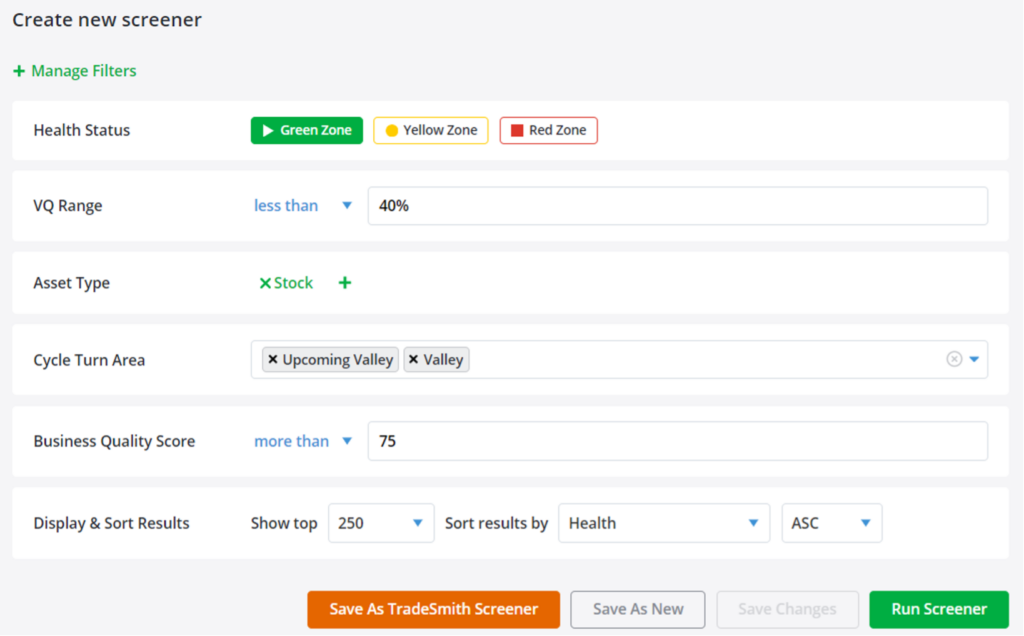
Here, I’m looking for Healthy stocks in the Green Zone that also meet the following filters:
- VQ% Range: Less than 40%, to signal a lower-volatility stock
- Cycle Turn Area: In a Cycle Valley or Upcoming Valley, for a stock that’s about to be on the rise
- Business Quality Score: More than 75, to limit results to only the top 25% by quality
TradeSmith Screeners make it fast and easy to crunch the numbers on thousands of stocks, helping you make a more informed decision in minutes.
Mike Burnick’s Bottom Line: Think of it this way. Index investing is like going to a fast-food restaurant. Sure, it’ll fill you up for a little while, but you’ll need to stop and eat again and again.
TradeSmith indicators and screener tools are like a prix fixe menu at the best steakhouse in town. You can choose your appetizer, entrée, and dessert from the highest-quality items cooked to perfection, plus the finest wine that suits your tastes. You’re in control of your financial destination, with the TradeSmith Finance platform as your Michelin guide.
Good investing,

Mike Burnick
Senior Analyst, TradeSmith