

Stocks delivered a powerful performance in 2024, with the S&P 500 closing the year up an impressive 23% – even if the year did end on a sour note.
For starters, the fabled Santa Claus rally failed to materialize at the end of December, and market breadth worsened steadily into year-end.
Instead of the 12 days of Christmas cheer expected by investors, more stocks hit new lows than highs for 13 days straight.
And today, a few talking heads on CNBC are already prepared to throw in the towel on the market’s prospects for 2025 – citing various concerns:
- First, there’s the un-inverted yield curve…
- Next, the Federal Reserve signaled fewer rate cuts than expected…
- And finally, there are just too many darn bullish investors right now!
These are just a few of the reasons some pundits are sounding alarms before the third week of 2025.
But of all these excuses, the most interesting is “too many bulls.” Really?
This is a bull market, after all. And it does take an abundance of bulls to make a bull market. In fact, market history clearly tells us that too many bulls is not a thing to worry about; it’s when too many bulls suddenly turn bearish that you should watch out:
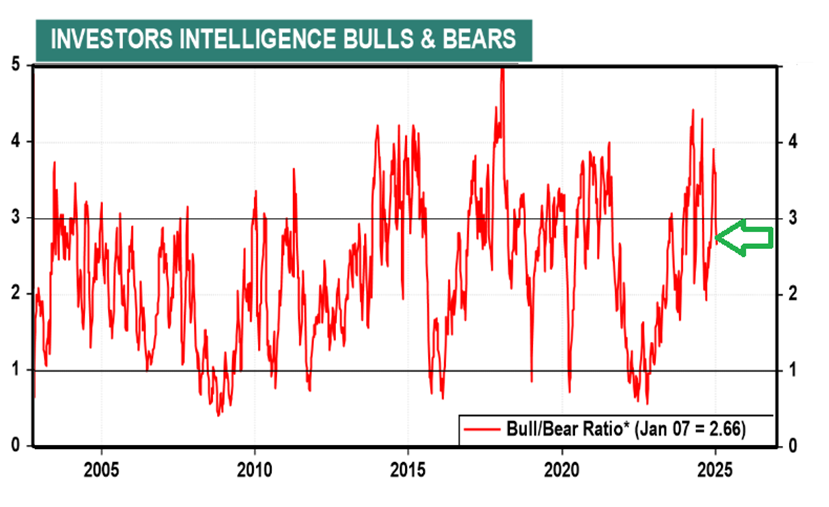
The chart above displays a popular sentiment indicator from Investor’s Intelligence, tracking the percentage of bulls versus bears among professional investment advisors.
As shown, the bulls-to-bears ratio did pull back at the end of 2024, but it remains at 2.6 – not far from its historical average of 1.9.
In other words, it’s not indicating a sudden shift in sentiment.
Granted, as we head into 2025, there are legitimate concerns – chief among them, the steady rise in Treasury bond yields:
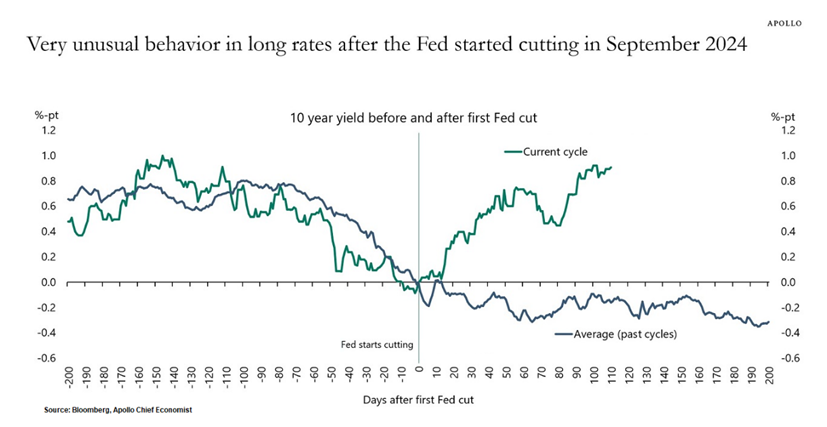
The Fed has cut short-term rates by a full percentage point, yet longer-term Treasury bond yields are up over 1% since then, as you can see above.
That’s puzzling. Historically, Treasury yields tend to fall alongside Fed rate cuts.
Recent strong economic data, coupled with the potential for tax cuts and trade tariffs, are reasons to worry about resurgent inflation – something that would usually be a clear and present danger for stocks.
But in the here and now, a quick glance at our own TradeSmith market indicators tells me the stock market remains healthy.
While the number of healthy stocks in the S&P 500 Index (SPX)’s Green Zone have fallen off a bit in recent months, reflecting the weaker market breadth indicators like new highs versus lows, it’s still close to 50%.
At this level, it’s not a big concern:
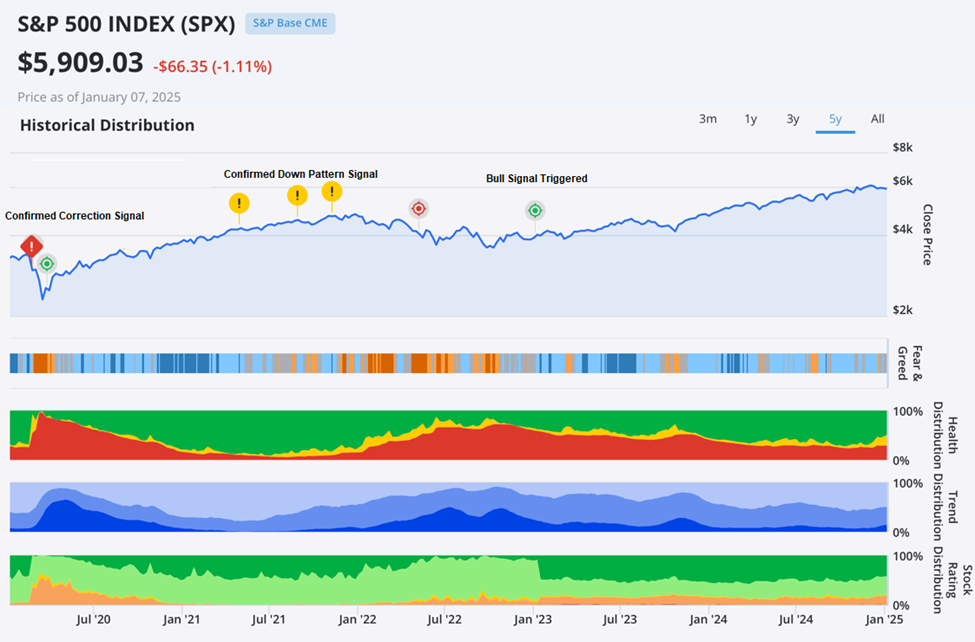
As you can see above, SPX remains in a Bull Signal, with no confirmed correction or downtrend signals triggered at this time.
Plus, the Dow Jones Industrial Average (DJIA) and Nasdaq 100 (NDX) are telling even more bullish stories, with 56.7% and 57.4% of their respective component stocks in the Green Zone.
For more evidence, take a closer look below at our key sentiment indicator: the Fear & Greed Index. It is firmly in neutral territory – rather than excessively greedy, which would be a red flag.
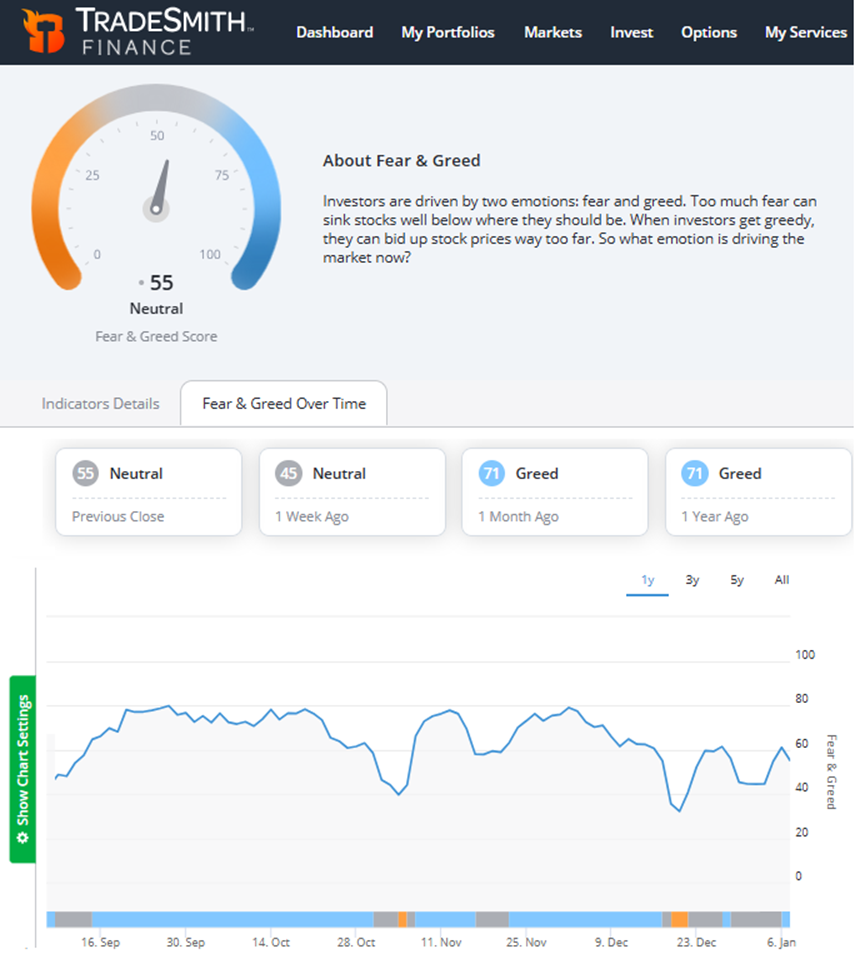
In fact, this indicator has been in a solid downtrend since November, signaling a decline in overall levels of greed and speculation since the 2024 holiday season.
Finally, our proprietary Seasonality indicator for SPX, shown below, clearly points to a favorable first half of 2025 for the S&P 500 overall:
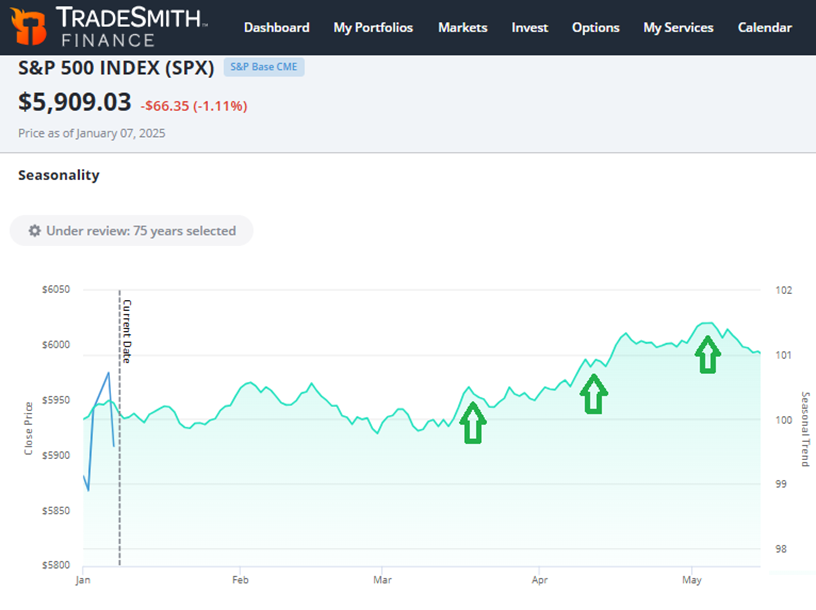
Granted, it’s true that we may continue to experience choppy trading over the next few months. But TradeSmith’s proprietary Seasonality indicator suggests that for the S&P 500, this chop will give way to a nice uptrend from spring into summer.
Mike Burnick’s Bottom Line: While there are reasons to be a bit cautious of the market as we enter the new year, our TradeSmith indicators tell us the stock market remains healthy. And our Seasonality indicators point to more upside to come, even if 2025 starts on a rocky note.
Good investing,
Mike Burnick
Senior Analyst, TradeSmith
P.S. As market history reminds us, bull markets thrive on optimism. And even though pundits are ready to throw in the towel, with half the S&P 500’s components still in the Green Zone and multiple sentiment indicators firmly in neutral territory, the future looks bright for 2025.
And when it comes to charting out that future, you’ll want to hear what TradeSmith’s CEO Keith Kaplan has to say.
Yesterday, Keith held his highly anticipated Breakthrough 2025 event – where he formally introduced a groundbreaking new “Green Zone” seasonality strategy designed to thrive in any market condition… even as many folks panic over uncertainty.
This strategy, backed by years of research and powered by decades of historical data, identifies the critical periods when stocks are primed for growth – down to the exact day – with an 83% rate of success across 18 years of backtesting.
At the heart of Keith’s system is a proprietary calendar tool that transforms complex predictions into actionable, timely trading insights – and with our Seasonality indicators pointing to a potentially favorable first half of 2025, you’ll want to put this powerful tool to good use.
For those looking to seize the year’s opportunities, don’t miss the chance to watch the replay of Keith’s Breakthrough 2025 presentation before it’s gone. Plus, along with the details on this groundbreaking new seasonality system, Keith shared two exclusive recommendations you won’t want to miss.
Click here to secure your seasonal edge – and put TradeSmith’s greatest achievement to use in 2025.