Time for Caution on the AI Chip Trade
Listen to the audio version of this article (generated by AI).
In This Digest:
- AI chipmakers have gone missing from this momentum screen
- Tech’s seasonally bullish window runs through July 24
- Four stocks set to profit from the emerging longevity theme
The market’s most-crowded trade has gone missing from our momentum screen…
My morning premarket ritual always involves our Project Heat Seeker screen.
It scans the market for stocks with strong fundamentals breaking out to fresh one-month highs. This gives me a quick read on where money is moving, even during flat stretches for the market like we’re in now.
Yesterday, 237 stocks made the list. It was full of financials, defense contractors, for-profit education, and healthcare – the last of which we’ll go into more depth later in this issue.
But unlike any of the daily screens I can remember for the better part of two years, not a single chipmaker ranked.
No Nvidia. No AMD. No Broadcom. No Micron. The stocks that have led this market for two years straight, the ones most bullish headlines are still built around, were nowhere on the list of what’s breaking out right now.
And yesterday, the iShares Semiconductor ETF (SOXX), a popular ETF that tracks the chipmakers as a group, fell 5.1%.
We don’t know if this is just a dip or the start of a steeper correction. But there’s another reason to be cautious with the AI chip trade right now.
Nvidia just entered a Short-Term Health Yellow Zone…
If you’re not familiar with how it works, Short-Term Health looks at each stock individually to understand its normal volatility range – how dramatically the stock has moved in recent months.
Then it detects abnormal moves outside that range… the kind of moves that signal a momentum shift.
Green means a stock is in a healthy uptrend. Red means a downtrend is confirmed. And Yellow signals a potential transition between the two. It’s not a signal to sell. But it does mean momentum is starting to shift.
Nvidia entered a Yellow Zone one week ago on July 1. Take a look at this chart of NVDA with its Short-Term Health status along the bottom:
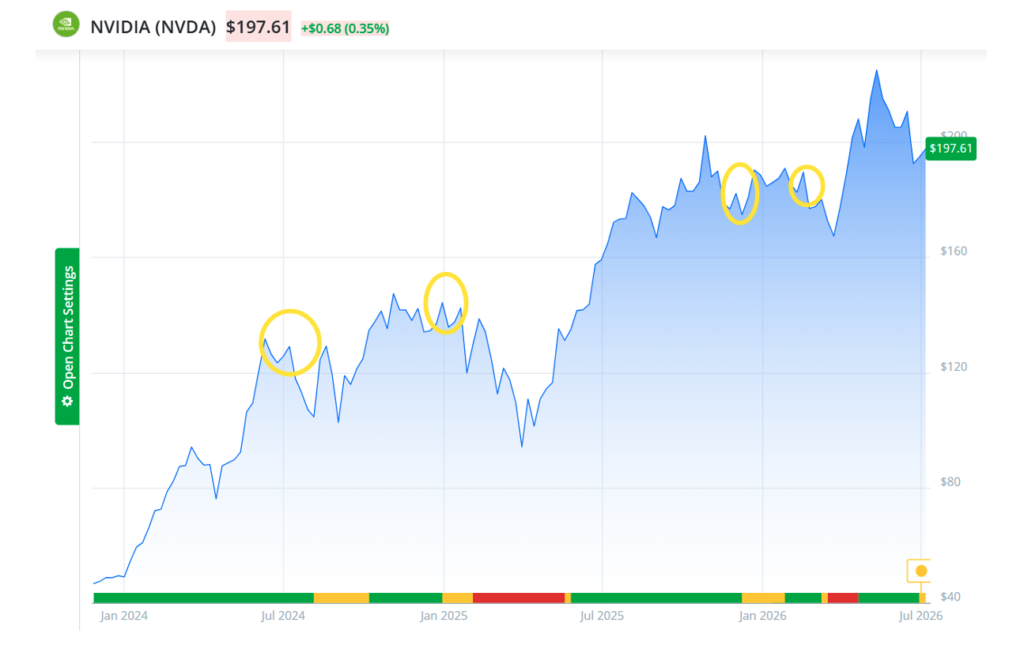
Each of the yellow circles above marks when Nvidia entered Yellow Zones going back to the start of 2024. Every one of them brought a stretch of turbulence. And one of them foretold a steep drop.
That Yellow Zone entry happened in December 2024. NVDA went on to drop as much as 35% through the end of May, when it took off gains and entered a fresh Green Zone.
We’re not calling for a crash here. But our data is showing weakness in the chip sector. And because the chip sector has been a major driver of this bull market, it’s worth having on the radar.
Seasonality remains bullish in general for tech…
I brought this to your attention in the June 23 Daily.
I showed you this chart from our Seasonality tool that’s very bullish on tech stocks right now.
See that green shaded area on the chart below? Going back 15 years, the Nasdaq 100 has finished higher from June 24 to July 24 100% of the time.
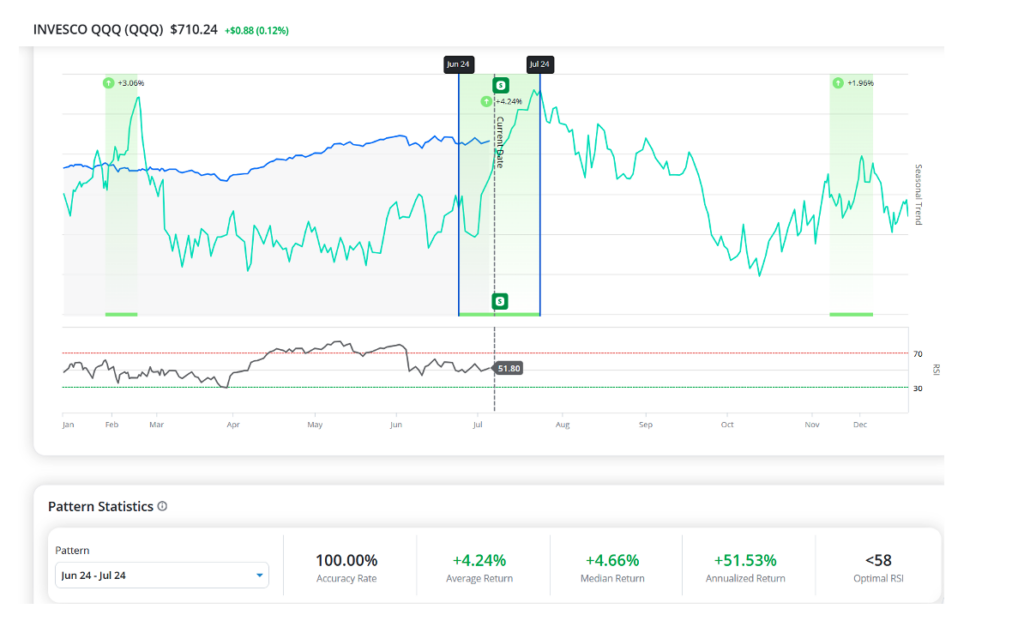
We’re in that bullish window right now, and we will stay there for another two weeks. That’s no guarantee that we’ll see the same pattern repeat in 2026. But it stacks the odds in favor of the bulls.
Keep in mind, though, that what follows is a much spottier stretch for seasonality.
From July 24 through the seasonal trough on Oct. 12, the Nasdaq has been up only a little more than half the time for the past 15 years and is roughly flat on average:
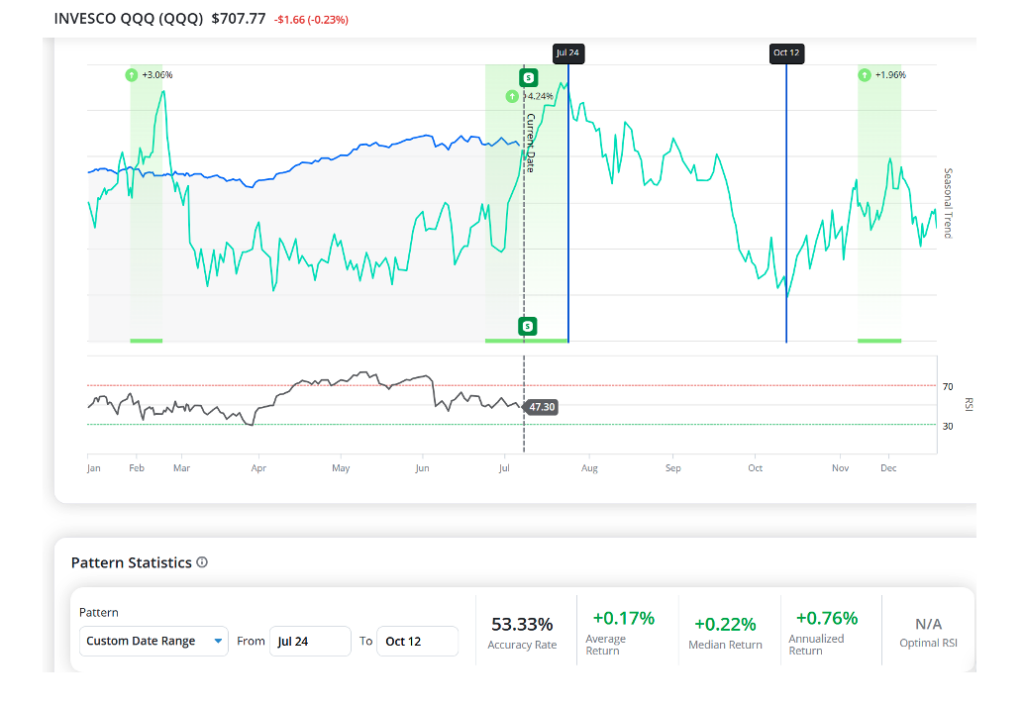
If you’re going to own tech stocks, the data says now is the time to do it – with a major profit-taking window opening later this month.
Finally, the longevity trend is heating up…
Over at our MegaTrends advisory, Andy and Landon Swan have been tracking what they call the longevity trend.
It covers a lot of ground – including GLP-1 drugs, peptides, biological age testing, telemedicine, and longevity-focused fitness.
But it all comes down to one idea: healthspan. Not how many years you live but how many of those years when you actually feel good.
And it’s being driven, in part, by a massive demographic shift.
The U.S. is an aging nation, and it’s aging quickly. From 2020 to 2024, the portion of U.S. population aged 65 and older grew by 13%, while the share of working-age adults (18 to 65) grew by just 1.4%.
As folks get older, they naturally become more interested in extending their healthy years.
This theme is popping up on Project Heat Seeker. Home health aides, senior living operators, physical therapy, and behavioral care – these formed the biggest cluster on this morning’s screen. Fifteen healthcare stocks hit fresh one-month highs, more than any other sector.
The strongest of the group, going by the fundamental rankings in our Quantum Score system, were:
- PACS Group (PACS) runs skilled nursing and post-acute care facilities – the places people go to recover after a hospital stay or to receive longer-term care later in life.
- Pennant Group (PNTG) operates home health, hospice, and senior living communities across the country.
- BrightSpring Health (BTSG) delivers home- and community-based care and pharmacy services to high-need patients, including a large base of seniors managing complex, long-term conditions.
- Hinge Health (HNGE) comes at healthcare from a different angle – app-based physical therapy for chronic joint and muscle pain. It rounds out a group that, top to bottom, is posting some of the strongest fundamentals in the entire market.
PACS Group stands out from the pack for its Predictive Alpha forecast. Here’s what our AI trading model sees for this stock in the weeks ahead.
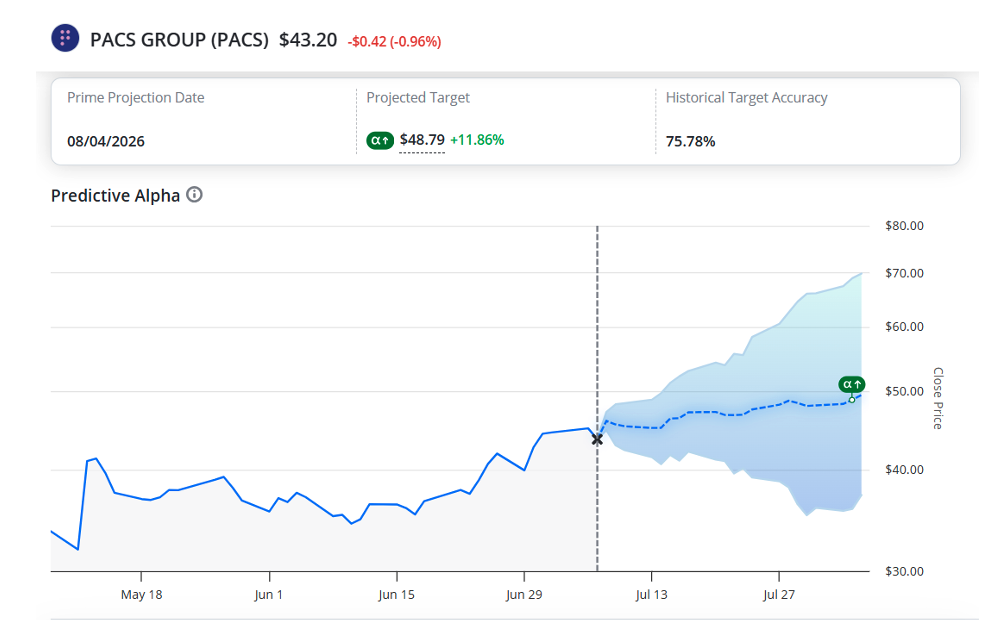
Predictive Alpha’s past forecasts on PACS have hit their mark 75.8% of the time. This time, it’s projecting (dotted blue line) a nearly 12% gain by Aug. 4.
Put PACS on your watchlist along with the other three healthcare stocks. The longevity theme is coming through in the data. But we’re still in the early innings of this trend. We’ll know it’s later in the game when every mainstream media pundit and Wall Street shop starts talking about it. And we’re not there yet.
If you’re a paid-up subscriber, pull all four up in TradeSmith Finance and run their Health signals to see which look strongest for an entry.
To building wealth beyond measure,

Michael Salvatore
Editor, TradeSmith Daily