TradeSmith’s Secret To Consistent, High-Probability Options Profits
Buying call or put options is a great way to speculate expected stock moves without breaking the bank – as each option contract controls 100 shares of the underlying stock for a fraction of the cost.
This leveraged nature of options allows you to risk a small amount of cash for a large potential payoff. It’s no wonder why options trading has exploded in popularity over the last five years… especially as the average stock price – and the price of everything else – has been on the rise.
But as I explained in my last issue, as an options buyer, time is always working against you. That’s because options lose value daily, as they tick closer and closer to expiration day.
On the other hand, that means that time is on your side when you take the role of an options seller!
That’s the core idea behind one of my favorite options trading strategies. Selling puts is a great way to earn steady income – and with the latest upgrades to TradeSmith’s Options360 software, we’ve made it even easier to earn consistent profits by selling options.
In tonight’s issue of Inside TradeSmith, I’ll show you how it works.
Increase Your Option Odds With The Options360 Screener
When you sell a put option, you don’t need to own the underlying stock to place the trade. That’s because put options are all about selling shares of stock… at least on the buyer’s side.
As a quick reminder, buying a put option gives you the right (but not the obligation) to sell 100 shares of a stock at a set price – the strike price – until the option contract expires.
If you’re selling a put option, on the other hand, you’re taking the other side of that deal: You’re promising to buy those 100 shares of stock at the strike price, if the put buyer decides to exercise their right to sell.
In exchange for making that promise, you get paid a premium upfront. That’s cash income delivered straight to your brokerage account as soon as you hit ‘sell.’ And as the option seller, you get to select the strike price of your put option before you enter the trade.
So, if you are “put” the stock before the option expires – meaning the option buyer on the other side of your contract has chosen to sell stock to you at the strike price – you can make sure that you’re buying shares at a discount from current prices.
That’s a great way to pick up shares of stock you want while being paid for your time.
However, if you wanted to sell puts just for the income potential, without wanting to purchase stock, then you want the stock price to stay above your chosen strike price. If it does, you keep the 100% of the premium you earned – and move on to the next income producing trade.
The question, then, is how to find the best options to sell? If you scan through an option chain, you’ll find hundreds of different contracts with different strike prices, premium values, expiration dates, and more…
Thankfully, we’ve made the job easy for you – no need to run the numbers! You can use the Options360 Options Screener to uncover money-making put trades with a high probability of success, based on our proprietary indicators.
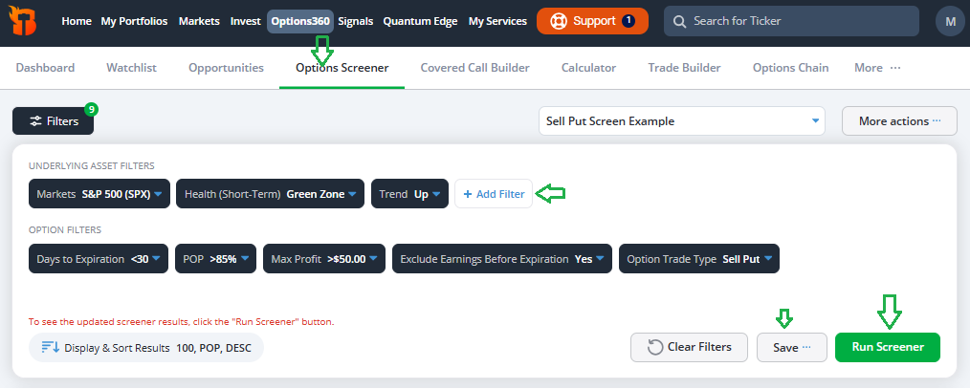
To get started, log in to your TradeSmith Finance platform, then select Options360 from the top menu. Click the Options Screener tab, and you’ll be taken to the page shown below:
(Please Note: If you don’t see the Options Screener – and would like to – simply contact our Customer Care team at 888-623-0858 to learn more… or look out for more details next week!)
The Sell Put option screener I put together in the screenshot above includes a few more filters than we used for the call option screen in my last issue.
Again, you can fully customize the filters as you see fit. To add filters, simply click the blue +Add Filter button on the right in the top filter row.
Now, let me explain how these filters can give you a successful edge when selling put options.
We’ll start with our Underlying Asset Filters…
- Markets: S&P 500 Index
- Health (Short Term): Green Zone
- Trend: Up
Remember, when selling options for income, your goal is for the put option to be out of the money – above the strike price – at expiration.
So, here I’m looking to sell puts on S&P 500 stocks that are in our Short Term (ST) Health Green Zone and that are in an uptrend. This helps stack the odds in your favor as you bet against a decline in prices.
Next, we can review our Option Filters:
- Days to Expiration: Set to less than 30 days
- POP: More than 85%
- Max Profit: > $50
- Exclude Earnings Before Expiration: Yes
- Option Trade Type: Sell Puts
Options lose value every trading day as they approach their expiration date. That process is called “time decay,” and it tends to accelerate in the last 30 days or so of an option’s life.
As an options seller, you want to take advantage of time decay. That’s why I screen for short-term trades expiring in 30 days or less.
Now, POP, or the Probability Of Profit, is the TradeSmith indicator that makes this whole screener work.
As I mentioned in a recent issue, POP tells you the odds of making money on this trade. When selling options, you want a high POP value – as that means high odds of success.
To prove my point, just look at the results of our Constant Cash Flow and Infinite Income Loop services: By sticking to a strategy that sells out-of-the-money put options with a high POP (80% or higher), the CCF and IIL model portfolios have enjoyed a success rate of over 95% after hundreds of options trades!
Options with strike prices closer to the underlying stock’s current price pay out more premium, because they have a greater chance of going in the money. They also have a lower POP as a result.
More risk, more reward. But the Probability of Profit gives you an easy method to check the odds as you determine how much risk is worth it to you.
Moving back to our model screener, however, we can use the Max Profit filter to make sure our sold options are worth our time and effort.
When selling options, your max profit is limited to the premium you earn when initially selling the option. You want to make it worthwhile, and so $50 is a reasonable minimum profit to consider.
Next up, we can’t forget that stocks can make wild moves after reporting quarterly results. You don’t want a profitable trade to turn into a loss overnight if the stock gaps down after reporting… and so, that’s why I exclude stocks that report earnings before expiration.
Once you have your filters set, simply click the green Run Screener button to view your results. If you want to save this screener for later, click on the green Save button to keep the screener filters for future reference.
When I ran this Sell Put screen earlier this week I got over 30 results, with a sample shown here:
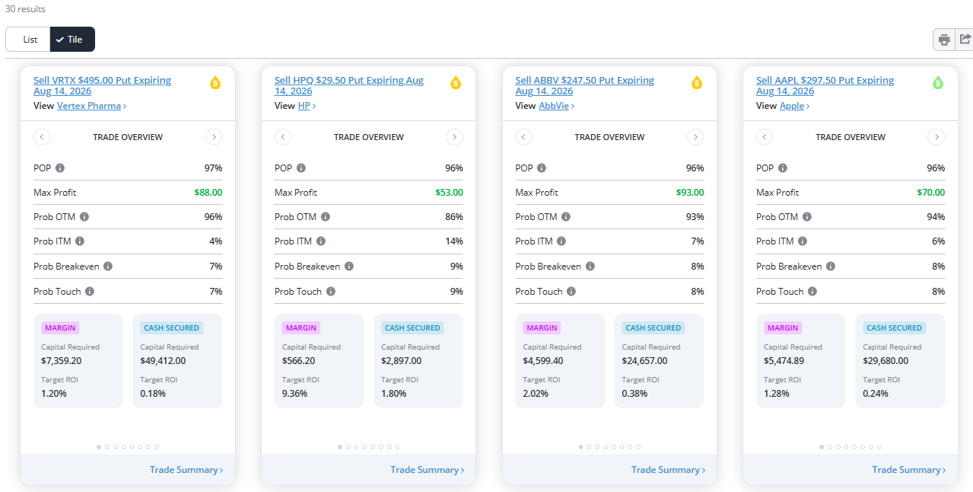
The option tile cards you see displayed above for each result include a wealth of additional information about each trade.
At a glance you can see the option, underlying stock, strike price and expiration date of each option listed at the top. Other key metrics include…
- Our proprietary Probability of Profit (POP) indicator, which displays a calculated probability of earning a profit of any size on the trade…
- The Max Loss of the trade, which for calls is the option premium you paid…
- Prob ITM and Prob OTM, listing the probabilities that the option finishes in or out of the money at expiration…
- Prob Breakeven, the probability that the trade finishes at or better than breakeven…
- Prob Touch, the probability of the stock touching the strike by the expiration date…
- The Capital Required to place the trade…
- The Target ROI, your estimated return on investment…
- And even more.
Armed with these Options360 metrics, you can objectively judge the success probability and profit potential for each trade.
Let’s take a closer look at the HP (HPQ) $29.50 Put Option expiring tomorrow on Aug. 14, 2026 – and compare it to the AbbVie (ABBV) $247.50 Put with the same expiration date:
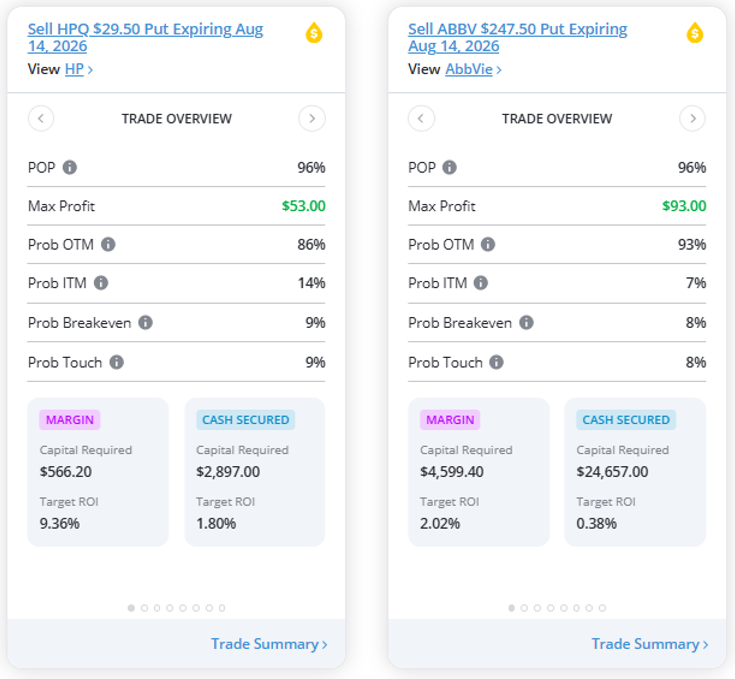
Notice that they both have a 96% POP. In other words, there’s high odds of success that you turn a profit on these put sell trades.
The Max Profit is higher for ABBV at $93, vs. a Max Profit of $53 for HPQ. That’s because ABBV is a more expensive stock, so you’ll need to put up more cash or margin buying power to make the ABBV trade in the first place ($4599.40 vs. $566.20).
In exchange, you’re paid a higher premium for entering the trade.
ABBV put has a higher probability of being OTM at expiration (93% vs. 86% for HPQ), based on the Prob OTM value – so that means less risk of the stock price falling below the option strike price. The Prob Breakeven is about the same for both stocks.
Note also that the return on investment (ROI) is much higher for the HPQ put (9.36% margin ROI vs. 2.02% for ABBV). So, let’s say we go with this trade.
On the Option Tile Card, simply click on the arrow icon at the side of the card to scroll left or right and view more data. Scroll right by clicking the arrow for the HPQ put to find the Option Detail section, shown below:
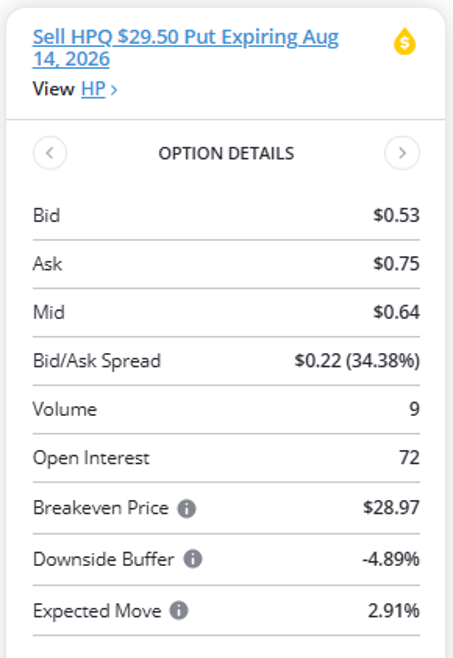
The breakeven price, $28.97, is the $29.50 strike price minus the $0.53 (or $53 total) of premium income you would earn for selling the option.
The Expected Move of HPQ stock is just 2.91%, based on option pricing. But you have a Downside Buffer of -4.89% on the trade. In other words, the stock can drop that much and you would still make money.
Again, the odds are in your favor.
Also note the wide option spread between the $0.53 bid and $0.75 ask prices. The Mid price is $0.64 – exactly in the middle of the spread.
If you wanted to sell this option, you could try to do it with a limit order at the Mid price of $0.64 to earn extra income, instead of selling at the $0.53 bid price.
Now click the arrow to scroll right again, and you’ll find the Underlying Asset Price Forecast graph…
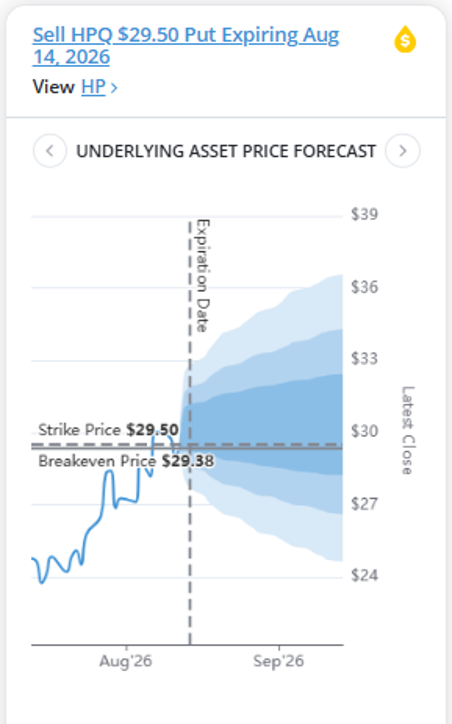
The shaded blue area of this graph charts the probable price range of PBR stock from now through the expiration date of the call option. The strike price of the option and your breakeven price are also displayed, as seen above.
Notice that there is a smaller shaded area below the breakeven price than there is above it, according to our price forecast. That tells you that HPQ is more likely to stay above that level by expiration… which accounts for the high POP on this trade.
Mike Burnick’s Bottom Line: When selling put options, time is on your side… but that doesn’t mean you can succeed by selling any put option you choose.
Selling put options is a great way to earn steady, repeat income with options. And our Options360 tools, including the Options Screener tool and our new indicators, give you plenty of tools to find options trades with a high probability of success – and high chances to earn consistent profits.
Good investing,
Mike Burnick
Senior Analyst, TradeSmith
P.S. With prices rising sharply in stores, at the gas pump, and on the stock market, it’s a smart idea to try and increase your income however you can.
Our Options360 software can help you consistently turn put options into a paycheck, as we saw today, but there are plenty of other opportunities in the market you can make use of… as long as you know where to look.
Here at TradeSmith, we believe that everyday investors can benefit from access to cutting-edge, hedge-fund grade technology – and that’s why we’ve been hard at work building new systems, strategies, and tools leveraging the latest advances in AI and machine learning.
The result? A money-making strategy that relies on trading just five stocks at a time, selected by one of our most powerful AI tools yet.
Click here to learn more about this simple, powerful AI strategy.