

Yesterday marked the 39th anniversary of one of the market’s darkest days – 1987’s “Black Monday” stock market crash.
That day, the S&P 500 fell a whopping 20.47% in just a single trading session, marking what is still the largest single-day drop in the index’s history.
Nearly 40 years later, investors are grappling with many of the same fears that preceded Black Monday… to the point that last Friday’s drop in the S&P 500 led some to draw comparisons on the eve of the anniversary.
Thankfully, instead of plunging yesterday the S&P 500 rose by a respectable 0.4%.
To be sure, some sectors of the market have suffered deeper pullbacks recently. But the overall market is holding up so far, only 1.2% away from its most recent peak on Oct. 6.
And as investors shift their focus into new sectors and stocks, this kind of rotational price action could present a good buying opportunity.
You may want to get ready to buy the dip in select sectors or stocks…
Or you could consider selling the dip instead, by using one of my favorite strategies.
No matter which approach you prefer, options allow you to easily position yourself for success as the market rotates. And when it comes to trading options, there are few tools as handy to have as TradeSmith’s Fair Valuetool.
Options360 subscribers and TradeSmith Platinum members can access the Fair Value tool just by logging into TradeSmith Finance. From the Home page, simply scroll down the page to find from the Fair Value tool, as shown below:
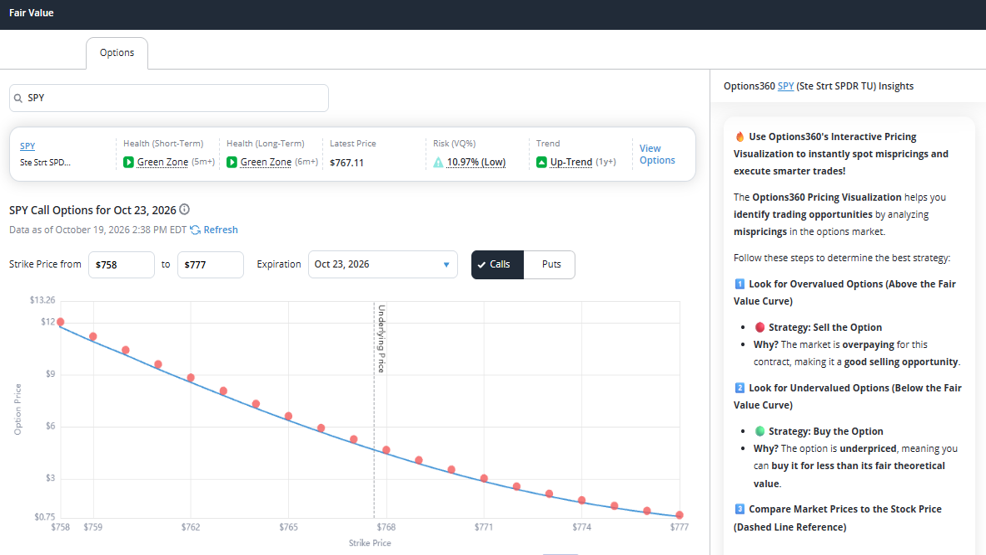
By using the Search for Ticker box in the top left corner of the panel, you can type the symbol for any optionable security to analyze it with our Options360 system.
Then you can quickly scan for options that may be trading above or below fair value, based on that analysis. This can give you an opportunity to capitalize on the mispricing – and profit in the process.
You can also select from a range of different option strike prices and expiration dates by adjusting the selections above the graph.
The blue line on the Fair Value graph represents the estimated fair value options curve that we calculate using a modified Black-Scholes model.
The dots on the line correspond to contracts on the options chain, and the color and position of those dots track the market prices of each contract:
- When the dots are above the blue line, it means the option is overvalued. If the dot is red, it’s flashing an overvalued signal…
- When the dots appear below the blue line, it means they are undervalued – and dots that are green are flashing an undervalued signal…
- And dots sitting at the blue line are close to fair value, regardless of color.
Simply hover your mouse over any dot with your mouse to view details about how under- or over-priced the option is, according to our analysis.
With the Fair Value tool, you can potentially get more than your money’s worth when buying or selling an option.
If you’re a buyer of call or put options, find undervalued options you can buy for less than fair value. And if you’re a seller of options, look for overvalued options – priced above fair value – that you can sell to earn a bit of extra income.
For option traders, knowing whether an option is over- or under-priced before placing a trade can make a big difference in profit potential and odds of success.
That’s what makes our Fair Value tool so valuable. To go even further, let’s look at two examples: buying undervalued call options and selling overpriced puts.
Using Fair Value to Cheaply Buy The Dip!
Below, you’ll see the Fair Value graph for tech stock Zoom Communications (ZM). ZM shares are down about 12% from their most recent high.
The stock is in our Long-Term Health Green Zone, and so may offer good rebound potential, despite being in the Short-Term Health Red Zone:
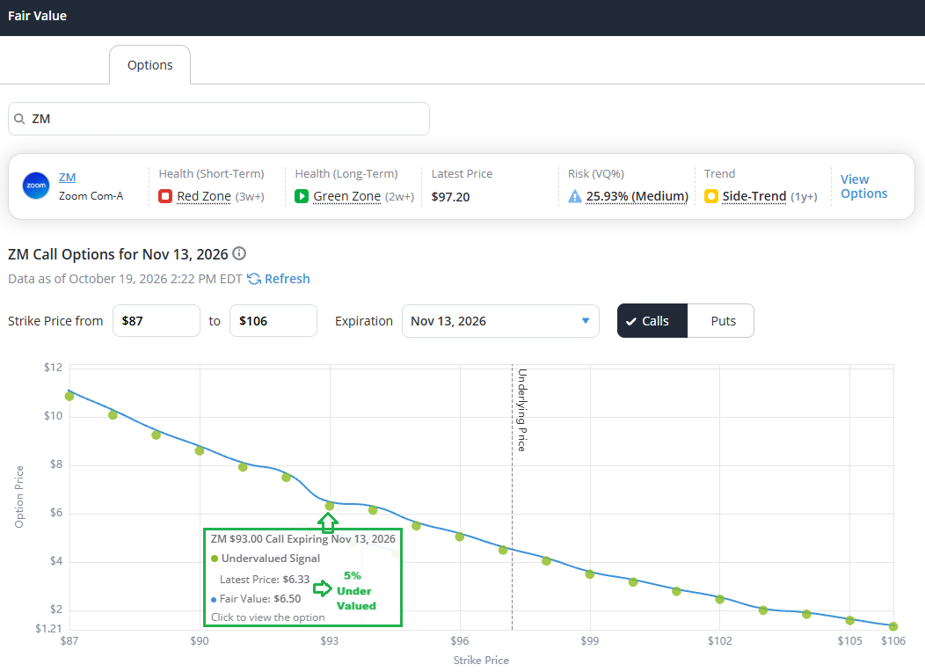
In the graph above, I’m scanning for underpriced call options on ZM to try and buy the dip. By buying a call option on the cheap, you could possibly cash in on a rebound in the stock – either by selling your option for premium or by exercising it to purchase ZM shares later.
Notice that a few in-the-money calls (with strike prices below the current share price) look undervalued. Simply hover your mouse over any dot to view the details.
In particular, the ZM $93 Call Expiring Nov 13, 2026 looks attractively undervalued. The latest price is $6.33, but our Fair Value calculation shows a true value of $6.50, so it’s underpriced by about 5%!
So, you could buy this option at a discount to fair value and earn extra profit as ZM shares rebound.
Sell The Dip For Bigger Potential Profits Using Fair Value!
Now, what if you wanted to take advantage of the recent pullback to buy leading tech stocks at discount?
In that case, you can use one of my favorite trading strategies by selling put options. Let’s take Apple (AAPL) for example.
AAPL shares have held up well, compared to some other tech stocks, currently trading near $342.
But when it comes to entering positions, my motto is “never pay retail.”
Don’t just buy AAPL shares at the current price of $342, when you can aim to buy the stock at a discount and get paid to do it in the process!
To do that, consider selling a short-dated put option on APPL with a strike price that’s comfortably below the current market price. You get paid the option’s cash value, the premium, to do this.
If AAPL share prices fall below the put’s strike price by the expiration date, you will automatically be assigned shares of AAPL, which you’ll purchase at the strike price… but you’ll keep the premium income earned in the process.
If you’re assigned, then you just bought a quality stock at a nice discount well below the market price. And if you aren’t, you’ll still keep the premium!
So, let’s go back to our Fair Value tool and look for AAPL put options that are trading above their fair value:
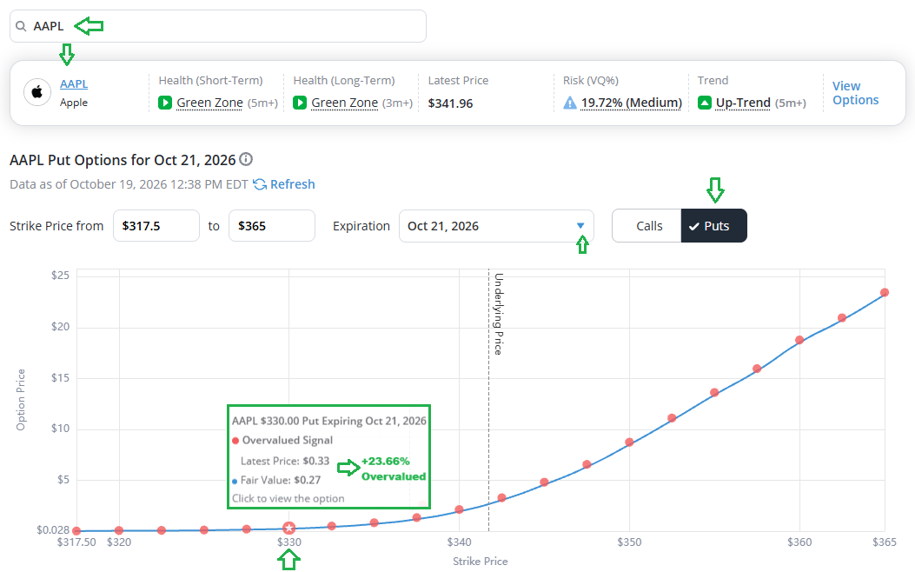
You can sell these overvalued put options for more than they’re worth, and pocket extra income in the process.
The AAPL $330 Put Expiring Oct 21, 2026 shown above looks like a good candidate for this strategy. Just hover over this option and you’ll see the details.
The latest price for the option is $0.33. But according to our calculations, its fair value is just $0.27 – so it’s overvalued by 23.6%!
You can sell this put option – aiming to buy AAPL stocks at a $12 discount – and get paid $33 to do it. In this case, you’re getting paid more than the option is worth.
Mike Burnick’s Bottom Line: If you’re looking to buy or sell the dip using call or put options, it’s important to know if they are overvalued or undervalued before placing the trade. So, before you pull the trigger on any option trade, be sure to consult our Fair Value Option graph first.
At a glance it will show you the market price of any option compared to its data-driven fair value. And that gives you a valuable edge at trading options.
Good investing,
Mike Burnick
Senior Analyst, TradeSmith
P.S. TradeSmith’s Fair Value tool is one of headline offerings of our Options360 platform – but it’s just one tool in our toolbox.
Our latest tool is just as powerful… and as we get into the busiest part of earnings season, it might be one of the best tools available for an options trader.
Every day, hedge funds and big Wall Street trading firms use options to place massive bets on where stocks will move next – hidden and buried beneath the millions of data points and price updates that make up your average trading day.
These are leveraged bets placed by some of the biggest players in the market: the smart money, the insiders, the major institutional investors. Major market players with connections… and with access to critical information that allows them to make good bets before anyone else can.
To uncover the hidden signals left behind by these major options trades, and turn them into actionable ideas for traders like you, our team built something new:
We call it Smart Money Edge.
Instead of guessing where a stock is headed next, Smart Money Edge is an AI tool that gives you a chance to see how the Wall Street pros and the really-in-the-knows are placing their bets behind closed doors.
It finds the invisible patterns left behind when these players make their bets, then follows those patterns and crunches the numbers to select the best trades to follow along with that activity – allowing you to trade alongside the Wall Street pros who are quietly putting big money into these leveraged bets.
And based on our research and our extensive backtesting, Smart Money Edge works: This is a system that can deliver big wins and deliver them with consistency. We found that a whopping 80% of the stocks flagged by Smart Money Edge moved higher within a month.
Click here to find out more about this AI tool – and how you can start using it today.