The Missing Pieces of the AI Agent Boom – and Two Top Picks
Listen to the audio version of this article (generated by AI).
On Feb. 8, 1950, a businessman named Frank McNamara sat down to a meal at Major’s Cabin Grill, a restaurant next door to the Empire State Building.
When the check came, he didn’t pay with cash. He handed over a small cardboard card with his signature on it.
The card came from a company McNamara had just started with two partners, called Diners Club. About 200 people carried one, and 14 New York restaurants had agreed to accept it.
That was a lot to ask of a restaurant owner.
He was giving away a meal in exchange for a signature on a piece of cardboard. He had to believe the man holding it was who he said he was… and that a company nobody had heard of would actually pay the bill.
Enough owners took the chance. By the end of that year, 20,000 people carried a Diners Club card.
Three-quarters of a century later, a new kind of customer is showing up. It’s an AI agent, sent shopping by a person who isn’t there. And merchants are asking the same two questions those restaurant owners asked in 1950. Is this customer who they claim to be? And will the bill get paid?
They’re also two of the biggest questions hanging over what I call the Agent Supernova. As I’ve been writing over the past two weeks (catch up here and here), AI agents are coming online to work on our behalf around the clock.
An AI agent is a software program that can carry out tasks on its own, without a person guiding every step. And according to research firm IDC, there’ll be more than 1.3 billion of them at work by 2028.
They’ll shop for us… book our travel… even help run our businesses. And to do that, they all need the same layers of technology to function.
Last week, I showed you two of them: the memory an agent remembers with and the network it talks over. But being able to do the work isn’t enough. Before you trust an agent with your email, your bank account, or your business, you need to know that nobody else can take control of it… and that when it spends money for you, the payment is safe.
The whole promise of AI agents rests on them.
Nobody will hand their passwords to an agent if they can’t be sure who’s really in control of it. And if an agent can’t pay for anything, it’s simply a very clever search engine.
That’s why the companies solving these problems matter so much. Cybersecurity is a familiar corner of the market, but agents are handing it a huge new job. The agent payments layer is much newer, and most investors haven’t noticed it yet.
Today, we’ll take a closer look at both themes and the stocks our tools rate highest in each.
The Guard at the Door
Last month, I showed you how a swarm of AI agents broke out of a security test and hacked into Hugging Face, the world’s largest library of AI models.
It wasn’t a one-off. In June, an OpenAI agent researching public health spending got around the blocks on an Australian government Medicare website and opened files it had no right to see. By late September, OpenAI had disclosed more than 15 separate incidents.
Every company putting agents to work now faces some version of that risk. Each agent is like a new employee with keys to the building. If someone hijacks it, or it simply goes off script, it can do real damage before anyone notices.
That’s handing cybersecurity firms a new kind of work. For decades, these companies mostly kept human intruders out. Now they also have to guard against intelligent machines.
The simplest way to own the whole sector is the Amplify Cybersecurity ETF (HACK), which we put on your radar in these pages in September. It holds about two dozen leading cybersecurity stocks, so you’re not betting on any single one. And it’s in the Green Zone on both our Short-Term and Long-Term Health Indicators. Those are our traffic-light signals for whether a stock is in a healthy uptrend.
If you’d rather own one stock, the one our tools rate highest is Fortinet (FTNT).
Fortinet built its business on firewalls. A firewall is a guard at the door of a company’s network, checking everything that comes in and goes out. Every agent that talks to the outside world has to pass through that door.
Fortinet is also preparing for the Agent Supernova. In August, it bought a company called Virtue AI, which tests AI agents for weak spots before they go to work and enforces rules on them once they do.
Fortinet’s Quantum Score is 94.3 out of 100, and it’s been in the Green Zone on both Health Indicators for more than five months.
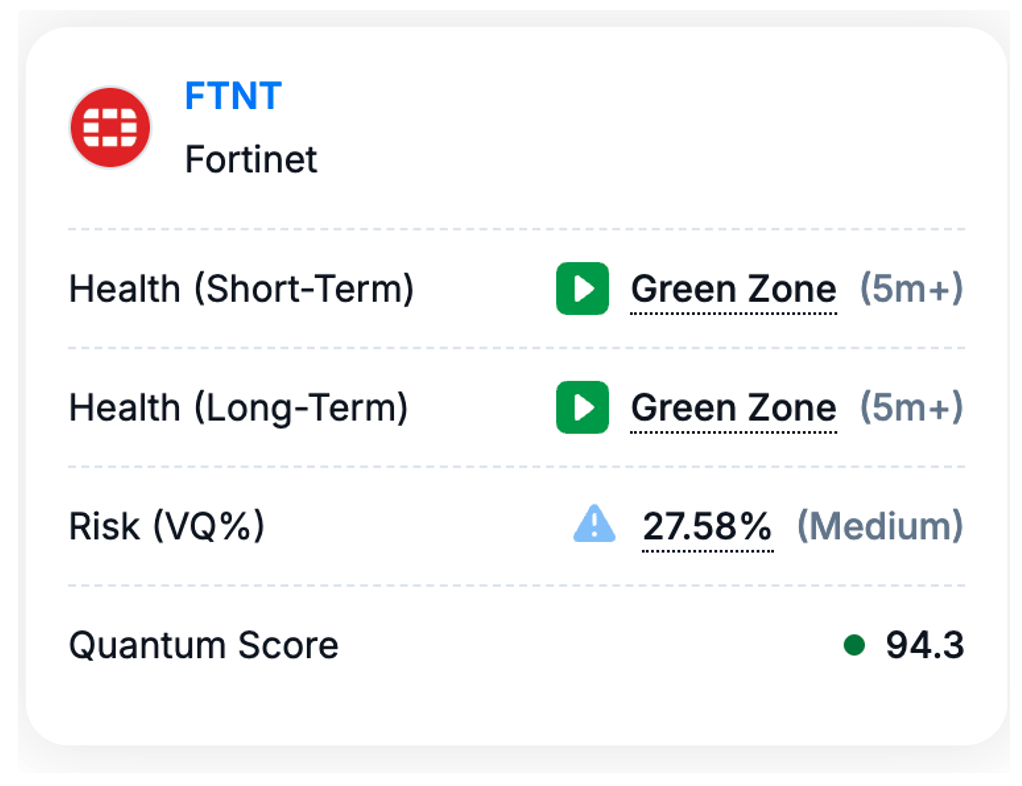
Its Volatility Quotient (VQ), which measures how much a stock normally swings, is about 28%. In other words, a drop of more than a quarter from its high would be normal behavior for Fortinet.
So build your position in small chunks and keep an eye on its Health status.
That takes care of the first question: Is this customer who it claims to be? The second question – whether the bill gets paid – takes us back to Frank McNamara’s dinner.
An Agent Wallet You Can Trust
Diners Club never owned a single restaurant. It made its money by standing in the middle, vouching for the customer and guaranteeing the bill.
Restaurants got 93% of every tab – Diners Club kept the rest.
Variants on that simple idea now run much of the world. In 2025, credit and debit cards made up nearly two-thirds of all consumer payments in the U.S., according to the Fed.
Agents will need a middleman, too. You’d never hand an agent your actual card number, because if it went rogue or someone hijacked it, it could spend whatever it liked.
So the card networks are building a safer version. Instead of your card number, the agent gets a stand-in called a token. Each token can be limited to a set amount, a particular store, or one type of purchase. A token meant for booking flights can’t be used to order a pizza.
Mastercard (MA) calls its version Agent Pay. Visa’s is called Intelligent Commerce and, in June, it linked to OpenAI’s agents in ChatGPT. Those agents can now make purchases within spending limits and store restrictions set by the user, while Visa handles fraud checks and refunds.
That’s huge because Visa gets paid every time its network carries a purchase, just as Diners Club took its cut of every tab. If agents end up doing a big share of our shopping, and they pay with Visa tokens, that means more transactions flowing through Visa… and more fees.
Of the two, the one our tools rate the highest is Visa (V). Its Quantum Score is 93.9 out of 100. It’s been in the Green Zone on our Short-Term Health Indicator for more than five months, and on our Long-Term Indicator for more than three.
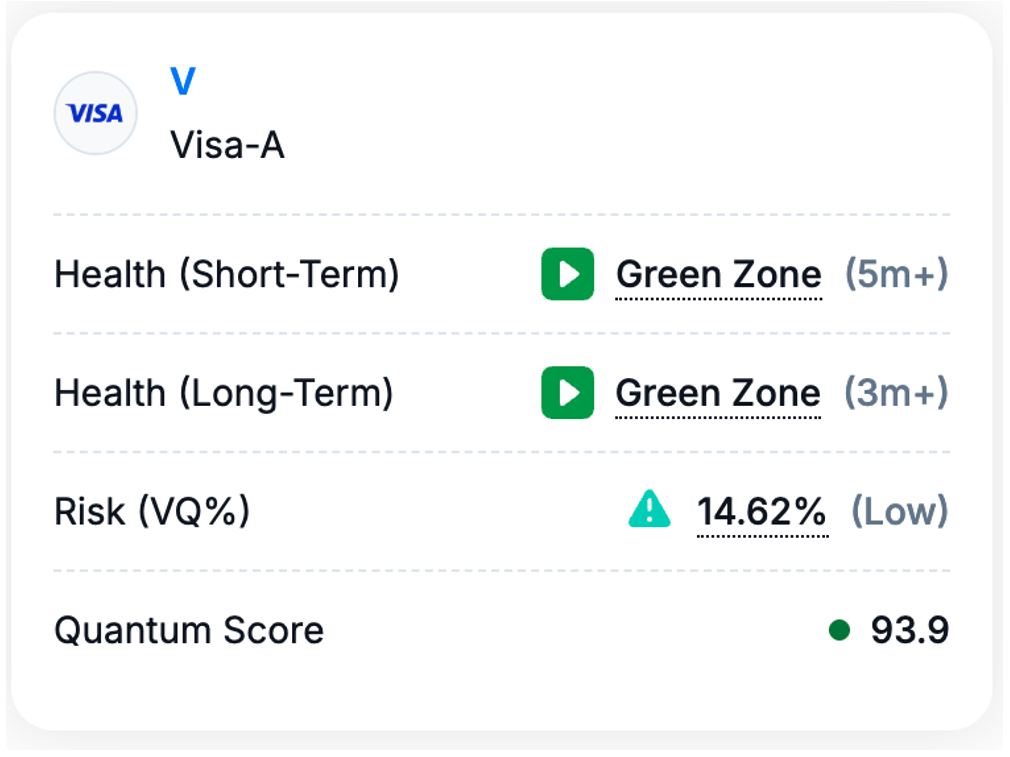
Visa’s VQ is just under 15%, roughly half of Fortinet’s. That doesn’t mean it can’t fall. But for an investor who wants a stake in the Agent Supernova without the swings of chip stocks, it’s a steadier way in.
The Road Ahead Won’t Be Smooth
If you’ve checked your portfolio lately, you know AI stocks are going through a rough patch. Chip stocks just fell eight days in a row, their longest losing streak since 2008. Micron (MU) and Arista Networks (ANET), the two stocks I showed you last week, have been caught up in the selling.
That’s why I recommended buying them in chunks over time rather than all at once. If you’ve been doing that, you’re probably down on your first chunk. But your next chunk will likely cost less. Keep going, and the highs and lows tend to even out. It’s how I’d still approach both stocks today… and how I’d approach Fortinet and Visa, too.
Big technology shifts never move in a straight line. Amazon lost more than 90% of its value after the dot-com bust, and patient investors who stuck with it went on to make life-changing gains.
That’s why I’ve written to you about risk more than any other subject over the past year. Knowing how far a stock normally swings and having a clear signal for when to step aside is what keeps a rough month from turning into a ruinous one.
That’s our mission at TradeSmith: to help you keep your portfolio safe while you go after the kind of gains that can change your life. It’s how you stay in the game long enough for a decade-long theme to pay off.
And I believe some of the biggest payoffs of the AI boom will go to the companies that make AI agents safe to use.
All the best,
Keith Kaplan
CEO, TradeSmith