
Listen to the audio version of this article (generated by AI).
In This Digest:
- Tech just one of its worst months of this bull market, but this key trend is still intact
- Healthcare stocks are breaking out as tech breaks down, led by our top “bio-intelligence” pick
- Surveys say consumers are miserable, but they’re still spending in this key “wants” area
We just wrapped one of the worst months for tech stocks in recent memory…
The tech-focused Nasdaq 100 fell 6.7% in October, outpacing the recent decline we saw this past summer.
It’s the second-worst monthly drop in tech since the AI-led bull market began, bested only by the Liberation Day crash in April 2025.
Individual tech stocks saw historic moves late last week that contributed to the overall slump.
Intel (INTC) fell 28.6%, its worst day since 1974. Reddit (RDDT) lost 29.2%, its worst decline since it debuted in 2024. And ServiceNow (NOW), one of the largest software-as-a-service stocks that recovered after the year’s early wave of selling, dropped by more than a third.
These are huge losses. And after a day like Friday, the question at the top of everyone’s minds is whether the bull market trend is broken.
On the two benchmarks that matter most for the AI trade, it isn’t.
The S&P 500 and the Nasdaq 100 are both still in Short-Term and Long-Term Health Green Zones. That tells us their uptrends are intact on both major timeframes we track – even after Friday’s selling.
They, along with the large-cap Russell 1000 benchmark, are the only major markets to hold this status.
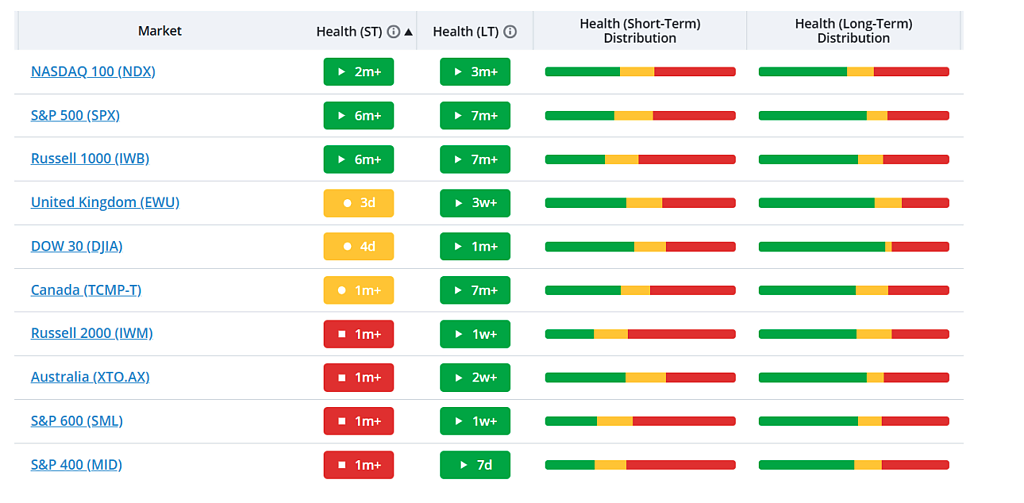
This might seem strange, given the steep falls we’ve seen over the last month. But remember, TradeSmith measures the historical average volatility of these markets to determine trends.
Take the Nasdaq 100, for example. Its average historical volatility, measured by our Volatility Quotient (VQ), is about 16%. That means we’d expect a drawdown of 16% from the highs before we consider the trend broken on a long-term basis – and the index would shift into the Red. That would be another 8% decline from here.
To be clear, we’re not out of the woods yet. These Health statuses can shift. And as you see in the Distribution columns to the right, many of each index’s stocks are not participating in the trend.
But our quant expert Lucas Downey, editor of Quantum Edge Pro, has another reason to be bullish you should consider. And that’s the fact that midterm election years are notoriously volatile.
He noted that in each of the last three midterm election years – 2014, 2018, and 2022 – a painful fall sell-off marked the bottom.
In 2014, the S&P 500 saw a correction of nearly 10% from Sept. 19 to Oct. 15, before rebounding ahead of the midterms.
Four years later, 2018 saw a more dramatic, 20% drawdown from the start of October through nearly the end of the year.
And stocks fell more than 19% from mid-August 2022 to their lows in October, which ultimately set the stage for the new bull market.
As Lucas put it in an internal note on Friday:
These are the moments to buy, not sell… There will be a crowd-stunning rally… likely sooner than most realize. And it’ll be the staircase down, elevator up kind of move that has been the case the last 3 years.
So don’t let Friday shake you out.
With the midterm elections tomorrow, expect more turbulence this week. Use the dips to add to your favorite AI stocks, while the S&P 500 and Nasdaq 100 stay Green – and keep your stop-losses in place.
If you’re a paid-up subscriber, seek out the ones that are Green on Short-Term Health themselves. Those are the ones with the strongest momentum in this rout.
And we’ll keep you informed of the major market Health statuses, whether you subscribe or not.
The “bio-intelligence” boom is breaking out as tech breaks down…
While tech stocks were getting hammered last week, a different group was setting new highs.
One of our internal reports showed 20 high-quality healthcare stocks setting new one-month highs on Friday – the worst day of the tech carnage.
And that group ties into one of the most important market themes on our radar: bio-intelligence.
As Keith has laid out in these pages here and here, it’s the emerging trend of using AI to read our bodies to cure diseases and slow aging.
In October, Keith broke the theme into three kinds of companies: one reads our genetic code, one fixes it, and one sells the tools.
The fixers are where breakthroughs turn into sales. Reading a broken gene tells a doctor what’s wrong. Fixing it is what patients and insurers pay for.
Twenty separate high-quality healthcare stocks hit new one-month highs last Friday according to our internal reporting, even as the market sold off.
But Vertex Pharmaceuticals (VRTX) – one of the “fixer” companies in Keith’s lineup – stood out on last week’s list.
Vertex made its name treating cystic fibrosis, a deadly lung disease caused by a single faulty gene. Its drugs are approved for about 95% of people with the disease.
Now Vertex drugs are going after the genes themselves.
Vertex makes Casgevy, the first approved cure built on CRISPR – a technology that edits DNA – for sickle cell disease and beta thalassemia. In the second quarter, Casgevy sales jumped 151% from a year earlier, to $76 million. And Vertex raised its outlook for the year to as much as $13.2 billion in revenue.
Our Quantum Score confirms this momentum. Vertex scores 87.9 on the Quantum Score, which rates stocks on fundamental growth and big-money buying. Anything above 75 is a buy.
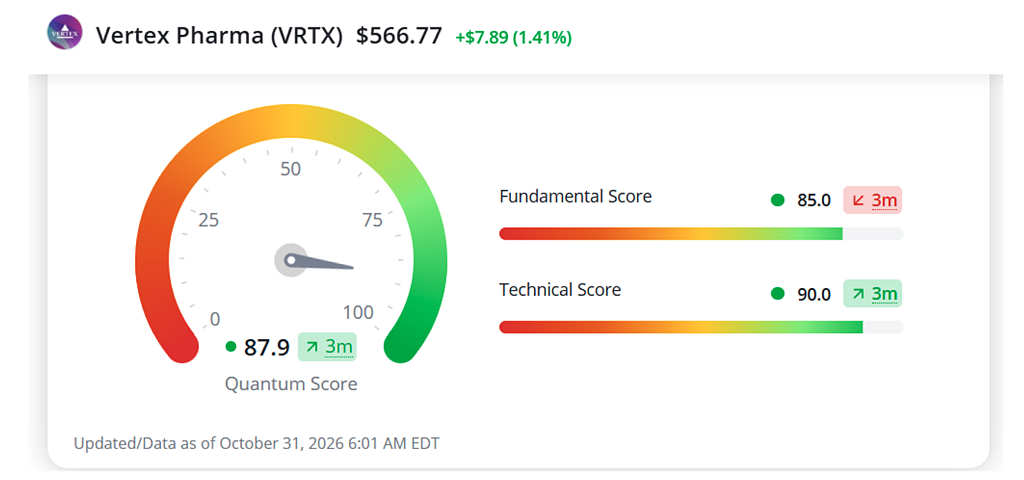
That’s up from 85.7 when Keith featured Vertex on Oct. 2. And its technical score of 90 out of 100 tells us big investors are buying the stock right now.
Note that Vertex is set to report third-quarter results after market close today. So if you’re itching to buy it now, consider a smaller position in case the stock sells off after earnings. Then you can re-evaluate whether to buy more or take a smaller loss.
If you don’t own a bio-intelligence stock yet, Vertex is the one to start with. It’s a business already making money from the biggest breakthroughs in medicine – and the money leaving tech is finding it.
Finally, consumers say they’re miserable. Their spending tells a different story…
The University of Michigan’s consumer sentiment survey is one of the most-watched gauges of how Americans feel about the economy. Right now, it’s sitting near record lows.
When I asked Andy Swan during our weekend interview whether his data backs that up, he didn’t hesitate.
“I think it’s complete junk.”
Surveys ask people how they feel. But Andy and his brother, Landon, track what people actually do – what they search for, download, post about, and buy. They report those results in their MegaTrends advisory.
And what people are doing is a lot more upbeat than what they’re saying.
One of the brightest spots is hobby spending, specifically in the collectibles space.
According to the research firm Circana, U.S. toy sales rose 17% in the first half of 2026 – the strongest start in six years. The biggest driver was adults buying for themselves. Their purchases jumped 25%, led by trading cards and collectibles.
That’s great news for stocks like Hasbro (HAS).
You probably know it for Monopoly and Transformers. But Hasbro’s profit engine is Magic: The Gathering, a collectible card game whose average tabletop player is about 35 years old.
Last quarter, Magic brought in $616.1 million, up 34%. It’s the first time the game has topped $600 million in a single quarter. Hasbro’s Magic and digital games unit earned $367.4 million in operating profit – more than twice what its toy and game unit made. And Hasbro raised its outlook for the year.
The trouble with a spending wave like this is that it usually shows up in a company’s earnings report after the stock has already moved.
That’s why 60-year investing legend and OG Wall Street quant Marc Chaikin teamed up with Andy and Landon.
The Swans’ Social Heat Score spots demand while it’s still building online.
And Marc’s Power Gauge, which rates stocks on more than 20 fundamental and technical factors, confirms that demand is landing in a high-quality business with big money moving in.
When the two agree, it pays to listen. In their backtest, the two systems lined up on 432 stocks. Six out of every 10 went on to double or more at their peaks.
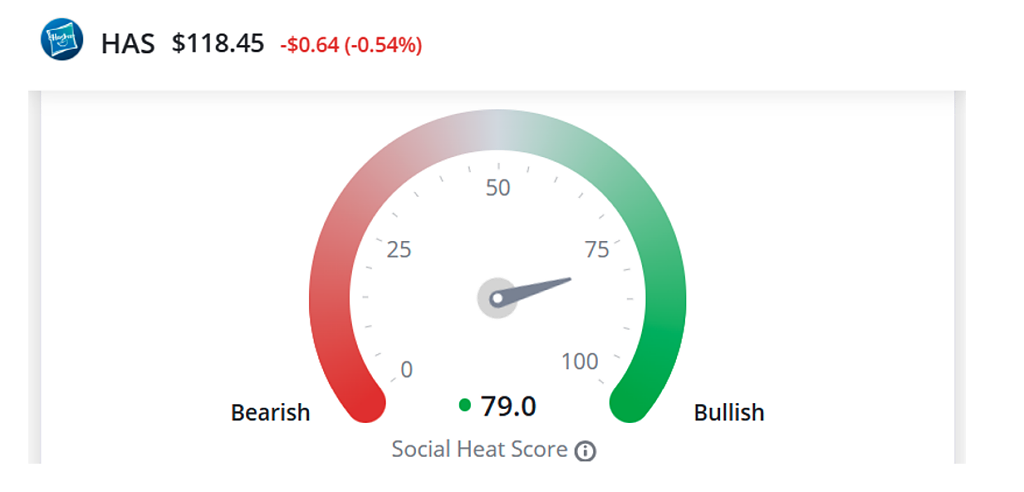
Hasbro has both. It scores 79 on the Social Heat Score…
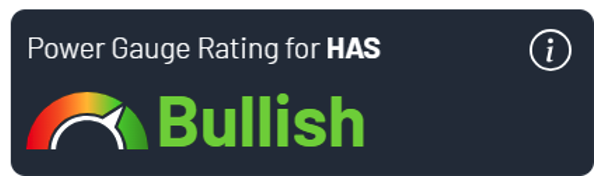
And the Power Gauge rates it Bullish…
Consider buying Hasbro ahead of the holiday shopping season.
And if you subscribe to MegaTrends, keep an eye out for more consumer stocks with strong Social Heat scores.
Marc and the Swans laid out their full case at The Stock Tsunami Detector event last week. They showed the stocks both systems agree on right now and shared three free ideas: two buys and one sell. The replay is still online, but only for a limited time. Click here to watch it.
If you’re a Platinum member, you’ll find every stock both systems agree on in TradeSmith Finance. Go to Baskets and select “The Stock Tsunami Detector.”
To building wealth beyond measure,

Michael Salvatore
Editor, TradeSmith Daily