

If you’re feeling uneasy about the market’s drop today and the volatility of the past few weeks, you’re not alone.
It’s uncomfortable – and sometimes downright tough – to watch stocks that held the market up for so long draw back 10%, 20%, even 30%.
But this kind of choppiness, no matter the cause, is normal. Every time the market has pulled back, it’s made up the losses and reached new highs. It’s just a matter of how long it will take.
With more than 80% of S&P 500 companies reporting earnings results by the end of this week, the winners and losers are now clear, and they can help inform your asset allocation going forward.
Here’s my 10-second takeaway:
- The biggest losers: The Magnificent 7
- The biggest winners: The S&P 493!
In other words, the market’s leadership is changing and knowing where it’s headed can help you profit from it.
A Magnificent Quarter… for Most
On the surface, third-quarter results were impressive for most companies… but not so hot for the market-leading Magnificent 7 stocks (Apple, Microsoft, Amazon, Google, Nvidia, Meta, and Tesla).
S&P 500 profits overall are on track to jump 30% year-over-year. And that’s the third straight quarter of 25%+ earnings growth for the index.
Earnings surprises have been broad-based, with over 80% of S&P companies reporting positive earnings surprises, which is well above average.
On the other hand, the magnitude of surprises has been lacking. Companies with positive profit surprises beat Wall Street estimates by an average of less than 2%.
That’s well below the 10-year average beat rate of 8%.
That’s no surprise, considering S&P 500 net profit margins are stretched at 14.9% in the third quarter. And that’s actually down a bit from the record-high 17% profit margin reported in the second quarter.
With margins already this high, companies have a very high bar to clear, which helps explain why the average beat rate has shrunk to under 2%.
Investors are beginning to question whether 25%+ earnings growth is sustainable with margins already at peak levels and now declining.
That’s a concerning sign that we may already be past peak earnings growth for this cycle.
And nowhere is this slowdown more visible than among the market’s biggest names.
The Mag 7 Lose Their Magic
The market’s most profitable and valuable stocks are now falling short of earnings growth expectations.
Amazon.com (AMZN) and Google’s parent company, Alphabet (GOOGL), are the two biggest of the Mag 7 stocks to disappoint recently, both reporting quarterly profits below analyst estimates.
Overall, Mag 7 earnings fell short of Wall Street forecasts by 14.7% this quarter. Meanwhile, earnings for all other companies beat estimates on average!
As a result, the S&P 493 is posting stronger profit growth than the Mag 7: 32.6% vs. just 22.6%!
This is a sea change from what investors have grown used to.
For years, the Mag 7 consistently beat estimates, often by a wide margin. That led Wall Street to regularly raise their profit forecasts. A virtuous cycle.
But now, that cycle is running in reverse as Wall Street cuts estimates for the Mag 7.
And it’s set to continue in the quarters ahead.
Expected net income growth for the Mag 7 in the first quarter 2027 is 3%, vs. 25% for the S&P 493.
And for the second quarter next year, estimates turn negative for the Mag 7 at -19%, compared with 7% growth for the rest of the index.
Granted, this is partly due to tough year-over-year comparisons with the strong profits earned early this year.
But I suspect it also has a lot to do with Mag 7 stocks spending hundreds of billions of dollars each quarter on the AI buildout.
These staggering expenses are seen as an investment in potentially much greater profits tomorrow.
But as a result, AMZN, GOOGL, Oracle (ORCL), Facebook parent Meta (META) and many more companies are posting deeply negative free cash flow today!
The Mag 7 are transitioning from high profit-growth, cash-rich businesses to somewhat less profitable businesses that now burn through cash.
Perhaps this is only temporary until greater profits arrive someday.
But judging by the negative price reactions to Mag 7 earnings this quarter, I’d say investors are very impatient to see improving results.
With this in mind, it’s more important than ever to consider adjusting your allocation toward high-quality stocks.
In reviewing earnings results over the past few weeks, I’ve noticed positive free cash flow surprises – not earnings surprises – are driving the biggest upside price reactions in quality stocks.
Let’s take a closer look.
How to Screen for Quality, Cash-Rich Stocks
This is a good time to use our TradeSmith Screener tool to search for high-quality stocks.
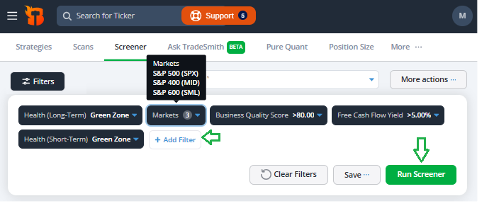
Simply click on Invest from the main menu bar, then on Screener as shown above. Next, click on + Add Filters and add the filters and settings shown.
Remember, you can always add your own filters. Perhaps add some of your personal favorites to this mix.
But here I’m keeping it relatively simple, with just five key filters to help you screen for high quality, cash-rich stocks you can add to your portfolio:
- Health (short-term) > Green
- Health (long-term) > Green
- Markets > S&P 500 (SPX), S&P 400 (MID) & S&P 600 (SML)
- Business Quality Score (BQS) > 80
- Free Cash Flow Yield > 5%
I start by looking only for Healthy Stocks in the S&P 500 (SPX), S&P 400 (MID), and S&P 600 (SML), otherwise known as the S&P 1500, which covers stocks of all sizes.
I also screen out any of these stocks not that are not in the Green Zone on both our short- and long-term Health indicators. Only the healthiest stocks make the cut.
Next is one of my favorite TradeSmith proprietary filters: our exclusive Business Quality Score (BQS).
BQS considers the most important qualities of stocks that tend to outperform, including:
- Growth: in sales, profits and cash flow, with high returns on equity and assets
- Profitability: compared with to the company’s own history and with compared to other stocks
- Safety: low debt, low risk, and low volatility
- Payout: How profits are used to reward shareholders and grow the business
BQS ranks every stock from zero (lowest quality) to 100 (highest), showing you at a glance how each stock measures up.
For my money, I prefer high-quality stocks with a BQS of 80 or more. That’s the top 20% of stocks we rate. But you can lower the filter value slightly, to 70 or 75, to get more results.
Finally, I add my personal favorite valuation metric for finding quality, reasonably valued stocks: Free Cash Flow Yield (FCF).
FCF Yield measures the cash a business generates after paying all costs, including capital expenditures for future growth, divided by the stock’s enterprise value (equity market value + debt).
It’s a purer measure of core-profitability than earnings per share, which can often be manipulated. And you use it much like the dividend yield: higher is better.
Currently, the S&P 500’s average FCF yield is just 2%. So I set my filter to screen only for stocks with FCF Yields more than twice the average, or 5%.
If you have any trouble finding these specific filters among the many available in our Screener tool, you can always search for any filter by name.
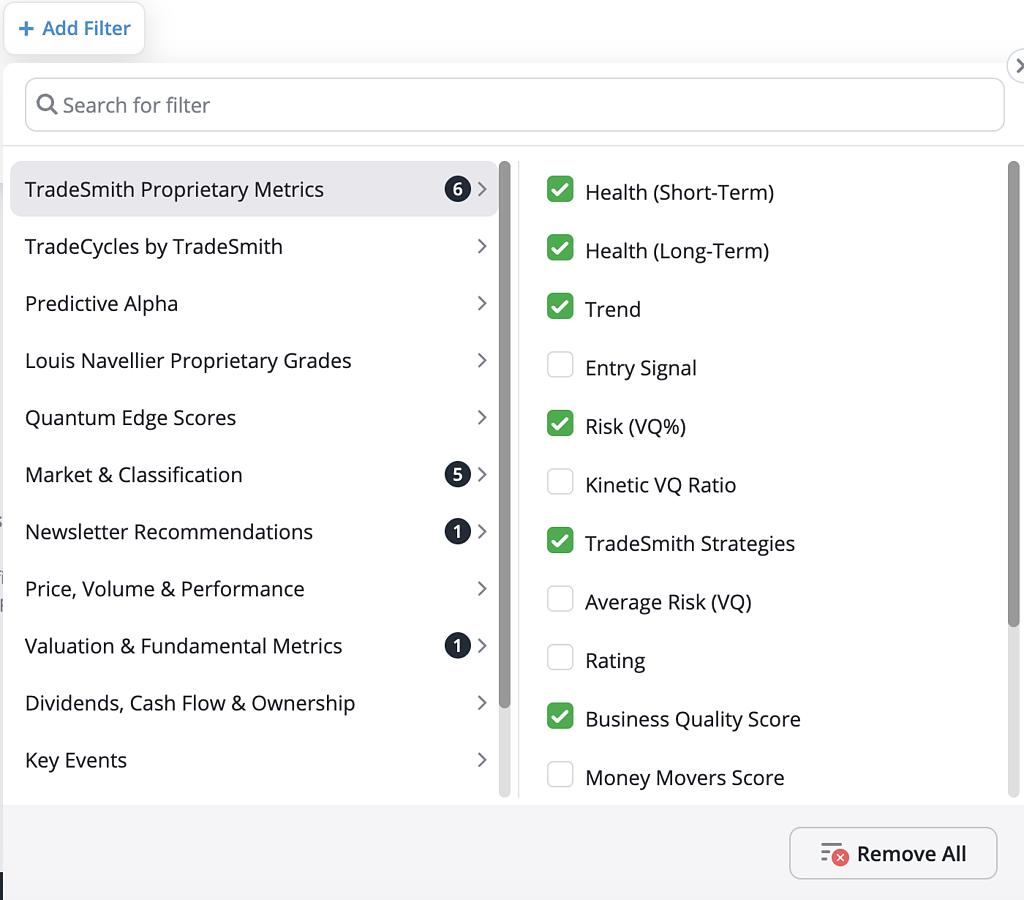
Just click on + Add Filter and a search box will appear. Then type the name of the filter, select it from the menu and click to apply.
Once your filters are set, remember to click Save and name your screen so you can revisit it again and again. Then simply click Run Screener to view your results.
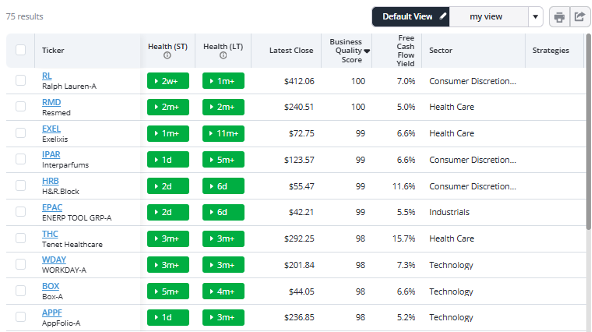
When I ran this screener yesterday, I got 75 results, which is a good starting point for further research. Due to limited space, the top 10 sorted by BQS are shown above.
You can easily sort by other column headings to view your results in different ways. For instance, you could sort by the Free Cash Flow Yield column, or by Health (ST) to see the most recent flash buy signals at the top of the list.
Mike Burnick’s Bottom Line: Investor preferences are shifting as this bull market matures. The leading Mag 7 stocks used to be the market’s favorites. But their big spending is leading to declining free cash flow and lower profit estimates. Today, investors are rewarding high-quality stocks with strong free cash flow. And those are exactly the kinds of stocks I want to target.
Good investing,
Mike Burnick
Senior Analyst, TradeSmith