


Listen to the audio version of this article (generated by AI).
Michael’s Note: In A.D. 79, a volcano buried a Roman library. And for nearly 2,000 years, every attempt to read its riches of lost knowledge would destroy them.
Eventually, a technology came along that made it possible. And how that happened is the best showcase of our newest breakthrough software I’ve yet seen.
TradeSmith’s Signals uses AI to comb through price history and find small patterns that no human analyst would think to look for, but that consistently come before big moves.
When those conditions line up again, Signals flags the trade and tells you how often that pattern has worked on that stock before. So you’re acting on a track record instead of a hunch or a headline.
Read on to see our CEO, Keith Kaplan, connect the dots between these two breakthroughs. And learn why he thinks the market is heading straight for a big shift on Nov. 25.
And be sure to sign up for his event Wednesday, Nov. 18, at 10 a.m. ET. There, he’ll give away two stock recommendations from our software – one to buy and one to avoid. Reserve your spot here.
In A.D. 79, a volcano did something no librarian in history has managed. It preserved an entire library for nearly 2,000 years.
The library was housed in a villa in Herculaneum, on the Bay of Naples. When Vesuvius erupted, an avalanche of volcanic gas hot enough to melt lead tore through the town at more than 100 miles per hour.
It didn’t burn the villa’s 1,800 scrolls – there wasn’t enough air to feed a flame. Instead, it baked them black, like logs in a sealed stove. Then 60 feet of rock buried the house.
Workmen found it in 1752. They mistook the scrolls for charcoal and tossed some on their fires.
When scholars realized what they were, they sliced them open with knives and soaked them in mercury. Scroll after scroll crumbled like burnt newspaper. Nobody knew what the scrolls said, and every way of finding out destroyed them.
Then, in 2023, a 21-year-old Nebraska computer science student named Luke Farritor picked out a word written inside one: porphyras, Greek for “purple.”
He never opened the scroll. He used AI to find hidden words in X-ray scans.
On the scans, the sooty ink looked almost exactly like the charred papyrus around it. The difference was nearly impossible to see. So Farritor trained an AI model to spot it.
It found letters nobody had read in nearly 2,000 years. This June, scholars announced it had read an entire scroll, end to end, without opening it.
The writing had been there all along. It just took a machine that knew what to look for.
I’m telling you this because the stock market has its own “invisible ink.” For the past year, my team at TradeSmith has been using AI to read it.
We trained an AI on decades of trading research, then set it loose on 10 years of data from 2,467 stocks. It found more than 30,000 patterns – or signals – that had reliably preceded big moves. Some had historical accuracy rates of 90% or higher.
That’s not a guarantee a signal will work the next time. But when you know how often a signal has worked before and by how much, you’re no longer betting on a hunch. You’re putting the odds on your side before you invest a penny.
Today, I’ll walk you through some of these signals and show you how they work. You’ll see how this new trading technology puts math and probability on your side and lets you stop trading on headlines and guesswork.
And at the end, I’ll share one of the first lines anyone had read from those scrolls. It holds up remarkably well today.
Sometimes Bizarre Patterns
Farritor’s AI didn’t start from scratch. He trained it on faint traces of ink another researcher had already spotted in the scans.
We built ours the same way. Before it found a single new signal, it learned from the best ones we already had.
Our chief developer, Mike Carr, spent 40 years collecting signals studies. Mike is a Chartered Market Technician who has co-managed mutual funds and private accounts worth up to $200 million. Over his career, he documented patterns that had a history of working.
We trained an AI model on Mike’s collection and asked it to find more like them. It found thousands, including some no human would ever have thought to look for. Today, the system runs more than 4,000 calculations on every one of 2,467 stocks. Each morning, it weighs 10.4 million possible trades.
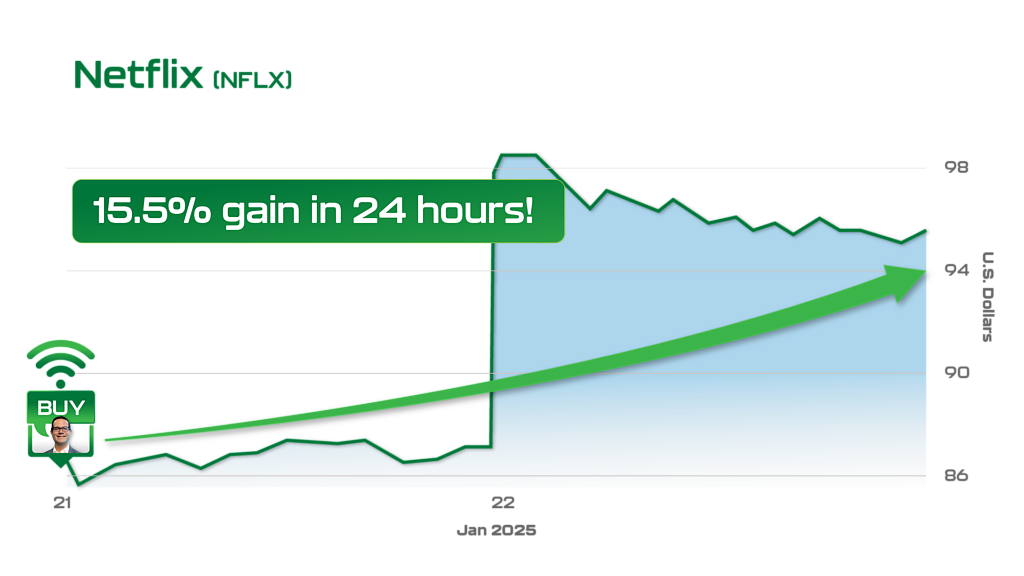
One signal for Netflix (NFLX), for instance, involves a particular kind of price swing and the kind of data tied to the number of people watching Squid Game.
You may be wondering what a TV show has to do with Netflix’s share price.
Quite a lot, as it turns out. Netflix lives and dies by how many people are watching. And Squid Game is one of the most-watched shows it has ever made. When viewing jumps, Netflix’s business feels it, and so does its stock.
Our system is built to find those kinds of connections. Not the viewing figures themselves, but the imprints they leave behind in the data. The last time that pattern turned up, Netflix rose 15.5% in 24 hours.
Or take Lam Research (LRCX), which makes the machines that make computer chips. We found that when the stock closes above its 200-day average exactly two trading days before a market holiday, it tends to jump. That has worked 86% of the time.
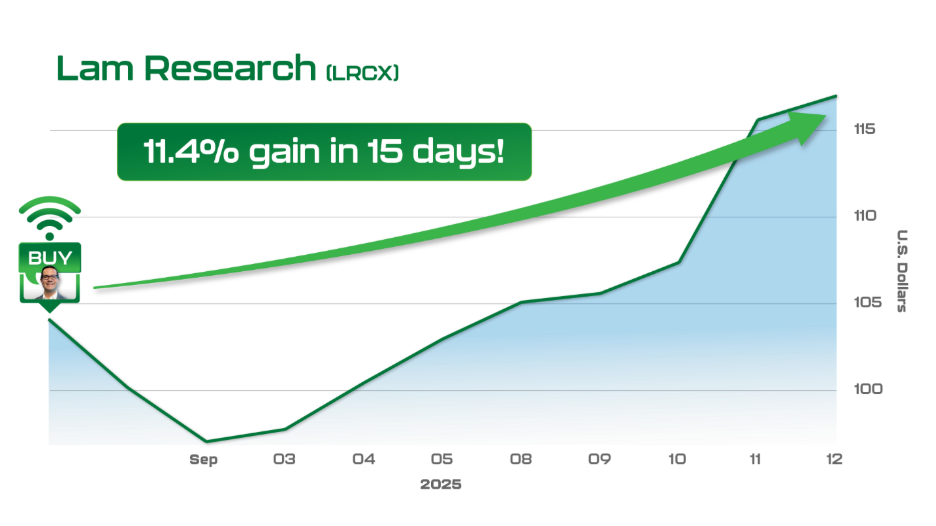
On Aug. 28, 2025, two trading days before Labor Day, the pattern turned up again. Lam rose 11.4% over the next 15 days.
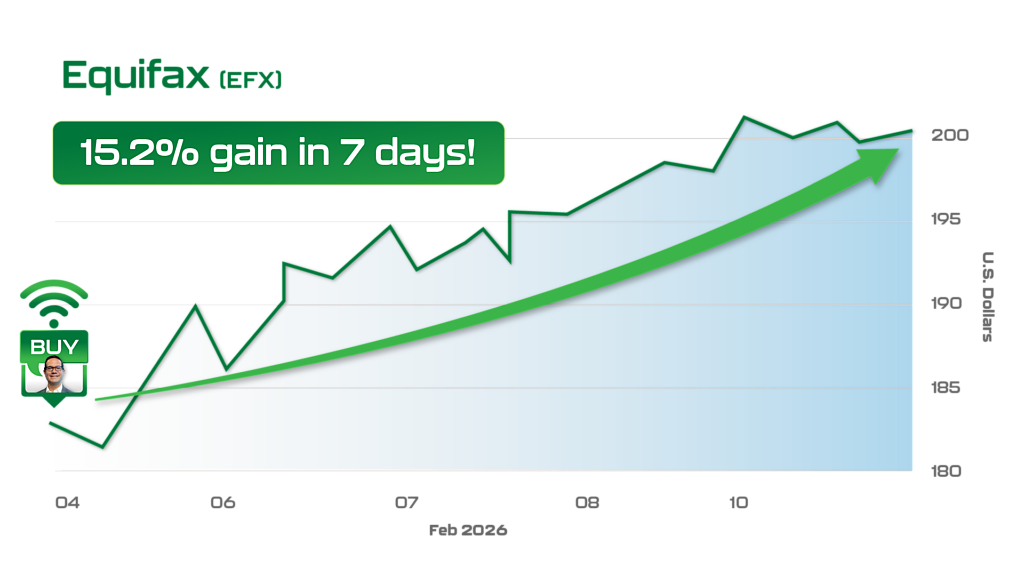
Equifax (EFX), the credit-reporting company, has a pattern of its own. When its stock falls four days in a row and market volatility is running above its 10-day average, the stock has gone on to rise over the next two weeks 91% of the time. During our test run this year, that pattern delivered a 15.2% gain in seven days.
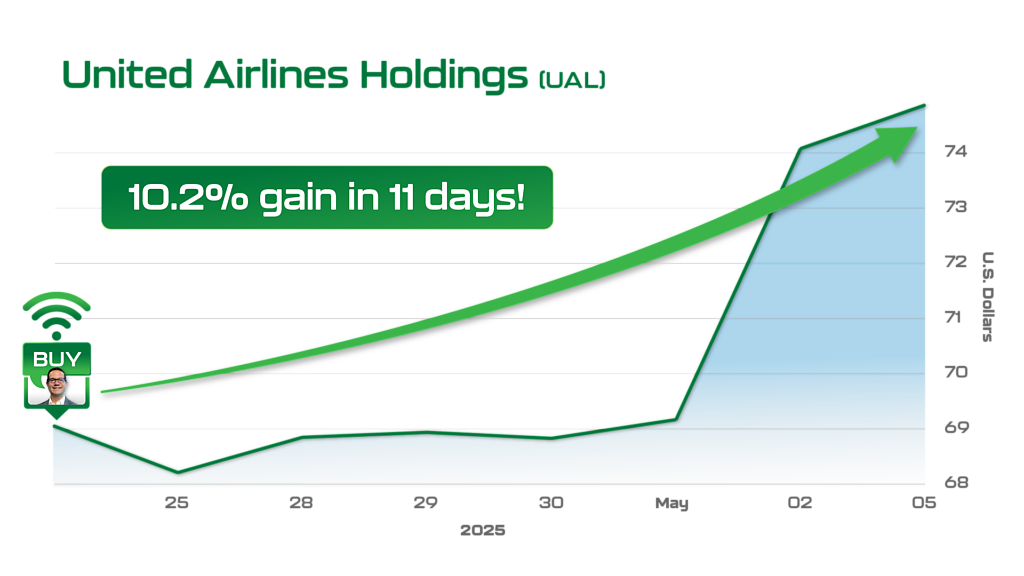
And on April 24, 2025, the market was in the middle of a sell-off that had wiped $1.8 trillion off the biggest tech stocks. Most investors weren’t buying anything. Our system flagged United Airlines (UAL), on a pattern with a 94% historical success rate. United rose 10.2% in 11 days.
None of those trades depended on a news story or an earnings report. And the AI doesn’t care what the company does. It only cares whether certain conditions have lined up before and what happened next.
We put the whole system through a live test in January. Of the top 100 trades it posted, the average gain was 11.6% in seven days.
No system gets every trade right. But that’s what happens when you stop reading the headlines and start reading the data.
Prepare for a Bumpier Ride
There’s no way to sugarcoat it. The past few weeks have been rough. Stocks that looked unbeatable this summer have plunged. And the elections have kicked up a lot of uncertainty – which investors hate.
That’s bad news for buy-and-hold investors. Our signals trading system, however, doesn’t depend on a “good” market. It’s built to find opportunities even when buy-and-hold is struggling.
Take 2022. The S&P 500 had its worst year since 2008, falling nearly 20%. When we tested a portfolio built on these signals over that same year, its average gain nearly matched what the S&P 500 earned in all of last year’s bull market.
That’s because the system isn’t betting on which way the market goes. It’s only asking whether a stock’s conditions have lined up the way they did before its past moves.
That doesn’t mean every individual signal will work out. Some won’t. But across the whole portfolio, the odds held.
And when markets get choppy, those rare combinations show up more often, not less. Calm markets are predictable. Rough ones throw off the odd patterns the AI was built to catch.
That’s important, because I think things are about to get choppier.
Our seasonal research shows the S&P 500’s strongest stretch of the year ends right after Thanksgiving. That seasonal trend has held 93% of the time over the past 15 years. After that, I expect the kind of whipsaw market we saw in the late 1990s, with sharp drops inside a longer climb.
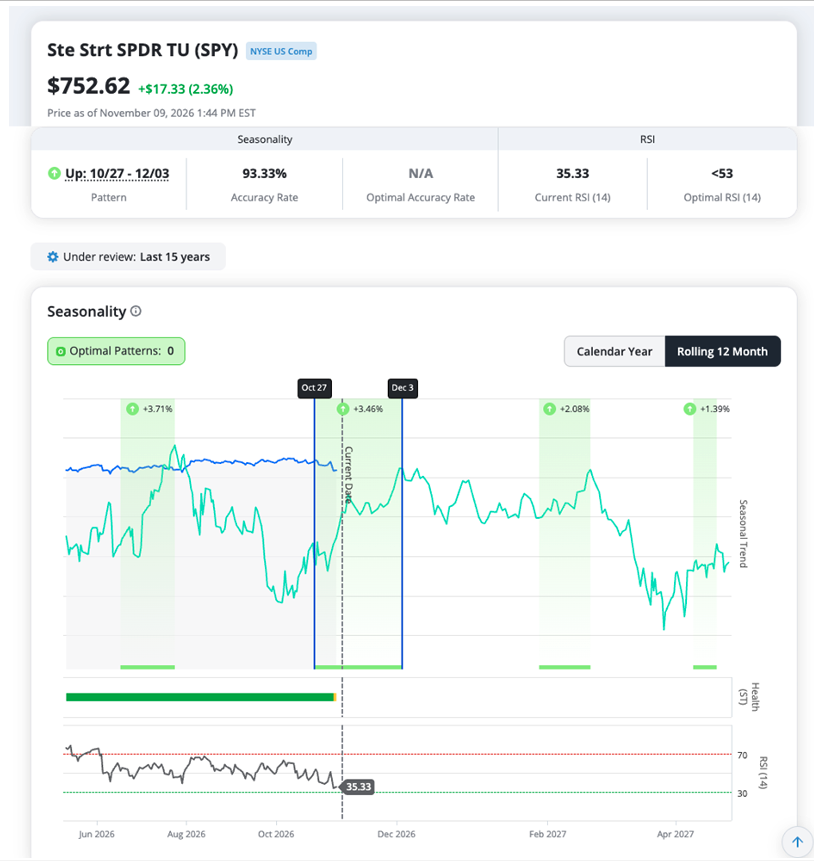
I don’t think that’s a reason to sell your long-term holdings. I think it’s a reason to change how you trade.
On Nov. 18 at 10 a.m. ET, I’m holding an online event to show you exactly how this system works, including the patterns it’s flagging right now.
I’ll also give away two recommendations for free. The first is the stock with the strongest bullish pattern in our system today. The second is a popular stock our system says you should stay away from.
You’ll also see Mike put his own money into a stock he knew nothing about, using nothing but one of these trading signals.
History says choppier markets are coming. For most investors, that means more worry and more second-guessing. But choppy markets are exactly when these patterns show up most. And I want you to have this system in hand before that happens, not after.
Reserve your spot here. It’s free, and I hope you’ll join me.
All the best,
Keith Kaplan
CEO, TradeSmith
P.S. That scroll was attributed to Philodemus, a Greek philosopher who lived at the villa and is thought to have taught the Roman poet Virgil.
The passage is about pleasure, and whether rare things, like the costly purple dye in that first word, bring more of it. His answer: “We do not right away believe things that are scarce to be absolutely more pleasant.”
There’s no need to hunt down rare wines or the priciest caviar. A good meal with old friends can satisfy as much as the rarest bottle in the cellar.


