Get Your TradeSmith Tools Ready For The Biggest IPO Ever
Well, it’s time to circle your calendars for next Friday, June 12 – because that’s the target date for IPO mania to hit Wall Street in full force.
That’s right! It’s time to roll up, roll up, one and all… Step right this way for Elon Musk’s magical mystery tour, The SpaceX IPO: coming soon to a stockbroker near you.
That’s when Musk’s magical combination rocket business, AI company, and social media platform is set to go public – with a rumored valuation of roughly $2 trillion.
With a valuation that high, SpaceX could easily turn out to be the most anticipated IPO in decades, and perhaps the biggest IPO of all time.
Plus, the SpaceX IPO is acting as the launch of a massive IPO season – with some of the biggest names in AI following with their own public offerings in the months following.
It should be quite the show, indeed!
So, with roughly two weeks of trading before the big day, let’s discuss the big IPO and what it could mean for markets… along with how you can use your TradeSmith tools to get ready.
Buyers Are Lining Up – Whether They Want To Or Not!
Next week’s IPO is big news for the market, and retail investors are already in a frenzy ahead of next week’s big event. Many are setting aside as much cash as possible to buy in, after Musk promised that up to 30% of available IPO shares would be reserved for retail purchase through brokers like Charles Schwab and Fidelity Investments.
Others are attempting to trade the hype ahead of time, by buying up related stocks like Virgin Galactic (SPCE)… which has seen a spectacular rise and fall over the last week, as you can see below:
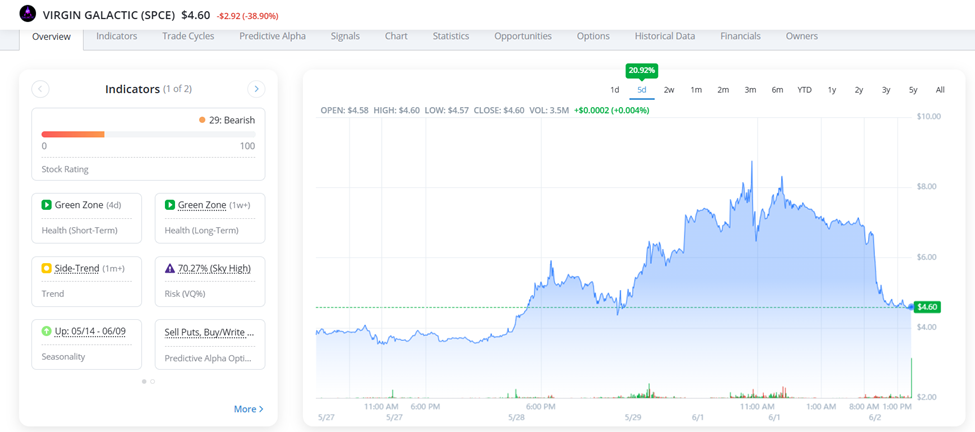
With a Sky High Risk rating of over 70%, according to our proprietary Volatility Quotient (VQ%), and higher trading volumes in the last week than SPCE has seen at any point in its 11 years on the market… well, it’s clear that there’s plenty of energy going into next week.
But even as retail investors are getting a big piece of the pie all to themselves, don’t think that institutional investors are getting shut out. They’ve had ample opportunity to buy into SpaceX early through multiple rounds of private equity financing over the years.
That said, the big story of the SpaceX IPO in my eyes is that index investors will be getting an early chance to buy in too.
That’s because managers of the major indexes – including FTSE Russell and Nasdaq – have already started to ease their listing rules ahead of next week’s IPO. These adjusted rules will allow SpaceX early access into benchmarks like the Nasdaq 100 Index, which is expected to admit SpaceX into its ranks as early as next month.
Officials at Dow Jones and Standard & Poor’s are similarly expected to bend their rules in the coming months, to allow for early entry of SpaceX into their own indexes.
According to some analysts, if the stock is admitted as early as expected, then index funds will be forced to buy “between $15 billion and $30 billion of SpaceX stock across major funds like the S&P 500, Nasdaq-100, and Russell 1000” – with all that buying expected soon after the IPO.
So, there is expected to be a steady supply of “forced” index buyers lining up to scoop up post-IPO SpaceX shares… whether they like it or not.
But if that gives you pause, just keep this in mind: As big as the SpaceX IPO will be, its projected index impact would still be smaller than today’s heavyweights like Nvidia (NVDA).
Take a look at the Holdings data for the State Street SPDR S&P 500 ETF Trust (SPY):
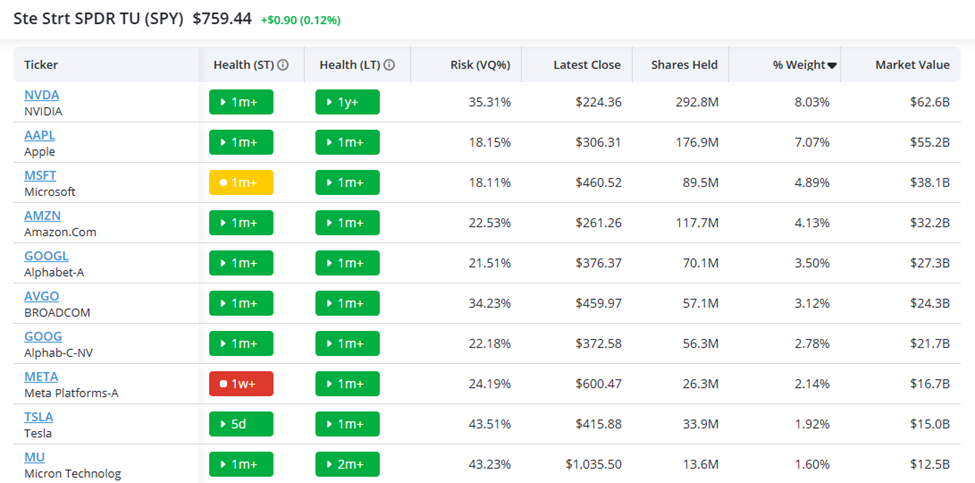
The top 10 stocks in the S&P 500 Index account for nearly 40% of the index’s total weight. And while SpaceX’s rumored valuation of around $2 trillion is steep – remember that Nvidia (NVDA) has a current valuation of roughly $5.3 trillion and only makes up a little over 8% of the benchmark index.
So, the limited number of SpaceX shares initially outstanding won’t measure up close to the top 10, even if index funds are required to buy in.
A Rich IPO Season Awaits
But wait, there’s more!
If you enjoy the SpaceX IPO show, then you’re going to love the sequels that are coming soon after.
That’s because artificial intelligence darlings OpenAI (creators of ChatGPT) and Anthropic (creators of Claude) are both reported to be upcoming stars on the 2026 IPO road show.
This has the potential to bring additional trillions worth of capital into the markets before the end of this year. And as you can see in the chart below, that amount far exceeds the SPAC-driven IPO boom in 2021… and it positively dwarfs the late 1990s IPO boom.
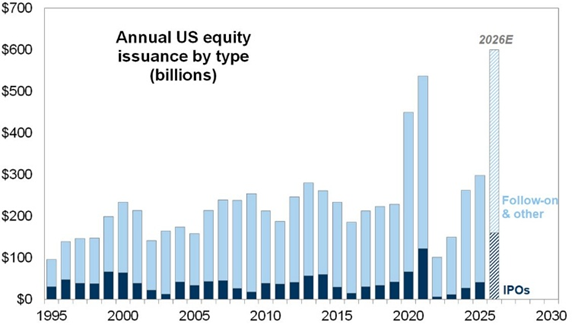
Of course, both of those prior booms ended badly for investors. And that’s probably not just coincidence…
The Post-IPO Blues
Hot IPOs do typically spike higher right from the get-go, with a first-day IPO pop averaging +23%, according to research from Barron’s.
But history also shows that from 2011 to 2024, companies that IPO have seen their stocks lag behind the market by 25% over their next three years as publicly traded companies.
And when it comes to IPOs, bigger is definitely not better.
Since 1980, the largest IPO companies – those with sales of $100 million or more – going public at high valuations (with price-to-sales ratios above 40x) have delivered an average loss of 45% in the three years following IPO day.
SpaceX certainly fits into both categories.
Not only is it the biggest IPO in history, but at an estimated price-to-sales ratio near 100X, SpaceX is also set to be one of the most richly valued companies in history.
What To Do About SpaceX?
With all that in mind, perhaps the right action for long-term investors to take next week is no action at all… at least not right away.
Longer-term index investors will automatically get exposed to SpaceX shares in their portfolios after IPO day, as index funds are expected to add the stock in the coming months.
But for more active investors and traders, if you’re shut out of the IPO itself it may tempting to buy SpaceX shares after the IPO.
Just remember the message from the long-term data.
There is typically a cooling off period that starts about six months post-IPO, usually coinciding with the end of the lockup period for insider stockholders. For SpaceX, the end of that lockup period is reported to be staggered, over a period of 70-135 days after IPO.
And on top of that, hot public offerings tend to cool off for quite a while – underperforming the stock market for up to three years after IPO day.
Market Impacts After Launch
Now, when it comes to the stock market overall, white-hot IPOs aren’t necessarily bad news for the market. At least not right away.
But when you’re talking about multiple IPOs with valuations in the trillions, you can certainly expect some IPO-related market disruption. At the very least, you should expect unusual volatility – like we’ve already seen with SPCE.
A series of high-profile IPOs, such as the three the market is expected to absorb this year between SpaceX, OpenAI, and Anthropic, can sometimes signal the start of a climactic move for stocks.
The money sucked out of other stocks to fund purchases of new IPOs could have a somewhat negative impact on indexes like the S&P 500, and hot IPOs do have a bad habit of leading to weaker stock market returns after some time has passed.
That’s due in part to the fact that typically, the IPO calendar fills up only after stocks have already made a big move higher, as is the case today.
After all, it is bullish market sentiment that attracts a lot of investor money into IPOs!
That was the case in the late 1990s dot-com boom. And the pattern repeated post-COVID with the SPAC-stock frenzy of 2021:
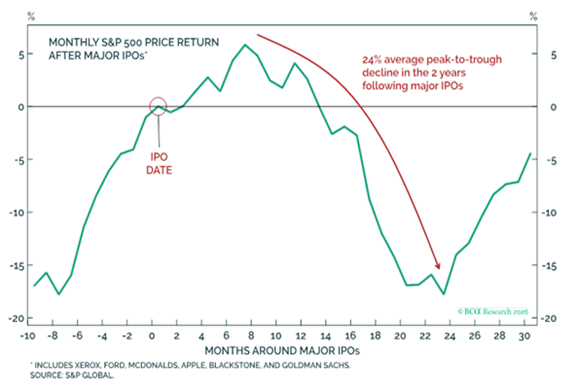
Historically, stocks tend to peak about 6 to 12 months after major IPOs, as you can see above. And on average, the S&P 500 has fallen about 24% in the two years following major IPO frenzies.
That said, taking a look at our Market Health data on TradeSmith Finance, at least we’re entering this IPO mania in good standing:
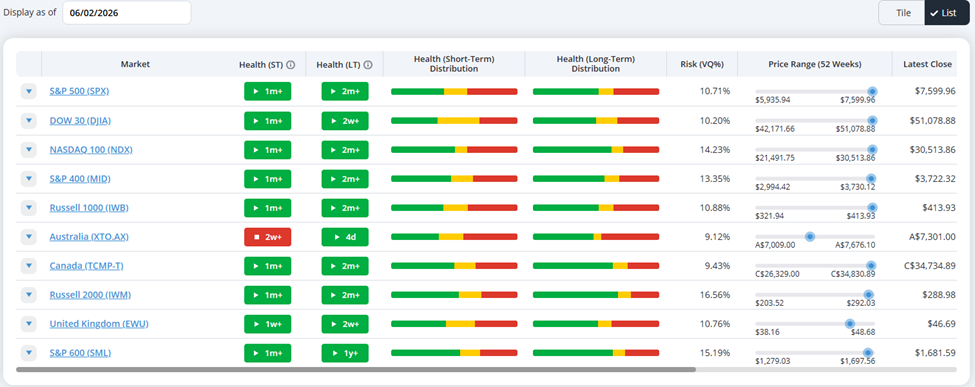
With all the major indexes in the Long-Term (LT) Health Green Zone, and all the major U.S. indexes also in the Short-Term (ST) Health Green Zone, I’m not worried about next week’s big events rocking the boat too much.
I personally expect the SpaceX IPO to be a success in the coming weeks. After all, there is so much money waiting for the chance to buy this magical stock that it would be hard for the stock to not do well.
But as we move further down the road… stock buyers beware!
In the meantime, though, just be sure to approach this major market event – and all your trades – responsibly.
Keep an eye on the Health of the market by visiting your TradeSmith Finance Dashboard, and if you’re concerned about the impact of these big IPOs on the broader market, remember to review your Risk and update your Alerts with our flagship TradeStops software.
Good investing,
Mike Burnick
Senior Analyst, TradeSmith
P.S. The SpaceX IPO – as well as the OpenAI and Anthropic IPOs expected soon after – will move trillions of dollars into and around the market this year. That’s a major move, and the impact of these stocks entering major indexes like the Nasdaq 100 and the S&P 500 is sure to affect millions of investors… for better or worse.
These money flows are sure to create plenty of trading opportunities for eagle-eyed investors. But you don’t need to wait until these major IPOs arrive to take advantage of the moment. Instead, you just need to look out for the right opportunities as they arrive…
That’s why I’ve been listening closely to my colleague Jeff Clark – the editor of Delta Report, Market Minute, and the publications over at Jeff Clark Trader. He’s one of the sharpest minds I know, and one of Team TradeSmith’s premiere experts in technical market analysis.
You see, amidst all the volatility markets have seen lately, Jeff has identified signals pointing him to one conclusion: That the market is currently in the middle of a “disruption window.”
These are rare stretches of time where traditional market rules break down… and that offer a prime opportunity for anyone with the right strategy to trade it.
Jeff has traded through disruption windows like this twice before – and in both cases, he ran win streaks long enough that someone rolling a single $5,000 stake from one trade into the next would have ended up with $1 million or more by the end of it.
Last month, Jeff went live with his new 12 Trades to $1 Million Challenge, announcing an attempt to capitalize on this latest disruption window as it develops… and to guide traders through a very profitable three-peat along the way.
Jeff started the challenge last week with a successful trade in Peabody Energy (BTU), and to celebrate the quick win – and the second trade of the challenge – he’s offering one last chance to join in.
If you’re interested in learning more about Jeff’s approach – and taking on his latest trade – click HERE to watch his introduction to the 12 Trades to $1 Million Challenge.
It’s your opportunity to start raking in profits before IPOs shake up the market… and it’s an opportunity that won’t be around much longer. Don’t miss it!