

As if investors don’t have enough to keep track of these days, with tariff deadlines, negotiations, and recession worries, next week kicks off first-quarter earnings reporting season.
Better buckle up for the ride!
Just a few months ago, earnings season would have been greeted by investors as a time to celebrate American exceptionalism once again. That’s because the S&P 500 was expected to post an exceptional profit growth of 12.2% for the first quarter of 2025.
But what a difference a few months – and a few trillion dollars in lost stock market capital– can make…
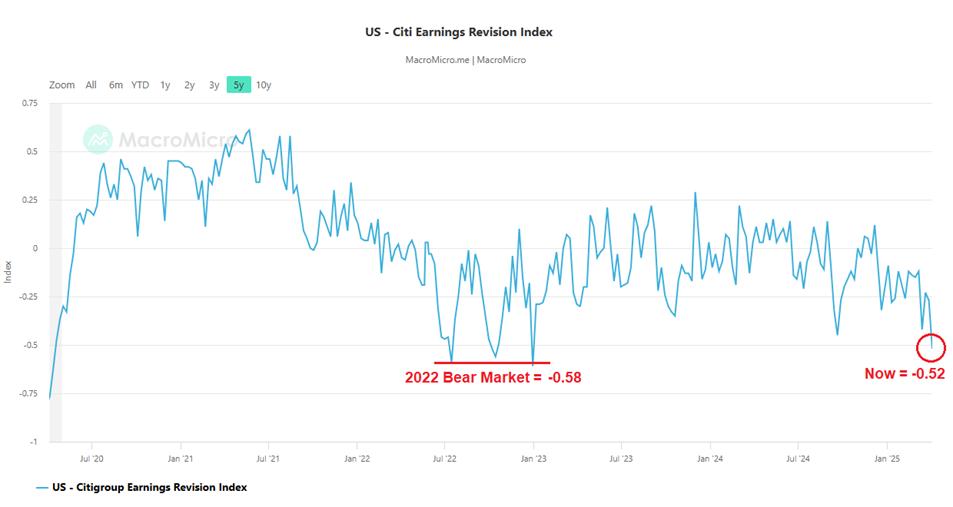
Even before last week’s “Liberation Day,” Wall Street analysts were busy taking a sharp knife to S&P 500 quarterly earnings estimates, as shown in the Earnings Revision Index above.
Just the fear of tariffs – that have been threatened since Election Day 2024 – was enough to slash earnings forecasts, from +12.2% at the start of this year down to just 7.8% today.
That’s roughly a one-third haircut to corporate profit forecasts … and tariffs haven’t even begun to tarnish the income statements of S&P 500 firms.
So, even if the U.S. economy manages to somehow avoid a genuine economic recession, we still face the likelihood of an earnings recession – a year-over-year decline in S&P 500 profitability.
In the graph above, you can also see that the current downward trend in earnings estimate revisions is about the same as it was in mid-2022. Back then, the deterioration in profit estimates was six months in the making.
Today, S&P earnings estimates have plunged nearly the same amount… in just over six weeks!
Granted, first quarter results – which start rolling in next week – should be fine. That’s because the drag of tariff costs on sales and profits hasn’t been felt yet. And typically, S&P 500 component companies beat earnings estimates by about 6%.
So, 12% profit growth for the first quarter may be a conservative forecast.
But a much bigger concern is the trajectory of earnings revisions for the rest of 2025.
On that end, Wall Street analysts have not only slashed first quarter earnings estimates, but have also taken a knife to fourth quarter earnings forecasts for this year:
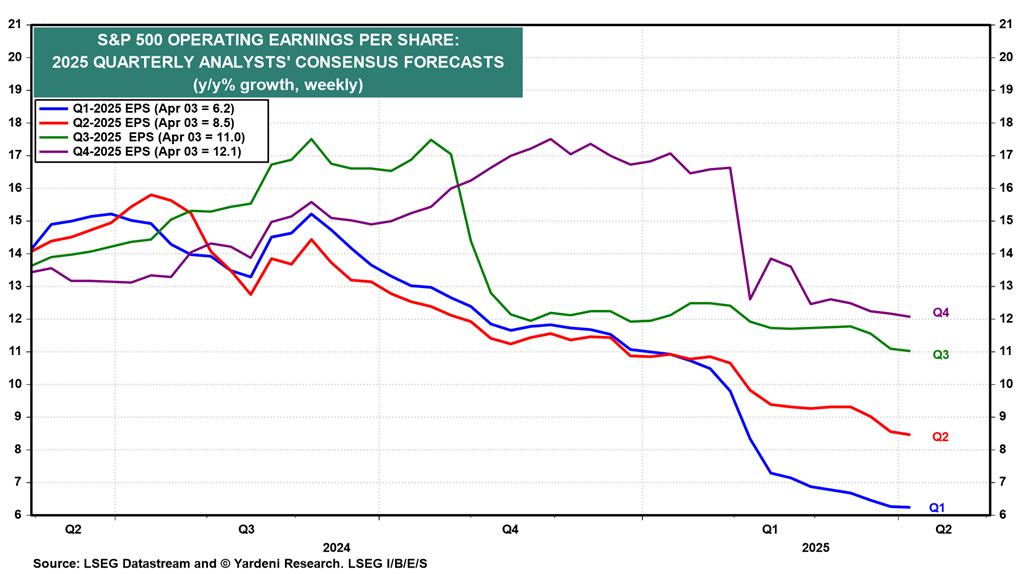
Like the expectations for first-quarter results, fourth-quarter earnings estimates have also been cut by about one-third since January, as you can see above. Curiously, however, estimates for the second and third quarters of 2025 only had minor trimming.
And that could be the other shoe waiting to drop.
Perhaps Wall Street analysts are convinced that the issue of tariffs will blow over before too long. But if that’s the case, why cut fourth-quarter estimates so deeply?
This reminds me of the old meme about Ohio… its “HI” in the middle, with two Os (or zeros) on either end.
In this case, first-and fourth-quarter profit growth estimates aren’t at zero (yet), but second- and third-quarter estimates clearly look far too high – and are bound to fall further.
In fact, a quick back-of-the-envelope calculation on my part leads me to believe that, if tariffs impact corporate profits as badly as expected, profits in the second and third quarters could easily decline year-over-year – meaning negative growth.
And the reality is, the tariff trauma could get a lot worse… as in retaliatory tariffs, which Canada has imposed already, China has promised, and the European Union is openly discussing.
When S&P 500 profits decline year over year, so do stock prices.
And that’s especially true for a stock market that’s still richly valued. Just look back at the last earnings recession in 2022 (see the first chart above) to see the impact that had on stocks.
Mike Burnick’s Bottom Line: The U.S. economy never entered an economic recession in 2022, but the S&P 500 entered an earnings recession – with profits falling 12.7% year-over-year in the fourth quarter, and falling even more in the first half of 2023.
Do recall, these profit declines were widely anticipated, because of cuts to estimates throughout 2022. And yet, the S&P 500 Index dropped as far as 35% in 2022 at its lowest – even with no economic contraction at all. And we’re seeing the same setup play out right now.
Good investing,
Mike Burnick
Senior Analyst, TradeSmith
P.S. Everything we discussed today brings us to one burning question: What’s next?
We’ve already seen what just the threat of tariffs can do – wiping out a third of S&P 500 profit expectations and sending the market into a tailspin.
And President Trump’s so-called “Liberation Day” has kicked off a new era in global trade, one that promises short-term pain in exchange for long-term gain. But for investors, that “pain” is being felt intensely right now – and it could get worse as retaliatory tariffs start to ripple across the globe.
So… what can we do?
That’s where An-E, TradeSmith’s breakthrough AI trading algorithm comes in.
An-E (short for Analytical Engine) uses cutting-edge predictive models to project stock prices one month in the future – with startling accuracy. In markets like this, where volatility is the norm and not the exception, knowing which stocks are likely to fall can be just as valuable as knowing which ones might rise.
On Wednesday, April 16 at 8 PM EST, TradeSmith is holding an emergency online briefing called The AI Predictive Power Event. TradeSmith’s CEO, Keith Kaplan, will show you exactly how An-E works – and how it’s identifying five stocks that are flashing bright red warning signs right now.
If you want to protect your portfolio – and even spot opportunities for gains while others are scrambling – you won’t want to miss it.
Click here to reserve your spot and get instant access to An-E’s five most bearish forecasts. In times like these, defense is just as important as offense… and if you want to shore up your portfolio’s defenses, this is an event you won’t want to miss.