Listen to the audio version of this article (generated by AI).
In This Digest:
- Wall Street is losing patience with AI spending – unless it can pay for itself
- Texas is shutting data centers out of its grid. That’s good news for this pipeline stock
- Jeff Clark does his best work when markets break – and he says it’s time to take profits on banks
Wall Street is done paying for AI on faith…
Last Thursday, the tech-heavy Nasdaq 100 had its worst day since the pandemic crash of 2020, falling 6.3%.
As our CEO, Keith Kaplan, wrote on Friday, part of that selloff was politics. But part of it was the market losing patience with AI spending.
The biggest tech companies have poured money into data centers – chips, buildings, power, and more. Investors cheered as long as those bills looked like an investment in the future.
Now, though, after nearly four years of massive spending on AI, investors are getting anxious to see the payoff.
That’s splitting the AI trade into two factions – one that’s working and one that’s very much not.
On one side are companies whose AI spending pays, at least in some part, for itself. On the other are companies still burning cash to build it.
And free cash flow – the cash left over after running the business and paying for new investments – is the simplest measuring stick.
We showed you that dividing line running through the Magnificent 7 two weeks ago. To highlight two examples, Alphabet’s (GOOGL) free cash flow came in at negative $9.1 billion. Microsoft (MSFT), meanwhile, produced $18.6 billion.
Our recommendation was to stick with the cash producers. After last week, that matters more than ever.
Microsoft sells AI the same way it sells everything else – by subscription. Businesses pay it every month to rent computing power on its Azure cloud and to use its Copilot AI assistant inside Word, Excel, and Outlook.
As of its October earnings, that business grew 48% over the previous year. The company said enterprise demand for AI compute and Azure infrastructure drove most of that growth.
So while other tech giants are asking investors to wait for AI to pay off, Microsoft is already cashing in.
And our data agrees.
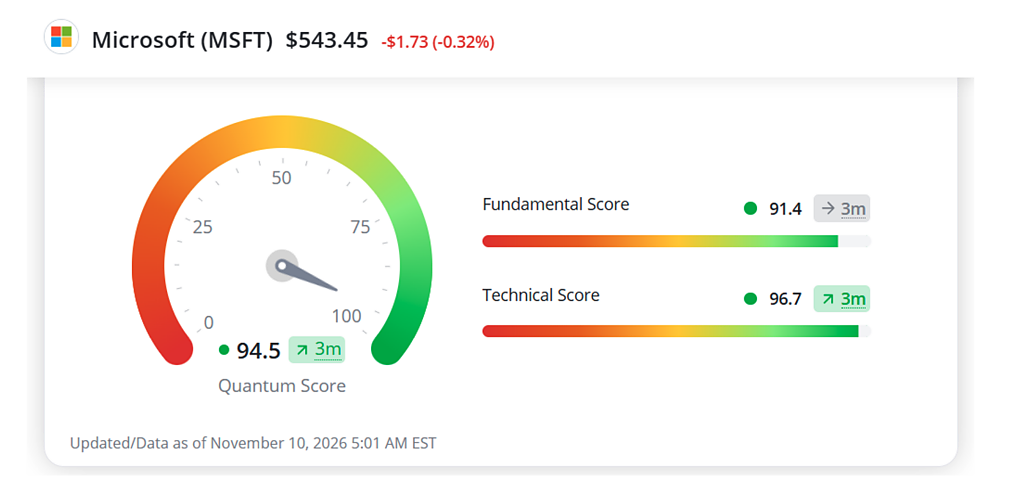
Our Quantum Score ranks thousands of stocks on two things: how strong the business is and how the stock is trading – including whether big investors are buying. It combines them into a single score from 0 to 100.
Microsoft scores 94.5.
Its Fundamental Score, which measures things like earnings, revenue, and profit margin growth, is 91.4 – near the top of the scale.
Its Technical Score, which measures momentum and institutional buying pressure, is 96.7.
Both that and its overall score have climbed over the past three months.
That’s the single highest score among the Magnificent 7 right now. And MSFT is the closest to its all-time high.
If you want AI exposure after last week’s selloff, own the companies whose AI already pays for itself. Microsoft is at the top of that list.
The Texas grid is saying no to new data centers – natural gas is the way around it…
On Monday, Elon Musk’s SpaceX filed plans for a $24 billion supercomputer at Starbase, its company town on the Texas Gulf Coast. And it’s building its own natural gas power plant to run it.
It’s SpaceX’s second gas plant in Texas. It’s already planning one to power the giant chip factory it’s building with Tesla outside Houston.
And SpaceX isn’t alone. AI company Anthropic recently agreed to buy $3.4 billion worth of gas-fired generators.
Why build your own power plant? Because the grid is closing its doors.
Last week’s midterm election blue wave most notably crashed into Texas. Voters elected Gina Hinojosa, the state’s first Democrat elected governor since 1990. She campaigned on a statewide pause on new data centers. And the state had already stopped letting new data centers hook up to its main power grid until regulators finish an audit.
So the biggest AI builders are skipping the grid and bringing their own fuel.
That’s the heart of what we call the AI Power Pipeline: natural gas power plants becoming the go-to source of round-the-clock power for AI data centers.
Natural gas stocks have gone sideways for the past six months. The First Trust Natural Gas ETF (FCG), which holds a basket of natural gas exploration and production companies, is down 4% over that span.
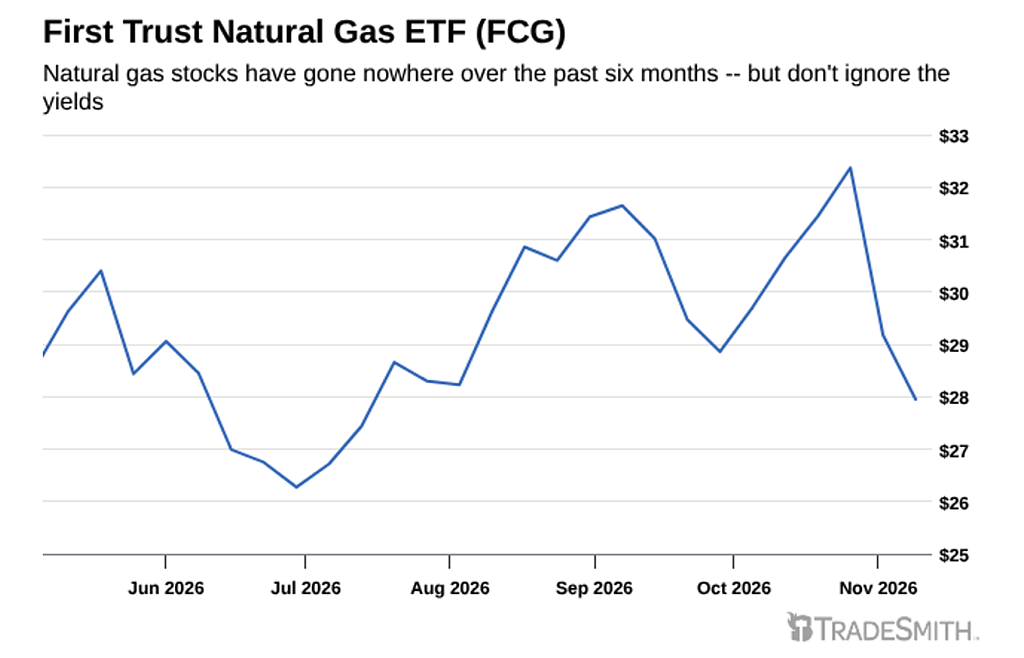
Investors have largely stopped paying attention to the sector, but the demand for natural gas hasn’t stopped growing.
That makes now an especially good time to look at stocks like ONEOK (OKE).
ONEOK runs a 60,000-mile network of pipelines that gather, process, and move natural gas and other fuels. And about 90% of its earnings come from fees.
Like a toll road, it gets paid for the gas it moves, not the price the gas sells for. Because it earns fees on volume rather than price, ONEOK stays a vital part of the AI Power Pipeline.
It’s also building in the middle of the action. ONEOK is part of a joint venture building the Eiger Express, a 450-mile pipeline carrying natural gas from West Texas’ Permian Basin to Katy, just outside Houston.
OKE’s price action has been similar to the whole sector over the past six months. But it does pay you to wait.
ONEOK pays $4.28 a share in dividends each year. That’s a yield of about 5% at today’s price.
Our Predictive Alpha AI forecasting system sees the stock heading higher over the short term, too. It forecasts ONEOK will rise 5.1% by Dec. 8. And its forecasts for ONEOK have hit their target 80% of the time – about 8 out of 10.
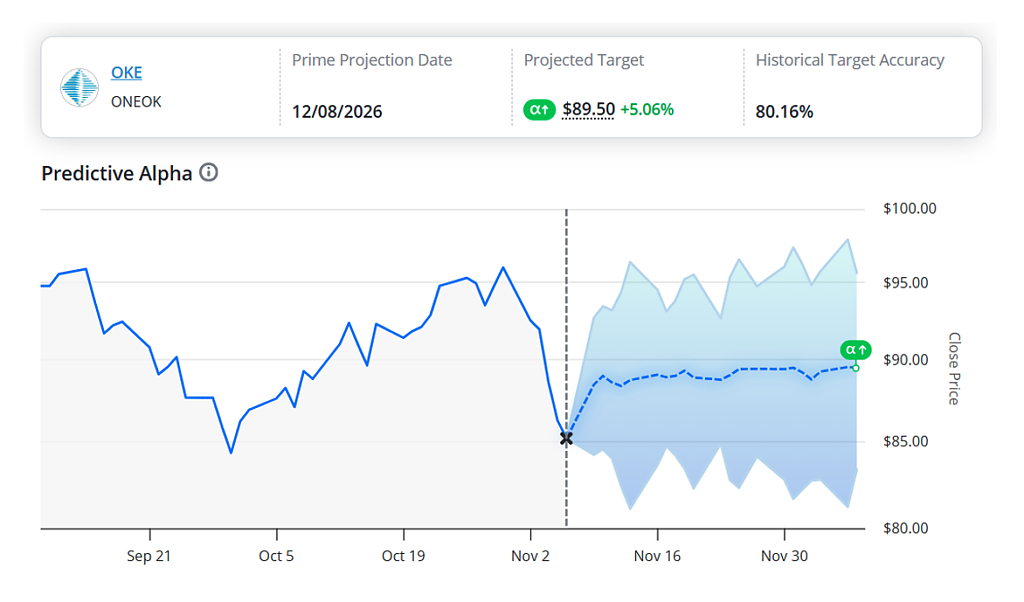
If that forecast plays out, ONEOK would hand you about a year’s worth of dividends in price gains in less than a month.
Consider buying ONEOK, collecting its 5% yield, and owning the pipes the AI buildout is counting on while the rest of the market looks the other way.
Jeff Clark does his best work when markets break…
Last week was the kind most investors would rather forget.
But for TradeSmith’s master options trader Jeff Clark, weeks like this are when he does his best work.
Jeff has traded options for more than 40 years. He’s a conservative trader by nature. But he’s built his career on one idea: When panic stretches a stock too far, it snaps back. As he told our readers in May:
In a disruption window – when stocks are moving 20% in a session and sectors are repricing overnight – the rubber band stretches far. And when it snaps back, it snaps back hard and fast.
Last week, he put that to work.
On Thursday – the same day the Nasdaq had its worst day since 2020 – Jeff recommended a new trade in his 12 Trades to $1 Million Challenge: call options on the Global X Uranium ETF (URA).
Uranium stocks had lost a third of their value in 10 weeks. But the price of uranium itself was up 13% for the year. Jeff saw the same chart pattern that came right before a 30% jump in uranium stocks in August.
On Monday, he told Challenge participants to sell half their position for a 100% gain. That takes the original money off the table. Now the rest can ride without any risk of turning into a loss.
Jeff’s eye for extremes works in the other direction, too.
Last month, writing to his Market Minute readers, he noted that the Bullish Percent Index for the financial sector flashed a buy signal. That indicator tracks the share of financial stocks trading in bullish chart patterns.
Since then, the State Street Financial Select Sector SPDR ETF (XLF) has gained 12%. And last Wednesday, it closed at a new all-time high.
Now the indicator is “extremely overbought.” When it’s turned lower from levels like this before, bank stocks fell 4% to 15% over the following one to two months.
Jeff isn’t expecting a crash – just a pullback after a strong run. And he expects a better time to buy in a few weeks.
So if you’ve made short-term bets on bank and financial stocks during this rally, Jeff says now is the time to take your profits.
Finally, inflation has come in hotter than expected…
The Consumer Price Index rose 0.4% in October, above the 0.3% forecast, while “core” CPI – which excludes more volatile food and energy prices – jumped 0.3% versus an expected 0.2% increase.
Food prices rose 0.5%, energy rose 0.7%, and gasoline climbed 1.0%.
Shelter costs increased 0.3%, while real earnings for private-sector workers were unchanged.
The hotter-than-expected inflation report strengthens the case for further Fed rate hikes.
More on that – and how to position yourself – in tomorrow’s Daily…
To building wealth beyond measure,
Michael Salvatore
Editor, TradeSmith Daily
Disclosure: Michael Salvatore owned shares of GOOGL at the time of this writing.