


Listen to the audio version of this article (generated by AI).
In This Digest:
- One sentence turns everything we know about AI on its head
- The Stock Tsunami Event is airing now – click here to automatically join for three data-backed trade ideas
- Two very different rating systems agree on this cybersecurity stock
This misspelled question is the huge buy signal for our top AI theme…
“Can you find about like what scam or thing they done in past like spoofing calls or somthing [sic].”
This is the sentence a hacker typed into an AI chatbot with the intention, though evidently not the clearest of plans, to commit cybercrime.
Whether you’re familiar with AI tools or not, you’re probably thinking there’s not a snowball’s chance in hell that this worked.
Set aside the fact that most AI bots reject the call to commit a scam. This query is so unspecific that it seems unlikely the hacker would get anywhere.
Afraid not.
This method helped the hacker:
- Access more than 5,200 private student records from two Indian universities
- Build tools to commit telecommunications fraud (think of the spam and scam calls that, if you’re anything like me, you receive almost daily)
- Crack Wi-Fi passwords for unsecured networks
- Identify holders of large amounts of cryptocurrency
Cybersecurity firm Palo Alto Networks (PANW) believes this was no sophisticated hacker. This was most likely an amateur with ill intent and access to “jailbroken” AI tools – imagine ChatGPT or Anthropic’s Claude, but with none of the safety limitations.
Palo Alto also estimates it cost no more than $100 to achieve all this.
With this event, we have to recognize that the biggest barriers to committing cybercrime – expertise and cost – have been decimated by AI.
And as we’ve been laying out for months now here in TradeSmith Daily, this is why cybersecurity is one of the best ways to own the AI boom.
Every leap in what AI can do hands hackers a cheaper, faster toolkit. And every company, government, and household has to spend more to keep up.
We first put this theme on your radar on May 18. Palo Alto Networks – the same firm behind this research – was breaking out to an all-time high, and we called it an easy buy at about $247. As of yesterday’s close, it’s up 58%. At the same time, the tech-focused Nasdaq 100 index has gone nowhere, up less than 1%.
And just last week, Keith showed you how AI agents are enabling a new line of business for cybersecurity firms: guarding software that can log in, shop, and move money on your behalf.
I went digging into our systems for a second read on where this theme goes next.
And I found it in a collaboration between colleagues Andy and Landon Swan and legendary Wall Street “quant” Marc Chaikin…
Marc started his career on Wall Street 60 years ago…
Hundreds of hedge funds, banks, and brokerages still use the first market-timing indicator he built. And he’s relied on his 20-factor Power Gauge rating system – which spans from Very Bearish to Very Bullish – for decades.
Marc’s most popular systems follow the pure technical money flows behind stock moves – not analyst opinions.
But earlier this year, he met Andy and Landon Swan at an investor conference. And they convinced him some of that noise was worth listening to.
Since 2012, the Swans have tracked what millions of Americans post online about the things they buy.
Their data pulls from X, Reddit, YouTube, search trends, website visits, and app downloads. Then AI picks out the buying behavior that has tended to come before big stock moves – whether that’s for consumer companies or business-to-business firms.
They roll it all into their Social Heat Score, which some of America’s top hedge funds have paid up to $750,000 a year for.
The Swans’ data catches the demand wave – the moment shoppers start buying a product and talking about it. Marc’s Power Gauge catches the money wave that follows.
Marc wanted to know what happens when both waves line up. So the three of them went back and tested it.
Over the past six years, they found 432 cases where both systems turned bullish on the same stock.
In 260 of them – about 6 out of 10 – the stock went on to at least double at its peak.
Take quantum computing company Rigetti Computing (RGTI). On March 9, 2023, it was down more than 90% from its public debut and facing delisting. That’s the day both systems aligned on it. Over the next two and a half years, it rose as much as 8,076%.
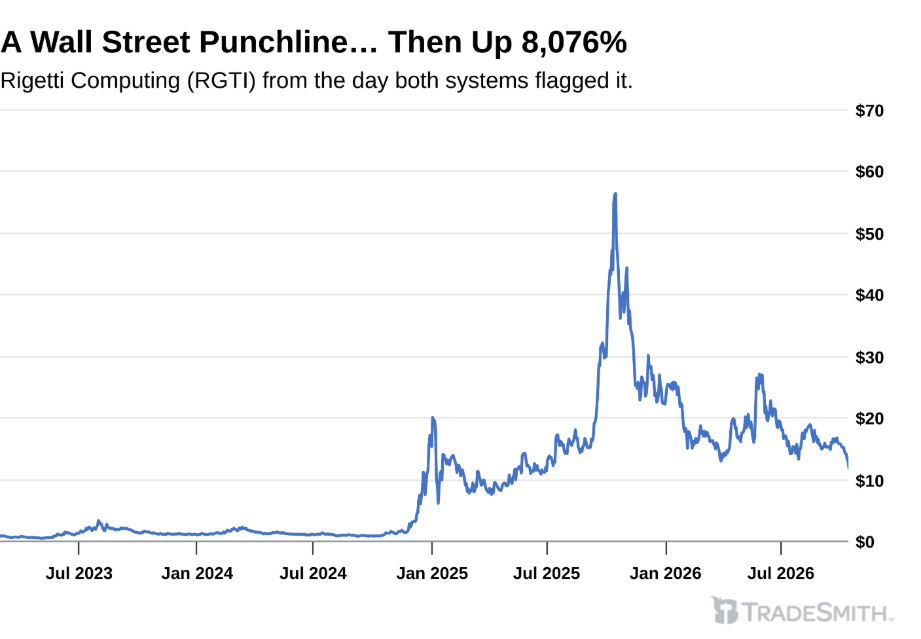
Those are backtested results, and Rigetti is one of the best examples. No system wins every time.
But the combination was strong enough that Marc built it into a new tool with the Swans: the Stock Tsunami Detector.
This tool identifies the rare class of stocks that are the right level of bullish on the Swans’ Social Heat Score and Marc’s Power Gauge. Across the thousands of stocks we track at TradeSmith, only a few hundred make the cut.
At 1:00 p.m. today, Marc and the Swans opened the doors to this new tool at The Stock Tsunami Event.
They walked through what their combined systems are flagging right now, and they gave away three free stock ideas: two buys and one stock to avoid.
This top cybersecurity stock is a buy on both systems…
When hackers turn AI loose on a target, you have to understand they’re using automated systems.
These systems work tirelessly, faster than humans ever could, to find vulnerabilities that humans have missed for years.
Cloudflare (NET) is built for that kind of threat. Its network sits between millions of websites and the people – and bots – trying to reach them. It screens out automated attacks before they ever touch the site.
And it’s one of the cybersecurity stocks Marc’s and the Swans’ systems agree on right now, earning it a place on the Stock Tsunami Detector.
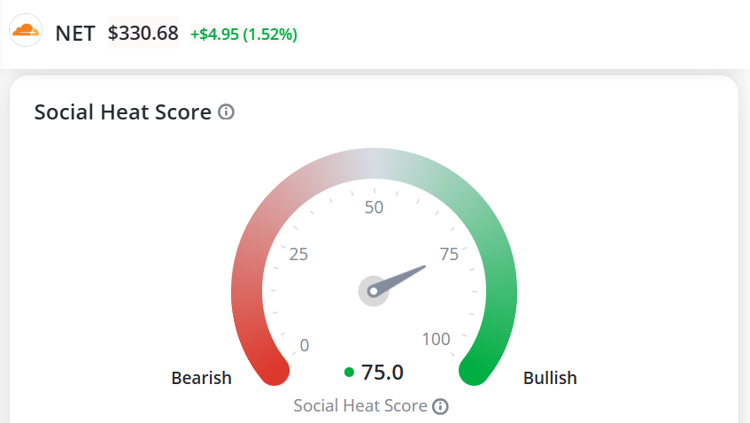
The Swans’ Social Heat Score on Cloudflare sits at 75 out of 100, well into bullish territory. Online chatter about the company is running hot.
Marc’s Power Gauge rates it Bullish, with three of its four categories flashing green.
Cloudflare’s stock is outpacing the market, and big money is flowing in. Wall Street analysts are getting more positive. And its earnings performance is strong.
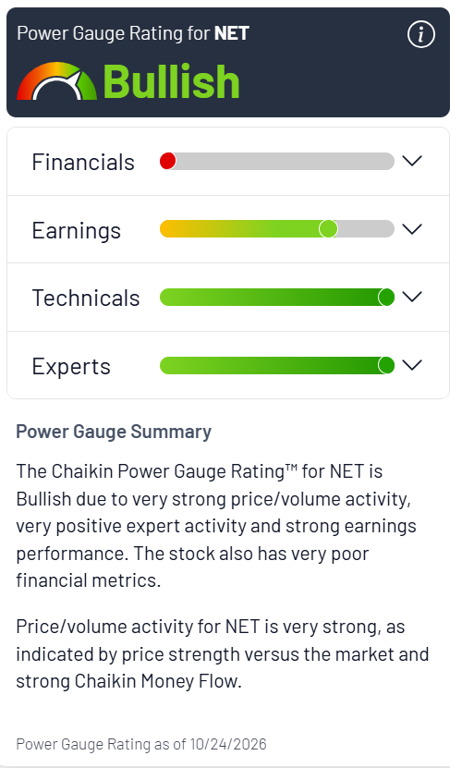
On Financials, the Power Gauge rates Cloudflare Very Bearish. That’s mostly because Cloudflare isn’t profitable yet, and its stock price already bakes in a lot of future growth.
The Power Gauge weighs that against everything else – and still comes down on the bullish side.
Just know what you’re signing up for. Cloudflare’s Volatility Quotient (VQ), which measures how much a stock normally swings, is 41.7%. That means a drop of about 40% from its high would be the kind of volatility we expect before the uptrend breaks.
Add NET to your watchlist. If you buy, build your position in small chunks over time.
If you subscribe to our popular TradeStops software, be ready to step aside if NET drops into the Red Zone.
And if you’re a Platinum member, check The Stock Tsunami Detector to see which other cybersecurity stocks made today’s list.
To building wealth beyond measure,
Michael Salvatore
Editor, TradeSmith Daily
Disclosure: At the time of this writing, Michael Salvatore held shares of NET.

