1 Billion New AI Users Point to This One Trade
Listen to the audio version of this article (generated by AI).
In This Digest:
- Hundreds of millions of new AI users are coming
- This rare signal on Broadcom (AVGO) points to a swift recovery after a 13% smackdown
- Only 42 stocks in the S&P 500 pass our new quant filter
Apple’s new AI features are a huge deal – just not for Apple…
Yesterday, Apple debuted its much-anticipated AI overhaul as part of its Worldwide Developers Conference.
It’s launching its own dedicated Siri app to compete with chatbots like OpenAI’s ChatGPT, Anthropic’s Claude, and Google’s Gemini. It’s also embedding AI features into iOS, which runs its flagship iPhones.
Apple’s AI will proactively search a user’s text messages, photos, emails, and other sources to answer questions and help in day-to-day tasks.
The new features aren’t exactly revolutionary. Many Android phones already have similar features via Google’s Gemini AI assistant. And its stock dropped about 2% following the news.
But what was interesting about Apple’s presentation wasn’t what it means for its share price. It’s what it means for the AI Chokepoints investing theme we’ve been covering here at the Daily.
Billions of new AI users are coming online…
About 1.5 billion people around the world have an iPhone. So that’s potentially more than a billion new AI users.
And that’s going to put even more pressure on the AI data center buildout.
As our CEO, Keith Kaplan, has been laying out in these pages, they are:
- High-bandwidth memory chips that feed AI processors data fast enough to keep up.
- Silicon photonics that replace copper wiring with pulses of light.
- Power conditioning equipment that turns high-voltage transmission lines into clean power a data center can use.
- Liquid cooling systems that keep AI chips from melting under load.
- And the grid construction companies that physically connect the buildings to power infrastructure.
These are the key types of stocks to focus on right now.
The AI data center buildout needs to keep pace with a billion-plus new Apple AI users. And the demand keeps growing — because as we covered yesterday, today’s AI models are also being used to help build tomorrow’s.
It’s currently the world’s most powerful market megatrend.
The question for us as investors is: What’s the best way to profit?
One way is to buy the chipmakers that make it all possible. And one of those chipmakers —Broadcom (AVGO) just fired two powerful signals.
Broadcom isn’t widely known as an AI chipmaker…
Most people have heard of Nvidia — the company making the chips that power AI.
But Broadcom is doing something different and, in some ways, just as important. Instead of selling one-size-fits-all chips, it works directly with the tech giants — Google, Meta, and others — to build custom chips designed specifically for each company’s AI workload.
Think of it as the difference between buying a suit off the rack and having one made to measure.
Broadcom also makes the networking chips that connect thousands of AI processors inside a data center — the electronic equivalent of the roads and highways that keep the whole system moving.
Without those, the AI chips can’t talk to each other. That’s why Broadcom’s AI revenue hit $8.4 billion in just the first quarter of 2026 — more than double what it made from AI the same time last year.
Broadcom plunged 12.6% in a single session last Thursday after it shared expectations of $16 billion of revenue in Q3 from AI chip sales – rather than the $17.2 billion Wall Street expected. That slide erased $280 billion from its market value.
For most investors, that kind of drop would be enough to make you hit the sell button.
But according to our in-house signals studies expert, Lucas Downey, history shows that a drop that steep is actually a great buying opportunity.
After Lucas saw the big drop, he looked at what has historically happened in Broadcom (AVGO) when it falls 12% or more.
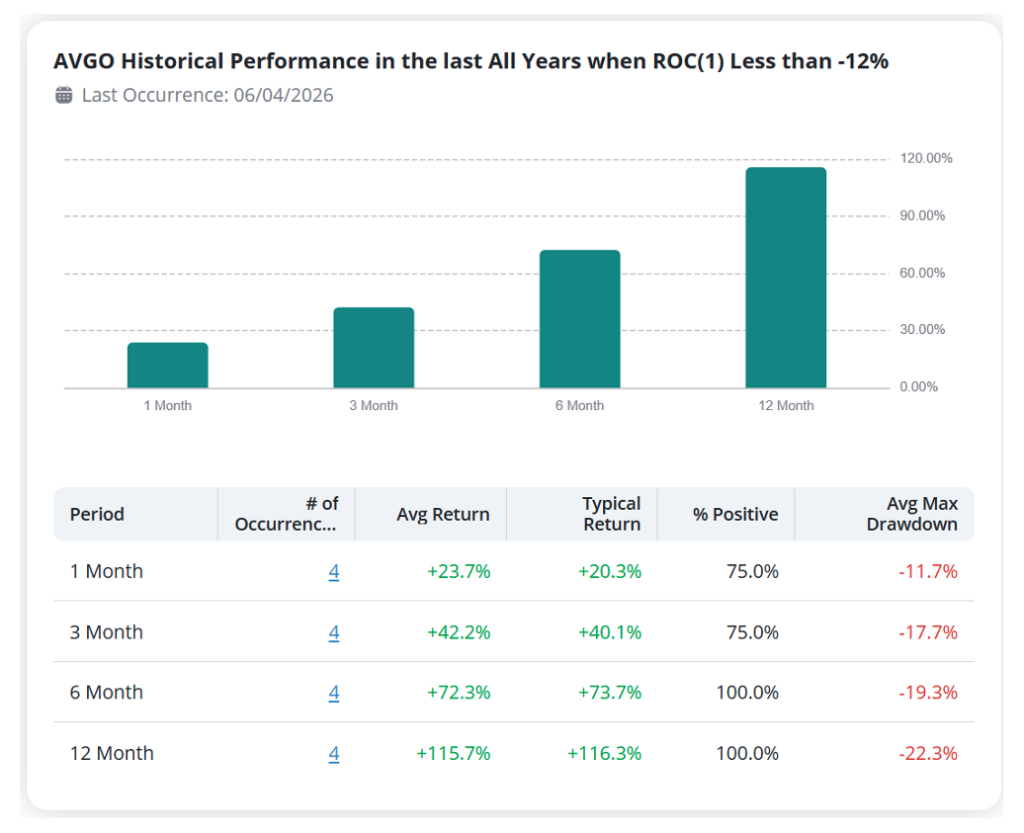
Turns out, a drop that steep has happened only four times in history – the most recent being the DeepSeek scare of January 2025, when a new Chinese AI model threatened to disrupt the market with low costs.
On average, Broadcom has gone on to see:
- A 1-month average gain of 23%
- 3-month average gains of 42%
- 6-month average gains of 72.3%
- And 12-month average gains of 115.7%
History clearly suggests it’s time to buy the dip in AVGO.
And that’s not the only bullish signal for Broadcom we’re seeing right now…
Our Signals software platform found a new short-term Pivot signal in Broadcom that fired just yesterday.
As a reminder, our Signals software takes these price-based signals studies several steps further.
With the help of AI, it detects short-term anomalies in stocks’ historical data. Then it finds statistical connections between them that a human analyst would never find.
Think of it like a “thumbprint.” Every great trade has one. A unique alignment of factors – technical indicators, price patterns, market conditions – that has appeared before.
When those factors align again, our system flags a high-probability setup. Some with historical accuracy rates of 90% or more.
Pivot signals look for patterns in stocks that show they’re about to change direction. It’s designed for contrarian investors — people who like the idea of buying a stock after a dip, rather than chasing one that’s already running higher.
This particular Pivot signal fires during a quick momentum collapse during a strong long-term uptrend.
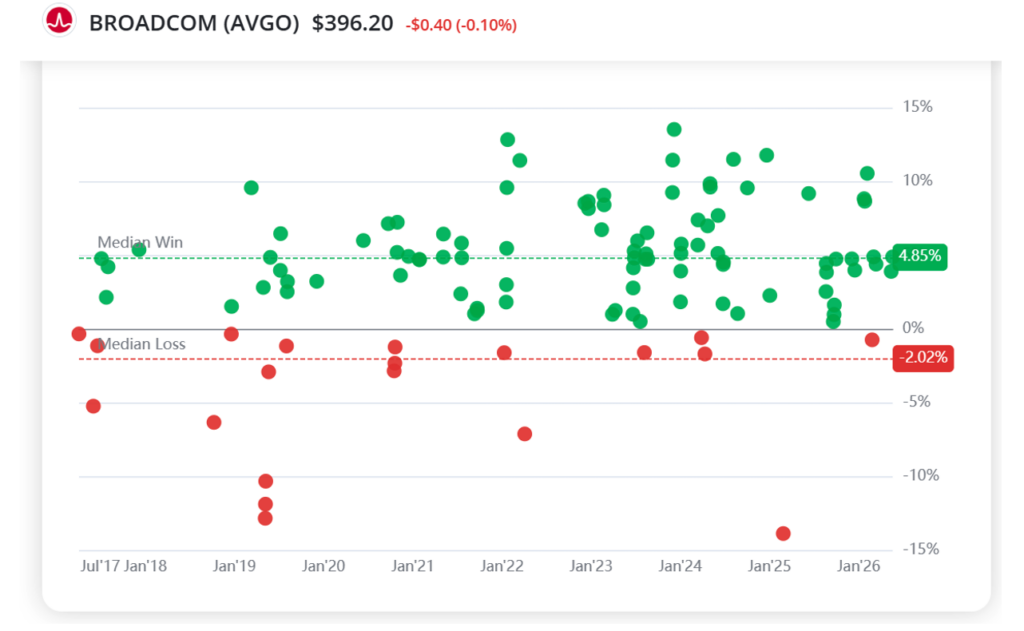
We’ve seen this happen in AVGO 113 times in the past. More than 82% of the time, the stock has rallied after the signal has fired. And it’s typically gained 4.5% over a median hold time of just seven days.
As you can see in the chart below from the TradeSmith Finance platform, most of these signals have occurred in the past three years of a 10-year dataset.
Most of the time it’s resulted in gains (green dots). And when the signal doesn’t work (red dots), losses are typically small.
That’s two reasons to dive into AVGO this week – whether you’re a long-term holder or are looking for any evidence that this dip is worth buying.
Signals is one of the most powerful AI-powered trading systems we’ve created so far in our firm’s 20-year history. But we’re not resting on our laurels.
Instead, we’ve partnered with a 50-year master quant to help him improve his already market-beating stock-picking system.
His name is Louis Navellier…
Over five decades of investing in growth stocks, Louis has forgotten more about finding big winners than most people will ever learn.
He’s one of the original “quants.” He began building stock models on a Wells Fargo mainframe while still a finance student in the 1970s before quantitative investing even had a definition.
Once he learned that he could beat the market by finding the stocks with the most “alpha” – or potential to outperform – he started building a stock-picking system to help isolate them.
It’s called the Stock Grader. It grades stocks from A to F based on a proprietary mix of technical and fundamental metrics. The higher the grade, the better odds the stock will outperform the market.
He started using Stock Grader model in his first growth stock investing newsletter, the MPT Review, in 1980.
Since then, it’s identified 676 stocks that went on to double – including recommendations like Microsoft in 1987, Nike and Apple in 1988, and Nvidia in 2005 – a full 17 years before the launch of ChatGPT.
Every one of those wins started as a ping on Louis’ Stock Grader system.
But while Stock Grader has proven its ability to find great stocks, it’s always had one weakness: It’s never been able to tell you exactly when to buy and sell them.
TradeSmith is using AI to enhance Louis’ system…
For the past year, the TradeSmith Research Lab has been helping Louis build a new trade signal layer on top of Stock Grader.
It adds precise, data-driven entry and exit signals to the stocks he’s already identified as the market’s strongest.
In our testing, we found that by applying these signals to Louis’ 1987 recommendation of Microsoft (MSFT) boosted a 21.7% annualized return into 37.6%.
It turned a 23% annualized return in Nexstar Media (NXST) from Louis’ recommendation in 2013 into 173%.
And it even turned Louis’ winning trade recommendation in Broadcom (AVGO) back in 2014 from a 292% profit to 6,284%.
Stocks with this setup are rare. For example, only 42 of the stocks in the S&P 500 share this unique combination of factors. And the most recent stock to see a buy signal is Eli Lilly (LLY).
That signal came just ahead of LLY’s break to new highs. And you can see for yourself how well the signal has worked as an entry and exit point into LLY over the past six years:
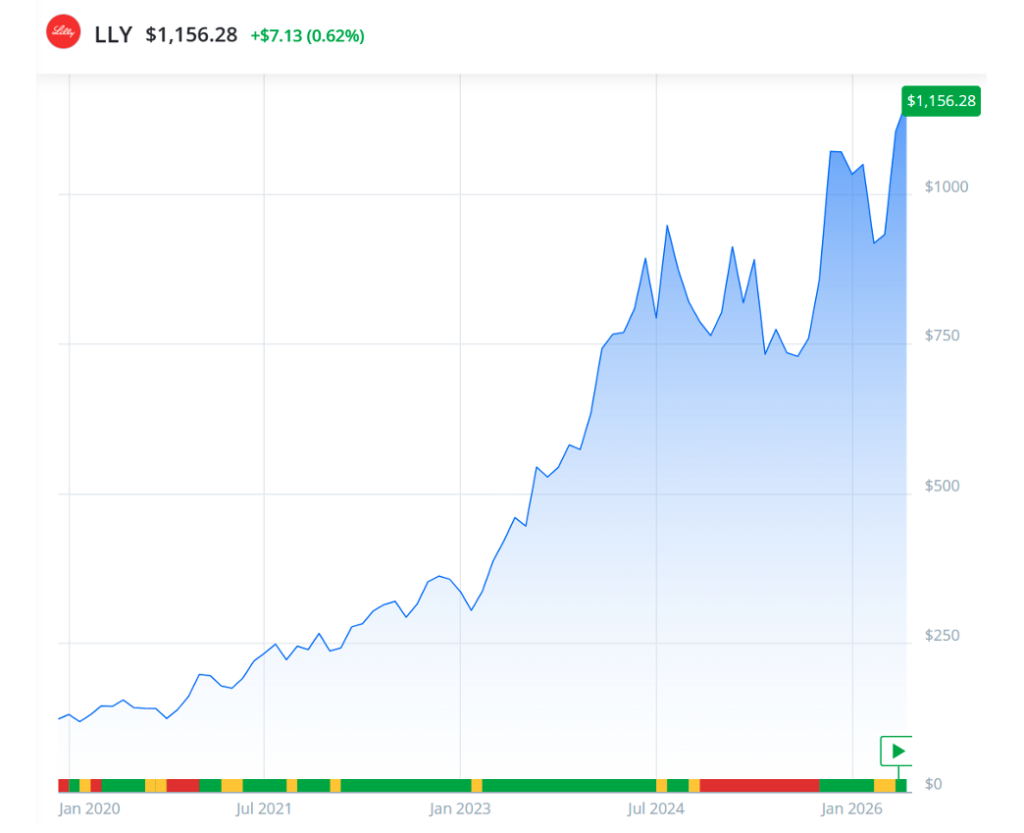
The green bars below the chart show the stock is in a healthy uptrend. Yellow patches are caution zones. And red means the stock is on a sell signal.
But that’s not all we built when we teamed up with Louis…
We also took it a step further by developing the AI Fusion score.
This score is based on our prized master machine-learning algorithm that powers some of our most advanced strategies. Rated from 0-100, it selects the stocks with highest probability to rise faster than the market.
By holding the top 5 stocks that qualify by AI Fusion score since 2021, a $10,000 stake would’ve turned into more than $56,000.
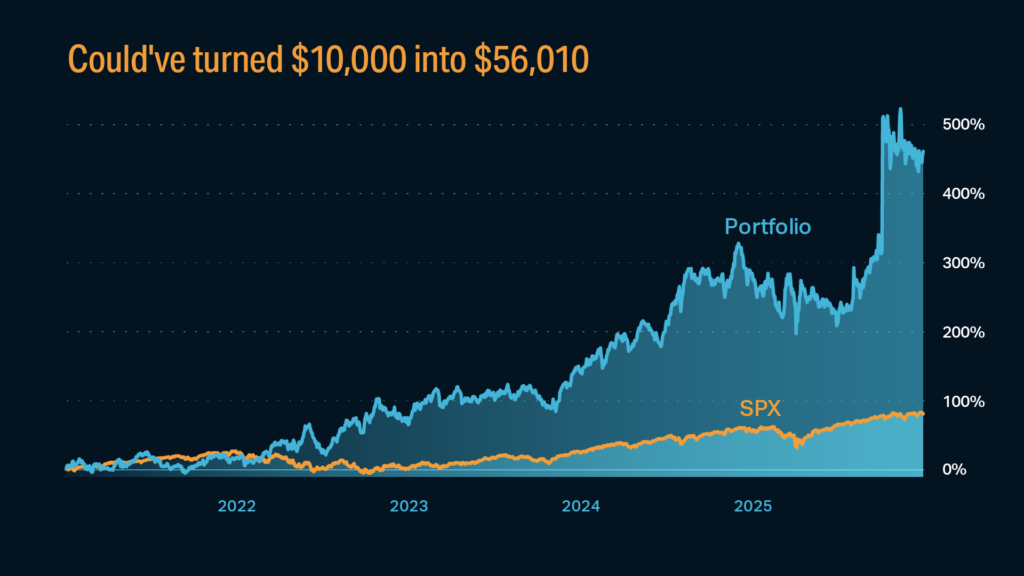
It even rose by 50% in 2022… while the S&P 500 fell 20%.
That’s why there’s so much excitement this week here at TradeSmith about Louis’ upcoming launch event.
Tomorrow, June 10, at 10 a.m. ET, he’ll be getting together with Keith to walk through exactly how the system works – including an urgent buy and an urgent sell our new AI tools have just identified.
Before the event, you can even test-drive part of the technology for yourself. You can enter the ticker symbols of stocks you already own – or stocks you are thinking about buying – and see if our system considers them a buy, a sell, or in a caution zone.
The link to sign up is right here.
If you’re already a Platinum member, you have access to Short-Term Health. Before Wednesday’s event, pull up any stocks on your watchlist and check their Health status – Green Zone stocks in healthy uptrends, Yellow Zone stocks are holds, and Red Zone stocks are sells.
If you have short- to medium-term holdings that are in Red Zones, you’re best off selling them and putting the cash to work in Green Zone opportunities.
To building wealth beyond measure,

Michael Salvatore
Editor, TradeSmith Daily