Meta’s New AI App Has Lit a Fire Under Chip Stocks
Listen to the audio version of this article (generated by AI).
In This Digest:
- Did you miss it? Catch this morning’s AI trading event
- Meta’s new app shows AI demand is real
- Time to buy the Bitcoin breakout
2,927 TradeSmith folks joined Keith for this morning’s AI trading event…
And if you haven’t yet used AI to help you invest, it could be the most important event you attend this year.
Our CEO, Keith Kaplan, showcased the newest version of our Predictive Alpha AI trading model.
It forecasts prices for thousands of stocks up to 21 trading days out. It’s not looking for stocks that are about to shoot the lights out. It’s looking for high-probability setups with more modest gains.
And it learns as it goes. It tracks how each forecast turns out so it can improve its accuracy over time.
And as the model has evolved, the results have improved.
We recommend trades only when they have historical accuracy rates of 85% or more. That means the model’s forecasts on this stock have been right in the past roughly 8 times out of 10.
It’s not a guarantee of an accurate forecast this time around. But it tilts the odds in your favor.
So far this year, at our AI Super Portfolio service, it’s given subscribers the chance to lock in a total gain of 38%. That’s roughly three times the performance of the S&P 500.
If you missed the event, catch up here. Keith included a free stock recommendation for anyone who attended. And it’s one of the most bullish trades across the more than 2,000 stocks it tracks.
Meta’s new AI app has brought animal spirits back…
One of the biggest questions about the AI boom is how much demand there’ll be for this technology.
Big Tech companies in the U.S. will spend upward of $800 billion on capacity this year and more than $1 trillion next year.
That will cover everything from chips, servers, and the data centers they’re housed in… to the cooling systems and power generation needed to run them.
The big question: Will it pay off?
Some of those fears were squashed yesterday with the release of Meta’s new AI app, Muse.
It’s like ChatGPT, but it also acts on your behalf as an online “agent.”
Muse can schedule appointments, book restaurants, and shop online. It also works seamlessly with WhatsApp, Meta’s messaging app with more than 3 billion users.
And it’s a hit. Muse hit No. 1 for free apps on Apple’s App Store – a key measure of consumer demand.
On the back of that success, investors backed up the truck on semiconductor stocks yesterday.
- Advanced Micro Devices (AMD) jumped 10% and crossed $1 trillion in value for the first time.
- Intel (INTC) gained 12%.
- Arm Holdings (ARM) – a chip designer – rallied 17%.
- The VanEck Semiconductor ETF (SMH) jumped nearly 4% to new two-month highs.
We’ve been calling for a recovery in chip stocks in these pages since early August. And AMD has been front and center on our radar.
On Aug. 3, we showed you how AMD had the top Quantum Score in the semiconductor sector despite the price being down more than 16% from its highs.
Since then, the stock is up more than 26%.
Now, Nvidia has the top spot…
Regular readers know the Quantum Score is a 0-to-100 readout that combines fundamental strength (earnings, revenue, and margin growth) with technical momentum (price action and unusually large institutional buying). Anything above 70 is a buy.
We use it to find top stocks in trending sectors that have excellent business and money flowing in from folks on Wall Street.
And right now, the data is clear. The king of AI’s chipmakers, Nvidia (NVDA), is the one to buy.
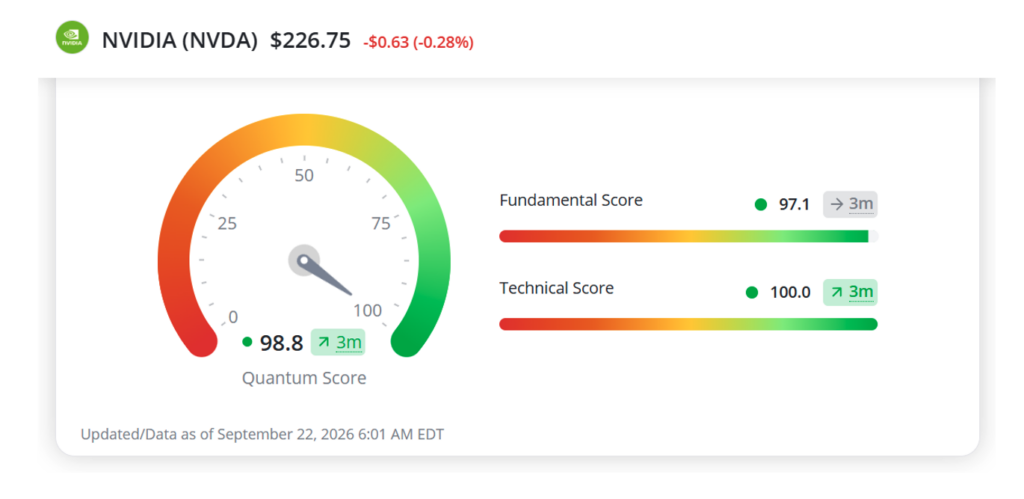
Nvidia is about 3% below its May all-time high. But it’s the highest-rated chip stock in our system with a 97.1 Fundamental score and a perfect 100 Technical score. That means it’s seeing a lot of institutional buying.
If you don’t already own NVDA, you can own it today at a 3% discount from its peak.
It may be the world’s biggest stock and the poster child of the boom, but it’s also the top semiconductor stock to buy.
Bitcoin is trading at its highest level since January…
In early August, bitcoin was drowning in bad news.
Hackers had drained more than $110 million in bitcoin from ColdCard hardware wallets – thought to be the gold standard of security.
Then Michael Saylor’s bitcoin treasury firm, Strategy, revealed it had sold off 1,637 bitcoins.
If you were a bitcoin bull, it’s been rough. But that’s also the kind of headline that tends to mark a bottom.
As I showed you on Aug. 4, bitcoin’s Short-Term Health had just flipped from Red to Yellow.
After a string of Red Zone entries, it was the first sign the bearish trend could be turning.
After a few more weeks of chop, bitcoin entered a new Short-Term Health Green Zone trading at about $69,000 – confirming the bullish shift:
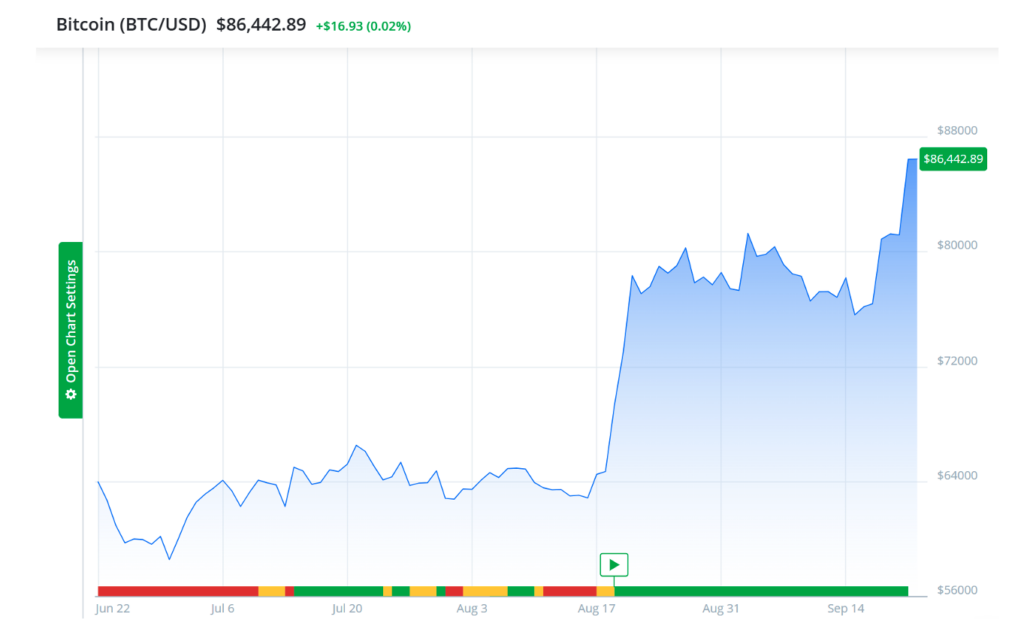
Short-Term Health compares an asset’s price action to its typical trading range, and it looks for deviations from that norm.
It works like a traffic light. Green means a stock is in a healthy uptrend, Yellow is a potential transition between two trends. And Red means it’s in an unhealthy downtrend.
And unlike our classic Long-Term Health indicator, it’s built for trades that last months, not years.
Bitcoin is up roughly 25% since that Green signal fired. Until we see it enter a Red Zone, it’s a buy according to our system.
I’m not the only one who’s been right about bitcoin lately. Our master trader, Jeff Clark, has been profiting from this trade since before it was popular.
In his Delta Report options trading service, he closed a bullish IBIT position for a 75% gain three weeks ago on Aug. 11.
He closed another IBIT trade for a 100% gain shortly after that.
Then – in a trade so unloved it got him hate mail – bitcoin broke above $80,000 days later for another triple-digit win.
Take this breakout seriously. Bitcoin’s past bull runs haven’t crept higher – they’ve moved fast once they got going.
Purists will head to Coinbase or another crypto exchange. But don’t be afraid to buy in via the iShares Bitcoin Trust (IBIT) if you’d rather skip the exchange. You then own Bitcoin like a stock or fund in your brokerage account.
To building wealth beyond measure,