The AI Healthcare Wave Is Just Beginning
Listen to the audio version of this article (generated by AI).
In today’s digest:
- The AI healthcare story is moving fast
- Three big movers just lit up on our screens
- A 165% win in seven days for Jeff Clark challenge participants
AI is a powerful weapon in the fight against disease…
When most people think of AI, they think of asking ChatGPT, Claude, or Gemini a question. But chatbots are just one kind of AI model.
All of them share the same superhuman skill. They find patterns in massive amounts of data that humans can’t see, then use those patterns to make predictions.
For a chatbot, the data is text. It learns that certain words tend to follow certain other words — and uses that to answer your questions. But the same approach works on any kind of data. Including medical data.
Feed an AI model millions of patient records, tumor scans, and blood test results — and it starts finding patterns no human doctor could spot on their own.
It also spots patterns that can predict cancer survival rates… which tumors will respond to treatment… and which diseases are growing silently, before a single symptom appears.
And it’s moving fast.
- Tempus AI unveiled results from a model trained on all of its 45 million patient records, focusing on the most relevant 2.5 million subjects. In a real-world test on lung cancer patients, the model predicted which patients would survive — without any additional training. Just pattern recognition from data.
- Lunit showed that its AI can scan a tumor’s cellular environment to show which patients are most likely to respond to immunotherapy.
- Mayo Clinic presented data on AI tools that can detect multiple types of cancer from a single blood test — before symptoms appear.
AI is also speeding up the drug discovery process.
Finding a new drug used to take 10 years or more. A company called Insilico Medicine used AI to go from initial idea to a drug candidate ready for human trials in just 18 months — and for just over $2 million.
The same process through conventional means typically costs over a billion dollars.
It’s part of an AI healthcare boom that’s just in its early innings…
This week, nine healthcare stocks lit up on our emerging trend screen. Three of the biggest movers have AI at their core.
- Veracyte (VCYT) makes AI-powered cancer tests that help doctors decide which patients need chemotherapy — and which can safely skip it. At ASCO last week, it presented data from two major trials. One showed its breast cancer test could spare many patients from chemo they don’t need. The other did the same for prostate cancer. Doctors called both results practice-changing.
- Illumina (ILMN) makes the gene-sequencing machines that power modern cancer research — the equivalent of a microscope for DNA. Without them, AI cancer tests like Veracyte’s wouldn’t exist. This year, it added machine-learning tools that help doctors spot cancer mutations faster.
- Dexcom (DXCM) makes wearable sensors that track blood sugar around the clock. Its newly released next-generation G8 monitor goes a step further — it learns how each patient’s body works and adjusts its readings accordingly. With millions of people now on GLP-1 weight-loss drugs, Dexcom wants to be the device that tells them whether those drugs are actually working.
Three different companies. One idea: Use AI to see what doctors can’t — and turn that into better care.
Our Predictive Alpha engine sees a 12% move for Veracyte…
Predictive Alpha works like a large language model — but instead of predicting the next word in a sentence based on vast amounts of text, it predicts where a stock is likely to go next based on hundreds of billions of market data points.
One of its strongest forecasts right now is on Veracyte. Take a look…
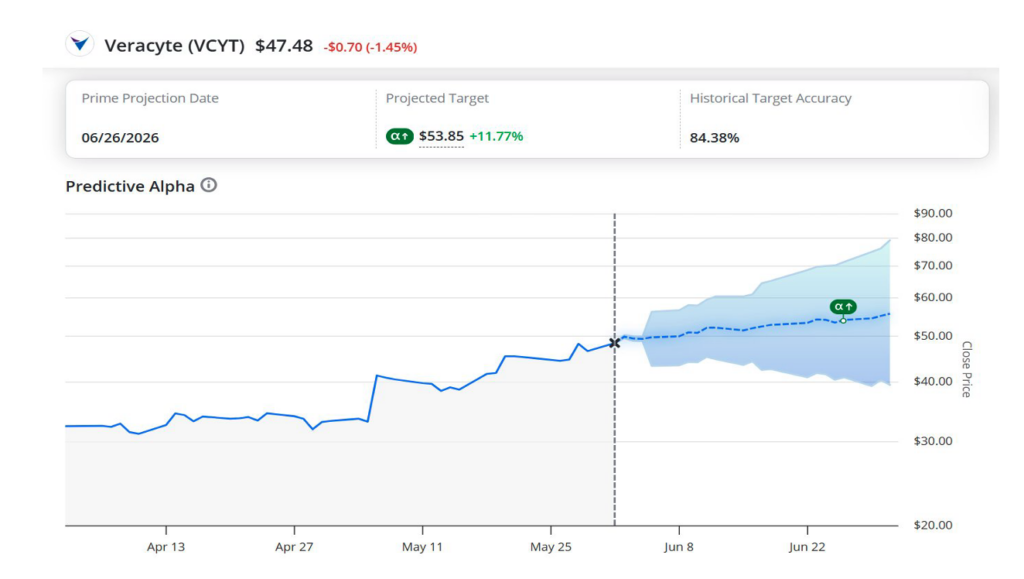
The blue line on the left is the stock’s past price action. The dotted blue line is its average forecast. And the blue shaded areas show the upper and lower ends of the forecasted range.
Right now, Predictive Alpha is forecasting a nearly 12% jump in VCYT by June 26. Forecasts on this stock have been accurate 84.4% of the time.
VCYT is not only at the center of the AI healthcare megatrend. Our model is spotting patterns in the data that tend to precede this kind of price jump.
Cybersecurity stocks are bouncing…
Earlier this year, the advent of new AI coding tools like Anthropic’s Claude Code sent software stocks tumbling as much as 27%.
And cybersecurity stocks got caught up in the drop. The sector fell as much as 21%.
When AI makes it cheaper and faster to write software, the first fear on Wall Street is that it also makes it cheaper and faster to write malicious software — viruses, ransomware, and phishing attacks that are harder to spot and harder to stop.
That fear isn’t wrong. But it misses the bigger picture.
The rise of AI agents — autonomous programs that can browse the web, execute tasks, and make decisions without a human in the loop — is creating an entirely new attack surface.
These agents can probe for security weaknesses at machine speed, across thousands of targets simultaneously. No human hacker works that fast.
That means every company running an AI agent — which will soon mean every company on Earth — needs a new layer of protection. Cybersecurity isn’t becoming less important because of AI. It’s becoming more important, faster than most investors realize.
Our emerging trend screener confirms it. On this morning’s screen, nine cybersecurity firms lit up.
As a reminder, this screen looks at top-ranking Quantum Score stocks that are hitting new highs. When we see clusters of stocks in the same sector, that points to an emerging theme.
We already put Palo Alto Networks (PANW) on your radar as a buy on May 18, after its Short-Term and Long-Term Health buy signals fired at the same time.
Since then, it’s up 21%. And it remains in Short-Term and Long-Term Green Zones, meaning it’s still a buy.
Jeff’s $1 million challenge scored its first win…
Last month, TradeSmith’s master options trader Jeff Clark launched his first-ever trading challenge — the 12 Trades to $1 Million Challenge.
It’s a structured attempt to take a $5,000 stake and roll it into $1 million in no more than 12 options trades.
We realize that may sound a little crazy.
And Jeff is the first to admit that the odds are stacked against him.
But his track record shows it’s entirely possible.
During the 2023 banking crisis, he gave his subscribers the chance to close out nine straight winning trades in a row. Had you rolled the profits from the first to the last, it would have turned $5,000 into $1.3 million.
During the AI repricing of 2025, Jeff recommended 12 winning trades in a row that could have turned $5,000 into $2.6 million.
And he’s closed the first trade of the challenge, in just seven days, for a 165% gain.
So kudos if you took the leap and joined Jeff for the challenge… or if you’re a Platinum subscriber and already have access to Jeff’s trading services.
And if you missed it, you have a new opportunity to join. We’re opening access again for a second intake. If you’re interested, go here before we close the doors again tomorrow at midnight.
To building wealth beyond measure,

Michael Salvatore
Editor, TradeSmith Daily