The Nvidia of 2026 Is Closing in on New Highs
Listen to the audio version of this article (generated by AI).
In This Digest:
- This stock is the new guard to Nvidia’s old – and our AI just flagged a fresh entry
- Why we like this under-the-radar AI stock for a small, speculative buy
- Regional banks are a can’t-miss trade as we get deeper into October
In 2023, Nvidia owned the AI trade…
The chipmaker gained 238% that year.
Then it added another 171% in 2024.
That’s what happens when a company sells the premier version of the most important piece of hardware for the AI buildout: semiconductors.
But AI models don’t just need chips. They also need memory.
Think of an AI chip as a chef. Memory is the counter space next to the stove, where the ingredients sit within arm’s reach. The faster the chef can grab what he needs, the faster the meal gets made.
And today’s AI models cook enormous meals. Every time you ask a chatbot a question, the chip has to pull huge amounts of data from memory in a split second. If the memory can’t keep up, the world’s fastest chip sits idle… waiting.
It makes a special kind of memory called high-bandwidth memory, or HBM. These are stacks of memory chips that sit right beside AI processors like Nvidia’s and feed them data at high speed.
Only three companies make it at scale: South Korea’s SK Hynix and Samsung… and Micron. And Micron is the only American one.
That’s why investors have bid up shares of Micron Technology (MU) 241% so far this year.
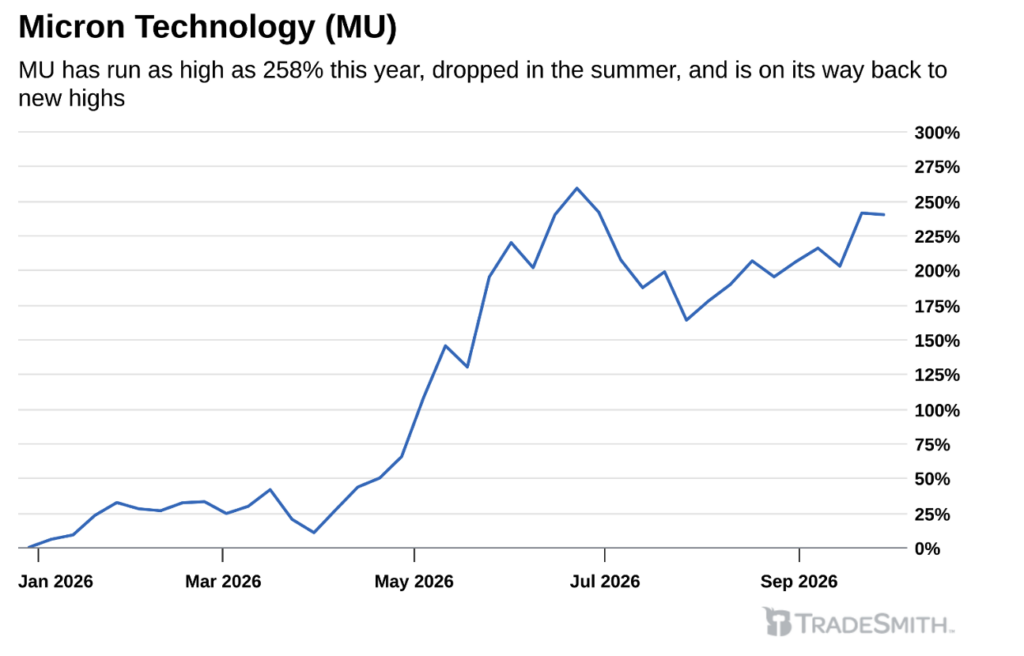
Buying a stock after that kind of run can feel uncomfortable. Investors must have felt the same way about Nvidia heading into 2024 after seeing that 238% run in 2023.
Had they bought anyway and held through to today, they’d be up 378%.
That’s what happens when you have a stock that controls a vital chokepoint of the AI boom. Big gains often lead to even bigger gains. The same is true of Micron.
And we got further confirmation of a short-term pop for the memory maker on Friday, after our Signals software highlighted a bullish trade setup.
Micron just flashed a fresh Bullish Pivot signal…
Signals is our new software tool that watches for moments when a stock’s own history shows a big move could be coming.
It starts from a simple observation: Every stock has its own way of behaving. An oil producer like Chevron reacts to the economy differently than a drug company like Pfizer. Over time, each stock leaves behind a distinct trading “thumbprint.”
Signals hunts for those thumbprints. Every day, it runs thousands of stocks through hundreds of calculations. It’s looking for the specific combinations of factors that have come before big moves in the past.
As of Friday’s close, Micron flashed a Bullish Pivot signal. It fires when a stock pulls back sharply after a string of higher highs and higher lows – a dip inside an uptrend.
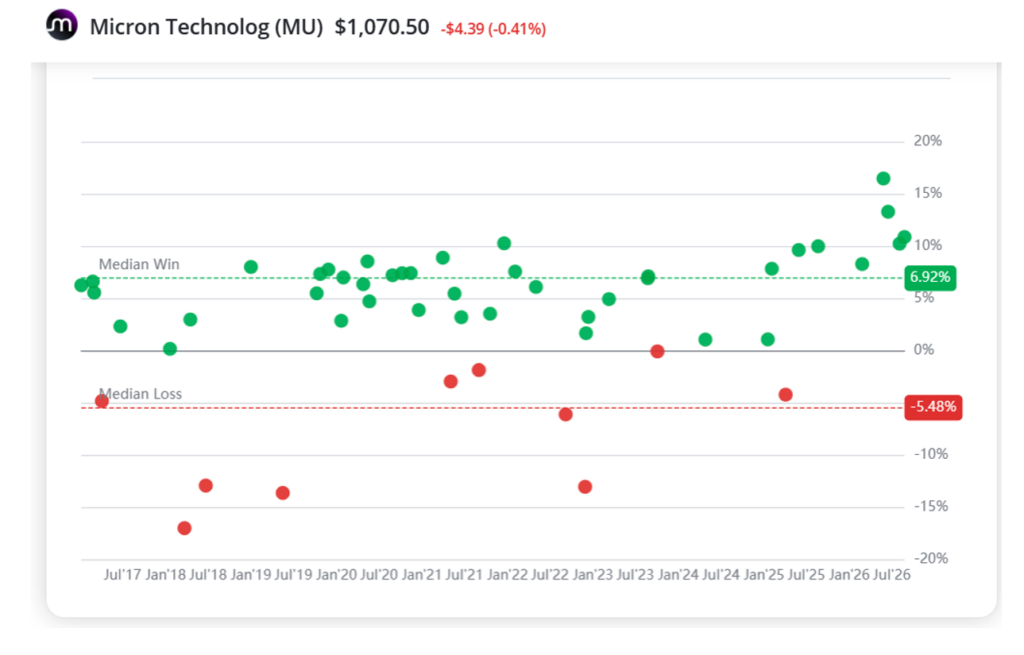
We’ve seen this same signal fire on MU 51 times over the past 10 years, and 5 times over the past 12 months.
Overall, the signal has been right on Micron 80.4% of the time. And winning trades have averaged a return of 6.5%. And these are quick trades. The median hold is just seven days (meaning half are longer and half are shorter).
And this year, the track record has been even better. Micron has completed five Bullish Pivot signals in 2026, and all five closed higher:
- May 26: 16.5% in one day
- June 15: 13.3% in a week
- Aug. 24: 10.9% by Sept. 8
- Aug. 3: 10.2% in one day
- Feb. 24: 8.3%, after falling as much as 16.7% first
The full history goes back to 2017, and the wins far outnumber the losses:
Paid-up subscribers can track this signal and every other active trade on the Signals dashboard on TradeSmith Finance.
This little-known AI stock is worth a close look…
SoundHound AI (SOUN) got its start as an app that could name a song when you hummed it into your phone.
By 2023, it had been downloaded more than 315 million times.
Today, SoundHound’s AI voices take phone orders at Jersey Mike’s and answer drivers’ questions in Hyundai cars.
That’s conversational AI – software that can hold a real back-and-forth transaction with a customer. And customer service is where it’s headed next.
SoundHound’s new OASYS software lets businesses build these AI agents in minutes instead of months. South Carolina’s MUSC Health has run more than 2.2 million patient calls through its SoundHound agent.
Not that you’d know it from the stock.
Last November, fears of an AI bubble knocked SoundHound down by nearly a third in a month. And so far this year, the stock is down about 45%.
SoundHound brought in a record $61.9 million in sales last quarter, up 45% from a year earlier.
That gap is what Andy and Landon Swan – the brothers behind our MegaTrends advisory – look for.
They built the Social Heat Score, which monitors millions of signals across the web every day – searches, web traffic, social chatter – to see where real-world demand is building.
Then it compares that Main Street demand with what Wall Street expects. When Main Street runs well ahead, investors may not have priced the strength in yet.
That’s how the Swans spotted Robinhood (HOOD) early, a call that delivered a 556% gain for MegaTrends subscribers last year.
Right now, SoundHound’s Social Heat Score is a bullish 84 out of 100. And its Main Street Score is running 58 points ahead of its Wall Street Score – indicating that customers are showing up to SoundHound much faster than Wall Street expects.
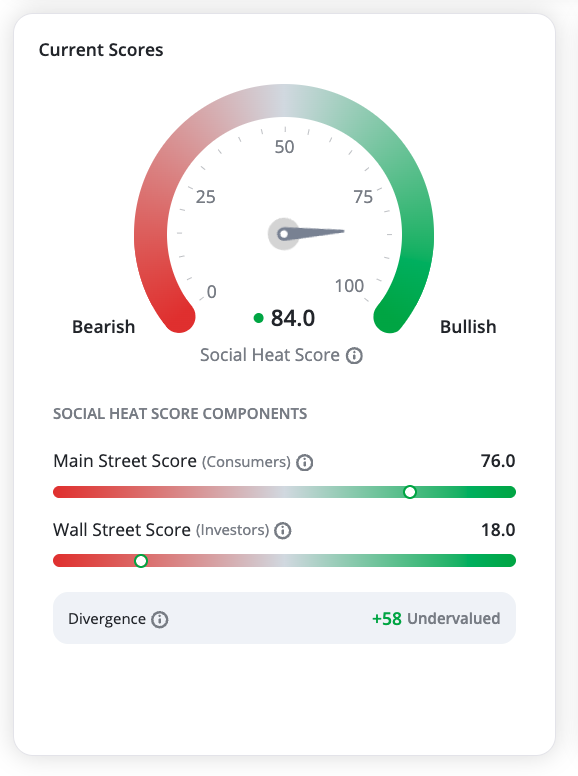
That’s one of the widest gaps in their system.
If you’re looking for an AI stock Wall Street is underrating, it’s worth a close look.
Just keep in mind that SoundHound has a market value of just $2.6 billion, making it a more speculative trade. So keep any position small.
Paid-up subscribers can hunt for more gaps like this in the Social Heat Score’s new Top Divergence tab on TradeSmith Finance. For example, fast-growing coffee chain Dutch Bros (BROS) is sitting right near the top today.
Banks are two weeks from their best stretch of the year…
On Sept. 24, I showed you how Meta’s new AI agent, Muse, set off a panic in financial stocks.
The fear was that Muse would remove the friction from typical “high-friction” financial decisions – changing insurance providers, shopping for loan terms, or even switching banks to get a higher interest rate.
That helped chop 7.5% off the State Street Financial Select Sector SPDR ETF (XLF) in just a few weeks.
Smaller regional banks – tracked by the State Street SPDR S&P Regional Banking ETF (KRE) – got hit harder, down 10.5%.
Senior TradeSmith analyst Mike Burnick has seen plenty of scares like this. He’s spent more than 30 years in the investment business, including running a mutual fund as a portfolio manager.
He compares Muse to the “SaaSpocalypse” last spring, when AI was supposed to put software companies out of business. The iShares Expanded Tech-Software Sector ETF (IGV) fell as much as 37%. But it’s rebounded nearly 40% since that scare’s worst point.
Mike says banks are next to bounce. And our Trade Cycles tool shows the calendar is on his side.
Trade Cycles looks at how thousands of stocks or ETFs have performed during precise calendar windows in past years.
For KRE, the next bullish window opens Oct. 19 and runs through Nov. 23:
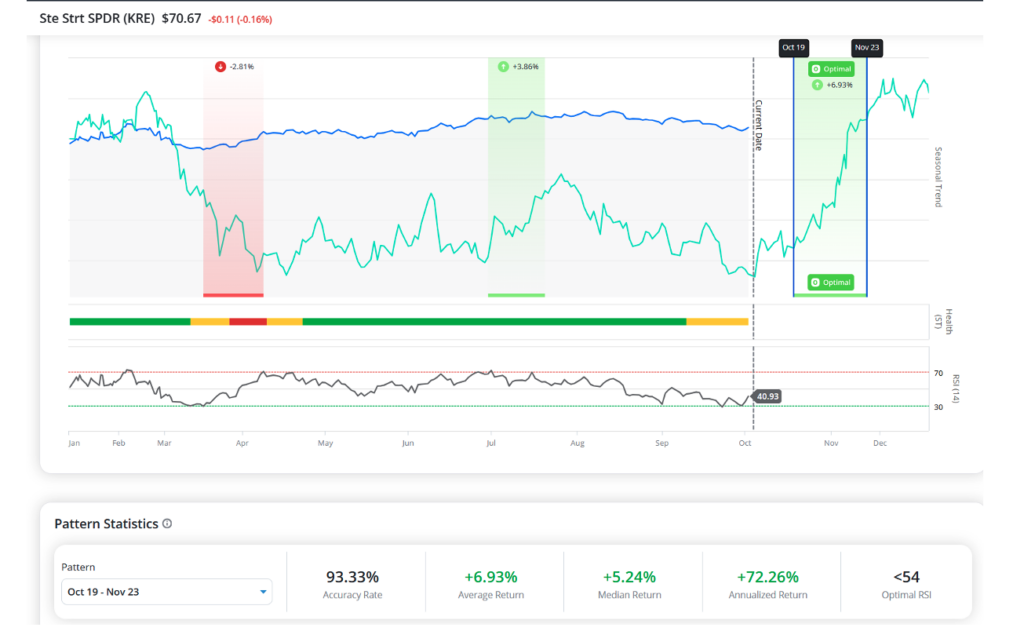
Over the past 15 years, KRE has risen during this window 93.3% of the time. The average gain is 6.9%.
KRE also meets the window’s best-performing conditions. Historically, the window has worked best when KRE’s Relative Strength Index (RSI) – a measure of how overbought or oversold a stock is – was below 54. And its RSI sits at 40.9 today.
The lower the RSI, the more oversold it is and the higher the likelihood of a snapback rally.
So put Oct. 19 on your calendar. Add KRE to your watchlist now and look to buy as the window opens.
To building wealth beyond measure,

Michael Salvatore
Editor, TradeSmith Daily