The Other Half of the AI Chokepoint Story
Listen to the audio version of this article (generated by AI).
In 1903, the Fisk Generating Station opened along the south branch of the Chicago River.
Its single-steam turbine generated 5,000 kilowatts (kW) of electricity — more than three times the output of any other turbine in the world at the time and enough to power the entire south side of Chicago.
This was the dawn of the Age of Electricity. Thomas Edison had opened the world’s first commercial power station in lower Manhattan just two decades earlier.
By the early 1900s, the country was gripped by the potential of electric power to transform manufacturing, transportation, and household life – and to create vast new fortunes in the process.
The man behind Fisk was Edison’s former personal secretary Samuel Insull. By 1907, he was running Chicago’s biggest electric utility – Commonwealth Edison. And it made him one of the richest men in America.
Edison’s lightbulbs were everywhere by then. Anyone could make one. The real chokepoint – the thing everyone needed and almost nobody could supply – was the generation and distribution of electricity itself.
Insull figured out the same thing Andrew Carnegie did a generation earlier during the railroad boom. The biggest fortunes weren’t made in the railroad companies. They were made selling the steel the railroads were built from.
And you didn’t need to live a century ago to see this play out.
When the internet boom took hold in the 1990s, most investors chased dot-com startups. But the biggest fortunes were built in the companies making the routers and switches the internet ran on.
Take Cisco Systems. Between 1990 and the spring of 2000, its stock rose more than 75,000% – enough to turn a $10,000 stake into $7.5 million. For a few months at the turn of the millennium, it was the most valuable company in the world.
The lesson is the same in every industrial boom. The headlines focus on the technology itself: steam power, electricity, the internet. The real fortunes are made by the companies that control chokepoints in the supply chains that make those technologies possible.
The $700-billion AI infrastructure buildout going on today is running headlong into at least five major chokepoints.
Last Friday, we looked at two of them: high-bandwidth memory and silicon photonics. Without these, AI chips can’t process data fast enough to run today’s largest models.
Today, we’ll look at three more – this time outside the AI hardware itself. Getting electricity into the buildings that house it, getting the heat back out, and connecting the whole thing to a power grid that wasn’t built for any of this.
Chokepoint No. 1 – Getting Electricity In
The most direct way to play this bottleneck is Eaton Corporation (ETN).
It’s one of the world’s largest manufacturers of the transformers, switchgear, and uninterruptible power supplies that move and condition electricity inside a data center — the equipment that turns a 230,000-volt transmission line into the clean, conditioned power a rack of AI chips can use.
When a hyperscaler decides to build a data center, Eaton is one of a handful of companies they have to call.
In Eaton’s first-quarter results this year, the Electrical Americas segment – the part of the business that sells into U.S. data centers – reported a 60% jump in total orders year over year. Data center orders alone were up 240%. And the company’s total electrical backlog now sits at $14.5 billion, up 44% from a year earlier.
A backlog is work that’s already been ordered and paid for – but hasn’t yet shipped. Eaton’s customers are placing orders today for transformers and switchgear they won’t actually receive until 2027, 2028, even 2029.
In other words, Eaton already knows what most of the next several years of revenue look like.
Now, the stock has already had a strong run. Shares are up about 32% over the past year and trade at about 39 times earnings – not cheap by any historical measure. So if you’re looking to buy this as a long-term holding, it’s best to wait for a pullback.
And if you’re looking for a short-term trade idea, ETN enters a seasonally bullish window – a time of the year when its shares tend to rise – at the end of next month.
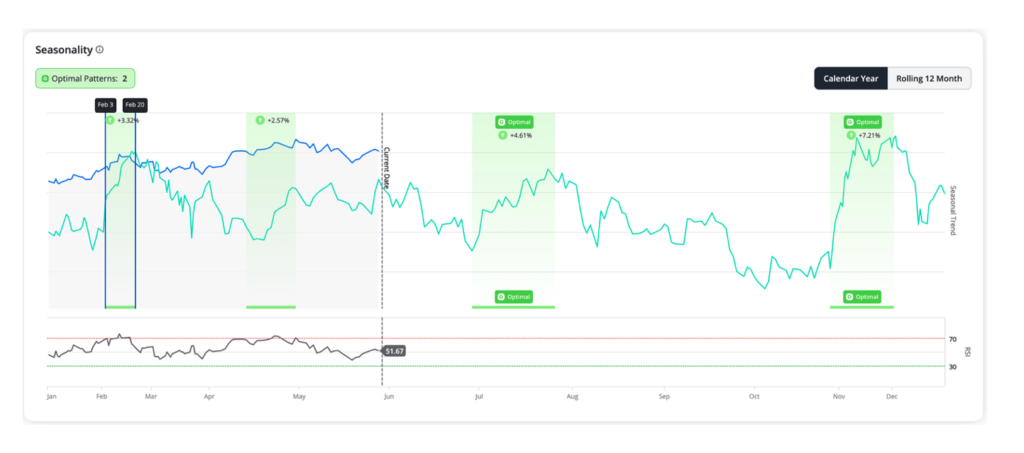
Between June 29 and July 27, it’s risen an average of 4.6% over the past 15 years, with a pattern accuracy of 87%.
Chokepoint No. 2: The Cooling Bottleneck
A top play here is Vertiv Holdings (VRT).
It makes the power and cooling equipment that runs inside a data center —most importantly, the liquid cooling distribution units that keep AI chips from melting.
Until about three years ago, data centers had a heat problem they could solve with air. A standard server rack runs at about 10 to 15 kilowatts of power. The big industrial air conditioners that data center operators have used for decades could handle that.
Today, a rack filled with the latest Nvidia AI chips runs at 120 to 130 kilowatts – 8 to 10 times the heat load. The next generation, due in the next 12 to 18 months, is projected to hit 240 kilowatts per rack.
Air can’t move that much heat. Water can. Water absorbs heat about 3,000 times more efficiently than air at the same volume.
So every hyperscaler building an AI data center is now switching from air cooling to liquid cooling. And Vertiv is the largest pure-play supplier of the gear they need to do it.
The company’s project backlog now stands at more than $15 billion, more than double what it was a year ago. That gives Vertiv the same kind of multi-year visibility we just saw with Eaton. Orders placed today won’t ship for years.
Now, VRT has had an exceptional run. Shares are up about 64% year to date and trade at around 46 times forward earnings. So if you’re looking to buy as a long-term holding, like with Eaton, it’s best to wait for a pullback.
But for short-term traders, there are two excellent seasonality setups later this year.
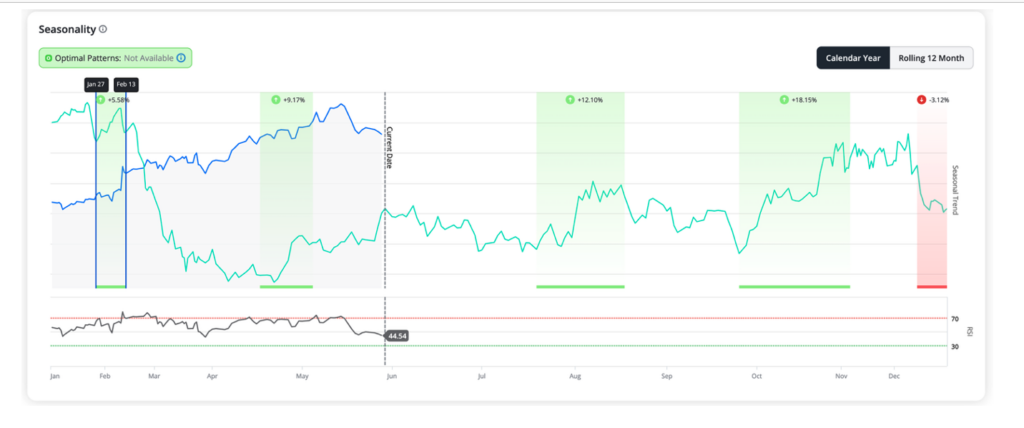
The first runs from July 20 to Aug. 18. Over the past 15 years, this stock has risen 100% of the time during this window for an average gain of 12%.
And between Sept. 25 and Nov. 6, it’s also been up 100% of the time over the past 15 years for an average gain of 18.5%.
Chokepoint No. 3: The Grid Bottleneck
The third chokepoint is the largest of the three and the least visible.
When a hyperscaler builds an AI data center, the building itself is the easy part. The chips are expensive but available. The cooling equipment is on order. But the external infrastructure – the substations, the high-voltage transmission lines, the heavy electrical work that connects a building full of servers to the grid that powers it – is truly stuck.
Someone has to build all of that. And the largest pure-play company doing it is Quanta Services (PWR).
It’s the company you call when you need to physically connect a new gigawatt of load to an aging grid.
Quanta builds and maintains the physical backbone of America’s electric power system – the transmission lines, substations, and distribution networks that move electricity from where it’s generated to where it’s used.
The company controls the largest private workforce of high-voltage linemen in North America, the skilled workers who string the wires and energize the substations.
In Quanta’s first quarter, revenue jumped 26% to $7.9 billion. The company raised its full-year earnings guidance. And its order backlog reached a record $48.5 billion – more than half a year of revenue already sold, much of it tied to data center power work that won’t be completed for years.
At its 2026 investor day, Quanta laid out a $2.4 trillion infrastructure opportunity through 2030, driven by data center demand, grid modernization, and the reshoring of American manufacturing.
PWR has had an exceptional run. Shares are up roughly 137% over the past year and trade at around 63 times earnings. By any traditional measure, that’s expensive if you’re buying now as a long-term hold.
The optimal time to buy as a short-term trader, according to its seasonality patterns, is in October.
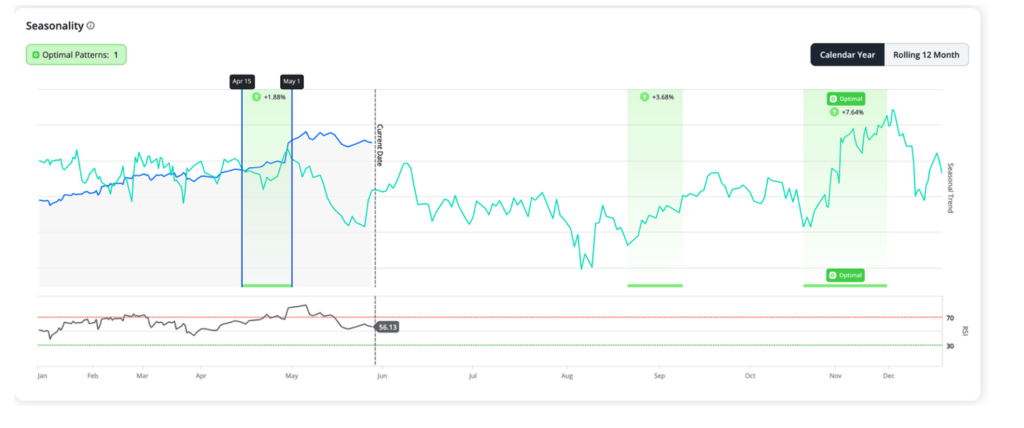
Between Oct. 19 and Nov. 30, PWR has averaged a 7.6% gain, with a 93% pattern accuracy over the past 15 years.
A Final Word on Risk
These three stocks all control critical chokepoints in the AI infrastructure buildout. And they’re all in powerful uptrends as a result.
But there’s a difference between owning a great business and buying it at a great price.
That’s why I lean on tools like Seasonality before pulling the trigger – not because it’s a crystal ball, but because it helps me wait for the moments when probability is on my side.
Managing your risk is an essential part of the wealth building toolkit. And that’s especially true in a boom, like we’re seeing today with AI.
That’s why these three stocks are better bought on pullbacks or traded during their bullish seasonality windows.
All the best,
Keith Kaplan
CEO, TradeSmith
P.S. I did an interview this week with the folks from MarketBeat all about the AI chokepoint story. And I got into some of the other chokepoint stocks on my watchlist.
The interview has already got more than 250,000 views on YouTube and a ton of great comments. So for more on this investment theme, make sure to check that out here.
And if you’re not already following me on X, you can find me at @KeithTradeSmith. It’s the best way to keep up to date with my latest ideas.