Three Stocks to Buy for the Bio-Intelligence Revolution
Listen to the audio version of this article (generated by AI).
Ann Johnson had plenty she wanted to say. But for 18 years, she had no way to say it.
A stroke had paralyzed almost every muscle in her body when she was just 30. She couldn’t move or speak, and for a while, she couldn’t breathe on her own. But her mind was fully intact.
She spent those years awake and aware, listening to conversations she couldn’t join, forming words no one would ever hear.
Doctors call it locked-in syndrome. It’s one of the most frightening conditions in medicine, and until recently, there was nothing to be done about it.
Then a team at the University of California, San Francisco, offered Ann a breakthrough way to unlock her speech.
Surgeons placed a thin grid of electrodes on the surface of her brain, over the patch that controls the muscles of speech. Every time Ann tried to talk, her brain still fired the signals. They just had nowhere to go, because the stroke had cut the line between her brain and the muscles it was signaling.
So they trained an AI to read those signals instead. It learned what her brain was telling her mouth to do, and turned it into words – on a screen, and aloud in a synthetic voice, at nearly 80 words per minute, five times faster than the visual device she’d been using.
By the end of the trial, Ann could hold a conversation again – in a voice the researchers rebuilt from a recording of her own, made at her wedding before the stroke. (You can watch it happen here.)
What gave Ann her voice back is an example of something I wrote about last week – what I call bio-intelligence.
You’ve heard no end about AI that writes your emails and answers your questions. Underneath, all it’s really doing is finding patterns in huge amounts of information. Bio-intelligence is what you get when you point that same skill at the human body instead of at words on a screen.
Because your body runs on information – in your DNA plus a constant stream of chemical messages your cells trade every second you’re alive.
A lot of what we call disease, and of what we call aging, is that information going wrong. What’s new is that we can finally read that code, copy the messages the body sends, and even write new ones and hand them back.
And Ann’s is only one of the jaw-dropping breakthroughs this revolutionary approach to medicine makes possible. As I covered last Friday, the same idea is behind the GLP-1 weight-loss drug phenomenon, the new skin cancer vaccine from Moderna (MRNA) AND Merck (MRK), and the CRISPR gene-editing technology now curing sickle cell disease and beta thalassemia – two of the most common inherited blood disorders.
These breakthroughs show you what the science can do. The harder question – the one that matters for us as investors – is which companies are already turning it into real products and real revenue. And how to tell those apart from the ones that will burn your capital chasing a breakthrough that never comes.
Last week, I showed you the simplest way in: the iShares Biotechnology ETF (IBB). Today I’ll get more specific and run through three companies leading the charge – all three in healthy uptrends right now, and all carrying high Quantum Scores on our system.
The Company That Reads the Code
Before anyone can find a tumor’s mutations, copy a hormone, or edit a faulty gene, someone has to read the DNA first. Illumina (ILMN) builds the machines that do the reading.
In 2001, sequencing a single human genome cost about $100 million. Today it costs a few hundred dollars. Illumina is most of the reason why – its sequencers are the standard equipment the rest of this field runs on.
And it sells them the way Gillette sells razors. The machine is the up-front sale. Then the lab buys Illumina’s chemical kits to run it, again and again, for as long as the machine is in service.
Illumina hasn’t been a great stock to own lately. But it’s now in Short-Term and Long-Term Health Green Zones – meaning the uptrend is intact on both the near-term and longer-term view.
And its Quantum Score – our broader measure of a stock’s quality and momentum – is 87.7 out of 100, with anything above 70 being a buy.
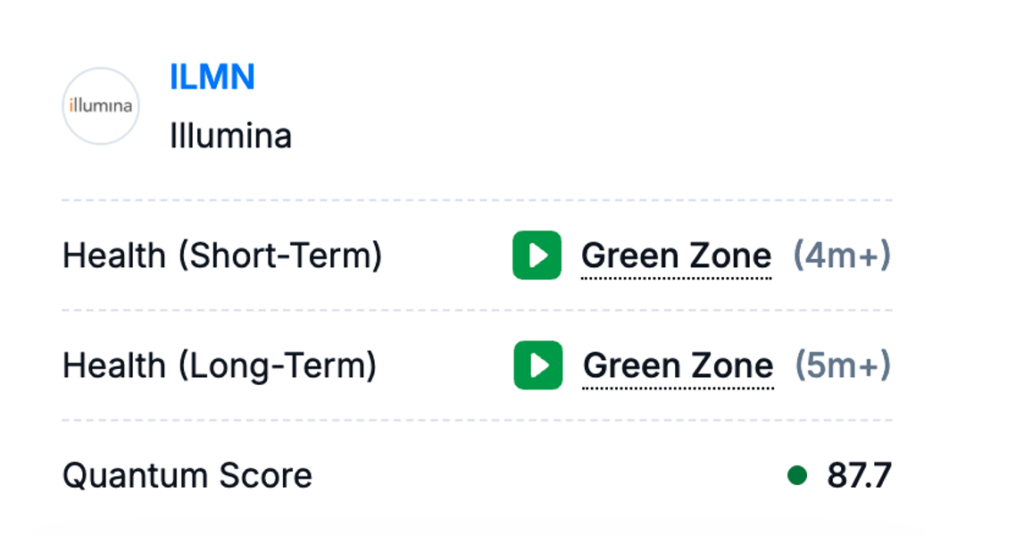
Of the three stocks we’ll look at today, Illumina is the most volatile. Its Volatility Quotient (VQ), our measure of how much a stock typically swings, is 36%, the highest on this list.
The green lights tell you the trend is healthy today. It’s not a steady, low-drama holding – so keep any position small.
The Company That Fixes Broken Genes
Earlier I mentioned the CRISPR technology now curing inherited blood disorders.
It’s worth a moment to discuss what CRISPR is because it sits at the heart of this whole shift. If your DNA is a code 3 billion characters long, CRISPR is the find-and-replace tool – it goes to the exact spot where a character is wrong and fixes it, the closest thing medicine has ever had to editing the body’s code directly.
Vertex Pharmaceuticals (VRTX) made its name fixing the damage from broken genes – though for years, it did it without touching the gene at all.
Take cystic fibrosis, a deadly disease caused by a single faulty gene. The error tells the body to build a key protein in the wrong shape, so it can’t move salt and water through your cells properly. The result is thick mucus that clogs the lungs. As recently as the 1950s, children born with it rarely reached grade school.
Vertex designed drugs that grab that misshapen protein and coax it into working anyway. What was a death sentence is now, for many patients, a condition managed with a daily pill. Those drugs are approved to treat about 90% of people with the disease – a franchise that brought in roughly $13 billion this year.
Now Vertex is going a step further, to the gene itself. It makes Casgevy – the first approved CRISPR cure, the one for sickle cell disease – turning that breakthrough into a treatment doctors can actually prescribe.
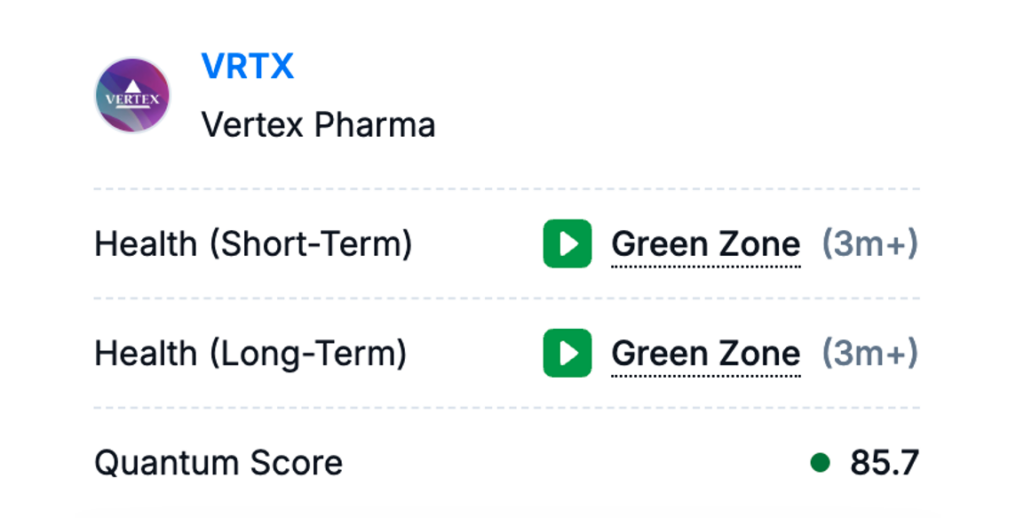
As you can see, our system has VRTX in a Green Zone on both Health timeframes, with a Quantum Score of 85.7. And it has a VQ of 21%, well below Illumina’s.
The Company That Sells the Picks and Shovels
There’s an old line about gold rushes: The surest way to make money isn’t to dig for gold… it’s to sell the picks and shovels. Thermo Fisher Scientific (TMO) sells the picks and shovels of the bio-intelligence boom.
Whichever of these therapies wins – a cancer vaccine, a gene-silencing drug, an edited cell, a printed organ – the odds are it was developed using Thermo Fisher equipment and made with Thermo Fisher materials.
The company supplies the instruments, chemicals, and lab gear to nearly every drugmaker, hospital lab, and university on the planet. That came to about $48 billion in revenue this year, which makes it bigger than most of the companies in this theme put together.
You aren’t betting on which treatment wins. You’re betting that the total amount of this research keeps growing – and collecting a toll on all of it.
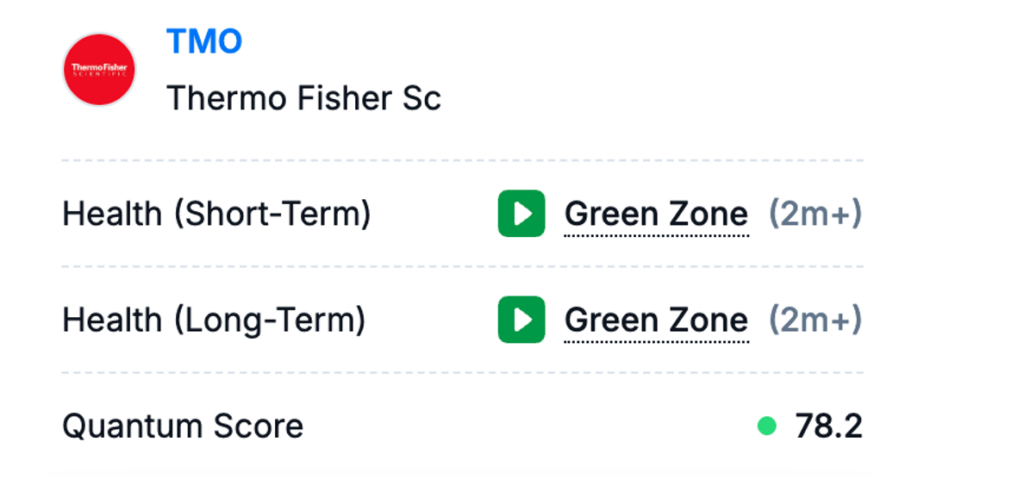
Our system has TMO in a Green Zone on both Health timeframes, with a Quantum Score of 78.2. Its Volatility Quotient is 20% – the lowest of the three.
It won’t double on one trial result. But it’s the steadiest way to own the whole trend at once.
A Word on Risk
Three green lights don’t make three sure things.
A Green Zone tells you a stock’s trend is healthy right now. It doesn’t promise the trend will hold, and biotech can turn fast – these are real companies with potential setbacks ahead. So a few plain risk rules matter more here than usual.
Don’t let any one stock get too big in your portfolio. Decide how much you’re willing to lose on a position before you buy it, not after. And lean toward the stocks with the lower VQs if you’re just stepping into this.
Being right about the trend isn’t the same as being right about a company. That’s the case for owning more than one and for keeping each one sized so a single bad week never does real damage.
All the best,

Keith Kaplan
CEO, TradeSmith