Will You Take the Ladder or the Elevator to AI Wealth?
Listen to the audio version of this article (generated by AI).
In This Digest:
- What anti-AI protests say about the world’s most powerful mega trend
- A reminder to sign up for Luke Lango’s 2026 AI Megadeal Event
- Meet the biotech company making the blind see
“In a race off a cliff, no one wins”…
That was one of the signs earlier this month, as anti-AI protestors gathered in San Francisco.
On Saturday, July 11, hundreds of people gathered at OpenAI’s headquarters in the city’s Mission Bay neighborhood. They marched to Anthropic’s offices, then on to Google DeepMind’s offices.
One protestor’s sign read “AI Is Not Inevitable.” Another, carried by a father pushing a stroller, read “Pls Do Not Kill Me.”
The protest was organized by a group called Stop the AI Race. It wants every AI lab in the world to stop building the most advanced AI models — as long as every other lab agrees to stop too. The group’s fears run from AI’s environmental cost… to lost jobs… to a world taken over by machines.
This kind of reaction isn’t new.
Every big leap in technology has been met with fear and resistance…
The Luddites famously campaigned against mechanized looms in the Industrial Revolution… by destroying them.
Britain’s 1865 Red Flag Act forced the first automobiles to creep along at 2 mph behind a man waving a red flag — all to protect the horse-and-carriage business.
When TV took over the living room, critics swore it would rot children’s brains, ruin their eyes, and kill the art of conversation.
These folks weren’t wrong to be worried. Weavers really did lose their livelihoods to the looms. Early automobiles really did kill pedestrians and foul the air. And TV really did affect how we dealt with one another.
The worries were fair. But they didn’t stop the Industrial Revolution, the automobile age, or the TV era.
Seen through that lens, the crowds marching on OpenAI and Anthropic aren’t a sign that AI is going away. They’re a sign of how much it’s about to reshape daily life — and how fast.
And when a technology is that big, the question for investors isn’t whether to own a piece of it. It’s how.
There are two ways up: a ladder or an elevator…
Most folks take the ladder. They buy the big AI stocks you can pull up in any brokerage account — Nvidia, Microsoft, Google.
And that’s been a fine way to play it. Nvidia alone is up more than 1,000% since ChatGPT launched in November 2022 and kicked off the AI boom. Microsoft and Google are up 77% and 281%, respectively.
But the ladder has a catch. By the time you can buy a company like that on the open market, the biggest gains have usually already happened — scooped up by the insiders and early backers who got in years before the rest of us ever heard the name.
The other way up is the elevator. It means doing what ultra-wealthy venture capital investors do: buying in while a company is still in private hands — down on the ground floor, long before it ever reaches the stock market.
Take Snowflake, a software company that went public in 2020. On its first day of trading, the stock roughly doubled — a great day if you bought at the IPO.
But the investors who’d gotten in years earlier, while Snowflake was still private, didn’t just double their money. They made dozens of times their money.
Same company, same day — a wildly different payday, depending on which floor you got on.
Sometimes the elevator is the only way up…
More and more, the hottest young AI companies never reach the stock market at all.
Big Tech companies, sitting on trillions in cash, buy them first. If you only shop in your brokerage account, you never get a shot at them.
That’s where private markets come in. It’s the one place you can still get in early — before the IPO, before the buyout, before the crowd shows up.
For most of our lives, that door was bolted shut. These deals were reserved for the wealthy and well-connected.
That’s finally changing. Regular investors can now get into some of them through a handful of vetted platforms — no million-dollar bank account required.
There are some important trade-offs to keep in mind. These are young, private companies. Your money can be tied up for years, and plenty of them fail outright. This is money you can afford to lose — not your nest egg.
But if you’ve got a small slice set aside to swing at something bigger, it’s worth understanding how this works.
These private deals can dwarf anything the stock market hands you…
Peter Thiel put $500,000 into Facebook while it was still private. By the time the company went public, that stake was worth more than $1 billion.
That’s 2,000 times his initial stake— and not at all what you could hope to make in a stock that’s already publicly traded.
Now, those are the home runs on big-name tech firms, not the typical result. For every one that pays off big time, plenty of others go to zero. But that’s the trade-off in a nutshell: a small amount of money buys a shot at the kind of gain you’ll simply never get buying into a $3 trillion company in your brokerage account.
And there’s no one better to walk you through it than Luke Lango.
He’s a Silicon Valley entrepreneur turned tech analyst who’s spent years getting his readers into new technologies early — before Wall Street catches on. He’s built and backed startups himself, so he knows how these deals come together from the inside.
Now he heads up the tech investing team at our corporate affiliate InvestorPlace, where he’s racked up gains of 634% on EHang Holdings (EH)… 1,216% on Marvell Technology (MRVL)… and 1,248% on Fulgent Genetics (FLGT) for subscribers by riding the world’s most powerful tech trends.
Luke’s laying out his whole framework — including the one private company he’s most excited about right now — this Thursday, July 30, at his 2026 AI Megadeal Event.
Reserve your seat and you’ll also get the chance to join his VIP text list. As a welcome gift, he’ll send you a free pre-event report: The AI Collectors’ Portfolio: 7 Stocks to Buy for the Biggest Tech Spending Boom of All-Time.
It walks through seven publicly traded companies Luke thinks are set to profit as hundreds of billions of dollars pour into building AI.
To download your report and secure your spot for the event, go here.
This biotech company is literally making the blind see…
A startup called Science just got approval from the European Union for a genuinely science-fiction-sounding breakthrough.
It’s a tiny chip called PRIMA, about the size of a grain of rice.
In a one-hour outpatient procedure, doctors place the chip in the back of the patient’s eye. It then connects to a camera-equipped pair of glasses that help the patient see. The glasses beam what they “see” to the chip, which turns it into signals the brain can read. There’s even a zoom feature for magnifying small print.
In the company’s trial, 84% of patients with macular degeneration — people who had completely lost their central vision due to age, one of the leading causes of age-related blindness — could read letters, numbers, and words again. One man in France finished a 300-page novel and mailed the book back to the company to prove it.
This isn’t slowing a disease down or managing it with a pill. It’s handing a blind person back the ability to read.
We’re entering an age where medicine goes beyond pharmaceuticals and approaches Six Million Dollar Man-level augmentation. The hit TV show’s main character — a test pilot rebuilt by a secret U.S. government program — famously had a bionic eye. Fifty years later, that technology is actually showing up in operating rooms.
The two best-known names in this kind of implantable tech — Science (the company behind PRIMA) and Elon Musk’s Neuralink — are both private, with no easy way in for everyday investors.
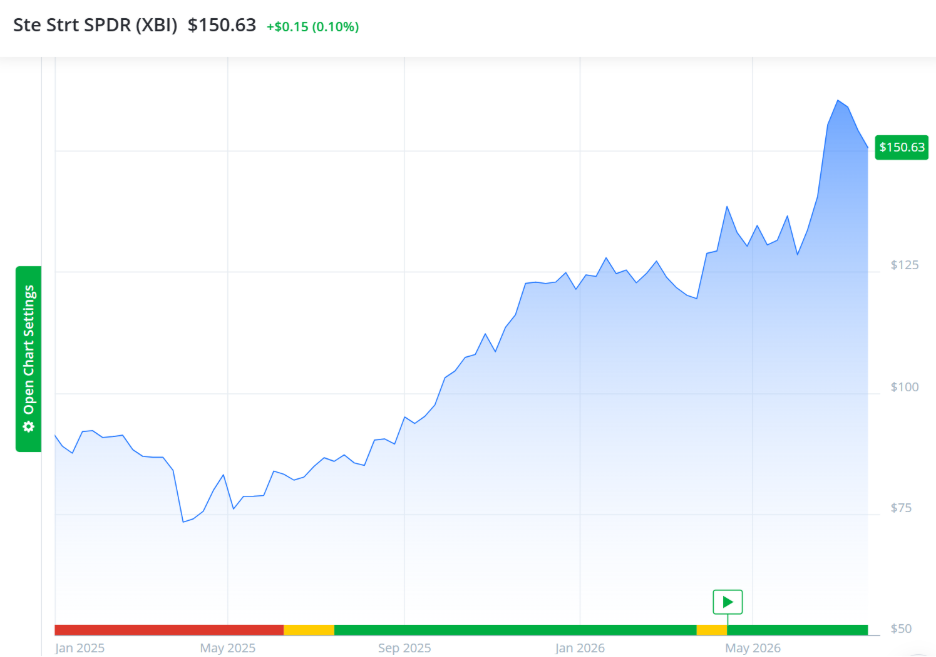
Instead, you can keep it simple and buy shares in the State Street SPDR S&P Biotech ETF (XBI), which holds an equal-weight basket of biotech stocks.
This is a theme we’ve been writing about regularly.
AI is compressing the traditional drug-discovery timeline – which before took 10 to 15 years and cost upward of $2 billion — by helping companies design and test drug candidates far faster than conventional R&D allows.
The result is the potential for new, breakthrough medicines at a pace never seen before. Investors have been bidding up the biotech sector in excitement. And our systems called it early.
See how it shifted from Red, to Yellow, to Green between June and July of last year? Since that Green signal, the ETF is up more than 76%.
And as long as XBI stays green, it’s a buy.
To building wealth beyond measure,
Michael Salvatore
Editor, TradeSmith Daily