The Best “Bio-Intelligence” Deal in the Market
Listen to the audio version of this article (generated by AI).
In This Digest:
• Novo Nordisk is down 70% from its highs – our AI model sees a bounce coming
• A tiny robotics ETF just flashed Green, so it’s time to take a closer look
• These seven signal studies are bullish on this nuclear stock
Time to buy this left-for-dead “bio-intelligence” stock…
Novo Nordisk (NVO) is the unsung hero of one the biggest themes on our radar right now: bio-intelligence.
As our CEO, Keith Kaplan, laid out in these pages recently (catch up here and here), it’s the emerging trend of using AI to read our bodies to cure diseases and slow aging.
That makes sense when you think about how our bodies work at a fundamental level. Keith said:
Our bodies run on information – in our DNA plus a constant stream of chemical messages our cells trade every second we’re alive.
A lot of what we call disease, and of what we call aging, is that information going wrong. What’s new is that we can finally read that code, copy the messages the body sends, and even write new ones and hand them back.
What Novo Nordisk has done is the perfect example of bio-intelligence at work. It turned an obscure gut hormone, the glucagon-like peptide-1 (GLP-1), into one of the most profitable drug classes in history.
GLP-1 isn’t a drug discovered in a lab. It’s a message our own bodies already send.
After a meal, our gut releases GLP-1 to tell our brains we’ve had enough. The signal fades within minutes. GLP-1s are near-copies of that message, redesigned to last for days.
Novo Nordisk is the maker of Ozempic and Wegovy – drugs that brought in over $32 billion in revenue in 2025.
But it didn’t pay off in its share price.
At its 2024 peak, Novo was the most valuable company in Europe. Today the stock sits more than 70% below those highs.
Competitor Eli Lilly (LLY) developed a competitor drug, tirzepatide, which beat Novo’s CagriSema in a head-to-head trial back in February. That spurred a slide of nearly 40% from its peak in late January to today.
The bear case is that Lilly’s drug works better, Novo’s pipeline keeps disappointing, and key patents start expiring in the early 2030s.
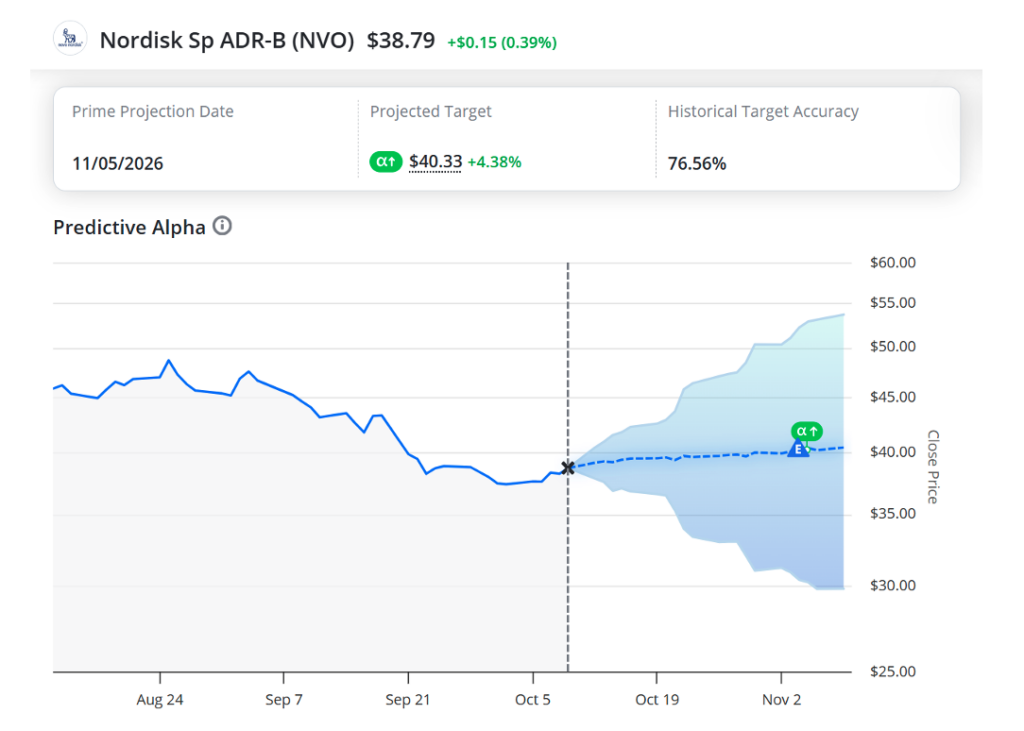
But according to our Predictive Alpha forecasting engine, it’s a promising short-term trade.
NVO is a buy according to our AI…
Predictive Alpha uses the same kind of AI that powers ChatGPT and Claude to crunch years of data to forecast stock moves up to 21 days out.
Similar to how ChatGPT reads reams of text to learn how to predict the next word in a sequence, Predictive Alpha predicts the next number in a sequence of data.
And right now, it’s forecasting a 4.4% gain by Nov. 5 – with a historical target accuracy of 76.6%. In other words, about 3 in 4 forecasts have panned out.
If you want to play the bio-intelligence boom that Keith sees coming, this short-term trade is a great way to do that.
This corner of the robot economy is heating up…
For decades, factory robots were simple machines. They were bolted to the floor and did one job, like welding the same seam on the same car door, over and over.
That’s changing fast.
Thanks to AI, robots can now see what’s in front of them, learn new tasks, and make decisions independently. That means they can do far more than repeat one motion. Hook enough of them together, and you get a “smart factory.” That’s a plant where machines handle most of the work and software runs the show.
Some already run with almost no people at all. At a FANUC plant in Japan, robots build other robots… about 50 a day. The lights stay off because nobody needs them.
This shift is already big, and it’s growing. There are now a record 5 million robots working in factories worldwide. The International Federation of Robotics expects installations to rise another 9% this year.
And our data says the market is taking notice.
Last Thursday, the ProShares S&P Kensho Smart Factories ETF (MAKX) flashed a fresh Short-Term Health Green signal. MAKX holds a basket of companies building these automated factories. Green means the trend is healthy, and buyers are in control.
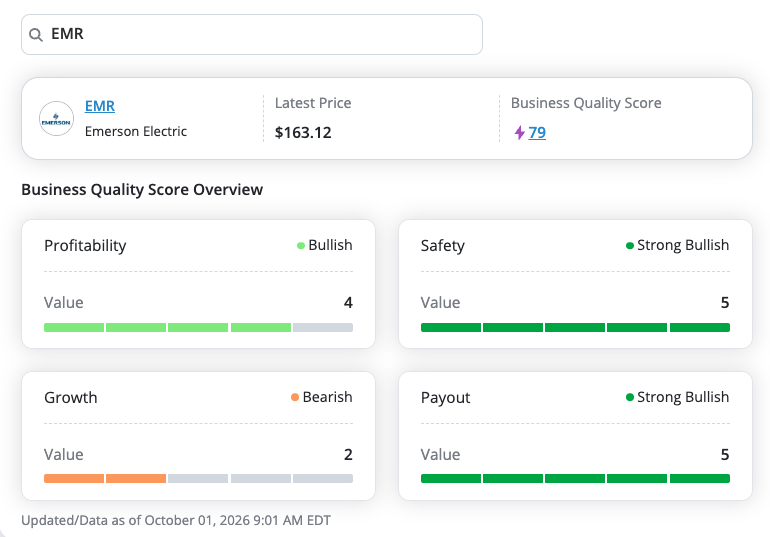
One of the best ways to play this trend is Emerson Electric (EMR).
Emerson builds the control systems and software that run factories, power plants, and chip plants. If you want a factory that runs itself, you need something like Emerson’s systems to run it.
Emerson is Green on both Short- and Long-Term Health. It also scores 79 on our Business Quality Score, our 0-to-100 grade on a company’s financial strength.
And the business backs up the signal. Last quarter, Emerson’s orders rose 7%. Orders from chipmakers for its testing gear, the tools that ensure new chips actually work, jumped 70%.
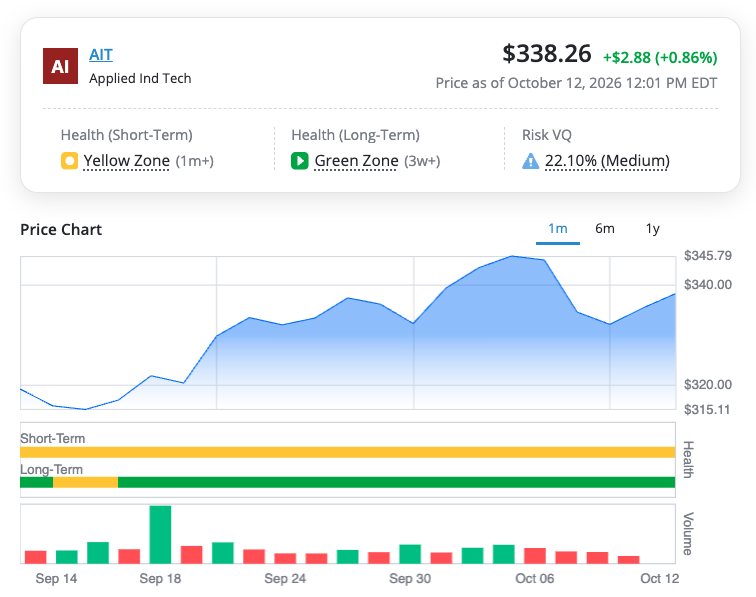
The one to watch next is Applied Industrial Technologies (AIT).
AIT sells and services the motors, pumps, valves, and automation parts that keep production lines moving. Its automation sales just grew more than 20% from a year ago… its best showing in four years. Management says customers are adding robots and machine vision, cameras that let machines “see” what they’re working on.
Right now, AIT is in a Short-Term Health Yellow Zone after a recent pullback. That’s our signal to be cautious. But it’s worth a spot on your watchlist for when it flashes a fresh Green signal.
If you’re a paid-up subscriber, pull up MAKX’s full list of holdings on TradeSmith Finance and sort by Short-Term Health. Emerson isn’t the only name in the basket quietly gathering steam.
Keith found something rare buried in our own software…
Here’s your regular reminder to follow Keith on X, where he posts daily.
He recently built seven separate signals inside our Signals software for Constellation Energy (CEG) – all of them pointing toward a rally.
You can see his full breakdown here.
Signals is TradeSmith’s AI-powered pattern-detection system. It’s looking for unique alignments of factors in a stock’s historical data that have typically preceded big moves. Then it flags when those patterns reappear.
It also lets you backtest your own custom signal studies — like Keith used here.
One study that really stood out to me was what happens when CEG’s 2-day Relative Strength Index hits 95 or above, indicating a big surge in short-term momentum:
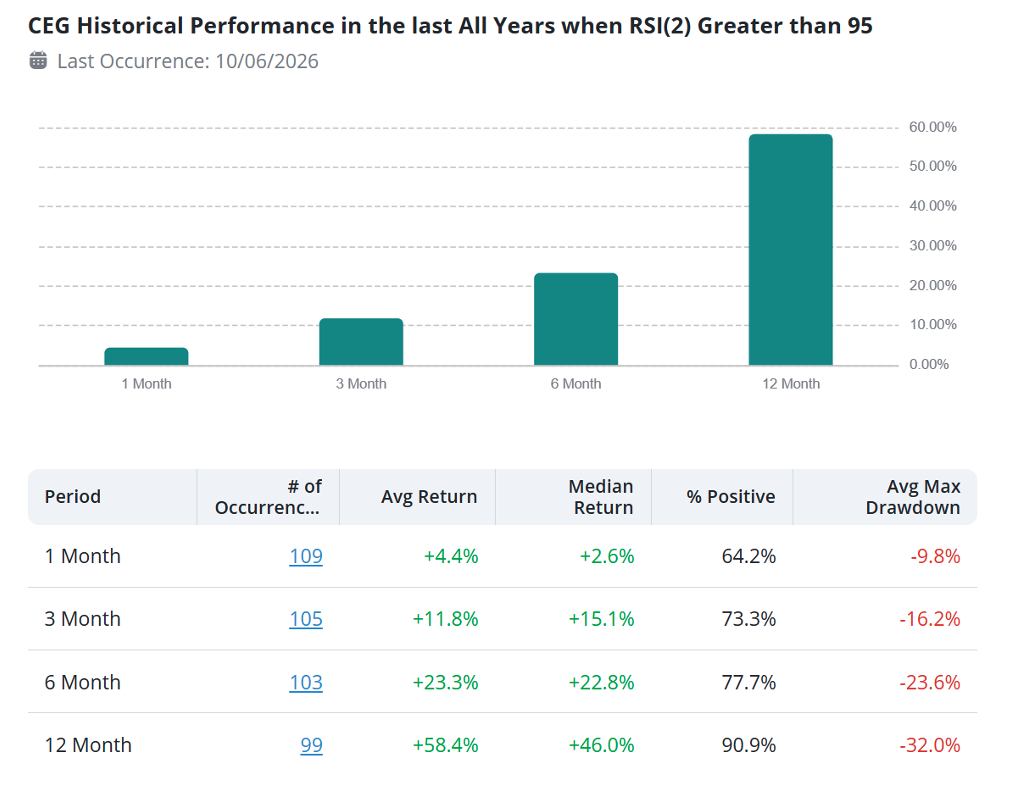
This has happened with CEG 99 times going back to 2022. Over the following 12 months, CEG was higher 90.9% of the time, with an average return of more than 58%.
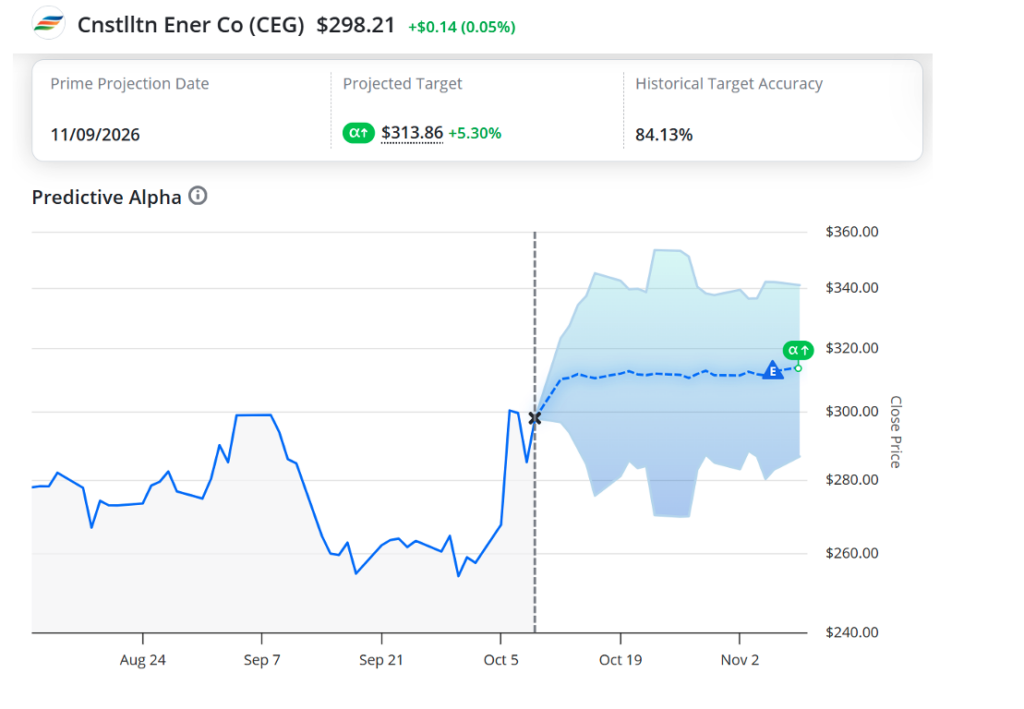
Predictive Alpha is also calling for CEG to climb to $313.86 by Nov. 9 – a 5.3% move from here – with a historical accuracy rate of 84.1% on this ticker.
The recent momentum in this major nuclear energy stock isn’t a huge surprise.
Nuclear power is the clearest way to scale the electricity AI data centers need without waiting a decade for new transmission lines to get built, and Constellation is the largest nuclear operator in the country.
Seven technical studies firing at once doesn’t happen without a reason – and right now, the reason on the table is the biggest buildout in the power grid’s history.
Add CEG to your watchlist here. If you’re a paid-up subscriber, pull up the Signal Study Builder tool on TradeSmith Finance and run CEG’s conditions yourself – then see what else is stacking up the same way.
And if you don’t already follow Keith on X, do it now @KeithTradeSmith – he posts his highest-conviction setups there first, often before they make it into these pages.
To building wealth beyond measure,

Michael Salvatore
Editor, TradeSmith Daily