Listen to the audio version of this article (generated by AI).
In This Digest:
- You have no edge in the Anthropic IPO. Trade this instead – and use our AI signals system free until 10 a.m. Wednesday
- AI is writing more of the world’s code, and hackers are booby-trapping it. This stock gets paid to stop them
- Gold just sold off like it lost its CEO, but Jeff Clark says it’s time to buy
Will you trade this trillion-dollar AI IPO?
On Thursday morning, Anthropic – the company behind the Claude AI chatbot – is expected to start trading on the Nasdaq under the ticker ANT.
It’s set to be one of the biggest IPOs of all time, with the company expected to go public at a roughly $1 trillion valuation.
By the fourth day of its roadshow – the stretch when a company pitches its shares to big investors – orders had reached about six times the number of shares on offer.
Come Thursday, you’re sure to hear plenty of confident calls about where ANT goes next.
But if you ask us here at TradeSmith, we’re confident saying those calls are all no better than guesswork.
Nobody knows how this stock behaves. There’s no record of how it reacts to a rough day for tech, a hot inflation report, or a selloff in chipmakers – all things we’ve seen in just the past two weeks.
And there are thousands of other stocks out there with years, if not decades, of trading data behind them.
Why does that matter?
Because you can find “tells” in those stocks trading data – combinations of factors that, when they align, have typically preceded moves higher. And you can trade those signals.
That’s what our Signals software does. Using machine learning, it’s found 3,000 of these tells and lets you know what happened after each one for more than 2,400 stocks. And some of them have historical accuracy rates of 90% or more.
Take the bullish signal that fired today on enterprise software maker Atlassian (TEAM):
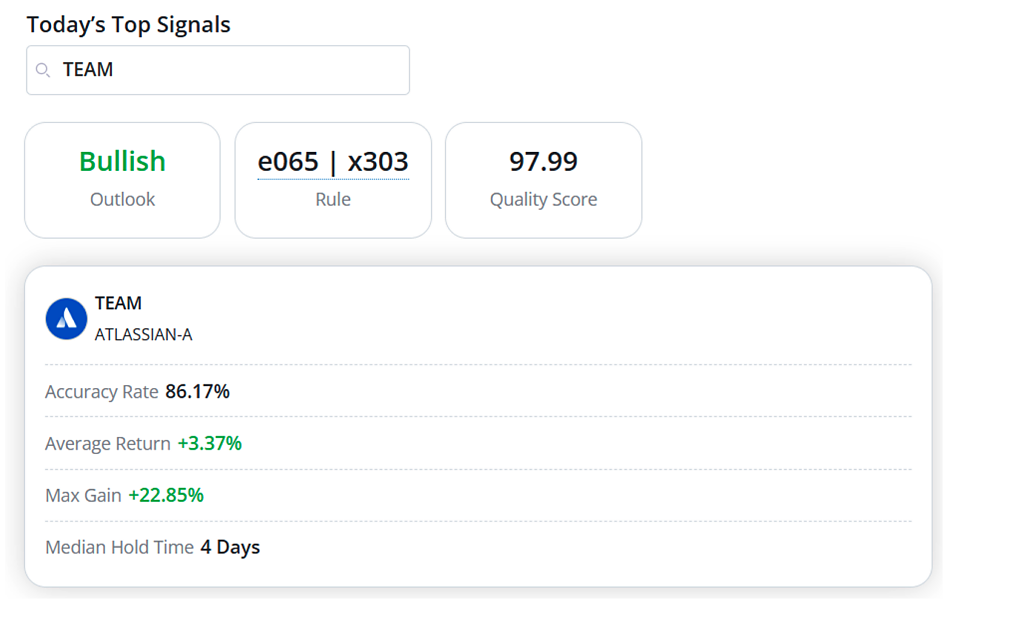
This signal fires when a stock takes a quick dip amid a powerful longer-term uptrend. For TEAM, it’s fired four times in the last year… and 94 times in the last decade.
And on average, it’s returned 3.4% with a median hold time of four days. It’s been accurate more than 86% of the time. And one of its strongest wins approached 23%.
You also get a Quality Score for each trade setup. This uses a second AI model to grade each signal based on the kind of broader market conditions we’re seeing. The higher the score, the stronger the signal.
So instead of trading a new IPO in a market it’s never been through… you can trade a stock with plenty of evidence behind it that’s been through volatility in the past.
To take advantage, you want to buy and hold TEAM until you see that short-term pop of 3.4% or for the next 21 trading days – whichever comes first. After that, you close the trade and move on to the next signal.
You can see for yourself how it works by test-driving our software. You’ll get immediate access when you sign up for our AI Signals Trading Event tomorrow, November 18, at 10 a.m. ET.
At the event, our CEO, Keith Kaplan, will walk you through how this trading system works… he’ll pass along the name and ticker of the stock with the strongest bullish pattern in our system today… and a popular stock it says to stay away from heading into Thanksgiving.
You’ll also see what happened when our chief quant Mike Carr put his own money into a stock he knew nothing about.
To unlock free access to Signals until 10 a.m. ET Wednesday and to save your seat for the event, register here.
AI is writing more of the world’s software – and some of it is booby-trapped…
You no longer need to be a programmer to build an app.
Today, people with no coding background describe in words what they want to build, and an AI model writes the code for them. It even has a name: vibe coding.
But very little software is written from scratch. Most of it is assembled from building blocks called packages – free, ready-made pieces of code that strangers write and share online.
AI coding models are happy to recommend their users download these packages. And in the case of autonomous agents, they might even download these packages for them.
Hackers have noticed.
AI models sometimes recommend packages that don’t exist. So attackers register those made-up names and fill them with malicious software. The next time an AI suggests that package, the unsuspecting user downloads the trap.
It’s one part of a fast-growing problem. Over the past year, security researchers found 177,000 new malicious packages across the big online libraries of free code. On NPM, one of the largest, the count of malicious packages rose 451%.
We’ve been drawing your attention to the cybersecurity theme for months. As AI writes more of the code we all rely on, somebody has to check it before it ships.
That’s what JFrog (FROG) does.
Its platform is where companies store, track and scan the building blocks that go into their software – catching malicious or vulnerable code before it reaches end users.
And business is booming. In the third quarter, revenue climbed 31% to $179.2 million. The number of customers paying JFrog more than $1 million a year jumped 58% to 112.
The market likes what it sees. JFrog entered a Short-Term Health Green Zone on May 15, when it traded at $66.16. It has stayed Green ever since and now trades at $110.90 – a 67.6% gain. Green means the trend is healthy and buyers are in control.
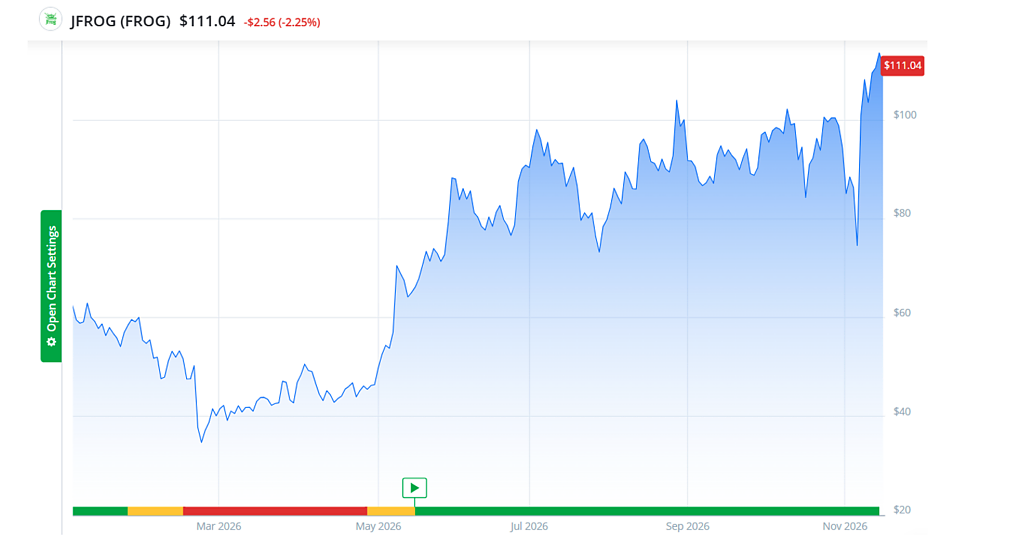
Our Quantum Score agrees. It rates stocks from 0 to 100 on two things: the strength of the business and how strongly big investors are buying. JFrog scores 84.6. Anything above 75 is a buy. Its Fundamental Score of 77.0 shows a solid business. Its Technical Score of 90.0 shows buyers firmly in control.
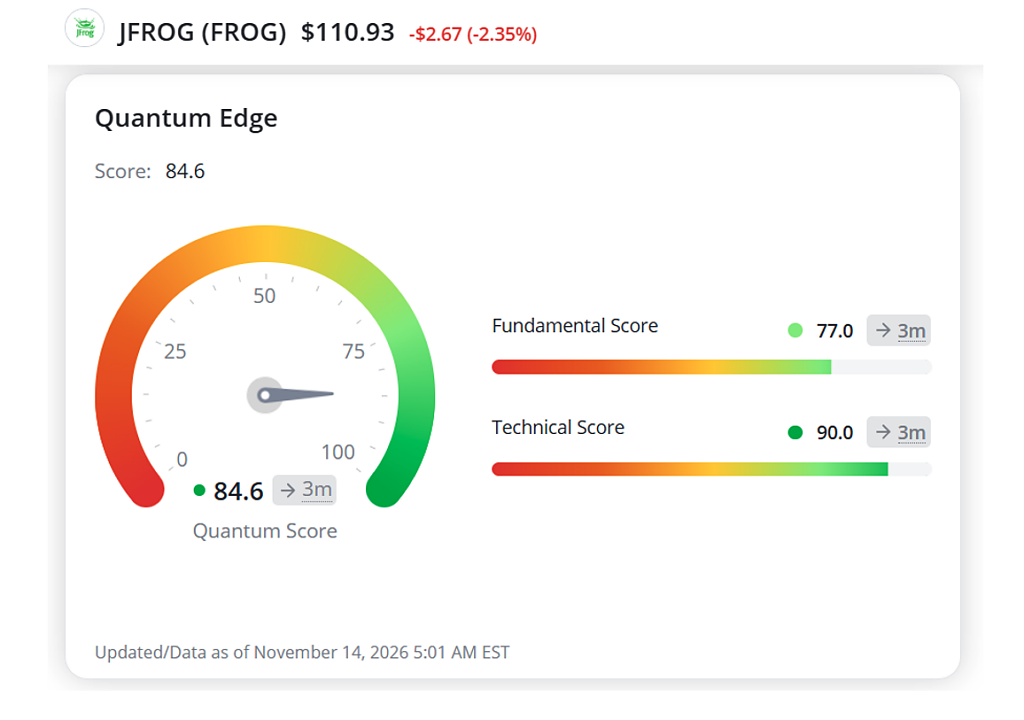
Consider buying JFrog as AI pushes more code out the door.
It’s a fast-moving stock, so size your position accordingly and keep a stop-loss in place.
If you’re a TradeStops subscriber, our software can help you pick one that keeps you in during the big swings and out when the trend changes.
Gold just got sold off as hard as NVDA, and Jeff Clark is buying…
Gold is supposed to be a safe place to hide when stocks get rough.
But not this month. Gold has been sold right alongside Nvidia and the rest of tech. At about $3,870 an ounce, it’s now roughly 28% below its January record price of approximately $5,400.
TradeSmith’s master options trader Jeff Clark sees an opportunity in that selloff. As he told his Jeff Clark Trader subscribers yesterday:
While everyone seems to be wondering if they should be buying [Nvidia] during its current scandal-ridden decline, they ought to consider buying gold instead.
Jeff’s case is simple. Gold mining stocks are setting up the same way they did in July. Back then, the VanEck Gold Miners ETF (GDX) went on to rally 50% in about six weeks.
And Jeff likes the miners more than the metal. Gold stocks tend to move further than gold itself, and they tend to move first. His target for GDX is its September high, just above $100. That’s more than 22% above Friday’s close.
The largest stock in that fund is setting up, too: Newmont (NEM).
Newmont is one of the most tightly converged stocks in our system right now. That’s based on an indicator Jeff built himself. It tracks three moving averages – a stock’s average price over different stretches of time. When the three lines bunch tightly together, the stock is coiled like a spring. And when the price breaks free, the move tends to be fast.
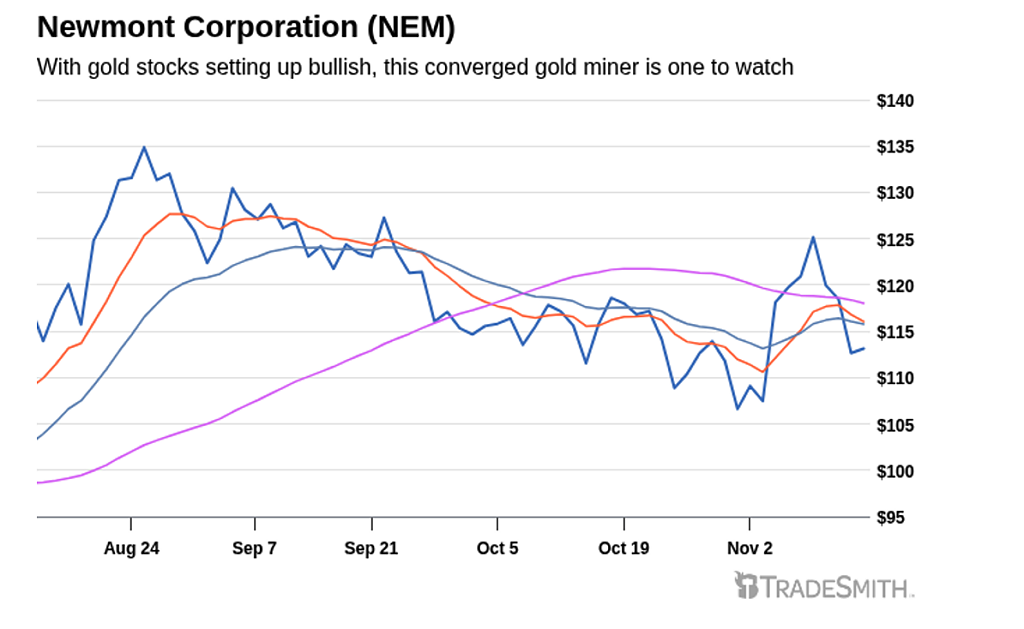
Newmont’s three lines have pinched together between $115 and $120 a share. Jeff’s bullish read on gold tells you which way he expects that spring to release.
Put Newmont on your watch list and watch for a close above $120. That’s the breakout signal. If you’d rather own the whole group, consider buying GDX instead.
To building wealth beyond measure,
Michael Salvatore
Editor, TradeSmith Daily