

Pullbacks don’t have to be painful. In fact, they can be profitable, if you know where to look.
As I pointed out last time, stock market breadth has turned bad.
Sure, the S&P 500 Index just notched new highs, but beneath the surface, most stocks are in downtrends.
In fact, 75% of New York Stock Exchange (NYSE) stocks were below their 50-day moving averages at the start of this week. Stocks above this key trend line are considered to be trending higher, while those below it are trending lower.
So, three-quarters of the NYSE stocks are in downtrends right now.
That may sound like bad news. But this kind of weakness could also be setting up the next big buy-the-dip opportunity.
I covered one of our proven indicators in my last column that can help you do this: Wait patiently for a stock or ETF to give you a “flash buy” signal.
That happens when the symbol moves back into the Health (ST) Green Zone.
But TradeSmith also provides dedicated trading strategies to help you buy-the-dip with confidence.
Here are two of my personal favorites.
Find Stocks with Snapback Potential
When the stock market trend – long or short term – turns up or down, it’s difficult to say how long it will last without the benefit of 20-20 hindsight.
But a market pullback could also prove to be a great buy-the-dip opportunity. And if that’s the case, we have a strategy that’s got you covered.
Our TradeSmith Strategies page is chock full of proven, short- and long-term trading and investment systems, and one of them is specifically geared for buying the dip.
Our Snapback Strategy is a rules-based approach designed to capitalize on volatile market conditions like the ones we’re seeing now.
We analyze short-term moving average divergences, along with historical price comparisons, to help pinpoint oversold stocks that are likely to deliver a quick rebound.
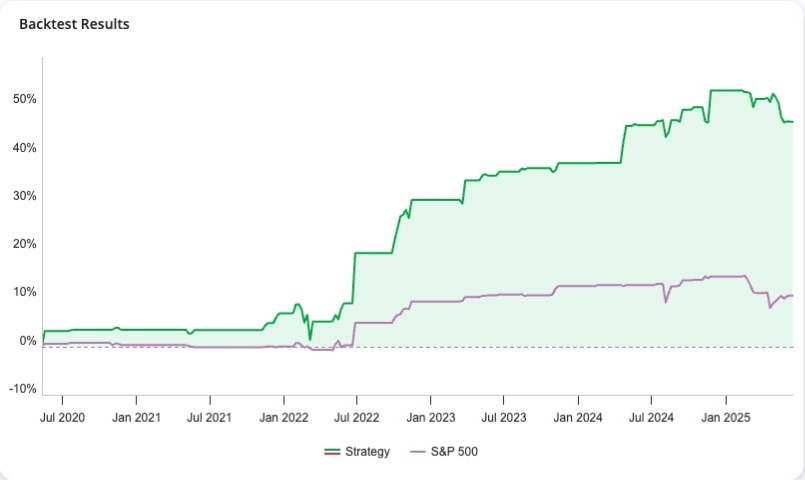
We backtested the Snapback strategy on the S&P 500 going back 10 years.
As you can see above, Snapback outperformed the S&P by more than 4-to-1 over five years. The average return – counting both wins and losses – was about 16%!
Here’s what that looks like in practice: When markets pulled back sharply in April, our TradeSmith system triggered a Snapback buy signal on April 14, 2025 in oil and gas giant Devon Energy (DVN).
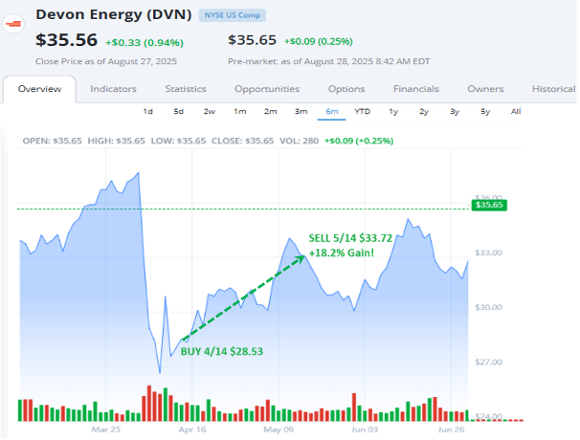
If you had acted on this signal, you could have grabbed gains of about 18% in just over 20 trading days. That’s exactly the kind of opportunity this strategy is designed to capture in volatile markets.
And the easiest way to access our Snapback Strategy signals within TradeSmith is to click on Invest, then select Strategies from the sub menu, as shown below.
Next, simply scroll down through our exclusive lineup of TradeSmith strategies to find Snapback.
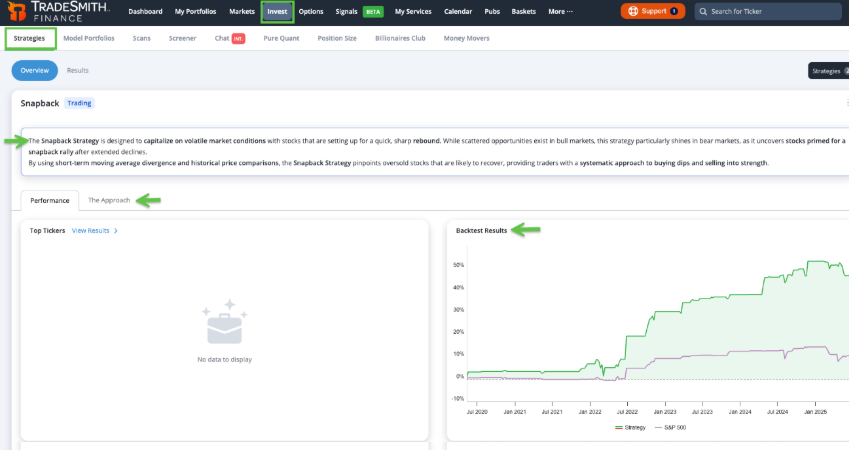
The backtest results are displayed at right, and the top current results are shown on the left.
You can also click on View Results at the top left to see details about stocks that qualify for the strategy in our Screener view. As you can see, there is currently no data to display, because no stocks qualify for the Snapback strategy today.
That’s actually the strategy working as it should – waiting for the right setup so you don’t chase trades that aren’t ready to pop.
So, be sure to check the Strategies page frequently – I do it every day. When market results are mixed, with lots of stock in downtrends as they are now, new Snapback results could show up on any given day.
This strategy – and our other TradeSmith Strategies – can deliver a powerful tactical edge for your trading and investing, especially in volatile markets.
Spot Oversold Stocks with Bollinger Bands
Another valuable strategy you’ll find on the same page is our Bollinger Bands strategy.
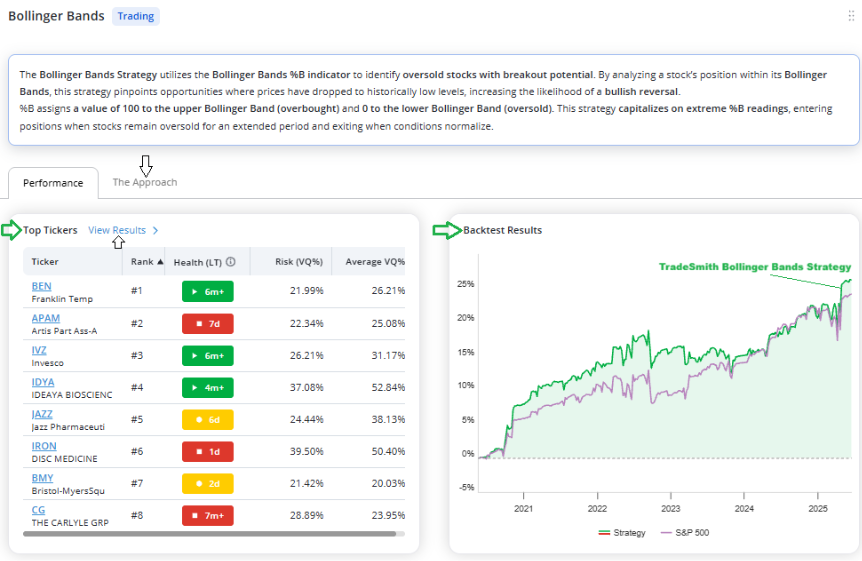
As you can see above, this strategy has also outperformed the S&P 500 Index based on our extensive backtests. It’s based on the popular technical indicator of the same name, developed by John Bollinger.
Similar to the Snapback strategy, our Bollinger Bands strategy aims to uncover oversold stocks with upside potential.
By measuring a stock’s position within its Bollinger Bands, we can pinpoint opportunities where its price has dropped to historically low levels, increasing the odds of a bullish move higher.
You can see all the details behind this strategy, and all our others, by simply clicking on The Approach tab.
Currently, several stocks match our Bollinger Band Strategy that you can consider for trades. The top-ranked matches are shown below.
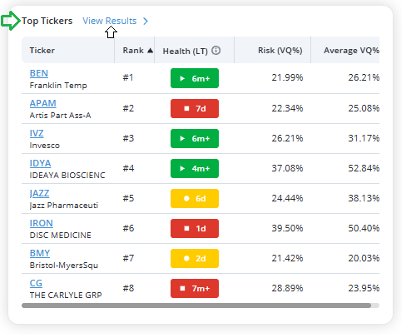
You can also click on View Results to see details on even more stocks that qualify for this strategy in our Screener view. From there, you can add your favorite Screener filters to narrow your results.
For instance, from the Screener view, I clicked + Add Filter to include our Health (Short-Term) filter and set it for Green Zone only.
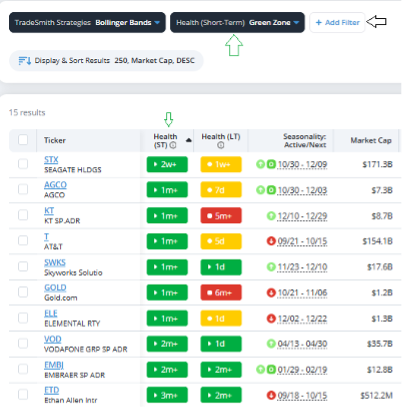
This narrowed the list down to 15 results. All stocks that qualify for both the Bollinger Bands Strategy AND are rated Health (ST) Green in our system.
Many of the stocks in the list above triggered “flash buy” signals within the past month.
And that gives me extra confidence these stocks are good potential rebound candidates!
Mike Burnick’s Bottom Line: Markets can deteriorate quickly and rebound just as fast these days. That’s why you should check our Invest > Strategies page every day. These trades can come quickly when market conditions shift. And you can easily aim to capitalize on brief pullbacks with our Snapback and Bollinger Bands strategies, because both are tailor-made for buy-the-dip opportunities.
P.S. Our Snapback and Bollinger Bands strategies are built to help you profit from pullbacks. But what if the next drop goes even further?
Right now, the market feels unstoppable. Yet weak breadth beneath the surface is a reminder that conditions can change quickly. That’s why TradeSmith CEO Keith Kaplan is sounding the alarm. He’s identified nine cracks he believes could hit the market at the same time and bring this bull run to an end.
He’s revealing what those cracks are, how to protect your portfolio, and how to position your money to potentially capitalize on the gains along the way.
Find out what they are – and how to prepare before it’s too late.