Five AI Chokepoints Flow Into This One Stock
Listen to the audio version of this article (generated by AI).
In This Digest:
- This company makes the foundations of every AI datacenter, and our systems are flashing buy.
- Our signal studies expert called the software bottom in February. And this beaten-down stock has a huge projected move ahead.
- The next big buildout is starting in “Tactical AI.” Here’s one smart idea.
The $700 billion AI buildout is hitting a wall…
As our CEO, Keith Kaplan, has been laying out in his Friday Dailys (catch up here and here) this year, four big tech companies — Microsoft, Google, Amazon, and Meta — will spend $700 billion this year on building out the physical backbone of AI.
And next year, that figure is set to hit $1 trillion.
It’s the largest sustained surge in spending in the U.S. since the end of World War II. If you’re not thinking about it as an investor, you’re ignoring the most powerful force in the market today.
But here’s the part the headlines miss: The money is moving faster than the physical world can absorb it.
This has created five major chokepoints in the AI supply chain:
- High-bandwidth memory chips that feed AI processors data fast enough to keep up.
- Silicon photonics that replace copper wiring with pulses of light.
- Power conditioning equipment that turns high-voltage transmission lines into clean power a data center can use.
- Liquid cooling systems that keep AI chips from melting under load.
- And the grid construction companies that physically connect the buildings to power infrastructure.
And Keith has been recommending ways to play each one.
Today, we’ll look at an additional layer that brings these five areas all together.
You see, someone has to build the systems that all five of those chokepoints flow into.
These are the server units that house Nvidia’s AI chips, link them together, route power to them, and keep them from overheating.
When a cloud giant like Microsoft or Google orders AI computing power, they’re not buying loose chips and assembling them in a warehouse. They’re buying complete, ready-to-run server systems.
That’s where Super Micro Computer (SMCI) comes in.
Think of SMCI as the final assembly line for the entire AI infrastructure boom.
Every chip Nvidia makes, every data center Microsoft builds, every AI model Google runs — most of it passes through a Super Micro server at some point.
And Short-Term Health – the most sensitive momentum signal in our system – just turned bullish on it.
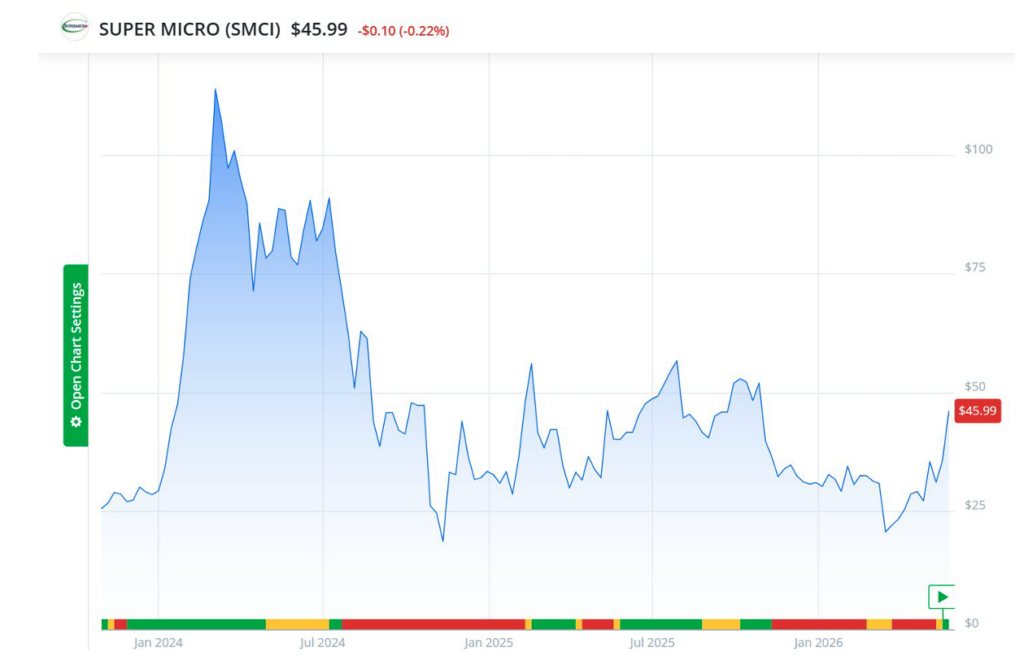
SMCI entered a Green Zone on May 19. Since then, the stock is up more than 50%.
And kudos if you’re a Trade360 member who has access to our newly launched Chaikin Flash S&P 500 Portfolio. From the May 22 recommendation in the new portfolio, SMCI is already up 31.3%.
Congratulations if you bought the software bounce…
In early February, bearish AI disruption narrative around software stocks reached a fever pitch.
After the release of new advanced coding AI models, investors started to worry that software-as-a-service (SaaS) stocks were going to die off. After all, if you have your AI model spin up some new enterprise software for a fraction of the price you pay to a SaaS provider, why keep paying for those expensive services?
ServiceNow (NOW) was down more than 40%. Atlassian (TEAM) had shed 44%. Even Microsoft – one of the most fundamentally sound businesses on the planet – had dropped 17% in three months.
The prevailing narrative was that AI tools would make traditional software companies obsolete.
But Lucas Downey, editor of TradeSmith’s Alpha Signals service, looked at the same wreckage and saw something different.
If you don’t know already, a signal study scans a stock’s unique history, identifies every past occasion when identical conditions occurred, and records what happened next.
In your Feb. 11 Daily, Lucas published a signal study on IGV – the iShares Expanded Tech-Software Sector ETF, which holds large positions in Microsoft, Palantir, Adobe, AppLovin, and other major software companies.
IGV had just hit a Relative Strength Index (RSI) level of 14. That’s a deeply oversold reading and was its lowest in over 20 years.
Lucas had found only six days in history when IGV’s RSI fell to 17 or lower. Every single time, IGV was higher three and six months later.
He said at the time:
These two signals suggest the selloff has gotten ahead of itself. Rarely has software been so oversold or bounced so hard out of such a state.
The chart below – from that Feb. 11 issue – shows what history said to expect:
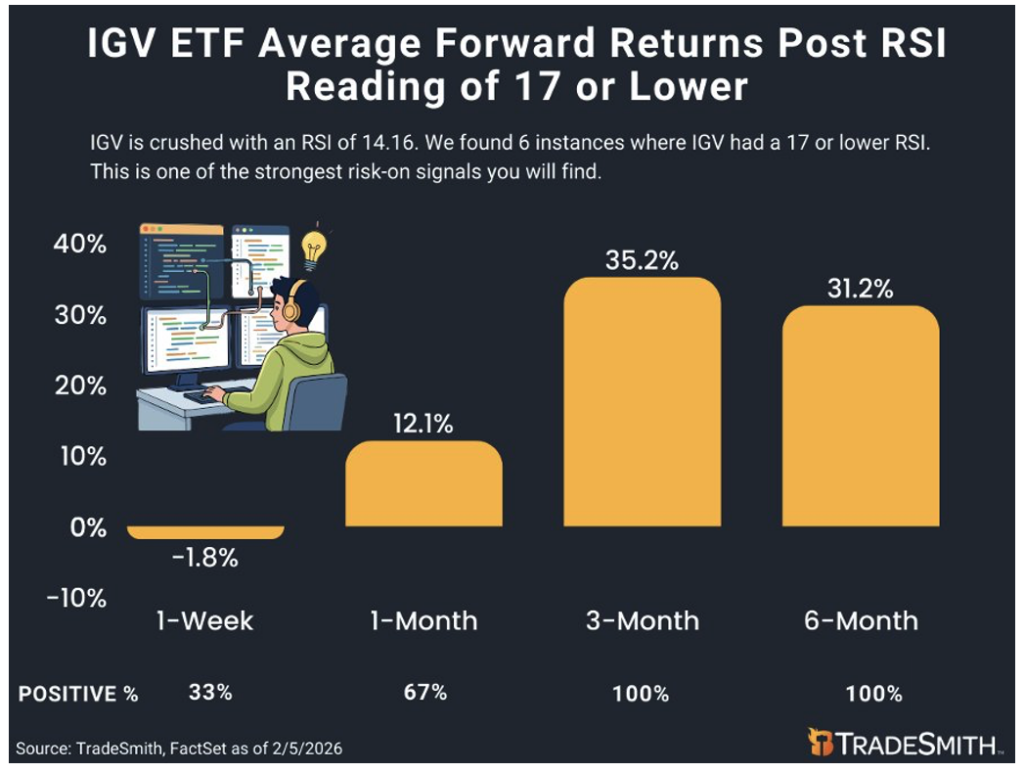
IGV closed at $82.23 the day Lucas published that call. It closed Friday at $101.66. That’s a gain of 23.6% in less than four months – right in line with the +35.2% three-month average his study projected, and still with time on the clock.
The recovery isn’t just showing up in the ETF. Our theme breakout screen – which looks for stocks with a strong Fundamental Quantum Score trading at a 1-month high – is now lighting up across the software sector.
Three companies are leading the charge:
- Datadog (DDOG) – cloud infrastructure monitoring software up 87.1% in the past month
- ServiceNow (NOW) – IT workflow service up 40.8% in the past month
- GitLab (GTLB) – software development platform up 40.2% in the past month
These businesses all have strong fundamentals and got caught in the forced selling Lucas identified. Now, they’re recovering — fast.
A new boom is underway in “Tactical AI”…
The U.S. Army has deployed thousands of AI-powered drones to find and destroy incoming Iranian kamikaze drones – drones that crash into targets to blow them up.
And it’s committed to buying up to 1 million new drones over the next two to three years.
So it’s no wonder why companies that make AI-powered warfare actually function in the field have been lighting up on our new emerging trend screen.
- Leonardo DRS (DRS) – AI-enabled sensors, targeting systems, and electronic warfare equipment.
- StandardAero (SARO) – the largest independent aircraft engine maintenance and overhaul provider in the U.S.
- Rolls-Royce (RYCEY) – builds engines that power the aircraft the rest of the stack serves.
- V2X (VVX) – the AI logistics, cyber operations, systems integration, and mission support layer that keeps Tactical AI units operational across 47 countries.
This last company deserves special note.
Because our Short-Term Health indicator first flagged VVX on July 21, 2025 at $48.47. From that entry to Friday’s close of $84.10, VVX has gained 73.5% in less than a year.
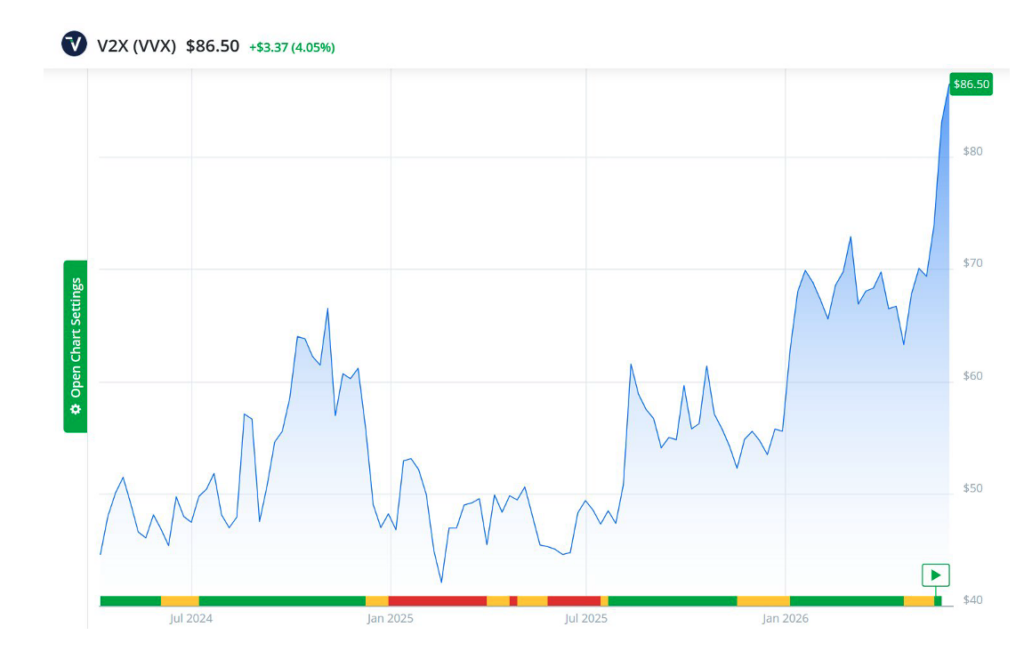
As you’ll notice above, VVX dipped into two Short-Term Health Yellow Zones – December 2025 and just recently, in early May.
Short-Term Health Yellow Zones are caution zones – not exits. They’re an early warning sign that a high-momentum trend is at risk of shifting. But VVX kept running after these Yellow Zones.
Now it’s fired green again, driven by two things converging at once:
- The Q1 earnings blowout, with revenues up 23% year over year, earnings up 55% – both trouncing estimates
- And a fresh Navy contract to integrate aircraft survivability systems onto Marine Corps aircraft.
The original signal is up 73.5%. But the new green signal is a fresh entry point into the same big idea.
The commercial AI buildout is the story everyone is following. The Tactical AI buildout is the one our screen found first.
Stay tuned to these pages for more ideas on this key emerging theme.
To building wealth beyond measure,
Michael Salvatore
Editor, TradeSmith Daily