SpaceX Is Now an AI Landlord
Listen to the audio version of this article (generated by AI).
In This Digest:
- Three of the biggest names in AI are now paying SpaceX billions to rent its data center
- After this week’s chip rout, our AI model’s most accurate forecast says buy the dip
- Wall Street’s “widow-maker” trade is waking up – here’s what our master options trader is watching
SpaceX is quickly becoming the go-to company for AI computing power…
On Monday, an Nvidia-backed AI startup called Reflection agreed to pay SpaceX $150 million a month.
Not for rocket launches or satellite constellations. This deal has nothing to do with the space part of SpaceX’s business.
Starting July 1, Reflection will rent compute – AI processing power – from SpaceX’s Colossus AI data center near Memphis, Tennessee. If the deal runs its full term through 2029, it’s worth about $6.3 billion.
And Reflection isn’t even SpaceX biggest AI compute client. Anthropic – the company behind the Claude AI model – is paying SpaceX roughly $1.25 billion a month for the same service. And Google is paying an additional $920 million a month.
Add in Reflection, and that’s more than $2.3 billion a month flowing into SpaceX for its AI computing power.
This is just more evidence of the biggest investment theme underpinning AI.
The four biggest U.S. tech companies – Microsoft, Google, Amazon, and Meta – are on track to spend more than $700 billion this year building the physical infrastructure to make AI possible at scale, a figure headed toward $1 trillion by 2027.
But the world can’t make high-bandwidth memory chips, networking kits, power inverters, cooling systems, and power infrastructure fast enough.
The SpaceX deals – and the eye-watering sums the companies are paying it for access to its data center – are more proof that these AI chokepoints matter.
This week, we’ve seen one of those chokepoint trades pull back…
A wave of selling in memory-chip stocks knocked Micron Technology (MU) down more than 10% and dragged the tech-filled Nasdaq 100 down 2.2%.
We also saw a major wobble in the South Korean stock market – heavy with memory chip stocks SK Hynix and Samsung. It fell hard enough to trigger an emergency “circuit breaker” to slow the selling. And Taiwan – home to chipmaker TSMC – dropped, too.
But demand for AI computing isn’t cooling off, even if some of the stocks that make it possible are.
If you missed our CEO Keith Kaplan’s breakdown of the five AI chokepoints – and the stocks set to benefit – he laid it all out here and here.
The AI infrastructure buildout has years to run, and companies that can solve chokepoints stand to benefit.
When you’re getting anxious about what we’re seeing in tech, keep those pieces close at hand so you can keep the big picture in focus.
Our AI trading model is buying the dip…
This morning, I pulled the Top Bullish forecasts from Predictive Alpha, our AI forecasting engine.
As regular readers know, it works like the large-language models behind ChatGPT, Claude, and Gemini – but instead of predicting the next word in a sentence, it predicts where a stock or ETF is headed next, trained on more than 100 billion data points.
For each one, it gives a target price, a target date, and how often its past calls on that ticker have proven right.
Even after today’s drop, the list is full of the AI buildout.
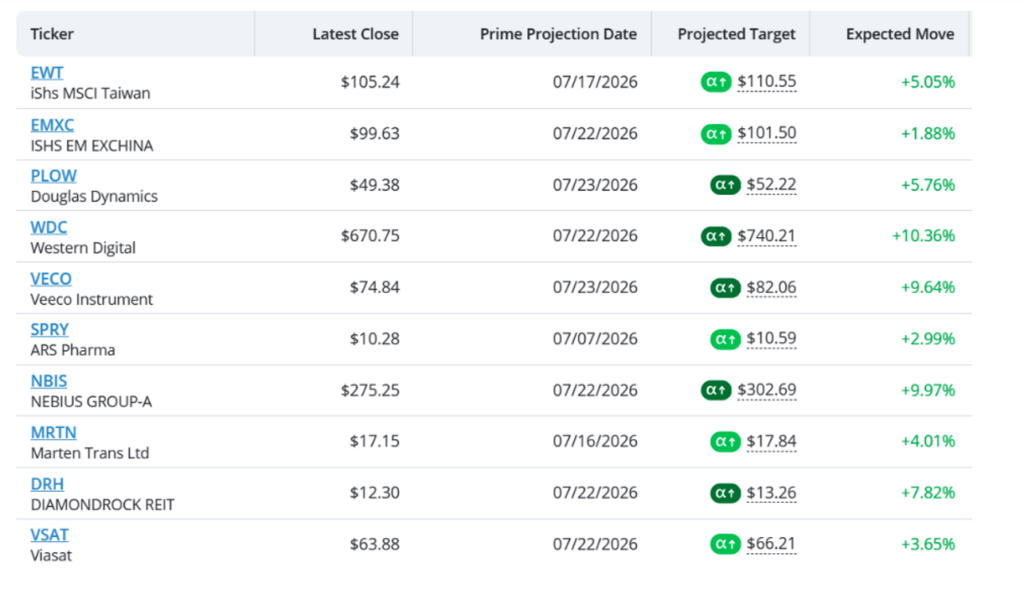
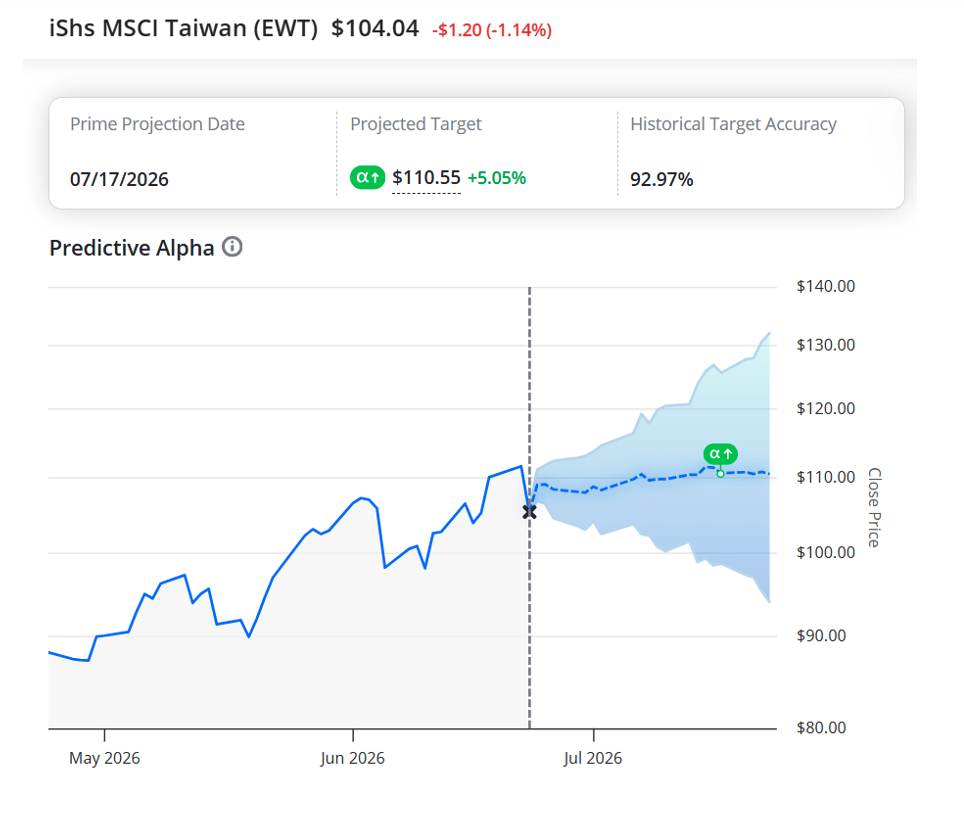
At the top of the bullish forecast list is the iShares MSCI Taiwan ETF (EWT). That’s one of the country ETFs that got smacked yesterday as Asian memory and semiconductor stocks sold off.
But our model expects it to climb 5.1% to $110.55 by July 17, with a 93% historical accuracy rate behind it.
And it isn’t the only AI bullish infrastructure trade Predictive Alpha is flagging:
- Western Digital (WDC) – makes the high-capacity drives that hold AI’s vast data libraries. It sold off with the rest of the memory group today, but our model forecasts a 10.4% rebound expected by July 22.
- Nebius Group (NBIS) – rents out AI computing power to companies training models. Our models see a 10% gain by July 22.
- Veeco Instruments (VECO) – builds the machines that manufacture advanced chips. Our model sees a 9.6% move higher by July 23.
With these forecasts in mind, today’s drop looks more like a shakeout than a top.
Finally, the “widow-maker” trade is waking up again…
There’s a reason natural gas earns its nickname the widow-maker.
According to our master options trader Jeff Clark, it’s notorious for being one of the hardest things on Wall Street to trade.
The price swings wildly, ignores the usual rules, rallies when it should fall, then falls when it should rally. Most people who try to trade it lose money.
But Jeff sees a clear opportunity in the chart of natural gas today. Take a look…
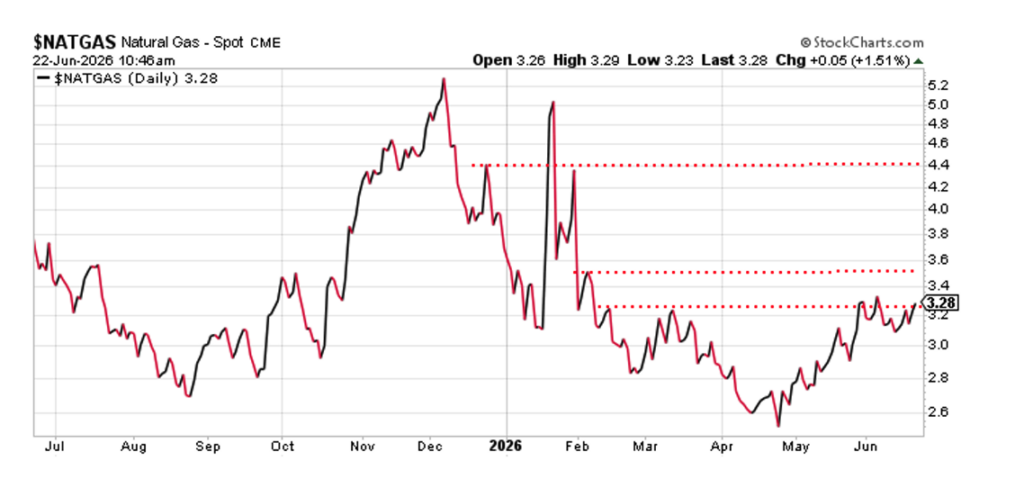
Natural gas bottomed in April. Since then, it’s climbed more than 20%.
For the past three weeks it’s been coiling in a tight range between $3.00 and $3.30 per million BTUs (British Thermal Units, the standard measure of energy content in natural gas) – the kind of pause that tends to store up energy for the next move.
Jeff says that if gas can push through a price ceiling near $3.50, the next stop is the February high around $4.40.
He’s quick to add it won’t be a straight line – this is the widow-maker, after all – but there’s a lot of fuel built up in that chart.
Jeff has been right on this trade before. Last August, with gas sitting near $3, Jeff flagged the same kind of snap-back setup. Over the next three months, natural gas rallied more than 80%.
Now, here’s why this matters even if you never trade natural gas…
A busier, stronger natural gas market is a tailwind for a group of stocks we wrote about last month – what we’ve been calling the AI Power Pipeline.
The AI data center boom is so power-hungry that companies like Microsoft and OpenAI are now plugging their facilities straight into natural gas plants rather than waiting on the grid.
All that gas has to be produced, moved, and burned – and the companies that do it stand to benefit.
We flagged three of them:
- ONEOK (OKE) – one of the country’s biggest natural gas pipeline operators (May 18)
- LandBridge (LB) – a Texas land company leasing out Permian acreage, sitting right on the gas, for data center campuses (May 19)
- GE Vernova (GEV) – the gas-turbine maker that powers many of these plants (April 28)
More demand for natural gas is a boon for this set of AI Power Pipeline stocks. Keep them on your watchlist.
And if you want to follow Jeff’s widow-maker trade as it plays out, he lays out his setups – entries, exits, and all – in his free e-letter, Market Minute. You can sign up to get it here.
To building wealth beyond measure,

Michael Salvatore
Editor, TradeSmith Daily
Disclosures: At the time of this writing, Michael Salvatore owned shares of GOOGL and SPCX.